Accelerated Aging Testing for Polymer Material Lifespan
Accelerated aging testing compresses years of environmental exposure into weeks or months, empowering engineers to predict polymer material lifespan with quantifiable confidence. By subjecting polymer specimens to intensified UV radiation, elevated temperatures, and controlled humidity cycles inside an accelerated aging chamber, researchers observe degradation patterns - discoloration, embrittlement, tensile strength loss - that would ordinarily take years to manifest in natural conditions. This methodology aligns with international standards such as ISO 4892, ASTM G154, and ASTM G155, ensuring data reliability and cross-laboratory comparability. Industries spanning automotive, packaging, and construction rely on these insights to select durable materials, validate product warranties, and mitigate costly field failures prior to commercial deployment.
Customer Feedback – Serbia
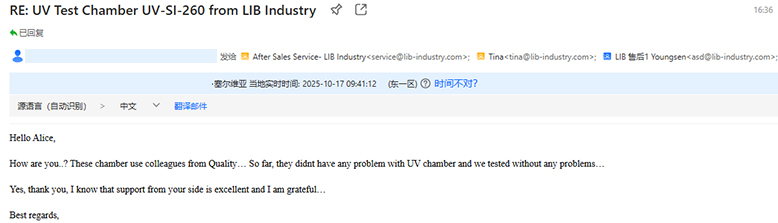
A quality team from Serbia applied the LIB industry UV aging chamber to test outdoor polymer materials, running continuous UV exposure with temperature and condensation cycles to evaluate color change, surface cracking, and mechanical performance over time. The system delivered stable operation and repeatable results throughout the testing process.
As the client noted:
"These chamber use colleagues from Quality. So far, they didn’t have any problem with UV chamber and we tested without any problems. Yes, thank you, I know that support from your side is excellent and I am grateful."
They also appreciated the reliable performance during long test cycles and the responsive technical support, which ensured smooth commissioning and confident day-to-day operation.
What Factors Influence Polymer Degradation Over Time?
Photochemical Chain Scission and Crosslinking
UV photons carry sufficient energy to rupture covalent bonds within polymer backbones. This photochemical process, termed chain scission, diminishes molecular weight and mechanical integrity progressively. Simultaneously, free radicals generated during UV irradiation trigger crosslinking reactions that amplify brittleness. The equilibrium between scission and crosslinking governs whether a polymer becomes tacky and soft or rigid and cracked over prolonged exposure.
Thermal Oxidative Breakdown
Elevated temperatures catalyze oxidative reactions within polymer matrices. Oxygen diffuses into the bulk material, reacting with carbon-centered radicals to form peroxides and carbonyl moieties. This cascade progressively weakens intermolecular forces, reducing elongation at break and impact resistance. Polymers sustained above their glass transition temperature exhibit markedly accelerated property decline compared to ambient-condition baselines.
Hydrolytic and Chemical Attack
Moisture penetrates polymer surfaces through diffusion, initiating hydrolysis in condensation polymers such as polyesters and polyamides. Cleavage of ester or amide linkages diminishes molecular weight and load-bearing capacity. Acidic or alkaline environments intensify hydrolytic degradation, while atmospheric pollutants like ozone attack unsaturated bonds in elastomers, producing characteristic surface cracking patterns.
Environmental Stressors: UV, Heat, and Humidity Effects
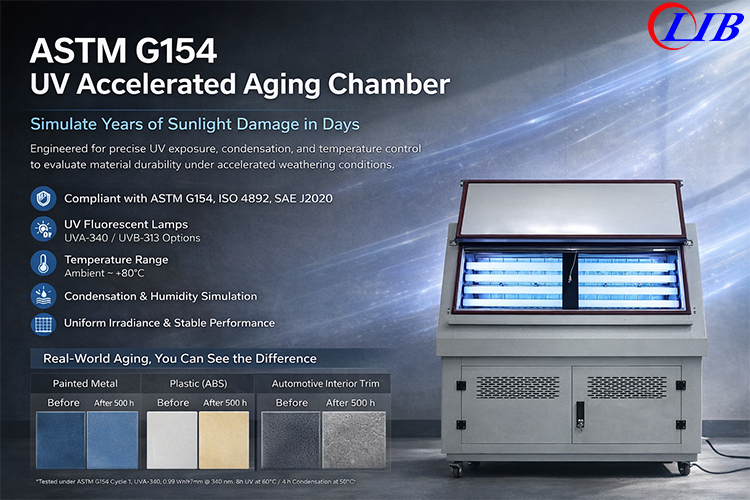
Table 1: Environmental Stressors and Their Effects on Polymers
|
Stressor |
Degradation Mechanism |
Observable Effect |
|
UV Radiation (300-400 nm) |
Photochemical bond rupture |
Yellowing, chalking, microcracking |
|
Sustained Heat |
Thermal oxidation |
Embrittlement, tensile strength loss |
|
Humidity / Moisture |
Hydrolysis, osmotic swelling |
Surface erosion, delamination |
|
Thermal Cycling |
Differential expansion/contraction |
Microcrack propagation, fatigue |
|
Water Spray / Rain |
Leaching of stabilizers |
Accelerated surface degradation |
Spectral Wavelength and Irradiance Intensity
Not all UV wavelengths inflict equivalent damage. Short-wavelength UV-B (280-315 nm) carries higher photon energy, inducing rapid bond rupture, while UV-A (315-400 nm) penetrates deeper into polymer bulk. Testing protocols specify irradiance - typically measured at 340 nm or 420 nm - to replicate the spectral distribution of natural sunlight. An accelerated aging chamber equipped with a xenon arc lamp reproduces this full spectrum more faithfully than fluorescent UV sources alone.
Cyclic Temperature Fluctuations
Polymers deployed outdoors endure daily thermal cycling that induces differential expansion and contraction stresses. These mechanical stresses, compounded atop chemical degradation, hasten microcrack propagation. Black panel temperature monitoring - spanning 35 °C to 85 °C (±2 °C) in professional accelerated aging test chambers - ensures specimen surfaces reach realistic peak temperatures during exposure cycles, replicating midday solar heating on dark-colored materials.
Synergistic Humidity and Condensation Damage
Humidity and condensation cycles compound UV and thermal degradation in non-linear ways. Moisture absorbed during high-humidity phases swells polymer matrices, generating internal stresses. Subsequent drying contracts the material, widening surface microcracks. Spray and condensation sequences within aging test equipment replicate dawn dew and precipitation, exposing subsurface defects that light exposure alone cannot reveal.
Principles of Accelerated Aging Testing for Polymers
Time Compression Through Intensified Exposure
Accelerated aging amplifies environmental stressors beyond natural intensity to compress degradation timelines. Xenon arc lamps deliver irradiance of 35-150 W/m² across the 300-400 nm bandwidth, exceeding typical midday solar UV intensity. Combined with elevated temperatures and humidity ranging from 50% to 98% RH, this approach condenses months or years of outdoor weathering into controlled cycles measured in days or weeks.
Correlation Between Laboratory and Field Performance
Meaningful lifespan prediction demands validated correlation between accelerated test outcomes and actual field data. Researchers establish acceleration factors by comparing property-retention curves from chamber exposure against outdoor benchmarks at sites in Florida, Arizona, or equatorial regions. Standards such as ASTM F1980 and ASTM D4332 provide frameworks for calculating these correlation coefficients systematically.
Standardized Protocols and Reproducibility
International standards prescribe precise parameters - irradiance, temperature, humidity, spray duration - to guarantee reproducibility across laboratories worldwide. ISO 4892 and ASTM G155 specify xenon arc conditions, while ASTM G154 covers fluorescent UV methods. Pre-programmed protocols in modern touchscreen controllers eliminate operator variability, delivering consistent datasets suitable for regulatory submissions and quality audits.
Simulating Long-Term Exposure in Controlled Conditions
Xenon Arc Lamp Technology
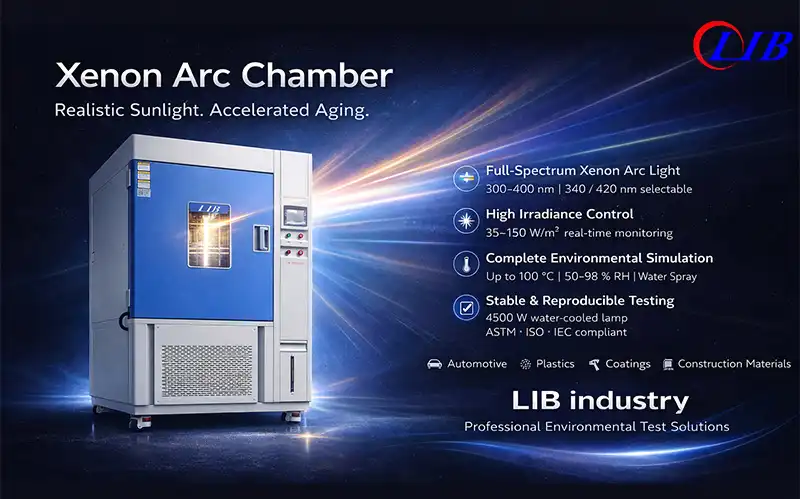
Xenon arc lamps constitute the gold standard for full-spectrum solar simulation. A 4500 W water-cooled xenon lamp generates a spectral power distribution closely matching natural daylight, encompassing UV, visible, and infrared wavelengths. Built-in irradiance feedback via UV radiometer (±5% tolerance) sustains stable light output throughout lamp service life, which extends up to 1,600 hours in well-maintained systems.
Programmable Environmental Cycling
Contemporary weathering test chambers feature programmable controllers automating complex cycling sequences. Light/dark phases, temperature ramps, humidity transitions, and water spray intervals are configurable across adjustable cycles from 1 to 9,999 hours and 59 minutes. This programmability enables simulation of diverse climatic profiles - from tropical high-humidity environments to arid desert heat stress conditions.
Specimen Handling and Uniform Exposure
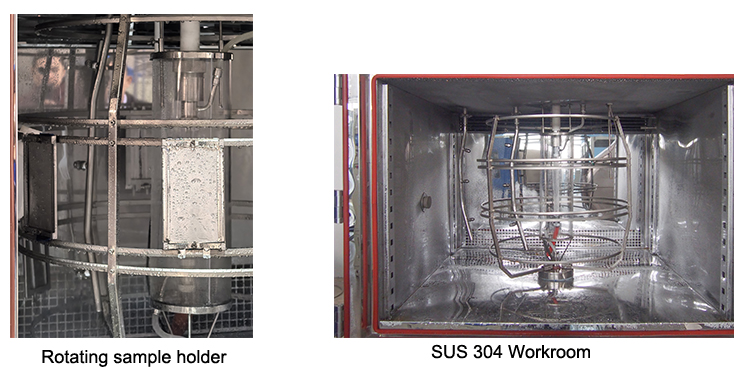
Rotating specimen holders guarantee every sample receives equivalent cumulative radiant energy throughout testing. Accelerated aging chambers accommodating 42 specimens on standardized holders (95 mm × 200 mm) provide statistically meaningful sample sizes per run. Uniform air circulation within the SUS304 stainless steel workroom prevents temperature gradients and hot spots that could compromise data integrity.
Table 2: Key Specifications - XL-S-750 Accelerated Aging Chamber
|
Parameter |
Specification |
|
Internal Dimensions |
950 × 950 × 850 mm |
|
Irradiation Source |
1 × 4500 W water-cooled xenon arc lamp |
|
Irradiance Range |
35-150 W/m² (300-400 nm) |
|
Black Panel Temperature |
35-85 °C (±2 °C) |
|
Humidity Range |
50%-98% RH (±5% RH) |
|
Specimen Capacity |
42 pieces on rotating holder |
|
Water Spray Cycle |
1-9999 H 59 M (adjustable) |
|
Safety Protections |
Over-temperature, over-current, water shortage, earth leakage, phase sequence |
Key Performance Indicators: Strength, Color, and Integrity
Mechanical Property Retention
Tensile strength, elongation at break, and flexural modulus serve as primary quantitative metrics for structural polymer degradation. Specimens are periodically extracted from the aging chamber and tested per ASTM D638 or ISO 527. Plotting property retention against cumulative radiant exposure reveals degradation kinetics, enabling engineers to define minimum acceptable performance thresholds for each end-use application.
Color Stability and Visual Appearance
Color change, quantified as ΔE using CIE Lab colorimetry, ranks among the most commercially sensitive aging indicators. Consumers and specifiers routinely reject products exhibiting visible yellowing, fading, or chalking well before mechanical failure manifests. Xenon-based accelerated aging testing excels at evaluating color fastness because it reproduces the complete visible spectrum alongside damaging UV wavelengths.
Surface Integrity and Microstructural Changes
Gloss retention, surface roughness, and microcrack density furnish early warning indicators of polymer degradation. Scanning electron microscopy and gloss measurements at defined intervals unveil progressive surface erosion. Chalking - the emergence of a powdery residue - signals advanced UV-induced breakdown at the polymer-pigment interface, often preceding catastrophic mechanical failure.
Table 3: Key Performance Indicators and Measurement Methods
|
Performance Indicator |
Measurement Standard |
Significance |
|
Tensile Strength Retention |
ASTM D638 / ISO 527 |
Structural load-bearing capacity |
|
Color Change (ΔE) |
CIE Lab Colorimetry |
Visual acceptance threshold |
|
Gloss Retention |
ASTM D523 |
Surface quality and aesthetics |
|
Elongation at Break |
ASTM D638 |
Ductility and flexibility |
|
Chalking Index |
ASTM D4214 |
UV degradation severity |
Predicting Service Life Using Accelerated Test Data
Arrhenius-Based Thermal Aging Models
For thermally governed degradation, the Arrhenius equation relates reaction rate to temperature, permitting extrapolation from elevated test conditions to anticipated service environments. Conducting tests at multiple temperatures and plotting ln(reaction rate) against 1/T yields activation energies unique to each polymer system. ASTM F1980 codifies this methodology, particularly for medical packaging shelf-life estimation.
Reciprocity and Dose-Response Relationships
The reciprocity principle posits that total degradation depends on cumulative radiant dose rather than irradiance level or exposure duration individually. When reciprocity holds valid, doubling irradiance halves the time needed to achieve equivalent degradation. Validating reciprocity for each specific polymer-additive formulation remains essential before applying dose-based lifespan projections to real product designs.
Statistical Confidence and Data Interpretation
Lifespan predictions inherently carry uncertainty that must be rigorously quantified. Confidence intervals derived from replicate specimens and multiple exposure conditions bracket this uncertainty. Weibull distribution analysis accommodates variability in polymer failure timelines, producing probability-based service life estimates rather than single-point values. Comprehensive data logging throughout each test cycle underpins robust statistical treatment and audit compliance.
Precise Environmental Control for Reliable Lifespan Prediction - LIB Industry
Full-Spectrum Simulation with Xenon Arc Technology
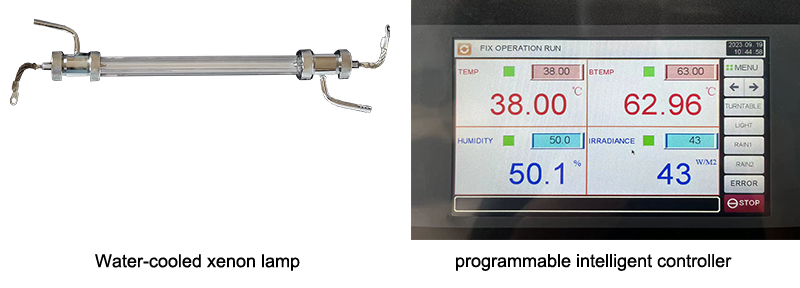
LIB Industry's XL-S-750 accelerated aging chamber employs a 4500 W water-cooled xenon arc lamp that faithfully replicates the solar spectrum from ultraviolet through visible to infrared wavelengths. The irradiance range of 35-150 W/m², measured across the 300-400 nm bandwidth with 340 nm or 420 nm narrowband selections, delivers spectral control aligned with ISO 4892 and ASTM G155 mandates.
Intelligent Control and Standard Compliance
A PID-governed programmable color touchscreen controller automates complex test protocols, with network connectivity enabling remote monitoring. Pre-loaded standard modes for ISO 4892, ASTM G154/G155, and SAE J2527 eliminate programming errors and ensure inter-operator consistency. Built-in data logging captures irradiance, temperature, humidity, and spray parameters continuously, generating audit-ready documentation.
Robust Construction and Safety Engineering
The SUS304 stainless steel interior resists corrosion under aggressive humidity and water spray conditions. Polyurethane foam insulation maintains thermal stability, while a mechanical compression refrigeration system enables precise chamber temperature management from ambient to 100 °C. Multi-layered safety protections - covering over-temperature, over-current, water shortage, earth leakage, and phase sequence faults - safeguard both equipment and laboratory personnel.
Conclusion
Accelerated aging testing provides an indispensable pathway to understanding polymer material lifespan without waiting years for field data to accumulate. By integrating controlled UV irradiation, precise thermal management, and programmable humidity cycling, engineers extract actionable degradation kinetics from compressed test timelines. Selecting the right accelerated aging chamber - one built for spectral accuracy, environmental uniformity, and standard compliance - directly determines the reliability of lifespan predictions. With validated test data, material selection decisions become grounded in quantified performance rather than estimation or guesswork.
FAQ
What standards govern accelerated aging testing for polymers?
Key standards include ISO 4892 for xenon arc and UV exposure methods, ASTM G154 and G155 for fluorescent UV and xenon arc apparatus operation, and ASTM F1980 for accelerated aging of sterile barrier systems and medical devices.
How long does an accelerated aging test typically run?
Test duration depends on the target service life and acceleration factor applied. Cycles commonly range from several hundred to several thousand hours, with spray and humidity intervals adjustable from 1 to 9,999 hours and 59 minutes.
Can one chamber simulate both UV and full-spectrum sunlight conditions?
Xenon arc chambers reproduce the complete solar spectrum - including UV, visible, and infrared - making them suitable for both photodegradation and color stability evaluations. UV fluorescent chambers focus primarily on short-wavelength degradation mechanisms.
Looking for a dependable accelerated aging chamber manufacturer and supplier? LIB Industry delivers turnkey environmental testing solutions - from design and production to installation and training. Contact us at ellen@lib-industry.com to discuss your polymer aging testing requirements.