JIS D 0203 rain testing validates the waterproof integrity of automotive components by subjecting them to controlled artificial rainfall inside a laboratory chamber. This Japanese Industrial Standard prescribes specific nozzle configurations, water flow rates, and spray angles that replicate natural precipitation patterns ranging from moderate drizzle to intense downpour. Engineers rely on JIS D 0203 R1 R2 rain test equipment to expose vulnerabilities in door seals, lamp housings, electric cabinets, and connector assemblies before vehicles reach production. By quantifying water ingress under repeatable conditions, the test cycle empowers design teams to refine gasket profiles, drainage channels, and enclosure geometries-ensuring each component withstands the relentless moisture exposure encountered across global driving environments.
What Is JIS D 0203 and Why Is It Important?
Origin and Scope of the Standard
JIS D 0203 was established by the Japanese Standards Association to define water exposure test methods for automotive parts and accessories. It covers multiple rain and spray conditions-designated R1, R2, S1, and S2-each calibrated to a distinct precipitation severity. The standard applies to exterior lighting, control modules, wiring harnesses, and any enclosure mounted on or within a vehicle body.
Relationship to International Protection Codes
JIS D 0203 aligns with broader ingress protection frameworks such as IEC 60529 (IP code) and ISO 20653. While IP ratings classify general enclosure resistance, JIS D 0203 tailors test parameters to automotive-specific geometries and mounting orientations. This complementary relationship allows manufacturers to satisfy both regional Japanese and global certification mandates through a single, well-configured rain test chamber.
Regulatory and Market Significance
Japanese OEMs and their tier-one suppliers mandate JIS D 0203 compliance as a prerequisite for part approval. Vehicles exported from Japan carry components validated against these protocols, making the standard an implicit benchmark across Asian, European, and North American supply chains. Failure to meet its thresholds can stall production timelines and jeopardize supply agreements.
Automotive Waterproofing Requirements and Challenges
Diverse Exposure Zones on a Vehicle
A single automobile presents dozens of distinct microenvironments-wheel wells saturated by road spray, A-pillar junctions channeling windshield runoff, and underbody cavities trapping standing moisture. Each zone demands a unique sealing strategy, and rain testing must replicate these varied conditions with matching nozzle angles, droplet sizes, and flow velocities to produce actionable data.
Material Degradation Over Service Life
Rubber gaskets, adhesive beads, and polymer housings lose elasticity and adhesion through thermal cycling, UV exposure, and chemical contact. A seal that passes rain testing on a freshly assembled part may fail after years of fleet operation. Progressive test sequences that combine rain exposure with pre-aging treatments help engineers anticipate long-term degradation pathways and design appropriate margins.
Rising Complexity in Electric Vehicles
Battery enclosures, high-voltage connectors, and charging ports introduce elevated stakes for water intrusion prevention. Moisture infiltration into a traction battery can trigger thermal events or insulation faults. JIS D 0203 rain testing conducted in a rain test chamber provides EV component engineers with quantifiable confidence that sealing architectures will endure sustained precipitation throughout the vehicle's operational lifespan.
|
Automotive Zone |
Primary Water Source |
Typical Sealing Method |
|
Headlamp assembly |
Direct rainfall, road spray |
Gasket ring + breather vent |
|
Door module |
Rain runoff along glass channel |
Weatherstrip + drainage slot |
|
Underbody connector |
Tire-splashed road water |
O-ring sealed housing |
|
Charging port (EV) |
Direct rainfall during charging |
Hinged cover + radial seal |
Rain Test Classifications: R1 vs R2 Conditions
R1 Rainfall Simulation Parameters
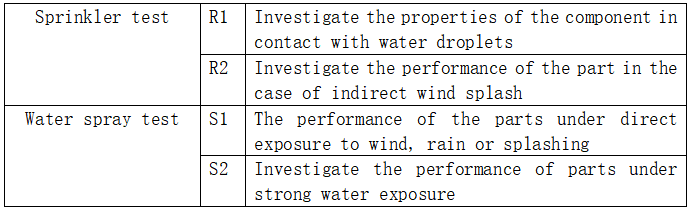
The R1 condition replicates moderate natural rainfall. Water is delivered through two rain nozzles, each featuring a Φ0.5 mm orifice, at a flow rate of 1.9 L/min. Specimens rotate on a turntable at 17 r/min, ensuring omnidirectional exposure. This configuration evaluates how well seals and housings repel gentle, sustained precipitation typical of routine driving weather.
R2 Intensified Rainfall Parameters
R2 elevates the severity by increasing the water flow rate to 3.3 L/min through the same Φ0.5 mm nozzle geometry. The heightened volume simulates heavy downpours and concentrated runoff scenarios. Components that survive R1 may still exhibit marginal leakage under R2 pressure, making this tier an indispensable gate for safety-critical assemblies like brake controllers and sensor modules.
S1 and S2 Spray Conditions
Beyond rainfall, JIS D 0203 defines spray conditions using 40 nozzles with Φ1.2 mm holes. S1 operates at 24.5 L/min and S2 at 39.2 L/min, replicating high-pressure road spray and vehicle wash jets. These modes stress-test splash zones that endure turbulent, aerosolized water driven at oblique angles, complementing the vertical rainfall modes.
|
Test Mode |
Nozzle Count |
Nozzle Diameter |
Flow Rate |
Simulation Target |
|
R1 |
2 |
Φ0.5 mm |
1.9 L/min |
Moderate rainfall |
|
R2 |
2 |
Φ0.5 mm |
3.3 L/min |
Heavy downpour |
|
S1 |
40 |
Φ1.2 mm |
24.5 L/min |
Road spray |
|
S2 |
40 |
Φ1.2 mm |
39.2 L/min |
High-pressure wash |
Simulating Real-World Rain Exposure in Vehicles
Specimen Positioning and Rotation
Test specimens mount approximately 400 mm from nozzle outlets on a SUS304 stainless steel turntable rotating at 17 r/min. This continuous revolution guarantees that every face, seam, and joint of the component receives equal water contact, eliminating directional bias that could mask orientation-dependent leak paths present in static exposure setups.
Water Pressure and Flow Control
A booster pump and calibrated flow meter maintain nozzle pressure between 0.03 and 0.30 MPa. The closed-loop water supply system-incorporating a built-in tank, automatic replenishment, and a water purification module-sustains consistent droplet characteristics across extended test durations without drift caused by mineral deposits or supply fluctuations.
Combined IPX3 through IPX6 Capability
Modern JIS D 0203 R1 R2 rain test equipment consolidates IPX3, IPX4, IPX5, and IPX6 evaluations within a single chamber. By reconfiguring nozzle sets and adjusting flow parameters, laboratories execute the full spectrum of water ingress tests without transferring specimens between separate stations-saving time, reducing handling errors, and compressing validation schedules.
Evaluating Sealing Performance and Water Ingress
Visual Inspection Post-Exposure
After each test cycle concludes, operators open the chamber and conduct a meticulous visual survey of the specimen interior. They look for pooled water, condensation trails, and staining patterns that reveal penetration routes. The double-layer insulating glass observation window with wiper also permits real-time monitoring during active spray phases.
Electrical Insulation Resistance Measurement
For electronic enclosures, post-test insulation resistance readings between conductors and housing surfaces quantify moisture infiltration severity. A drop below the threshold specified in the component drawing signals that the sealing system has been compromised and corrective redesign is warranted before mass production approval.
Leak Path Tracing with Fluorescent Additives
Adding UV-fluorescent dye to the spray water transforms leak detection into a precise forensic exercise. Under ultraviolet illumination, even micro-volume ingress pathways fluoresce vividly, allowing engineers to pinpoint exact entry coordinates-whether through a gasket compression gap, a mold parting line, or an insufficient sealant bead terminus.
Improving Waterproof Design Through Test Data
Iterative Seal Geometry Refinement
Rain test results feed directly into CAD models, guiding gasket cross-section modifications, lip angle adjustments, and compression ratio optimization. Each design iteration undergoes renewed rain test machine exposure, creating a closed feedback loop that converges on a sealing configuration robust enough to pass both R1 and R2 thresholds with measurable margin.
Material Selection Validation
Competing elastomer compounds-EPDM, silicone, TPE-exhibit distinct water absorption, compression set, and surface energy characteristics. Running identical rain test protocols on specimens sealed with each candidate material generates objective comparative data, stripping subjective bias from material selection decisions and anchoring choices in empirical chamber evidence.
Design Standard Documentation
Validated test reports become permanent entries in the organization's design standard library. Future programs referencing similar enclosure geometries inherit proven sealing strategies and minimum performance baselines, reducing redundant testing and propagating institutional waterproofing knowledge across product lines and engineering teams.
|
Design Parameter |
Data Source from Rain Test |
Design Action |
|
Gasket compression ratio |
Leak location mapping |
Adjust groove depth |
|
Drain channel capacity |
Water pooling observation |
Widen channel cross-section |
|
Connector seal material |
Insulation resistance drop |
Switch elastomer compound |
|
Housing wall thickness |
Deflection under water pressure |
Reinforce critical panel zones |
Precision Control Aligned with JIS D 0203 Specifications - LIB Industry
 |
 |
Arc-Shaped Nozzle Arrangement
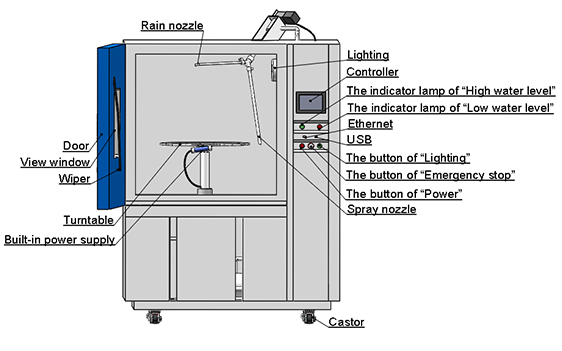
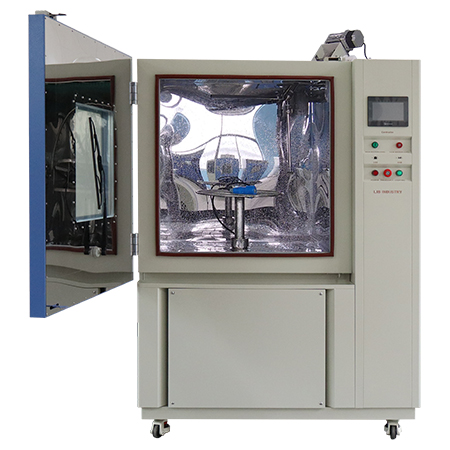
LIB's JIS D 0203 R1 R2 rain test equipment positions calibrated nozzles along an arc that replicates the exact spray pattern mandated by JIS D 0203. Each nozzle undergoes individual flow verification, and the multi-stage filtration system eliminates particulate matter that could alter droplet size distribution or obstruct orifices during prolonged test campaigns.
Intelligent Touchscreen Interface
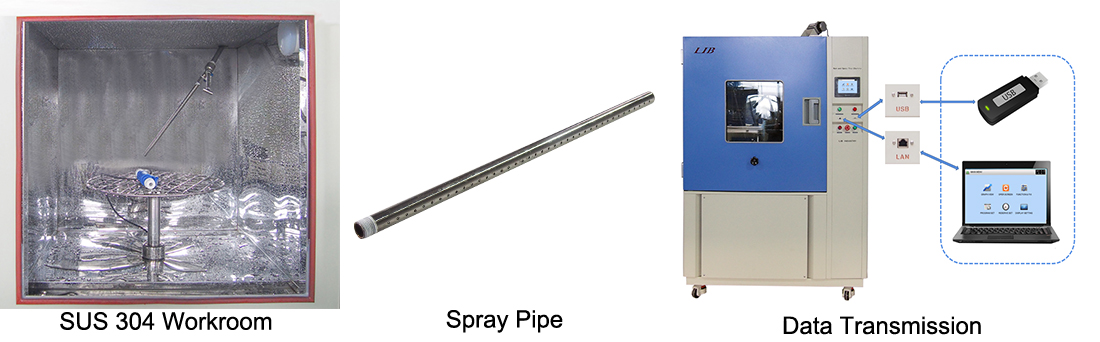
The programmable color LCD touchscreen controller stores preset modes for R1, R2, S1, and S2 conditions. Real-time displays track water pressure, flow rate, and turntable speed simultaneously. Ethernet connectivity and USB data export enable remote monitoring through local laboratory software, streamlining documentation and audit preparation.
Robust Construction and Safety Architecture
SUS304 stainless steel interiors resist corrosion across thousands of spray hours. Sealed electrical compartments protect powered specimens during energized testing. Integrated safety provisions-over-temperature, over-current, water shortage, earth leakage, and phase sequence protection-safeguard both personnel and equipment. An electromagnetic door lock prevents chamber access during active spray cycles, maintaining operator safety without interrupting test sequences.
Conclusion
JIS D 0203 rain testing bridges the gap between laboratory simulation and real-world automotive waterproofing demands. By prescribing distinct R1, R2, S1, and S2 conditions with precise nozzle geometries and calibrated flow rates, the standard enables engineers to identify and eliminate water ingress pathways during the design phase. Reliable rain test equipment that reproduces these parameters with tight tolerances transforms subjective waterproofing assumptions into measurable, defensible engineering decisions. The result is automotive components that withstand sustained precipitation throughout their service life-protecting passengers, electronics, and vehicle integrity alike.
FAQ
What is the difference between R1 and R2 in JIS D 0203?
R1 simulates moderate rainfall at 1.9 L/min through Φ0.5 mm nozzles, while R2 intensifies the flow to 3.3 L/min through identical nozzles to replicate heavy downpour conditions on automotive components.
Can one chamber perform both rain and spray tests under JIS D 0203?
Yes. Modern JIS D 0203 R1 R2 rain test equipment combines rain nozzles and spray nozzles in a single chamber, enabling R1, R2, S1, and S2 tests without transferring specimens between separate units.
Which automotive components commonly require JIS D 0203 testing?
Headlamps, tail lamps, door control modules, electric cabinets, wiring connectors, and EV charging ports are among the most frequently tested components, as they face direct or indirect water exposure during vehicle operation.
Need a dependable JIS D 0203 R1 R2 rain test equipment manufacturer? LIB Industry is a professional supplier and factory of environmental test chambers, delivering turnkey rain testing solutions worldwide. Reach us at ellen@lib-industry.com for custom configurations and technical consultation.