Accelerated Corrosion Testing Using Salt Spray Chambers
Accelerated corrosion testing using salt spray test chambers provides manufacturers with a rapid, controlled method to evaluate material durability and coating performance under harsh conditions. This standardized approach simulates years of environmental exposure in days or weeks, enabling product developers to identify weaknesses, compare protective treatments, and ensure compliance with industry specifications. By exposing test specimens to a fine salt mist under regulated temperature and humidity, these chambers reveal potential corrosion failures before products reach the market, ultimately reducing warranty claims and enhancing customer satisfaction across automotive, aerospace, marine, and electronics sectors.
Trusted by clients worldwide, LIB industry’s Salt Spray Corrosion Test Chamber delivers consistent, worry-free performance and effortless operation. Jack, one of our users, reported: “After installation, our first test panels ran perfectly—everything works smoothly.” Real-world feedback like this reflects LIB industry’s mission: to provide robust, easy-to-use testing solutions that guarantee stable, repeatable results—helping labs and manufacturers confidently verify product durability and maintain quality standards.Trusted by clients worldwide, LIB industry’s Salt Spray Corrosion Test Chamber delivers consistent, worry-free performance and effortless operation. Jack, one of our users, reported: “After installation, our first test panels ran perfectly—everything works smoothly.” Real-world feedback like this reflects LIB industry’s mission: to provide robust, easy-to-use testing solutions that guarantee stable, repeatable results—helping labs and manufacturers confidently verify product durability and maintain quality standards.

What Is Accelerated Corrosion Testing and Why It Matters?
Understanding Accelerated Corrosion Methods
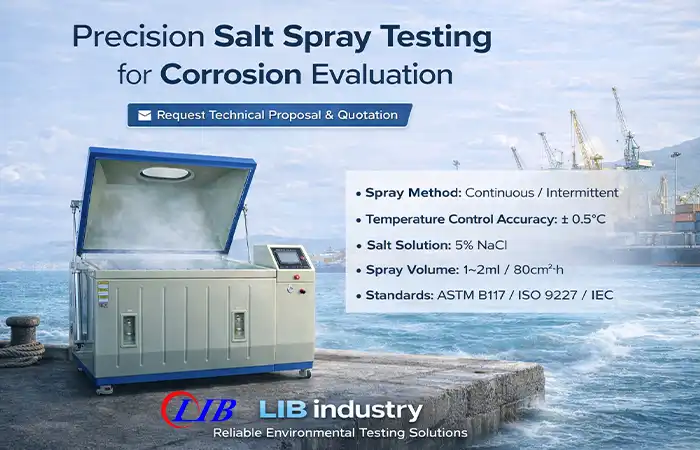
Accelerated corrosion testing compresses extended environmental exposure into manageable timeframes by intensifying corrosive conditions. Rather than waiting years to observe natural degradation, laboratories apply concentrated salt solutions, elevated temperatures, and controlled humidity to provoke material responses quickly. This methodology allows engineers to gather performance data efficiently while maintaining reproducible results across multiple test cycles.
Business Impact of Corrosion Failures
Corrosion-related failures generate substantial economic consequences, including product recalls, warranty expenses, and brand reputation damage. Automotive manufacturers face particular pressure as vehicle components must withstand road salt, coastal environments, and industrial pollutants throughout extended service lives. Proactive testing identifies vulnerabilities during development phases, reducing downstream costs and maintaining market competitiveness.
Regulatory Compliance and Quality Assurance
International standards such as ASTM B117 and ISO 9227 establish testing protocols that ensure consistency across industries and geographic regions. Compliance with these specifications demonstrates commitment to quality, facilitates global market access, and provides defensible documentation for liability considerations. Manufacturers leveraging standardized testing strengthen their position in procurement evaluations and certification processes.
Principles Behind Salt Spray Acceleration Methods
Chemical Mechanisms of Salt-Induced Corrosion
Sodium chloride solution creates an electrolyte layer on metal surfaces, accelerating electrochemical reactions that drive oxidation. The chloride ions penetrate protective oxide films and coatings, establishing corrosion cells where anodic and cathodic reactions occur simultaneously. This process mirrors natural coastal exposure but operates at intensified rates due to continuous salt fog saturation and temperature optimization.
Environmental Parameter Control
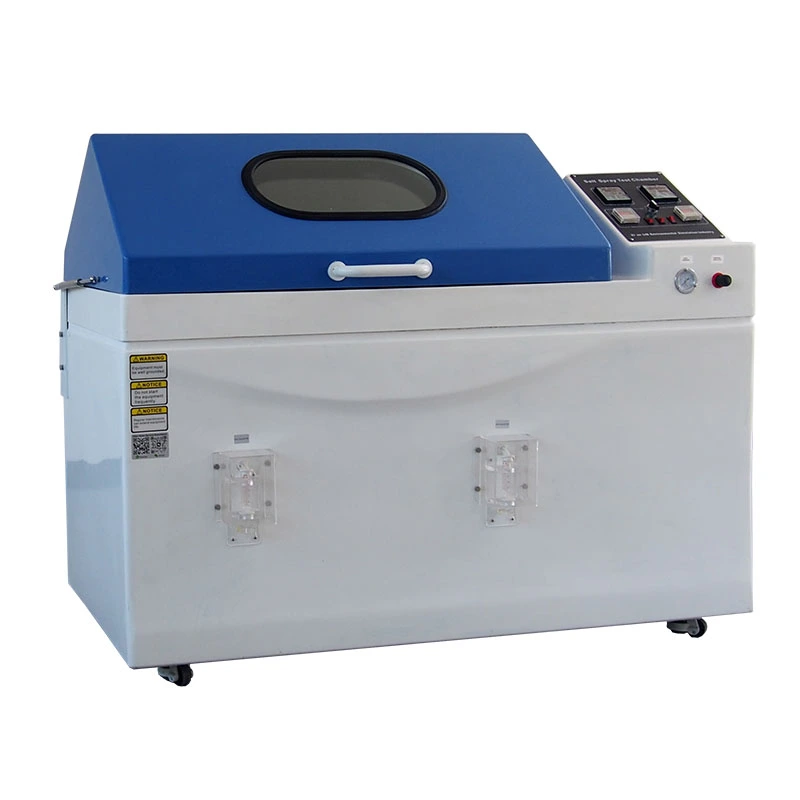
Effective acceleration requires precise regulation of temperature, humidity, and solution concentration. Salt spray test machine maintain temperatures between ambient and 60°C while sustaining humidity levels of 95-98% RH. Salt fog deposition rates typically range from 1-2 ml per 80 cm² per hour, ensuring uniform exposure across test specimens. These controlled variables eliminate weather-related inconsistencies that complicate natural weathering studies.
Material Response Under Accelerated Conditions
Different materials exhibit distinct corrosion patterns when subjected to salt spray environments. Ferrous metals develop rust layers, aluminum alloys form white corrosion products, and zinc coatings sacrifice themselves to protect underlying substrates. Understanding these characteristic responses helps engineers interpret test results and predict real-world performance trajectories across diverse applications and geographic deployment zones.
Neutral, Acetic Acid, and Cyclic Corrosion Testing Overview
|
Test Method |
Salt Solution |
pH Range |
Primary Applications |
Key Advantages |
|
Neutral Salt Spray (NSS) |
5% NaCl |
6.5-7.2 |
General corrosion resistance |
Widely accepted baseline |
|
Acetic Acid Salt Spray (AASS) |
5% NaCl + acetic acid |
3.1-3.3 |
Decorative coatings |
Enhanced penetration capability |
|
Cyclic Corrosion Testing (CCT) |
Variable solutions |
Variable |
Automotive, multi-layer systems |
Realistic wet-dry cycles |
Neutral Salt Spray Testing Characteristics
Neutral salt spray represents the foundational corrosion testing methodology, utilizing a 5% sodium chloride solution at neutral pH. This approach provides baseline performance data suitable for comparing different coating systems, material grades, and surface treatments. Its widespread adoption ensures abundant reference data and facilitates benchmarking against competitor products and historical performance records.
Acetic Acid Salt Spray Applications
Acetic acid salt spray testing employs pH reduction to approximately 3.1-3.3, creating more aggressive conditions that challenge decorative chrome, nickel, and copper-based coatings. The acidic environment accelerates penetration through coating defects and pores, revealing weaknesses that might not appear during neutral testing. This severity makes AASS particularly valuable for evaluating electroplated components and architectural hardware.
Cyclic Corrosion Testing Advantages
Cyclic corrosion testing conducted in a salt fog chamber alternates between salt spray exposure, ambient drying, and humidity phases, mimicking diurnal temperature fluctuations and precipitation patterns. This dynamic approach better replicates actual service conditions where wetting and drying cycles drive corrosion progression. Automotive manufacturers increasingly favor cyclic testing because it reveals delamination, blistering, and underfilm corrosion that continuous spray methods may overlook.
Setting Test Duration and Severity for Different Applications
Industry-Specific Duration Guidelines
|
Industry Sector |
Typical Duration |
Exposure Severity |
Acceptance Criteria |
|
Consumer Electronics |
24-96 hours |
Moderate |
No visible corrosion |
|
Automotive Exterior |
240-1000 hours |
High |
Limited rust at scribe marks |
|
Marine Hardware |
500-3000 hours |
Extreme |
Functional integrity maintained |
|
Aerospace Components |
336-1000 hours |
Controlled |
Zero coating failure |
Balancing Test Severity and Correlation
Excessive test severity can produce failure modes that never occur under actual service conditions, generating misleading results that over-predict field problems. Conversely, insufficient severity may fail to detect marginally adequate designs that experience premature failures post-deployment. Successful testing programs calibrate acceleration factors through field correlation studies that validate laboratory predictions against documented service performance.
Cost-Effective Test Planning
Extended testing durations increase chamber utilization costs, delay product launches, and consume valuable laboratory resources. Strategic test planning identifies minimum durations that provide statistically significant differentiation between acceptable and unacceptable performance levels. Preliminary screening tests at higher severity levels can quickly eliminate poor candidates before committing to extended validation protocols.
Correlation Between Accelerated Tests and Real-World Corrosion
Establishing Field-to-Laboratory Relationships
Meaningful accelerated testing requires understanding how laboratory hours translate to service years under specific environmental conditions. Coastal regions present vastly different corrosion challenges than inland agricultural areas or urban industrial zones. Correlation studies expose reference samples to both natural weathering and laboratory testing, establishing multiplication factors that connect accelerated results to anticipated service life.
Limitations of Direct Time Conversion
Simple linear extrapolation from laboratory hours to service years often proves unreliable because corrosion mechanisms shift under accelerated conditions. Continuous salt fog saturation eliminates drying periods that allow protective oxide layers to reform, potentially changing dominant degradation pathways. Sophisticated correlation models account for these mechanistic differences through empirical adjustments derived from extensive field validation programs.
Multi-Site Exposure Programs
Comprehensive validation programs deploy test panels across diverse geographic locations representing key market environments. Simultaneous laboratory testing using identical specimens enables direct comparison between accelerated results and natural weathering across coastal, industrial, rural, and tropical exposure sites. This parallel approach identifies testing protocols that best predict performance in target deployment regions.
Limitations and Best Practices of Salt Spray Testing
Recognizing Inherent Testing Constraints
Salt spray chambers cannot replicate every environmental factor affecting corrosion, including ultraviolet radiation, thermal cycling, mechanical stress, and microbiological activity. Some coating systems perform well in laboratory salt fog yet fail rapidly outdoors due to UV degradation or temperature-induced stress. Comprehensive evaluation programs supplement salt spray testing with additional environmental exposures addressing these complementary failure mechanisms.
Sample Preparation and Handling Protocols
Inconsistent sample preparation introduces variability that obscures meaningful performance differences between test specimens. Edge effects, handling contamination, and improper masking create artificial initiation sites that distort results. Standardized preparation procedures including degreasing, surface profiling, and controlled coating application ensure reproducibility and enable valid comparisons across test batches.
Data Interpretation Guidelines
Visual assessment of corrosion damage requires calibrated judgment to distinguish between acceptable surface staining and performance-limiting degradation. Rating scales like ASTM D610 for rust and ASTM D714 for blistering provide objective frameworks for documenting results. Combining visual evaluation with quantitative measurements such as adhesion testing, coating thickness reduction, and electrochemical impedance spectroscopy strengthens conclusions and reduces subjective interpretation errors.
Efficient and Accurate Simulation with LIB Industry Salt Spray Test Chambers
|
|
Model |
S-150 |
|
|
Internal dimensions (mm) |
470*590*400 |
||
|
Overall dimensions (mm) |
620*1400*1050 |
||
|
Temp. Range |
Ambient ~ +60 degree |
||
|
Temp. Fluctuation |
± 0.5 ℃ |
||
|
Temp. Deviation |
± 2.0℃ |
||
|
Humidity Range |
95 % ~ 98 % RH |
||
|
Salt Fog Deposition |
1~2ml / 80cm2 · h |
||
|
Spray Type |
Continuous / Periodic |
||
|
Heating Element |
Nichrome heater |
||
|
Salt Fog Collected |
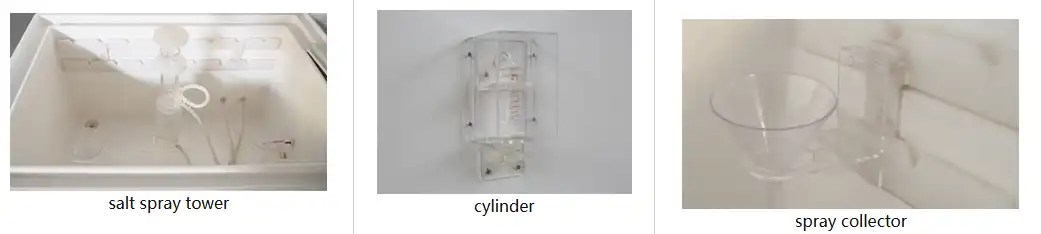
Fog collector and fog measure cylinder |
||
|
Controller |
PID controller |
||
|
Material |
Glass fiber reinforced plastics |
||
|
Standard Configuration |
8 round bars and 7 V-shaped grooves |
||
Advanced Chamber Design Features
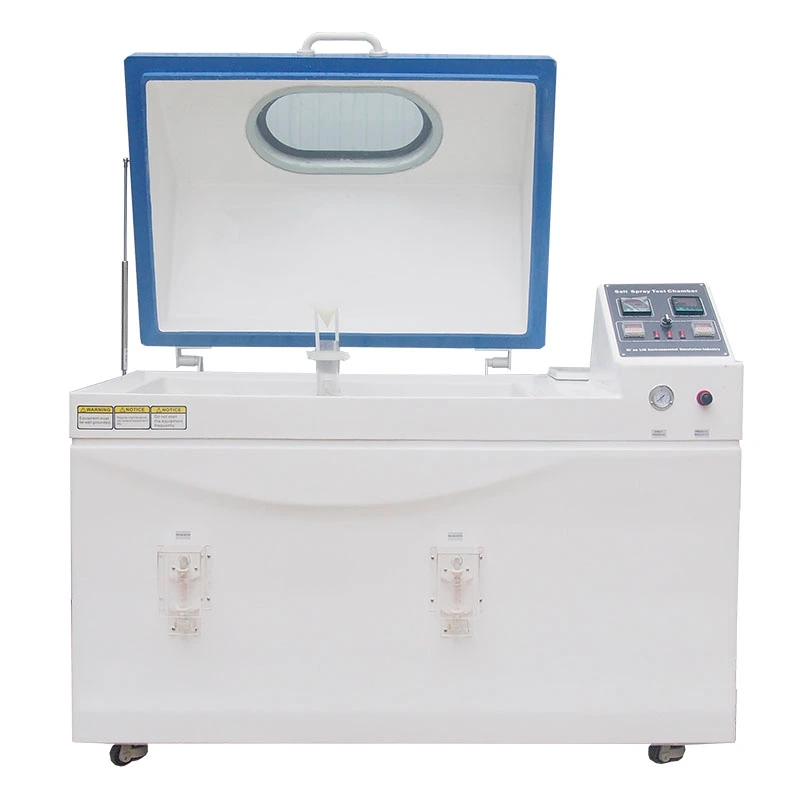
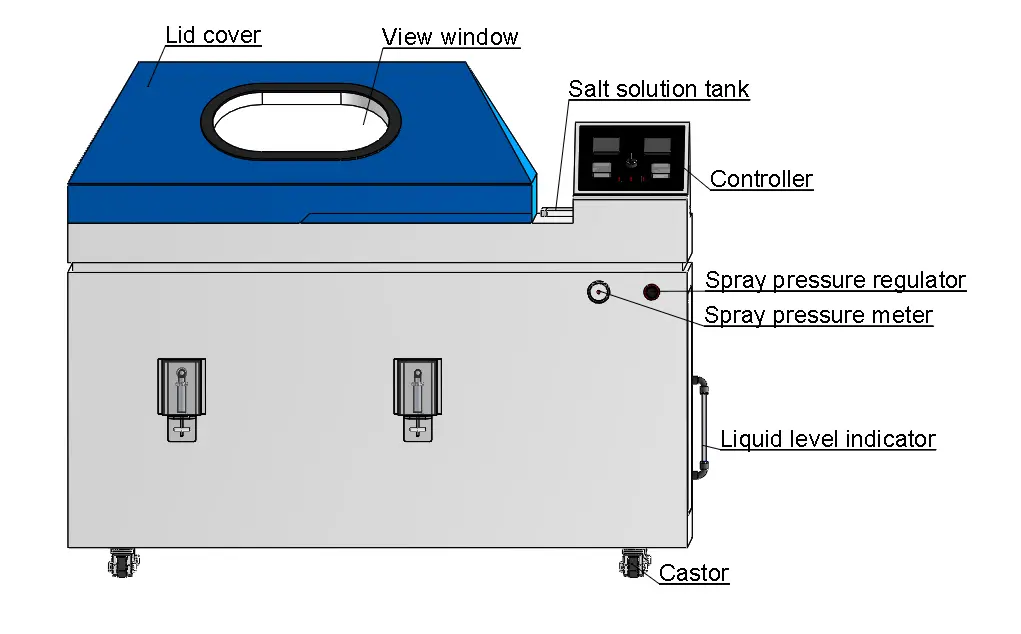
LIB Industry salt spray test chambers incorporate glass fiber reinforced plastics construction that resists corrosive salt fog degradation while maintaining dimensional stability throughout extended operations. Temperature control systems utilizing PID controllers maintain ±0.5°C fluctuation across the 95-98% RH humidity range, ensuring consistent test conditions. Adjustable spray towers accommodate various sample configurations while enabling height and volume modifications to meet diverse international testing standards.
Comprehensive Safety and Monitoring Systems
Integrated protection mechanisms including humidifier dry-combustion detection, over-temperature cutoffs, water shortage sensors, and earth leakage safeguards protect both operators and equipment. Network-enabled controllers provide remote monitoring capabilities with multilingual interfaces supporting English, French, Spanish, German, and Russian operations. Automated data logging documents temperature, humidity, and operational parameters throughout test cycles, generating compliance documentation for quality management systems.
Versatile Model Selection and Customization
|
Model |
Internal Volume |
Internal Dimensions (mm) |
Suitable Applications |
|
S-150 |
110L |
590×470×400 |
Small component testing |
|
S-250 |
320L |
1000×640×500 |
Research and development |
|
S-010 |
780L |
1000×1300×600 |
Production quality control |
|
S-020 |
1600L |
1000×2000×800 |
Large assembly validation |
LIB Industry offers chamber capacities ranging from 110L to 1600L, accommodating everything from individual fastener evaluation to complete automotive panel assessment. Customization options address unique testing requirements, enabling manufacturers to specify chamber dimensions, spray configurations, and control system features aligned with specific product portfolios and testing standards.
Conclusion
Accelerated corrosion testing using salt spray chambers remains an essential tool for predicting material performance, validating protective coatings, and ensuring product reliability across demanding applications. While understanding test limitations and maintaining proper correlation with field exposure proves critical, these chambers deliver reproducible results that guide engineering decisions and support quality assurance programs. Strategic implementation of neutral, acidic, and cyclic testing protocols enables manufacturers to optimize corrosion protection while controlling development costs and timelines.
FAQ
How long should salt spray tests run for automotive components?
Automotive exterior components typically require 240-1000 hours of neutral salt spray exposure depending on warranty requirements and deployment environments. Coastal applications demand longer durations while inland regions may accept shorter validation periods.
Can salt spray testing replace outdoor weathering exposure?
Salt spray testing provides rapid screening but cannot fully replicate outdoor weathering due to absent UV radiation, thermal cycling, and biological factors. Comprehensive programs combine accelerated laboratory testing with natural exposure validation.
What maintenance do salt spray chambers require?
Regular maintenance includes weekly cleaning of spray nozzles, monthly inspection of heating elements and humidity systems, quarterly verification of temperature and solution concentration accuracy, and annual calibration of control instruments.
Partner with LIB Industry for Your Corrosion Testing Needs
LIB Industry, a leading salt spray test chamber manufacturer and supplier, delivers turnkey environmental testing solutions worldwide. Contact our technical specialists at ellen@lib-industry.com to discuss chamber selection, customization options, and implementation support for your corrosion testing program.