Accelerated Weathering Tester for Plastic Product Lifespan
Plastic products fail outdoors not from a single event, but from relentless, cumulative assault by sunlight, temperature swings, and moisture. An accelerated weathering tester compresses years of this degradation into weeks, revealing how formulations truly perform. This isn't just about passing a test - it's about predicting real-world service life, optimizing material recipes, and preventing costly field failures. By simulating the full solar spectrum with precise environmental controls, manufacturers gain actionable data to extend product lifespans and protect their brand reputation.
Common Causes of Plastic Degradation in Outdoor Environments
The Tripartite Assault: UV, Heat, and Moisture
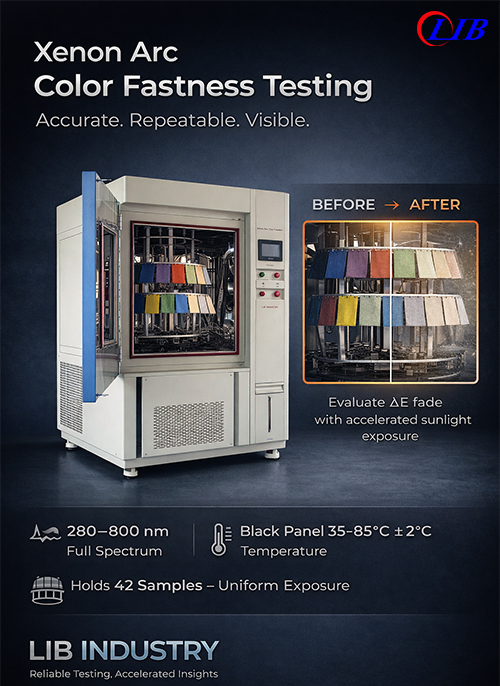
Outdoor plastic degradation stems from a synergistic interaction of three primary stressors. Ultraviolet radiation initiates photochemical chain scission in polymer backbones. Elevated temperatures accelerate oxidative reactions and plasticizer migration. Moisture, especially when combined with pollutants, drives hydrolysis and facilitates biological attack. These factors rarely act in isolation; a scorching, humid day with intense sun creates a perfect storm that no single stressor test can fully replicate.
Photochemical Breakdown Mechanisms
UV photons with wavelengths below 400 nm possess sufficient energy to break carbon-hydrogen and carbon-carbon bonds in common polymers like polypropylene and polyethylene. This creates free radicals that propagate chain reactions, leading to molecular weight reduction. The surface layer degrades first, creating a brittle, chalking skin that cracks under stress. Additives like UV absorbers and HALS (Hindered Amine Light Stabilizers) sacrificially absorb this energy, but their depletion dictates the material's ultimate endurance.
Environmental Multipliers: Pollution and Mechanical Stress
Industrial pollutants like sulfur dioxide and nitrogen oxides catalyze oxidative degradation. Salt spray in marine environments accelerates corrosion of metal inserts and promotes hydrolysis. Repeated thermal cycling between day and night causes differential expansion and contraction, inducing internal stresses that amplify UV damage. Even seemingly benign factors like rainwater's slight acidity (pH ~5.6) or condensed dew can leach plasticizers or create concentration gradients of degraded material.
Table 1: Degradation Drivers by Application Environment
|
Environment |
Primary UV Stress |
Temperature Range |
Moisture Factor |
Key Degradation Mode |
|
|
Automotive Exterior |
High (full sun) |
-40°C to +90°C |
Rain, dew, humidity cycles |
Surface chalking, gloss loss, embrittlement |
|
|
Agricultural Films |
Very High (full sun) |
-10°C to +60°C |
High humidity, soil contact |
Photo-oxidation, hydrolysis, biofouling |
|
|
Building & Construction |
Moderate (incl. window glass filtered) |
-30°C to +70°C |
Rain, condensation, humidity |
Color shift, tensile strength loss |
|
|
Marine Applications |
High (reflected UV) |
-5°C to +50°C |
Salt spray, immersion |
Hydrolysis, stress corrosion cracking |
|
|
Consumer Outdoor Furniture |
High |
-20°C to +50°C |
Rain, pool chemicals |
Fading, surface cracking, material swelling |
|
How Accelerated Weathering Simulates Real Climate Conditions?
Full-Spectrum Xenon Arc Technology
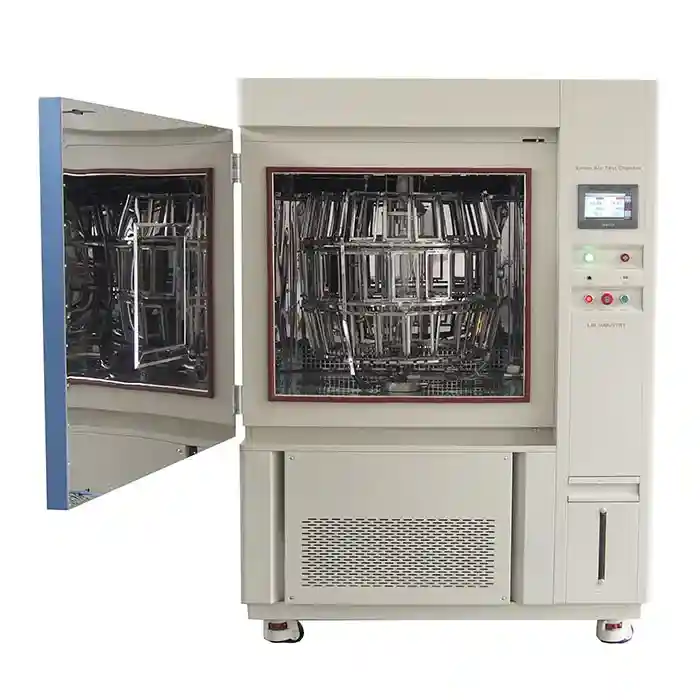
A true accelerated weathering tester uses a xenon arc lamp to replicate the entire solar spectrum from 280 nm (UV-B) through visible light to infrared (800 nm). Unlike fluorescent UV lamps that emit only narrow bands, xenon's continuous spectrum includes the infrared wavelengths that cause thermal aging. The 4500W water-cooled lamp in LIB's tester provides stable output for 1600 hours. Interchangeable filters - daylight, window glass, or UV-extended - tailor the spectrum to specific test standards like ASTM G155 or ISO 4892.
Dynamic Control of Temperature and Humidity
Real climates aren't static. The chamber's black panel temperature control (35-85°C ±2°C) mimics the actual surface temperature of a dark plastic object under the sun, which can be 20-30°C above ambient air temperature. Humidity cycling between 30-98% RH with ±2.5% precision simulates tropical humidity, desert dryness, and the dew formation that occurs during night cooling. This dynamic moisture exposure is critical for hydrolytic degradation studies.
Realistic Moisture Simulation via Spray Cycles
The programmable water spray system introduces a mechanical stress component. Spray nozzles deliver fine mist or coarse droplets, depending on the application. For automotive parts, an 18-minute spray every 120 minutes replicates rain events. This thermal shock - from hot, dry irradiation to sudden cooling - stresses coatings and adhesive bonds. The closed-loop water circulation with purification and recycling maintains water quality while conserving resources, a feature often overlooked in sustainability calculations.
Table 2: Xenon Test Parameters for Different Plastic Applications
|
Plastic Application |
Irradiance (W/m²) |
Black Panel Temp (°C) |
Humidity (% RH) |
Spray Cycle |
Typical Test Duration |
|
Automotive Bumpers |
0.55 @ 340nm |
70-85 |
50-70 |
18 min/120 min |
1000-2000 hrs |
|
Polycarbonate Glazing |
0.35 @ 340nm |
60-75 |
60-90 |
18 min/120 min |
2000-3000 hrs |
|
PVC Siding |
0.55 @ 340nm |
65-80 |
50-80 |
18 min/102 min |
1500-2500 hrs |
|
Polyethylene Geomembranes |
0.80-1.20 @ 340nm |
60-75 |
60-90 |
Not typically used |
500-1000 hrs |
|
Medical Device Housings |
0.55 @ 340nm |
55-70 |
50-65 |
Optional |
500-1000 hrs |
Measuring Color Fading, Brittleness, and Surface Damage
Spectrophotometric Color Analysis
Color change (ΔE) is the most visible failure. A spectrophotometer measures Lab values before, during, and after exposure. A ΔE > 2.0 is generally perceptible to the human eye; > 3.5 is considered a failure for most automotive and architectural applications. The accelerated weathering tester's uniform exposure - ensured by the 42-specimen rotating holder - allows statistical comparison between formulations. Testing reveals not just total fade, but whether color shifts toward yellow (b) or loses saturation (C).
Mechanical Property Retention Testing
Periodic removal of specimens for tensile, impact, and flexural testing quantifies embrittlement. Polypropylene might retain 80% of its original tensile strength after 1000 hours, but its elongation at break could plummet from 500% to 20%, indicating catastrophic surface degradation. The chamber's ability to maintain precise temperature (±2°C) is crucial here, as mechanical properties are highly temperature-sensitive during testing.
Surface Integrity and Microscopic Examination
Surface chalking is quantified by rubbing with a felt pad and measuring mass loss or reflectance change. Gloss loss is tracked with a 60° gloss meter - a drop from 90 to 50 units signifies severe surface roughening. Microscopy (SEM or optical) reveals micro-cracks, filler exposure, and the depth of the degraded layer. These measurements correlate directly with end-use performance, such as a car panel's resistance to stone chipping or a cable jacket's abrasion resistance.
Industry Standards for Plastic Weathering Evaluation
ASTM G155: The North American Benchmark
This standard governs non-metallic materials exposed to laboratory light sources. It specifies the xenon arc apparatus, filter combinations, and exposure cycles. Key parameters include irradiance at 340 nm (commonly 0.35 or 0.55 W/m²) and black panel temperature. The standard mandates calibration procedures using certified radiometers and reference materials. LIB's tester's built-in Solar Eye technology automates irradiance monitoring, simplifying compliance with ASTM G155's stringent reproducibility requirements.
ISO 4892 Series: Global Methodology
The ISO 4892-2 part details xenon arc exposure methods. It defines two primary filter types: "Daylight" (cut-on ~320nm) and "Window Glass" (cut-on ~300nm with IR rejection). The standard emphasizes reporting all conditions - irradiance, temperature, humidity, spray - to enable inter-laboratory comparison. For plastics, ISO 11341 provides specific methods for paints and varnishes on plastic substrates, a common automotive requirement.
Industry-Specific Protocols
Automotive OEMs like Ford, GM, and Volkswagen have proprietary specifications (e.g., SAE J2527, J2412) that define exact cycles, acceptance criteria (e.g., max 30% gloss loss after 1000 hrs), and specimen preparation. The aerospace sector references MIL-STD-810 for environmental testing. A accelerated weathering tester's programmability - LIB's controller allows 120 programs with 100 segments each - is essential for executing these complex, multi-stage protocols without manual intervention.
Accelerated Aging Data for Product Quality Improvement
Formulation Optimization and Stabilizer Packages
Accelerated weathering data directly informs R&D. Testing a base polypropylene against versions with 0.1%, 0.3%, and 0.5% HALS reveals the optimal loading. The data might show that beyond 0.3%, returns diminish. Similarly, comparing different UV absorber chemistries (benzotriazole vs. hindered amine light stabilizer) under identical xenon exposure identifies the most cost-effective package for a given application. This reduces the number of physical prototypes needed.
Supplier Qualification and Material Selection
When sourcing resins from multiple suppliers, identical weathering tests provide an apples-to-apples comparison. A "grade A" polycarbonate from Supplier X might retain 90% impact strength after 2000 hours, while Supplier Y's grade drops to 60%. This data becomes a critical factor in supplier scorecards. It also guides the selection between commodity and engineering grades - justifying a higher material cost with demonstrable longer service life.
Warranty and Life Prediction Modeling
The accelerated test data feeds into life prediction models using the Arrhenius or Peck equations. If a plastic formulation shows a 50% tensile strength loss at 2000 hours under aggressive xenon conditions (1.0 W/m² @340nm), engineers can correlate this to a specific number of years in a Florida or Arizona climate using established acceleration factors. This quantitative backing supports warranty periods and marketing claims about durability.
Selecting the Right Test Cycles for Plastic Applications
Matching Spectrum to End-Use
The filter choice is paramount. For outdoor furniture or automotive exterior trim, a "Daylight" filter (cut-on ~320nm) is standard. For materials behind glazing (e.g., automotive interior, window frames), a "Window Glass" filter removes short-wave UV-B, simulating the filtering effect of glass. Testing with the wrong filter yields misleading data - a material might pass a window-glass test but fail in direct sun. LIB's interchangeable filter system allows easy switching between these modes.
Balancing Acceleration with Realism
Higher irradiance (e.g., 1.2 W/m² vs. 0.55 W/m²) shortens test time but risks non-linear degradation or failure modes not seen outdoors. The key is establishing a correlation. Many manufacturers run parallel tests: a low-irradiance, long-duration test (e.g., 0.35 W/m² for 3000 hours) alongside a high-irradiance, short test (1.0 W/m² for 500 hours). If degradation modes and relative performance rankings match, the high-irradiance test is validated for screening.
Humidity and Spray: Critical for Certain Plastics
For polyamides (nylons) and polyesters, hydrolytic degradation is a major failure mode. These require high humidity (90%+ RH) cycling. For automotive headlamps (polycarbonate lenses), the spray cycle is critical to test coating adhesion under thermal shock. Conversely, for rigid PVC siding, continuous high humidity without spray might be sufficient. The test cycle must mimic the dominant stressors of the actual application.
LIB Industry Delivers Reliable Plastic Aging and Durability Testing
 |
 |
|
|
|


xenon lamp and filters
Engineering for Repeatability and Uptime
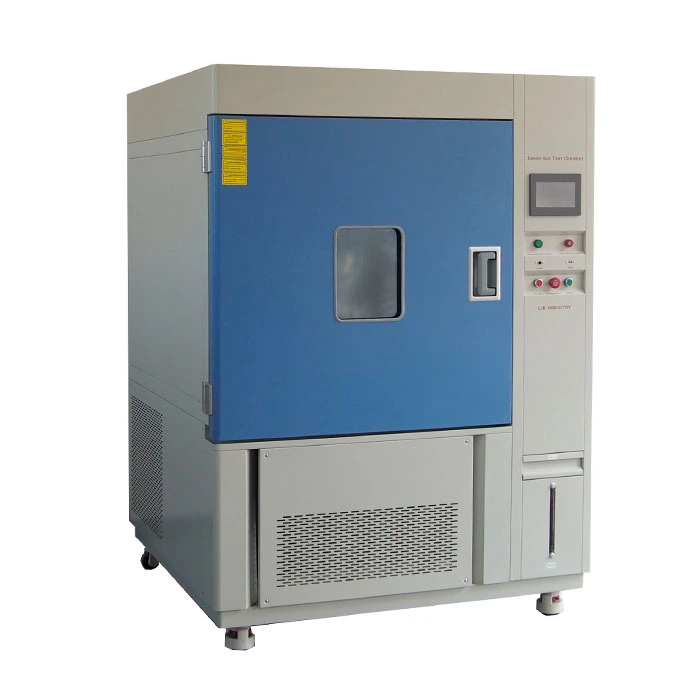
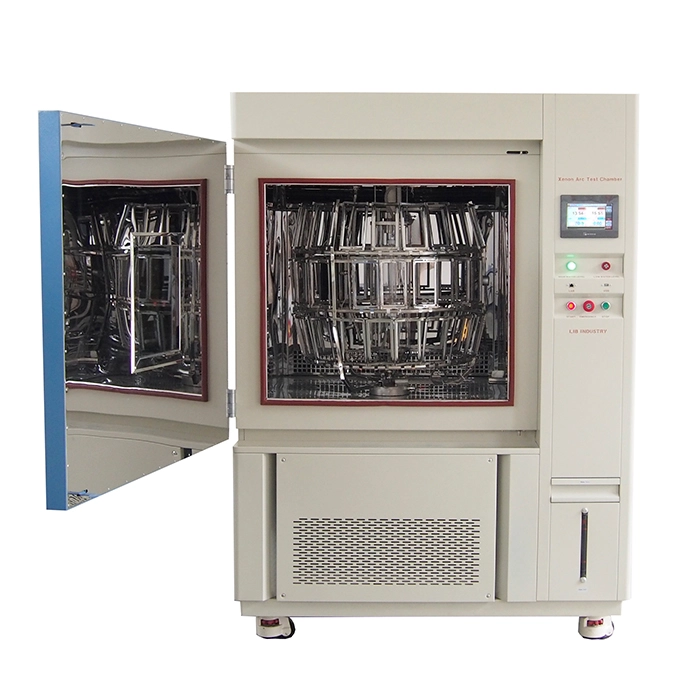
LIB's accelerated weathering tester is built for the long haul. The 4500W xenon lamp's 1600-hour lifespan reduces replacement frequency and cost. The mechanical compression refrigeration system provides reliable cooling without the maintenance issues of cryogenic systems. The rotating specimen holder for 42 samples ensures every specimen sees identical exposure, eliminating positional bias. This design focus on uptime and data integrity is what separates industrial-grade equipment from laboratory curiosities.
Intelligent Control and Data Integrity
The full-color touchscreen controller with Ethernet/Wi-Fi connectivity allows remote monitoring and centralized data management. This is invaluable for 24/7 testing in global labs. The system logs irradiance, black panel temperature, chamber air temperature, and humidity at user-defined intervals. Automatic data export via USB or network ensures no manual transcription errors. For regulated industries (medical, automotive), this audit trail is non-negotiable for compliance.
Global Support and Customization
With service centers in Malaysia, Canada, the UK, and the US, LIB provides localized support. Their expertise in non-standard design means they can modify chamber interiors for oversized specimens, integrate special fixtures for complex geometries, or develop custom humidity profiles based on a client's specific geographic climate data. The 3-year warranty and lifetime service commitment, including a promise of a brand-new replacement if repair isn't possible, de-risks the investment. This turn-key approach - from consultation through training - makes LIB a partner, not just a supplier.
Conclusion
An accelerated weathering tester is the crystal ball for plastic manufacturers. It transforms guesswork about outdoor performance into quantifiable, repeatable data on colorfastness, mechanical integrity, and surface durability. By selecting the right xenon-based system with precise environmental control, manufacturers optimize formulations, qualify suppliers, and extend product lifespans with confidence. This investment pays for itself through reduced warranty claims, stronger market positioning, and the ability to innovate with new materials knowing their true performance limits.
FAQ
How long should I test my plastic part in an accelerated weathering tester to predict 5 years of outdoor life?
There's no universal multiplier. Correlation requires outdoor exposure data from your target climate (e.g., Florida, Arizona). Typically, 1000-2000 hours at 0.55 W/m² @340nm might correlate to 3-5 years in a severe environment. Always validate with real-world field panels for your specific material.
Can I test large automotive bumper assemblies in a standard chamber?
Standard chambers hold 42 specimens of ~200mm length. For full assemblies, you need a custom large-capacity chamber or test representative coupons. LIB offers custom sizing. The key is ensuring the test specimen's surface experiences the same irradiance and temperature as a full part would.
What's the biggest mistake manufacturers make when starting weathering tests?
Using the wrong filter or irradiance for their application. Testing a behind-glass application with a "Daylight" filter overestimates degradation. Not establishing a correlation to real-world exposure renders the data meaningless for life prediction. Start with the standard for your industry and validate.
Contact LIB Industry for Your Weathering Testing Solution
As a global manufacturer and supplier of accelerated weathering testers, LIB Industry provides turn-key environmental testing solutions. Our chambers feature 4500W xenon arc lamps, 42-specimen rotating holders, and full ASTM G155/ISO 4892 compliance. Contact our engineering team at ellen@lib-industry.com to discuss your specific plastic durability testing requirements and receive a customized configuration.