Aerospace Seal Integrity in Cold Temperature Chambers
Aerospace seal integrity determines whether aircraft can safely operate across diverse atmospheric conditions, from tropical runways to stratospheric cruising altitudes. Sealing systems - comprising O-rings, gaskets, door seals, and pressurization components - must maintain functionality despite experiencing temperatures plummeting to -70°C or below. Cold temperature chambers provide controlled environments where aerospace engineers validate seal performance under cryogenic exposure, thermal cycling, and rapid decompression scenarios. These specialized test systems replicate high-altitude conditions while enabling precise measurement of leak rates, compression set, material hardening, and elastomer recovery. By subjecting sealing components to rigorous low-temperature validation, manufacturers ensure cabin pressurization integrity, fuel system containment, and hydraulic circuit reliability throughout the operational envelope.
Why Is Seal Integrity Testing Essential in Aerospace Applications?
Life-Critical Pressurization System Reliability
Cabin pressurization systems maintain breathable atmospheres at cruising altitudes where ambient pressure drops to 25% of sea level. Door seals, window gaskets, and fuselage penetrations must withstand pressure differentials exceeding 8 psi while exposed to -56.5°C outside air temperatures per RTCA DO-160 standards. Even microscopic seal degradation creates catastrophic decompression risks, making validation in cold temperature chambers non-negotiable for airworthiness certification.
Fuel System Containment Under Thermal Extremes
Aviation fuel systems operate across temperature ranges from ground-level heat to wing-tank cryogenic conditions during long-duration flights. Fluorocarbon and silicone seals in fuel pumps, valves, and tank access panels must prevent leakage despite thermal contraction that reduces seal compression forces. Low-temperature testing identifies seal materials exhibiting excessive hardening or brittle fracture tendencies that could compromise fuel containment and create fire hazards.
Hydraulic Circuit Integrity for Flight Control Systems
Primary flight controls - ailerons, elevators, rudders - rely on hydraulic actuators operating at pressures reaching 5,000 psi. The seals within these systems encounter hydraulic fluids formulated to function at temperatures down to -54°C. Cold chamber testing validates that piston seals, rod wipers, and valve O-rings maintain sealing effectiveness without excessive friction that would impair control response or cause actuator stalling during critical flight phases.
Low-Temperature Performance Validation for Aerospace Sealing Systems
Compression Set Measurement at Cryogenic Temperatures
Compression set quantifies the permanent deformation elastomers experience after sustained loading. Aerospace standards require seal materials to recover at least 85% of original thickness after 24-hour compression at minimum operating temperature. Test protocols position seal specimens under specified loads within cold chambers, stabilize at target temperatures (-40°C to -70°C), maintain conditions for designated intervals, then measure dimensional recovery upon return to ambient conditions.
Leak Rate Quantification Under Pressure Differential
Helium mass spectrometry and pressure decay methods quantify seal leakage rates at low temperatures. Engineers install seal assemblies in test fixtures connected to pressurized cold temperature chambers, then subject the entire assembly to cold soak within environmental chambers. Measuring helium tracer gas migration or pressure loss over time reveals whether thermal contraction creates leak paths exceeding maximum acceptable limits (typically 1×10⁻⁶ scc/sec for critical applications).
Dynamic Sealing Performance During Temperature Transitions
Actuator rod seals and rotary shaft seals must function during temperature transitions, not merely at stabilized conditions. Test sequences cycle assemblies through repeated extension-retraction or rotation movements while chamber temperatures ramp between temperature extremes. This dynamic testing exposes seal lip damage, stick-slip behavior, or friction coefficient increases that static compression testing might overlook.
|
Seal Application |
Test Temperature Range |
Pressure Differential |
Maximum Leak Rate |
Duration |
|
Cabin Door Gaskets |
-56.5°C to +85°C |
8.6 psi |
5×10⁻⁴ scc/sec |
500 cycles |
|
Fuel Tank Access Seals |
-54°C to +71°C |
3 psi |
1×10⁻⁵ scc/sec |
1000 hours |
|
Hydraulic Piston Seals |
-54°C to +135°C |
5000 psi |
Zero visible leak |
10,000 cycles |
Thermal Contraction Effects on Aircraft Seal Materials
Differential Contraction Between Seal and Housing
Aluminum aircraft structures contract approximately 23 μm/m per °C temperature drop, while elastomer seals exhibit contraction rates of 150-300 μm/m·°C depending on polymer composition. This differential causes seal compression force reduction - a 70°C temperature decrease may reduce O-ring squeeze by 15-25%, potentially dropping below the minimum compression threshold required for effective sealing.
Glass Transition Temperature Considerations
Elastomers undergo dramatic stiffness increases when cooled below their glass transition temperature (Tg). Nitrile rubber typically exhibits Tg around -40°C, while silicone formulations maintain flexibility to -60°C or below. Cold chamber testing identifies whether candidate seal materials approach their Tg within the operational temperature envelope, which would cause hardening that prevents conformance to sealing surfaces and creates leak paths.
Crystallization-Induced Seal Failure Mechanisms
Certain fluoroelastomer formulations undergo crystallization when held at temperatures below -25°C for extended periods. This phase transformation creates brittle, non-compliant seals prone to fracture under installation loads or dynamic movement. Extended cold soak testing (72+ hours at minimum temperature) reveals crystallization susceptibility before components enter production, preventing field failures that could ground aircraft fleets.
Recovery Rate After Thermal Cycling
Beyond steady-state cold performance, aerospace seals must recover sealing capability after rapid temperature transitions. Aircraft descending from cruise altitude experience heating rates exceeding 10°C/min as seals warm from stratospheric cold to ambient temperatures. Cold chamber testing with controlled heating rates validates that seals recover compression force and conformability quickly enough to prevent transient leakage during descent phases.
How Do Cold Chambers Simulate High-Altitude Conditions?
Altitude-Temperature Profile Replication
Commercial aircraft cruise at 35,000-43,000 feet where International Standard Atmosphere models predict temperatures from -56.5°C to -65°C. Advanced cold temperature chambers achieve temperatures down to -120°C, providing substantial margin beyond operational requirements. Programmable controllers execute temperature profiles matching climb-cruise-descent cycles, including asymmetric heating during ground operations that create thermal gradients across seal installations.
Controlled Humidity for Ice Formation Studies
High-altitude atmospheric moisture condenses and freezes on cold surfaces, potentially interfering with seal function. Chambers equipped with humidity control systems (20% to 98% RH capability) enable evaluation of ice accumulation on door seals and access panels. Engineers assess whether frozen condensate prevents proper seal engagement or creates leak paths when ice sublimes during cabin pressurization.
Rapid Temperature Transition Capabilities
Thermal shock testing subjects seals to instantaneous temperature changes simulating emergency decompression scenarios or rapid altitude changes. Chambers with heating rates of 3°C/min and cooling rates of 1°C/min replicate realistic operational transitions. More aggressive thermal shock profiles (15°C/min or faster using liquid nitrogen injection) stress-test seal materials beyond normal operational exposure, revealing latent weaknesses.
|
Altitude (feet) |
Ambient Temperature |
Typical Test Chamber Setpoint |
Test Margin |
|
Sea Level |
+15°C |
+85°C (ground heat) |
+70°C |
|
10000 |
-5°C |
-20°C |
-15°C |
|
35000 |
-54°C |
-70°C |
-16°C |
|
43000 |
-56.5°C |
-70°C |
-13.5°C |
Environmental Stress Testing for Aerospace Gaskets and Seals
Combined Temperature-Vibration Exposure
Aircraft structures transmit engine vibration, aerodynamic buffeting, and landing gear shock through mounting points where gaskets prevent fluid leakage or environmental ingress. Multi-axis vibration tables positioned inside cold chambers subject seal assemblies to simultaneous low-temperature and vibration exposure. This combined stress testing reveals fretting wear, seal migration, or fastener loosening that wouldn't appear during single-variable testing.
Ozone and UV Degradation Acceleration
Stratospheric ozone concentrations reach 10 ppm - ten times surface levels - accelerating elastomer degradation through polymer chain scission. While cold chambers primarily control temperature, integrated UV lamps and ozone generators within the test space enable combined environmental exposure. Sequential testing (ozone exposure followed by cold cycling) simulates years of operational aging within compressed test schedules.
Fluid Compatibility at Low Temperatures
Aerospace seals contact hydraulic fluids (MIL-PRF-83282, Skydrol), aviation fuels (Jet A, JP-8), and synthetic lubricants that exhibit viscosity increases and phase changes at low temperatures. Immersion testing within cold temperature chambers involves submerging seal materials in operational fluids maintained at minimum temperature extremes. Subsequent measurement of swell, hardness change, and tensile property degradation quantifies material compatibility across the operational envelope.
Salt Fog Corrosion Resistance
Coastal operations expose aircraft to saline environments that promote corrosion of metal seal housings. While salt fog chambers typically operate at elevated temperatures (+35°C per ASTM B117), modified protocols combine salt spray pre-conditioning with subsequent cold temperature exposure. This sequential testing reveals whether corrosion products interfere with seal seating or create galvanic cells that accelerate degradation.
Reliability Qualification for Aerospace Components in Extreme Cold
Statistical Confidence Through Accelerated Life Testing
Aerospace component qualification requires demonstrating reliability exceeding 99.9% over operational lifespans spanning 20-30 years. Accelerated life testing applies stress levels beyond normal operation (lower temperatures, higher pressure differentials, increased cycle rates) to accumulate equivalent damage in compressed timescales. Cold chamber testing at -70°C with 150% nominal pressure differential might replicate 10 years of operational exposure within 6-month test programs.
Weibull Analysis for Failure Prediction
Engineers subject multiple seal specimens to identical cold temperature stress protocols, recording time-to-failure for each sample. Weibull statistical analysis of failure distributions enables prediction of population reliability at specified confidence levels. A properly executed test program with 30+ samples provides 90% confidence that seal reliability exceeds design requirements throughout the qualification temperature range.
Environmental Qualification to DO-160 Standards
RTCA DO-160G Environmental Conditions and Test Procedures for Airborne Equipment defines qualification requirements across 26 environmental categories including low temperature (Category E), temperature variation (Category B), and altitude (Category A). Compliance testing in cold chambers follows prescribed exposure durations, temperature transition rates, and performance verification protocols that must be documented for FAA certification.
|
Qualification Standard |
Temperature Exposure |
Duration |
Performance Criteria |
|
|
DO-160G Category E3 |
-55°C operating |
3 hours |
Full functionality |
|
|
DO-160G Category E2 |
-40°C operating |
3 hours |
Full functionality |
|
|
MIL-STD-810H Method 502 |
-62°C storage |
24 hours |
No damage |
|
|
SAE AS5440 |
-54°C to +85°C cycle |
500 cycles |
<10% leak increase |
|
Design Validation Testing for New Seal Geometries
Novel seal designs - whether optimized cross-sections, integrated backup rings, or composite material constructions - require extensive validation before production implementation. Cold chamber testing progression begins with proof-of-concept evaluation at extreme temperatures, advances through design optimization using statistical DOE methods, and culminates in full qualification testing to aerospace standards. This phased approach minimizes development risk while compressing timeline.
LIB Industry: Reliable Extreme Low-Temperature for Aerospace
Wide Temperature Range Covering Aerospace Requirements
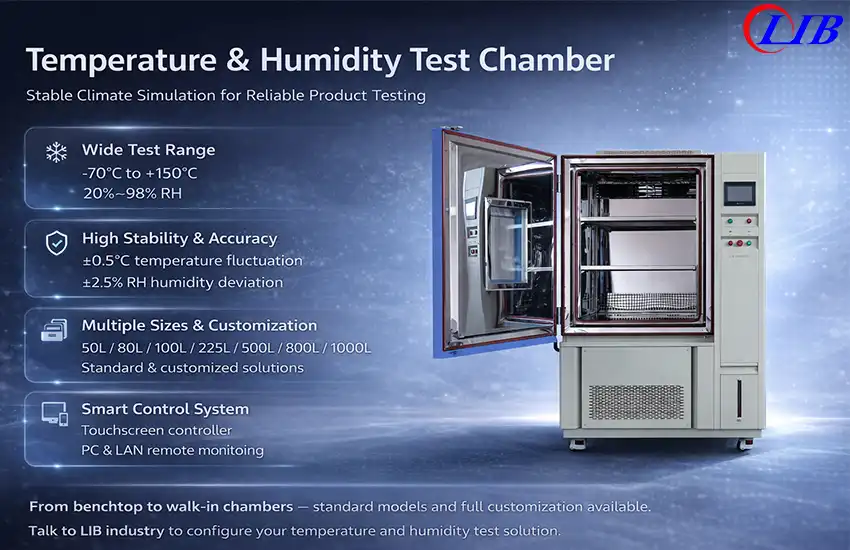
LIB Industry cold temperature chambers provide temperature capabilities from -20°C to -120°C, substantially exceeding the -70°C requirement for most aerospace applications. This extended range enables testing margin validation, accelerated aging protocols, and cryogenic propellant system component qualification. Models T-100 through T-1000 offer internal volumes from 100L to 1000L, accommodating components ranging from individual O-rings to complete door assemblies.
Precise Control for Repeatable Qualification Testing
Temperature fluctuation of ±0.5°C and spatial deviation of ±2.0°C ensure uniform exposure across large seal assemblies. PT100 Class A platinum resistance sensors provide 0.1°C measurement accuracy traceable to international standards. This precision proves essential for qualification testing where specification margins may be narrow and regulatory authorities scrutinize test documentation during certification reviews.
Programmable Profiles for Complex Test Sequences
The color LCD touchscreen controller stores complex temperature profiles replicating flight cycles, diurnal variations, or accelerated aging sequences. Programming capacity for multiple test segments enables unattended execution of week-long thermal cycling protocols. Ethernet connectivity facilitates data export to laboratory information management systems (LIMS), creating complete audit trails required for aerospace quality documentation.
Observation Capabilities for Failure Mode Analysis
Double-layer tempered glass observation windows with interior LED lighting enable visual monitoring throughout test execution. Engineers document seal deformation, ice formation, or leakage manifestation through the viewing port without disrupting chamber conditions. The 50mm cable port accommodates instrumentation feedthroughs for pressure transducers, leak detectors, or thermocouple arrays measuring seal interface temperatures.
French TECUMSEH Compressor Reliability
High-performance refrigeration systems utilizing French TECUMSEH compressors deliver rapid cooling rates and stable temperature control. These proven compressor systems accumulate millions of operational hours across industrial applications, providing reliability essential for critical aerospace qualification programs. Redundant refrigeration circuits (available in custom configurations) eliminate single-point failures that could invalidate months-long test programs.
Compliance and Certification Infrastructure
Every LIB Industry chamber undergoes CE certification and third-party validation, documenting conformance to electrical safety, electromagnetic compatibility, and pressure vessel standards where applicable. This certification infrastructure aligns with aerospace industry quality expectations and simplifies customer internal qualification processes. Calibration certificates traceable to national standards accompany each shipment, enabling immediate integration into regulated testing environments.
Conclusion
Aerospace seal integrity testing in cold temperature chambers constitutes non-negotiable validation for flight safety systems ranging from cabin pressurization to hydraulic flight controls. The unique combination of cryogenic temperatures, pressure differentials, and dynamic loading creates test conditions that reveal seal weaknesses before components enter service. LIB Industry chambers deliver temperature capabilities to -120°C with ±0.5°C control precision across volumes from 100L to 1000L, supporting seal qualification from individual components through complete assembly validation. Advanced features including programmable cycling, observation windows, and instrumentation ports enable comprehensive characterization required for DO-160 compliance and FAA certification.
FAQ
What temperature range is required for commercial aircraft seal testing?
Most commercial aircraft seals require validation from -54°C to +85°C per DO-160 standards, representing stratospheric cruise conditions through ground operations in desert climates. Military and high-altitude applications may specify testing to -70°C, while specialized cryogenic systems demand chambers reaching -120°C or below.
How long do aerospace seal qualification tests typically require?
Qualification duration varies by component criticality and certification basis. Basic material characterization requires 72-hour cold soak followed by compression set measurement. Complete qualification programs incorporate 500-1000 thermal cycles plus accelerated aging, potentially spanning 6-12 months for life-critical pressurization seals.
Can cold chambers simulate rapid decompression events?
Standard environmental chambers provide controlled temperature cycling rather than instantaneous pressure changes characterizing explosive decompression. Specialized altitude chambers combine rapid pressure reduction with low temperature exposure. However, thermal shock testing at maximum cooling rates identifies seal materials vulnerable to rapid temperature transitions during decompression scenarios.
Seeking proven cold temperature testing solutions for aerospace seal qualification programs? LIB Industry, a trusted environmental test chamber manufacturer with comprehensive turn-key capabilities, delivers customized low-temperature systems meeting stringent aerospace requirements. Our engineering team provides application consultation, installation support, and calibration services ensuring your qualification testing meets regulatory standards. Contact our aerospace solutions specialists at ellen@lib-industry.com to discuss temperature range requirements, chamber sizing, and certification documentation.