Battery Electrode Drying via a High-Temp Industry Oven
Battery electrode drying represents a pivotal manufacturing step that directly influences electrochemical performance, cycle life, and safety characteristics of lithium-ion cells. Residual moisture content exceeding 200 ppm in electrode coatings causes electrolyte decomposition, lithium plating, and irreversible capacity fade. High-temperature industry ovens equipped with precision thermal control and uniform air distribution remove adsorbed water molecules from porous electrode structures without damaging active materials or current collectors. The drying process requires temperature profiles ranging from 80°C to 180°C with controlled heating rates, extended soak times, and purge gas environments that extract moisture while preserving the structural integrity of cathode and anode formulations critical to battery longevity.
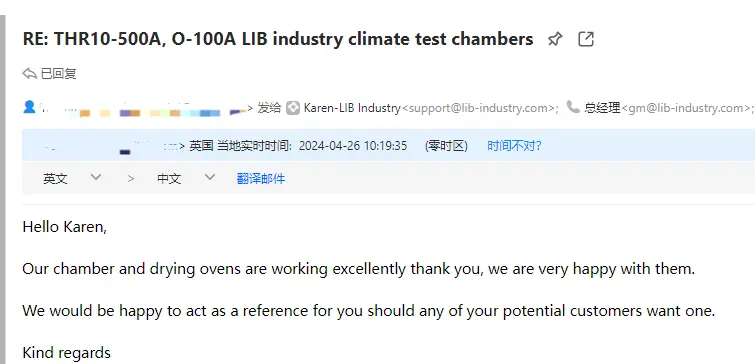
A prominent electronics testing facility shared positive feedback on the LIB industry THR10-500A and oven, emphasizing its outstanding oven performance:
“The oven system has been running reliably, and we are very pleased with its overall performance.”The oven delivers highly stable and accurate temperature control, even during long-duration burn-in tests and frequent thermal cycling. This level of consistency allows engineers to carry out precise evaluations of automotive electronics, sensors, and control units without disruption. Beyond that, it also supports effective material aging studies and battery testing, helping teams replicate real thermal conditions and enhance product durability with greater confidence.
Need a high-temperature oven for battery electrode drying? Contact LIB Industry to discuss your temperature, capacity, atmosphere, and loading requirements.
Why Electrode Drying Is Critical for Battery Performance?
Moisture-Induced Electrolyte Degradation
Water molecules trapped within electrode microstructures react with lithium hexafluorophosphate (LiPF₆) electrolyte salts, generating hydrofluoric acid that corrodes aluminum current collectors and degrades separator membranes. Even trace moisture levels between 100-300 ppm catalyze phosphorus pentafluoride formation, which attacks binder polymers and conductive additives. This chemical cascade reduces ionic conductivity by 25-40% and increases interfacial resistance at electrode-electrolyte boundaries, diminishing charge acceptance rates during fast-charging protocols.
Impact on Solid Electrolyte Interphase Formation
Residual water disrupts the formation of stable solid electrolyte interphase (SEI) layers on graphite anodes during initial charge cycles. Hydroxide and carbonate byproducts from moisture reactions create porous, electrically resistive SEI structures that consume active lithium irreversibly. Controlled drying maintains moisture below 50 ppm, enabling dense, lithium-ion conductive SEI layers that minimize capacity loss during formation cycling and extend calendar life beyond 10 years in automotive applications.
Calendering and Coating Adhesion Concerns
Moisture retention compromises the mechanical bonding between electrode coatings and metallic foils during calendering operations. Water vapor pockets create delamination sites where coatings separate under compressive rolling forces, generating electrode defects that propagate during cycling. Thorough drying ensures polyvinylidene fluoride (PVDF) or carboxymethyl cellulose (CMC) binders achieve maximum adhesion strength, withstanding calendering pressures exceeding 5 tons per linear centimeter without structural failure.
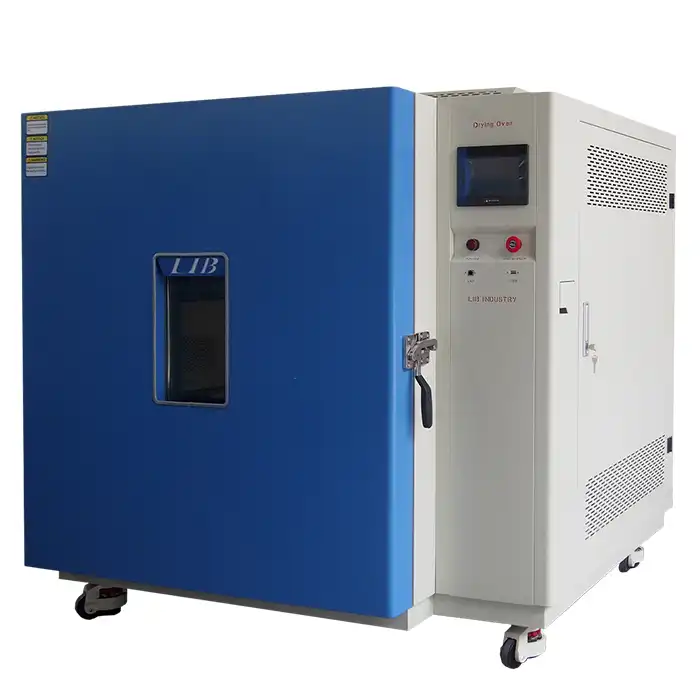
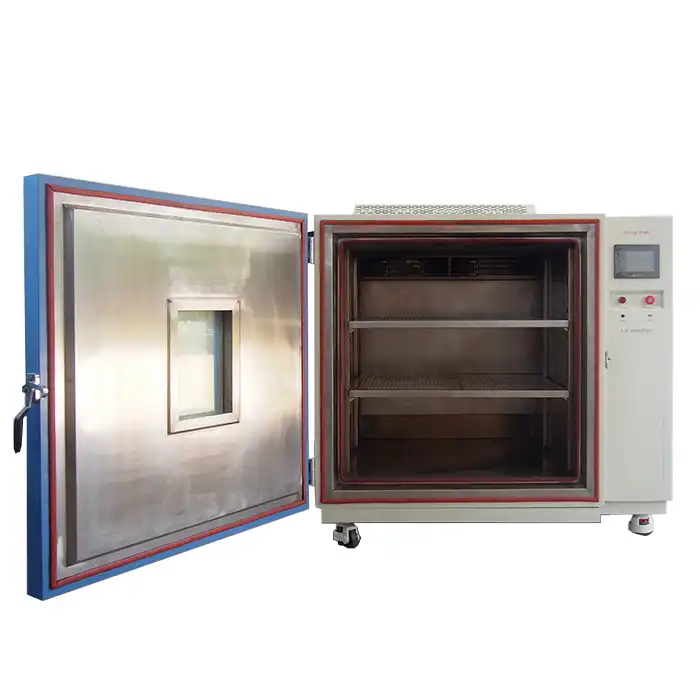
High-Temperature Ovens for Lithium-Ion Electrode Processing
 |
 |
Temperature Range Requirements for Different Electrode Chemistries
Graphite anode drying typically occurs at 110-130°C to volatilize N-methyl-2-pyrrolidone (NMP) solvents and physisorbed moisture without oxidizing carbon surfaces. Nickel-manganese-cobalt (NMC) cathode materials require elevated temperatures of 150-180°C to remove water from porous oxide particles while avoiding thermal decomposition of lithium-transition metal oxides. Lithium iron phosphate (LFP) electrodes tolerate higher processing temperatures up to 200°C due to superior thermal stability, enabling aggressive moisture extraction protocols. The industry oven must accommodate these varied thermal profiles through programmable multi-segment temperature curves.
Atmospheric Control and Inert Gas Purging
Drying under ambient air conditions risks electrode oxidation and surface contamination from atmospheric hydrocarbons. Advanced industry ovens integrate nitrogen or argon purge systems maintaining oxygen concentrations below 100 ppm, preventing unwanted surface chemistry during high-temperature exposure. Controlled atmosphere drying reduces moisture dew points to -40°C or lower, creating driving forces that extract water from deep within electrode pore networks. Purge gas flow rates between 5-15 chamber volume exchanges per hour optimize moisture removal kinetics without disrupting thermal uniformity.
Batch versus Continuous Drying Systems
Research and pilot-scale operations employ batch industry ovens ranging from 225L to 1000L capacity, accommodating electrode sheets on perforated trays with adjustable spacing. Production-scale facilities utilize conveyor ovens with multiple heating zones, processing electrode rolls continuously at web speeds up to 30 meters per minute. LIB Industry's O-800 and O-1000 models bridge this gap, offering sufficient volume for pre-production validation while maintaining the precision thermal control required for process development and material qualification studies.
|
Electrode Type |
Optimal Drying Temperature |
Typical Residence Time |
Target Moisture Content |
|
Graphite Anode |
110-130°C |
8-12 hours |
<50 ppm |
|
NMC Cathode |
150-180°C |
10-14 hours |
<100 ppm |
|
LFP Cathode |
160-200°C |
6-10 hours |
<80 ppm |
|
Silicon-Graphite Composite |
100-120°C |
12-16 hours |
<30 ppm |
If you need one oven to support multiple electrode drying processes, LIB Industry can configure programmable temperature profiles around your material and process requirements.
Moisture Removal Techniques and Best Practices
Multi-Stage Drying Protocols
Effective electrode drying employs graduated temperature ramps rather than abrupt heating, preventing binder migration and surface cracking. Initial stages at 60-80°C volatilize bulk solvents and loosely bound water without inducing thermal stress. Intermediate phases at 100-130°C remove capillary-condensed moisture from mesopores between 2-50 nm diameter. Final high-temperature holds at 150-180°C extract chemisorbed water from active material surfaces and eliminate residual solvent traces that would otherwise contaminate electrolytes during cell assembly.
Vacuum-Assisted Drying Advantages
Combining reduced pressure with elevated temperature accelerates moisture removal by lowering water's boiling point and increasing vapor pressure gradients. Vacuum drying at 0.1-10 kPa absolute pressure reduces required temperatures by 20-40°C, minimizing thermal exposure risks for temperature-sensitive electrode formulations. The industry oven equipped with vacuum capability achieves equivalent moisture reduction in 60% of the time required for atmospheric drying, improving manufacturing throughput while reducing energy consumption per kilogram of processed electrode material.
Real-Time Moisture Monitoring Integration
Advanced drying systems incorporate dew point sensors and residual gas analyzers that continuously measure water vapor concentrations in exhaust streams. Moisture breakthrough curves reveal when electrode materials reach equilibrium with the drying environment, indicating process completion. Automated endpoint detection prevents under-drying that leaves excessive moisture and over-drying that wastes energy and oven capacity. LIB Industry's Ethernet-connected controllers log moisture data alongside temperature profiles, creating comprehensive process documentation for quality assurance and regulatory compliance.
Controlling Thermal Profiles to Prevent Material Degradation
Heating Rate Optimization for Different Electrode Thicknesses
Thin electrodes below 100 μm thickness tolerate rapid heating at 6°C/min without internal temperature gradients that induce mechanical stress. Thick energy-dense electrodes exceeding 150 μm require controlled ramps below 3°C/min to allow heat penetration through low-thermal-conductivity coatings. Excessive heating rates create surface-to-core temperature differentials approaching 30°C, causing differential thermal expansion that cracks electrode structures and delaminates coatings from current collectors. Programmable industry ovens enable customized heating profiles tailored to specific electrode architectures.
Soak Time Duration and Temperature Uniformity
Temperature uniformity across the oven workspace directly impacts moisture removal consistency between electrode batches. The advanced air circulation system in LIB Industry ovens maintains temperature deviations within ±2.0°C throughout volumes up to 1000 liters, ensuring equivalent drying regardless of tray position. Sufficient soak time at peak temperature allows thermal equilibration between electrode surfaces and internal pore structures. NMC cathodes typically require 4-6 hour holds at 160°C after reaching setpoint temperature, while graphite anodes achieve moisture targets with 3-4 hour soaks at 120°C.
Cooling Rate Control and Moisture Reabsorption Prevention
Rapid cooling below dew point temperatures causes atmospheric moisture to re-adsorb onto hygroscopic electrode surfaces, negating drying effectiveness. Controlled cooling at 2-4°C/min while maintaining inert gas purge prevents condensation until electrodes reach safe handling temperatures around 40°C. Transfer from the industry oven to low-humidity storage environments occurs within sealed containers or directly into dry room facilities maintaining <0.1% relative humidity. This seamless transition preserves electrode dryness achieved during thermal processing, protecting product quality until cell assembly.
|
Process Stage |
Temperature Range |
Heating/Cooling Rate |
Duration |
Atmosphere |
|
Solvent Evaporation |
60-80°C |
4-6°C/min |
2-3 hours |
Air or N₂ |
|
Mesopore Drying |
100-130°C |
3-5°C/min |
4-6 hours |
Dry N₂ |
|
Chemisorbed Water Removal |
150-180°C |
2-4°C/min |
4-8 hours |
Dry N₂ or Vacuum |
|
Controlled Cooling |
180°C → 40°C |
2-4°C/min |
3-5 hours |
Dry N₂ |
Ensuring Uniform Drying Across Electrode Materials
Horizontal and Vertical Air Circulation Channels
Non-uniform air distribution creates localized moisture concentration variations that compromise batch consistency. LIB Industry ovens feature dual-axis circulation patterns combining horizontal cross-flow with vertical convection currents. This multi-directional airflow strategy eliminates stagnant zones between densely loaded trays, ensuring each electrode sheet experiences equivalent drying conditions. Adjustable fan speed control accommodates lightweight electrode materials that might flutter under excessive air velocities while maintaining sufficient circulation for effective moisture transport.
Perforated Tray Design and Loading Configurations
Punch-type sample holders allow heated air to contact both electrode surfaces simultaneously, accelerating moisture removal compared to solid trays that create thermal insulation barriers. Optimal tray spacing between 50-75 mm balances chamber capacity utilization against airflow restriction that degrades temperature uniformity. Loading patterns should avoid blocking circulation channels or positioning electrodes directly in front of heating elements where localized hot spots exceed ±5°C temperature variation tolerance.
Multi-Layer Heating Elements for Enhanced Uniformity
Strategic placement of heating elements on chamber sidewalls, top, and bottom surfaces surrounds electrodes with radiant and convective heat sources. This envelope heating approach minimizes temperature stratification common in single-source configurations where upper shelves receive excessive heat while lower positions remain cooler. Precision airflow management systems direct heated air through specific zones requiring temperature boost, automatically compensating for thermal losses near chamber doors and observation windows.
Enhancing Battery Longevity Through Effective Oven Drying
Capacity Retention Over Extended Cycling
Batteries manufactured with properly dried electrodes maintain 80% of initial capacity after 2000-3000 charge-discharge cycles, compared to 1200-1500 cycles for cells with moisture-contaminated components. Reduced SEI reformation during cycling minimizes continuous lithium consumption that degrades capacity. Lower interfacial resistance from stable electrode-electrolyte interfaces enables higher charge rates without lithium plating that permanently reduces energy storage capability. The quality of initial electrode drying establishes baseline performance that subsequent manufacturing steps cannot remediate.
Calendar Life Extension in Storage Conditions
Moisture-induced electrolyte decomposition accelerates during elevated temperature storage, generating gas that swells pouch cells and increases internal pressure in cylindrical formats. Batteries stored at 60°C for one year lose 15-25% capacity when electrodes contain >200 ppm moisture, versus <8% degradation for electrodes dried below 50 ppm. Automotive and grid storage applications demanding 10-15 year operational lifespans require rigorous moisture control during electrode manufacturing, achievable only through validated high-temperature drying protocols.
Safety Improvements and Thermal Runaway Prevention
Water contamination lowers thermal runaway initiation temperatures by 20-40°C through exothermic reactions between moisture and charged electrode materials. Dry electrodes exhibit superior thermal stability, withstanding abuse conditions like overcharge and external short circuits without transitioning to uncontrolled heat generation. Comprehensive drying reduces the risk of field failures and safety recalls that damage manufacturer reputations and incur warranty costs exceeding $500 per failed battery pack.
LIB Industry's High-Temperature Stability Supporting Critical Battery Manufacturing
Temperature Capability Across Product Range
LIB Industry offers industry ovens with temperature ranges spanning ambient to +250°C, +400°C, and +900°C, accommodating electrode drying alongside ceramic separator sintering and solid-state electrolyte processing. The O-500 and O-800 models optimized for battery applications feature SUS304 stainless steel interiors resistant to lithium compound corrosion and NMP solvent exposure. High-temperature silicone seals maintain chamber integrity through thousands of thermal cycles, while polyurethane foam insulation minimizes heat loss and reduces energy consumption per drying batch.
Programmable Control Systems for Process Validation
Color LCD touchscreen controllers store up to 50 custom temperature profiles, enabling rapid changeover between anode and cathode drying protocols. Ethernet and USB connectivity facilitate data export for statistical process control analysis and regulatory documentation. Real-time temperature logging at 1-second intervals creates audit trails proving compliance with automotive quality standards like IATF 16949. Remote control capabilities allow process engineers to monitor critical drying operations from central control rooms, receiving alerts if temperature deviations exceed specified tolerances.
Global Manufacturing Support and Installation Services
Since 2009, LIB Industry has delivered turn-key thermal processing solutions to battery manufacturers across Asia, Europe, and North America. Comprehensive commissioning services include temperature uniformity surveys per AMS2750 aerospace standards, operator training on programmable controller operation, and preventive maintenance scheduling. The network of service centers in Malaysia, Canada, the UK, and the US provides local spare parts inventory and rapid response to technical inquiries, minimizing downtime that disrupts production schedules.
|
Oven Model |
Internal Volume |
Temperature Range |
Heating Rate |
Shelf Loading Capacity |
|
O-225 |
225L |
Ambient-250°C |
6°C/min |
50 kg standard |
|
O-500 |
500L |
Ambient-250°C |
6°C/min |
50 kg standard |
|
O-800 |
800L |
Ambient-250°C |
6°C/min |
200 kg heavy-duty |
|
O-1000 |
1000L |
Ambient-400°C |
6°C/min |
200 kg heavy-duty |
Related Products for Battery Testing and Environmental Simulation
Battery manufacturing often requires more than electrode drying. Different stages may require controlled temperature, humidity, or accelerated thermal testing.
|
|
|
|
High-Temperature Industry OvenUsed for electrode drying, material aging, thermal processing, and battery-related process development. LIB Industry offers different working volumes and temperature ranges for laboratory, pilot-scale, and production-related applications. |
Temperature & Humidity ChamberUseful when battery materials or components need controlled temperature and humidity conditioning before or after thermal processing. Temperature and humidity chambers can help evaluate moisture sensitivity, environmental durability, and conditioning effects. |
Thermal Cycling ChamberDesigned for repeated temperature changes to evaluate battery cells, modules, electronic components, and materials under controlled thermal cycling conditions. It is useful for reliability evaluation after manufacturing and for accelerated thermal stress testing. |


Building a complete battery testing laboratory? LIB Industry can combine ovens, temperature & humidity chambers, thermal cycling chambers, and other environmental testing equipment into a customized testing solution.
Conclusion
Electrode drying via high-temperature industry ovens constitutes a non-negotiable manufacturing prerequisite for lithium-ion batteries achieving performance, longevity, and safety targets demanded by automotive and energy storage applications. Moisture control below 50-100 ppm requires precision thermal management, uniform air circulation, and controlled atmospheric conditions that specialized drying equipment provides. LIB Industry's comprehensive oven portfolio addresses electrode processing requirements from research through production scale, supported by programmable control systems, robust construction standards, and global technical support infrastructure that de-risks battery manufacturing investments.
FAQ
What moisture levels are acceptable in battery electrodes after drying?
Target moisture content varies by electrode chemistry, with graphite anodes requiring <50 ppm and cathode materials tolerating 80-100 ppm. Automotive-grade batteries demand lower thresholds around 30 ppm to ensure 10-year calendar life. Karl Fischer titration provides accurate moisture quantification for process validation and quality control.
Can the same oven dry both anode and cathode materials?
Shared equipment requires thorough cleaning between electrode types to prevent cross-contamination of transition metal particles or carbon residues. Dedicated ovens for anodes and cathodes eliminate contamination risks, while programmable temperature profiles accommodate different drying protocols. Chamber purging with inert gas between batches reduces changeover time.
How does vacuum drying compare to atmospheric high-temperature processing?
Vacuum drying reduces required temperatures by 20-40°C and shortens cycle times by 40%, beneficial for temperature-sensitive electrode formulations. Atmospheric drying with inert gas purge suits materials tolerating higher temperatures and offers simpler equipment operation. Cost-benefit analysis considers energy consumption, throughput requirements, and material compatibility when selecting the optimal approach.
Partner with LIB Industry for Advanced Battery Manufacturing Solutions
As a trusted industry oven manufacturer and supplier serving global battery producers, LIB Industry delivers customized thermal processing systems with comprehensive installation and validation support. Contact our technical team at ellen@lib-industry.com to discuss electrode drying applications, temperature uniformity testing, and turn-key solutions optimized for your specific battery chemistry and production requirements.