Blowing Rain Test Chambers for IEC and MIL Standards
Blowing rain test chambers deliver critical validation for products exposed to severe weather conditions, ensuring compliance with international standards like IEC 60529 and MIL-STD-810H. These sophisticated environmental simulation systems replicate wind-driven precipitation at controlled velocities, rainfall intensities, and droplet distributions, enabling manufacturers to verify ingress protection ratings and field performance before deployment. Understanding standard requirements, chamber configurations, and testing protocols ensures accurate assessment of product durability against moisture intrusion, corrosion, and operational degradation under realistic storm conditions.
Customers consistently report excellent experiences with LIB industry rain test chambers, highlighting smooth operation even during intensive testing schedules involving multiple environmental simulations. Engineers value the intuitive touch-screen interface, which makes retrieving and monitoring test data effortless. At the same time, LIB industry’s responsive support team is recognized for providing timely guidance whenever needed. This blend of dependable performance and attentive service gives manufacturers full confidence that their devices are tested accurately and that expert assistance is always within reach.

Which IEC and MIL Standards Require Blowing Rain Testing?
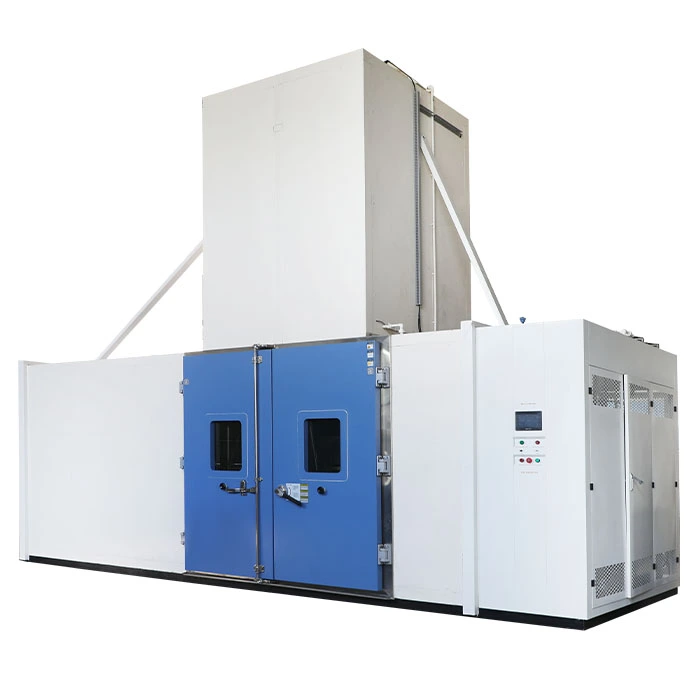
IEC 60529 Ingress Protection Rating Requirements
IEC 60529 establishes the international framework for classifying degrees of protection provided by enclosures against solid particles and liquid ingress. The standard defines IPX3 through IPX6 ratings specifically addressing water spray resistance, where IPX3 covers spraying water at angles up to 60 degrees from vertical, IPX4 extends to splashing water from any direction, and IPX5/IPX6 involve water jets at increasing pressure levels. Testing protocols specify precise nozzle distances, water volumes, and exposure durations that chambers must replicate accurately.
MIL-STD-810H Method 506.6 Rain Testing Procedures
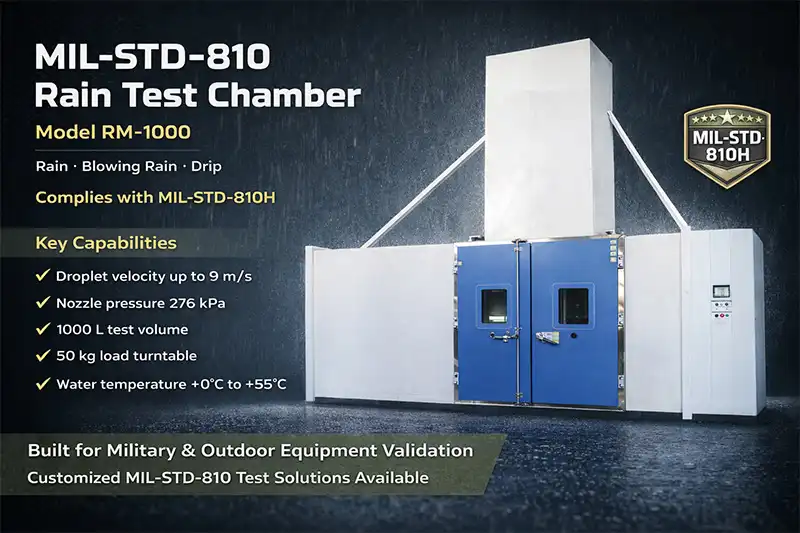
Military Standard 810H Method 506.6 outlines rain testing requirements for defense equipment subjected to precipitation during storage, transportation, and operation. Procedure I addresses combined rain and blowing rain scenarios, specifying droplet terminal velocities reaching 9 meters per second, rainfall rates exceeding 1.7 millimeters per minute, and droplet size distributions ranging from 0.5 to 4.5 millimeters diameter. The standard distinguishes between natural rain simulation and exaggerated conditions producing accelerated exposure for rapid assessment.
Industry-Specific Standards Referencing Rain Testing
Automotive manufacturers reference SAE J575 for exterior lighting water resistance, telecommunications providers follow ETSI standards for outdoor equipment protection, and aerospace companies implement RTCA DO-160 environmental qualification procedures. These sector-specific documents frequently incorporate IEC and MIL testing methodologies while adding unique requirements addressing operational contexts, mounting configurations, and performance criteria relevant to particular applications.
Differences Between IEC 60529 and MIL-STD-810G Rain Requirements
Water Application Methods and Intensities
IEC 60529 emphasizes static spray patterns using oscillating tubes or hand-held nozzles positioned at prescribed distances, delivering water volumes calculated per minute per enclosure surface area, typically conducted within a controlled rain test chamber environment. MIL-STD-810 incorporates dynamic wind generation systems creating horizontal water trajectories simulating driving rain encountered during vehicle operation or field deployment, with adjustable wind speeds modulating droplet impact angles and kinetic energy transfer.
|
Testing Parameter |
IEC 60529 (IPX3-IPX6) |
MIL-STD-810H Method 506.6 |
|
Water Pressure |
50-100 kPa (IPX5/IPX6) |
276 kPa (exaggerated) |
|
Flow Rate |
0.07 L/min per hole (IPX3) to 100 L/min (IPX6) |
20.8 L/min per nozzle |
|
Wind Speed |
Not specified |
Up to 25 m/s |
|
Droplet Velocity |
Free-fall to low pressure |
9 m/s terminal velocity |
|
Test Duration |
5-15 minutes depending on code |
Up to 999 minutes adjustable |
Temperature Differential Requirements
MIL-STD-810 specifies heating test specimens to maintain water temperature differentials of 10 degrees Celsius above ambient, with maximum specimen surface temperatures reaching 55 degrees Celsius. This thermal conditioning accelerates water penetration through capillary action and thermal expansion gaps, revealing vulnerabilities that might escape detection during ambient temperature testing conducted under IEC protocols.
Pass/Fail Criteria Distinctions
IEC 60529 defines failure as water ingress sufficient to interfere with equipment operation or accumulation inside enclosures exceeding specified limits, assessed through visual inspection and electrical continuity testing. MIL-STD-810 evaluates functional performance during and immediately following exposure, checking for corrosion initiation, seal degradation, connector integrity, and operational parameter drift that could compromise mission reliability.
Chamber Configuration and Test Parameters for Compliance
Essential Hardware Components for Standards Compliance
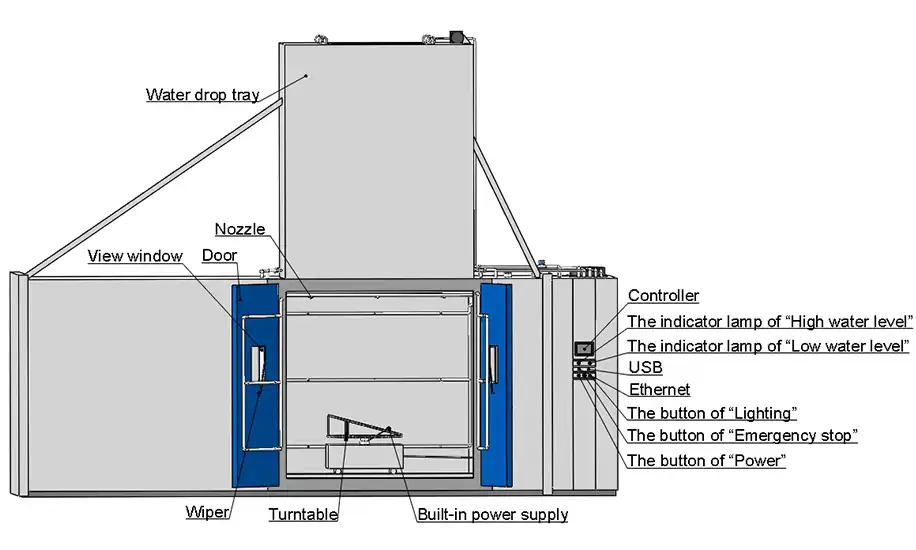
Compliant blowing rain test chambers integrate multiple subsystems working synchronously. Central fans generate controllable wind speeds through variable frequency drives, spray nozzle arrays positioned at standardized distances deliver calibrated water flow rates, rotating turntables provide 360-degree specimen exposure at 1-7 RPM, and specimen heating systems maintain prescribed temperature differentials. Water filtration prevents nozzle clogging while recirculation systems minimize consumption.
Workspace Dimensions and Specimen Capacity
The RIM-1000 configuration provides 1000-liter internal volume with 1000x1000x1000 millimeter workspace accommodating products up to 50 kilograms on an 800-millimeter diameter turntable. Larger chambers scale proportionally while maintaining consistent test conditions across expanded volumes. Stainless steel 304 construction ensures corrosion resistance, while electromagnetic door locks maintain chamber integrity during high-pressure water application.
Calibration and Verification Procedures
Regular calibration verifies nozzle spray patterns, wind velocity uniformity, water temperature accuracy, and pressure consistency against standard requirements. Droplet size distribution measurement confirms 0.5 to 4.5 millimeter range compliance, rainfall rate validation employs catch containers positioned throughout the test zone, and anemometer arrays map wind speed gradients. Documentation traceable to national standards maintains certification validity.
Test Setup and Instrumentation for Standardized Rain Testing
Specimen Mounting and Positioning Protocols
Mounting fixtures secure test articles in operational orientations matching field deployment configurations during evaluation in a rain test machine. Automotive components install at vehicle rake angles, telecommunications enclosures mount at specified heights above turntable surfaces, and connector assemblies orient mating interfaces toward predominant water trajectories. Cable entry points, ventilation openings, and potential ingress paths face maximum exposure zones.
Sensor Placement and Data Acquisition Strategy
|
Measurement Parameter |
Sensor Type |
Placement Location |
Recording Frequency |
|
Wind Speed |
Hot-wire anemometer |
48 cm from specimen |
1 Hz continuous |
|
Water Flow Rate |
Turbine flowmeter |
Supply manifold |
0.1 Hz |
|
Chamber Pressure |
Differential transducer |
Internal/external |
1 Hz |
|
Water Temperature |
RTD probe |
Specimen surface |
0.5 Hz |
|
Specimen Temperature |
Thermocouple array |
Multiple locations |
1 Hz |
Pre-Test Conditioning and Baseline Measurements
Specimens undergo visual inspection documenting pre-existing damage, dimensional measurements establish reference geometry, and electrical baseline testing captures initial performance parameters. Moisture-sensitive materials receive conditioning at controlled humidity levels ensuring consistent starting conditions. Leak detection dye added to test water enables post-exposure inspection revealing ingress pathways.
Reporting and Analyzing Compliance Test Results
Documentation Requirements Per Standard
IEC 60529 certification requires test reports identifying specimen description, rating claimed, test equipment specifications, ambient conditions, water application details, exposure duration, and pass/fail determination with supporting evidence. MIL-STD-810 documentation expands to include wind speed profiles, temperature differential maintenance records, specimen functional performance data, and photographic evidence of post-test conditions.
Statistical Analysis of Multi-Specimen Testing
Certification programs typically require testing multiple specimens revealing manufacturing variation effects. Statistical methods assess consistency across sample populations, identifying outliers indicating process control issues. Confidence intervals quantify rating margin, while Weibull analysis predicts field failure rates extrapolated from accelerated test exposure.
Failure Mode Investigation Techniques
Non-conforming specimens undergo detailed failure analysis isolating root causes. Dissection reveals water infiltration paths, seal cross-sections examine compression set and material degradation, and microscopy identifies manufacturing defects or design vulnerabilities. Corrective action implementation addresses systematic issues before production release.
Ensuring Product Certification Through Standardized Rain Tests
Third-Party Laboratory Selection Criteria
Independent testing laboratories accredited to ISO/IEC 17025 provide certification recognized globally. Laboratory selection considers accreditation scope covering relevant standards, blowing rain test chamber calibration documentation demonstrating capability, experience with similar product categories, turnaround time meeting project schedules, and cost structures aligning with program budgets.
Iterative Testing and Design Refinement Approach
Initial prototype testing frequently reveals design improvements necessary for standard compliance. Seal geometry modifications, gasket material selection, vent membrane specifications, and cable gland designs undergo iterative refinement. Each modification cycle includes verification testing confirming improvements without introducing new vulnerabilities.
|
Certification Phase |
Typical Timeline |
Key Activities |
|
Design validation |
2-4 weeks |
Initial prototype testing, failure analysis |
|
Design refinement |
4-8 weeks |
Corrective modifications, material changes |
|
Pre-certification testing |
1-2 weeks |
Validation of design changes |
|
Official certification |
2-3 weeks |
Third-party laboratory testing |
|
Documentation completion |
1 week |
Report compilation, certificate issuance |
Maintaining Certification Through Production
Ongoing production verification testing samples finished goods at prescribed intervals, ensuring manufacturing consistency maintains certified performance levels. Process control measures monitor seal installation torque, gasket compression, coating thickness, and assembly sequence adherence. Quality management systems document non-conformances and corrective actions maintaining certification validity.
Achieve Full Standard Compliance with LIB Industry Blowing Rain Test Chambers
|
|
|
|
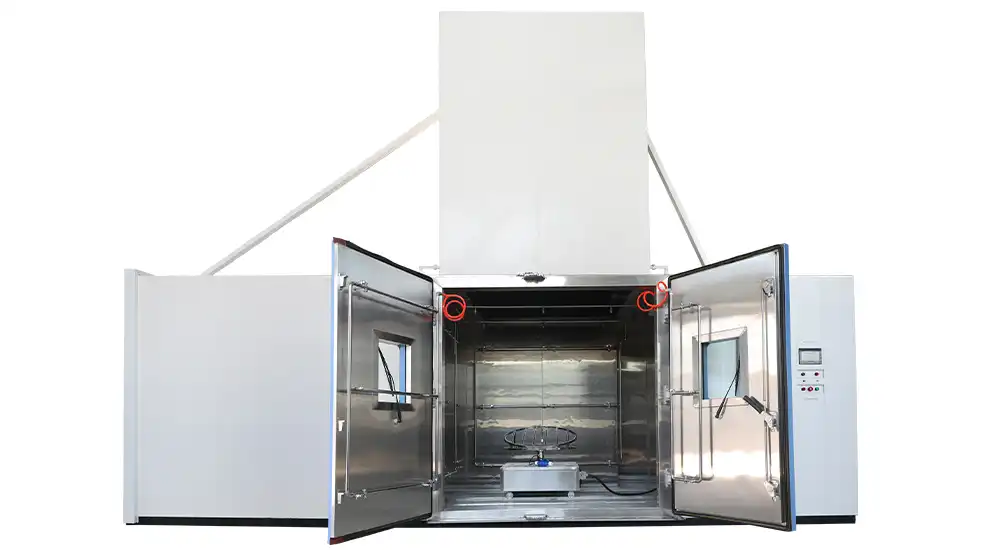
Model: RIM-1000 Interior Volume: 1000 L Turntable Load: 50 kg Turntable Diameter: 800 mm Door Lock: Electromagnetic lock Interior Material: SUS304 stainless steel Test Standard: MIL-STD-810H Test Time: 0 – 999 min, adjustable |
|
|
Rain & Blowing Rain Final Rain Droplet Velocity: 9 m/s on test item Rainfall Rate≥ 1.7 mm/min Droplet Size: 0.5 – 4.5 mm Water Temperature: +10°C to max. +55°C |
|
|
Drip Drip Area Dimensions: 1600 × 1000 mm, height adjustable Drip Hole Diameter: 20 – 25.4 mm Distance Between Holes: 25 mm Water Volume: ≥ 280 L/m²/h Water Temperature: +10°C to max. +55°C |
|
|
Exaggerated Rain Nozzle Pressure: 276 kPa Rainfall Rate: 20.8 L/min Nozzle Arrangement: One nozzle per 0.56 m² of surface area, approx. 48 cm from test surface Droplet Size:0.5 – 4.5 mm |
|
Advanced Multi-Directional Spray Technology Integration
LIB Industry chambers incorporate mobile spray heads adjusting vertically and horizontally, delivering uniform water distribution across all test surfaces through 360-degree ring nozzle arrays. The rotating turntable operating at 1-7 RPM provides complete exposure coverage, while variable frequency wind speed control generates realistic driving rain patterns matching field conditions. This integrated approach ensures products experience consistent water contact from every angle during testing.
Superior Water Management and Control Systems
The integrated water heating system maintains precise temperature differentials required by military standards, while high-efficiency filtration prevents nozzle blockages maintaining consistent spray quality throughout extended test durations. Recirculation systems minimize water consumption while the advanced control system displays real-time curves for wind speed, water flow, pressure, and temperature simultaneously, ensuring exact test condition maintenance.
Comprehensive Support and Custom Solutions
LIB Industry provides three-year warranties with lifetime service support backed by 24/7 global assistance responding rapidly to customer needs. The engineering team excels at non-standard designs creating tailored solutions matching specific testing requirements perfectly. ISO 9001 Quality Management System adherence, CE certification, and third-party testing from SGS and TUV ensure international compliance, stable performance, and high reliability across all equipment.
Conclusion
Blowing rain test chambers serve as indispensable tools for validating product durability against moisture ingress, enabling compliance with IEC 60529 and MIL-STD-810H standards that govern equipment performance across diverse industries. Understanding the distinct requirements between civilian and military specifications, implementing proper chamber configurations, following standardized test protocols, and conducting thorough result analysis ensures accurate certification supporting global market access. Advanced chamber technology from experienced manufacturers delivers reliable testing capabilities meeting evolving standard requirements.
FAQ
What droplet size range must blowing rain test chambers produce for MIL-STD-810H compliance?
MIL-STD-810H Method 506.6 requires droplet diameters ranging from 0.5 to 4.5 millimeters, replicating natural rainfall size distributions. Chambers achieve this through calibrated nozzle selection and pressure control, verified through droplet measurement systems during calibration procedures.
How do temperature differential requirements affect test chamber design?
Military standards mandate heating test specimens to maintain 10-degree Celsius water temperature differentials, requiring integrated heating systems, temperature control instrumentation, and thermal monitoring capabilities. This feature accelerates water penetration detection compared to ambient testing.
Can a single chamber configuration satisfy both IEC and MIL standard requirements?
Advanced chambers incorporate adjustable parameters including variable wind speeds, multiple spray configurations, programmable test sequences, and temperature control systems, enabling compliance testing across multiple standards. Proper calibration and configuration management ensure accurate simulation of diverse standard requirements.
Partner with LIB Industry for Your Environmental Testing Needs
LIB Industry stands as a leading blowing rain test chamber manufacturer and supplier, delivering turn-key environmental testing solutions worldwide. Contact our team at ellen@lib-industry.com to discuss your specific testing requirements and discover how our factory-direct equipment supports your certification goals.