Building Material Durability: Constant Climate Testing
Building material durability determines structural lifespan, occupant safety, and lifecycle costs across residential, commercial, and infrastructure projects. Constant climate testing exposes construction materials to precisely controlled environmental conditions - specific temperature-humidity combinations maintained continuously over extended periods - revealing degradation patterns that emerge only through sustained exposure. Unlike cycling protocols that alternate conditions, constant climate chambers maintain unwavering setpoints replicating specific geographic climates or storage environments. This methodology proves invaluable for evaluating adhesive bond durability, moisture-induced dimensional changes, condensation resistance, and long-term material stability. Manufacturers utilize these controlled evaluations to validate product specifications, achieve certification compliance, and prevent premature failures that compromise building performance and occupant welfare.
Why Is Constant Climate Testing Essential for Building Materials?
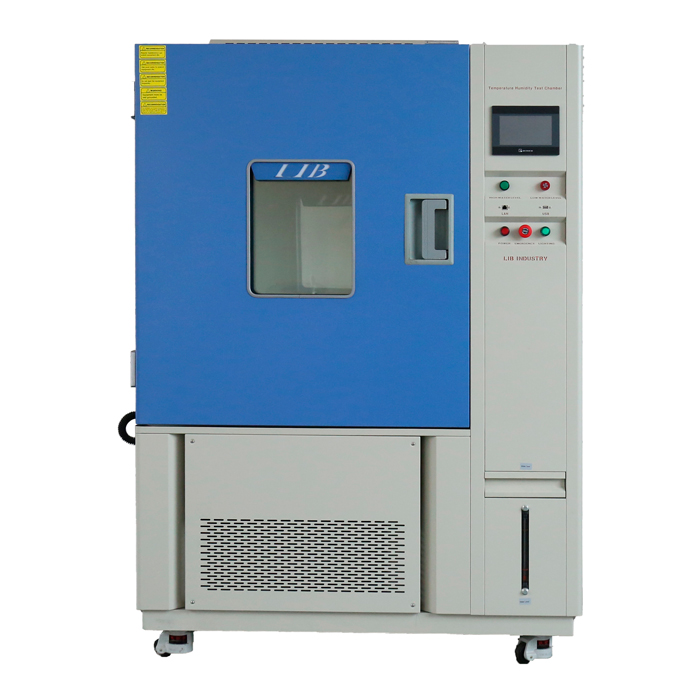
Preventing Structural Failure Through Predictive Analysis
Building materials remain embedded within structures for decades, making replacement extraordinarily costly and disruptive. Constant climate testing identifies degradation mechanisms before materials reach construction sites. Structural adhesives bonding curtain wall panels must maintain shear strength despite years of high-humidity exposure. Insulation materials cannot degrade under sustained moisture contact without compromising thermal performance. Sealants must retain elasticity through temperature extremes and UV exposure. Controlled environmental testing quantifies performance retention percentages after thousands of hours at specified conditions, enabling engineers to predict service lifetimes exceeding 50 years from accelerated laboratory evaluations.
Achieving Regulatory Compliance and Certification
Construction material approvals require demonstrated compliance with rigorous standards established by organizations including ASTM International, European Committee for Standardization (CEN), and national building code authorities. ASTM E96 moisture transmission testing mandates specific temperature-humidity conditions maintained continuously throughout evaluation periods. EN 13986 wood-based panel classification requires sustained humidity exposure determining swelling characteristics. Building code approvals often reference third-party certifications verifying materials withstand defined environmental exposures. Constant climate chambers providing documented temperature stability (±0.5°C) and humidity control (±2.5% RH) enable manufacturers to generate compliant test data supporting certification applications.
Optimizing Material Formulations for Target Environments
Geographic deployment locations impose vastly different environmental demands. Coastal construction faces salt-laden humidity accelerating corrosion, desert installations endure extreme dryness causing shrinkage and cracking, tropical climates promote biological growth, and northern regions experience freeze-thaw cycling. Constant climate testing at conditions matching deployment environments reveals formulation weaknesses early in development. Concrete admixture suppliers test samples at 95% RH/38°C simulating tropical exposure, while roofing membrane manufacturers evaluate products at -30°C representing arctic installations. This targeted testing optimizes material chemistry for specific climate zones rather than pursuing universal solutions compromising performance everywhere.
Environmental Simulation for Construction Material Durability

Replicating Geographic Moisture Regimes
Atmospheric moisture profoundly influences building material behavior, with equilibrium moisture content varying dramatically across climate zones. Hygroscopic materials like wood, gypsum, and cellulose-based products absorb moisture until reaching equilibrium with surrounding relative humidity. A constant climate chamber maintaining 85% RH at 30°C simulates tropical coastal conditions where wood flooring, drywall, and insulation constantly absorb atmospheric moisture. Conversely, 20% RH at 23°C replicates arid interior environments where materials desiccate, shrink, and develop static electricity. These sustained exposures reveal dimensional stability, moisture-related strength changes, and susceptibility to biological degradation.
Simulating Condensation-Prone Environments
Condensation occurs when warm, moisture-laden air contacts cold surfaces, creating liquid water that damages materials and promotes mold growth. Building envelope components - exterior wall assemblies, roof systems, foundation waterproofing - must resist condensation damage despite decades of intermittent wetting. Chamber testing simulates condensation conditions by maintaining high humidity (90-98% RH) at moderate temperatures while cooling specimen surfaces below dew point. This controlled condensation exposure reveals whether vapor barriers remain intact, whether insulation retains thermal resistance when wet, and whether structural members resist decay despite periodic moisture contact.
Evaluating Storage and Transportation Conditions
Building materials often remain warehoused or transit through diverse climates before installation. Packaging integrity, dimensional stability during storage, and susceptibility to premature curing or degradation all require validation. Adhesives stored in tropical warehouses (32°C/80% RH) must retain workability and bonding strength despite months at elevated temperature-humidity. Cement-based products cannot prematurely hydrate during humid storage. Constant climate chambers programmed to warehouse conditions (typically 25°C/60% RH or 30°C/75% RH) verify packaging effectiveness and establish shelf-life limitations protecting product quality throughout distribution networks.
|
Climate Scenario |
Temperature Setpoint |
Humidity Setpoint |
Building Material Applications |
|
Tropical Coastal |
30°C - 35°C |
80%-95% RH |
Exterior coatings, Corrosion resistance, Mold resistance |
|
Desert/Arid |
35°C - 45°C |
15%-30% RH |
Shrinkage resistance, Static control, Desiccation stability |
|
Temperate Indoor |
20°C - 25°C |
40%-60% RH |
Interior finishes, Dimensional stability, General durability |
|
Cold Storage |
-5°C - 5°C |
40%-70% RH |
Freeze resistance, Cold flexibility, Thermal shock tolerance |
Moisture and Temperature Resistance Testing for Structural Materials
Adhesive Bond Durability Under Sustained Humidity
Structural adhesives bonding dissimilar materials in curtain walls, composite panels, and laminated assemblies must maintain load-bearing capacity despite continuous moisture exposure. Water molecules penetrate adhesive interfaces, reducing interfacial bonding forces and enabling stress-corrosion cracking. ASTM D1183 wet strength testing requires specimens bonded, then conditioned at specified temperature-humidity combinations before destructive testing. Constant climate chambers maintaining 49°C/95% RH or 70°C/95% RH create aggressive hydrolytic environments. Lap shear strength measurements after 1000, 2000, or 5000 hours quantify bond degradation rates, establishing whether adhesives meet minimum retention thresholds (often 75-80% of dry strength).
Wood and Cellulose Product Dimensional Stability
Wood-based construction materials - structural lumber, engineered wood products, wood flooring, and composite panels - undergo hygroscopic dimensional changes correlating directly with atmospheric moisture. ASTM D1037 thickness swelling tests require constant humidity exposure at 30°C/90% RH measuring dimensional change magnitudes. Engineered products like oriented strand board (OSB) and medium-density fiberboard (MDF) demonstrate varying swelling characteristics depending on resin chemistry and manufacturing processes. Testing at multiple humidity setpoints (50%, 65%, 85%, 95% RH) generates sorption isotherms predicting real-world dimensional behavior across seasonal humidity variations.
Concrete and Cementitious Material Moisture Resistance
Concrete durability depends critically on resisting moisture penetration enabling freeze-thaw damage, reinforcement corrosion, and alkali-silica reaction. Permeability testing per ASTM C1202 and moisture vapor transmission evaluation require controlled environmental conditions. Constant climate chambers housing sealed concrete specimens at 95% RH/23°C simulate saturated exposure conditions. Electrical conductivity measurements quantify chloride ion penetration rates, while weight gain monitoring reveals moisture absorption characteristics. High-performance concrete mixtures incorporating supplementary cementitious materials undergo extended exposure validating impermeability claims supporting 100-year design lifetimes.
How Do Climate Conditions Affect Building Material Performance?
Thermal Expansion and Contraction Cycles
All building materials exhibit thermal expansion coefficients defining dimensional changes across temperature ranges. Dissimilar materials joined in assemblies (concrete-to-steel connections, glass-to-aluminum framing, composite panel laminates) experience differential thermal movement creating interfacial stresses. While cycling tests evaluate fatigue from repeated expansion-contraction, constant temperature testing at extreme setpoints quantifies maximum dimensional displacement magnitudes. A constant climate chamber maintaining +80°C or -40°C enables precise measurement of expansion coefficients, joint movement requirements, and clearance specifications preventing buckling or gap formation during temperature extremes.
Humidity-Driven Material Transformations
Many construction materials undergo phase changes or chemical transformations when moisture content exceeds critical thresholds. Gypsum wallboard loses structural integrity when saturated, cellulose insulation compresses and loses R-value when wet, and mineral wool products may experience binder degradation. Constant high-humidity exposure (95-98% RH) reveals these transformation thresholds and degradation kinetics. Materials designed for moisture-prone applications - bathroom wall systems, basement foundations, crawl space enclosulation - undergo sustained humidity testing verifying performance retention despite continuous moisture exposure. Products failing these evaluations require reformulation or application restriction.
Biological Degradation Susceptibility
Mold, mildew, bacteria, and wood-decay fungi proliferate when building materials remain at elevated moisture content and moderate temperatures. The critical moisture threshold for mold growth typically corresponds to 80-85% relative humidity at 25-30°C. Constant climate chambers maintaining these conditions enable biological susceptibility testing per ASTM D3273 and ASTM G21. Specimens undergo sustained exposure in chambers inoculated with specific fungal species, with periodic visual inspections and ATP bioluminescence measurements quantifying microbial proliferation. Building materials intended for humid climates require demonstrated mold resistance, while wood products need decay resistance verification through accelerated exposure protocols.
|
Material Category |
Critical Climate Vulnerability |
Testing Protocol |
Performance Threshold |
|
Structural Adhesives |
Hydrolytic bond degradation |
70°C/95% RH, 2000h |
≥75% retained strength |
|
Wood Products |
Dimensional swelling |
30°C/90% RH, 500h |
≤12% thickness increase |
|
Gypsum Board |
Core disintegration |
40°C/95% RH, 168h |
Maintain structural integrity |
|
Insulation Materials |
Thermal resistance loss |
38°C/90% RH, 1000h |
≥90% R-value retention |
Accelerated Aging Evaluation for Construction Applications
Establishing Equivalence Between Laboratory and Field Exposure
Accelerated aging protocols intensify environmental stressors, compressing decades of natural exposure into manageable laboratory timeframes. Temperature elevation proves particularly effective - reaction rates approximately double with each 10°C increase following Arrhenius kinetics. A constant climate chamber maintaining 70°C/65% RH might replicate 10 years of ambient indoor exposure (21°C/50% RH) within a single year. However, establishing valid acceleration factors requires careful validation. Materials must degrade through identical mechanisms at accelerated and natural conditions. Testing at multiple temperatures enables activation energy calculation, mathematically relating accelerated exposures to real-world equivalents.
Multi-Parameter Acceleration Strategies
While constant temperature-humidity represents the foundation of accelerated aging, comprehensive protocols incorporate additional stressors. UV radiation accelerates photodegradation in coatings and polymers, mechanical loading reveals creep and fatigue behavior, and chemical exposure simulates environmental pollutants. Advanced testing programs utilize chambers with integrated UV lamp arrays maintaining 340nm wavelength exposure at controlled irradiance levels. Combined temperature, humidity, and UV protocols more accurately replicate outdoor weathering than any single-factor approach. Exterior building products - siding, roofing, window seals - require multi-stress validation demonstrating resistance to simultaneous environmental challenges.
Statistical Confidence Through Extended Testing
Building product service life predictions carry enormous liability implications - premature failures trigger warranty claims, litigation, and reputational damage. Statistical confidence demands extensive datasets spanning thousands of test hours at multiple stress levels. Constant climate chambers enable parallel testing of numerous specimens, generating statistically robust datasets. Weibull analysis of failure distributions establishes B10 life values (time when 10% of population fails), supporting conservative service life predictions. Chamber reliability proves critical - testing interruptions from equipment failures invalidate months of accumulated exposure, making precision environmental control and robust construction paramount considerations.
Reliability Testing Standards for Long-Term Building Material Stability
ASTM Standards Governing Environmental Exposure
ASTM International publishes comprehensive standards addressing building material environmental testing. ASTM D1037 evaluates wood-based panel properties including thickness swelling and water absorption. ASTM C1185 specifies sampling and testing fiber-cement products, including moisture movement and freeze-thaw resistance. ASTM E96 governs water vapor transmission testing through building materials. Each standard prescribes specific temperature-humidity conditions, specimen configurations, and performance criteria. Constant climate chambers meeting ASTM precision requirements (temperature uniformity, humidity accuracy, air velocity specifications) enable compliant testing supporting product certifications and building code approvals.
European Norms for Construction Product Testing
European construction markets require conformance with harmonized standards (hENs) supporting CE marking under the Construction Products Regulation (CPR). EN 15101 addresses thermal insulation products, specifying conditioning atmospheres and moisture resistance testing. EN 13501 fire classification requires specimens conditioned at 23°C/50% RH achieving equilibrium before testing. EN 13986 establishes wood-based panel moisture resistance classes determined through cyclic humidity exposure and swelling measurements. Chamber capabilities must address European standard requirements, which sometimes differ from North American protocols in conditioning atmospheres, test durations, and performance classifications.
Industry-Specific Certification Protocols
Beyond general standards, industry organizations establish specialized testing protocols. The Adhesive and Sealant Council (ASC) publishes guidelines for structural glazing sealant testing. The National Roofing Contractors Association (NRCA) references specific environmental exposure protocols for roofing membrane evaluation. Green building certification programs like LEED incorporate environmental chamber testing verifying low-emitting material claims - VOC emission testing requires chambers maintaining 23°C/50% RH per CDPH Standard Method V1.2. Manufacturers targeting specialty markets must verify chamber capabilities align with applicable certification requirements.
|
Standard |
Governing Body |
Application |
Required Conditions |
|
ASTM D1037 |
ASTM International |
Wood-based panels |
30°C/90% RH for swelling |
|
ASTM C1185 |
ASTM International |
Fiber-cement products |
Multiple T/RH combinations |
|
EN 15101 |
CEN |
Thermal insulation |
23°C/50% RH conditioning |
|
ISO 9346 |
ISO |
Hygrothermal performance |
Variable T/RH profiles |
LIB Industry: Durable Chambers for Material Testing
 |
 |
|
|
|
|
|
|
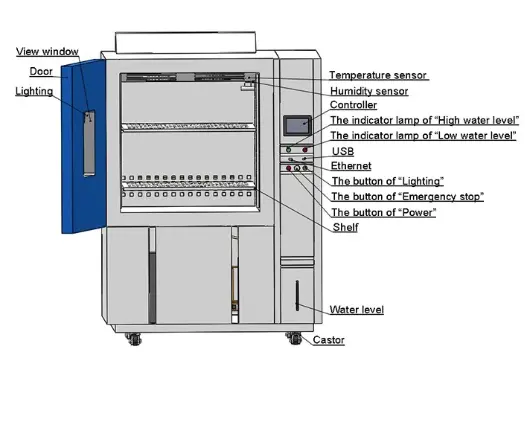
| Robust Workroom | Cable Hole | Temperature and Humidity Sensor | PID controller |


Precision Environmental Control for Construction Testing
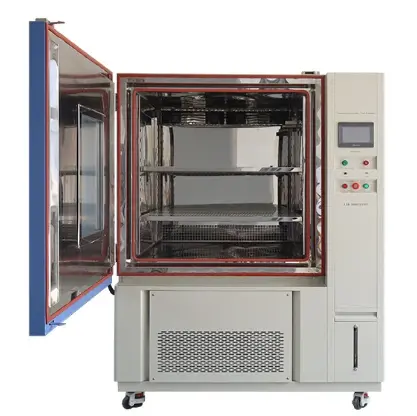
LIB Industry's constant climate chambers deliver exceptional stability essential for long-duration building material evaluations. Temperature fluctuation remains within ±0.5°C throughout test volumes ranging from 100L to 1000L, while humidity deviation stays below ±2.5% RH across the 20-98% operational range. This precision proves critical when testing hygroscopic materials exhibiting steep moisture sorption curves - small humidity variations produce significant moisture content changes affecting dimensional stability and strength properties. High-precision PT100 Class A temperature sensors with ±0.001°C resolution enable accurate setpoint maintenance and comprehensive data logging throughout multi-month exposure periods.
Robust Construction for Continuous Operation
Building material testing often requires uninterrupted chamber operation spanning thousands of hours. LIB chambers incorporate industrial-grade construction ensuring reliability throughout extended campaigns. SUS304 stainless steel interiors resist corrosion despite sustained high-humidity exposure, maintaining chamber integrity and preventing specimen contamination. The exterior features 4mm A3 steel framework with protective powder coating, providing structural rigidity and durability. French TECUMSEH compressor technology delivers dependable refrigeration performance, while polyurethane foam insulation combined with specialized insulation cotton minimizes energy consumption during prolonged operation.
External Humidification System Advantages
Traditional chamber designs positioning humidifiers within test workspaces create maintenance challenges and potential specimen interference. LIB's external stainless steel surface evaporation humidifier operates independently from the test chamber, feeding controlled moisture through dedicated ports. This architecture prevents mineral scaling on test specimens - particularly problematic during high-humidity concrete or wood testing where surface deposits alter moisture absorption characteristics. The isolated humidification system enables maintenance, cleaning, and water supply verification without interrupting ongoing tests or disturbing environmental conditions surrounding specimens.
Programmable Controllers Supporting Complex Protocols
Building material standards frequently mandate multi-stage conditioning sequences - initial drying periods followed by controlled moisture uptake at specified conditions. LIB's programmable color LCD touchscreen controller enables intricate sequence programming with multiple segments defining target temperature, humidity, duration, and transition parameters. Ethernet connectivity facilitates remote monitoring and automated data export into laboratory information systems, streamlining documentation for certification applications. Calendar scheduling initiates conditioning sequences during off-hours, maximizing chamber utilization across round-the-clock testing schedules common in high-volume commercial laboratories.
Comprehensive Safety Protection Systems
Building material specimens often represent significant investment - custom formulations, prototype assemblies, or samples requiring extensive preparation before testing. Chamber malfunctions could destroy irreplaceable materials and invalidate months of accumulated exposure time. LIB chambers incorporate redundant protection mechanisms: independent physical over-temperature cutoffs operate separately from software controls, refrigerant high-pressure protection prevents cooling system damage, water shortage sensors halt humidification before dry-combustion events, and earth leakage protection ensures electrical safety. Multiple alarm notification methods (visual indicators, audible signals, network alerts) enable rapid intervention should abnormal conditions develop.
Conclusion
Constant climate testing provides indispensable capabilities for evaluating building material durability, enabling manufacturers to predict long-term performance, validate regulatory compliance, and optimize formulations for specific deployment environments. LIB Industry's precision chambers deliver the environmental stability, robust construction, and comprehensive safety features essential for rigorous construction material testing protocols. Investing in proper constant climate testing equipment prevents catastrophic field failures, accelerates product development timelines, and ensures materials meet stringent performance expectations supporting durable, sustainable building construction worldwide.
FAQ
What temperature and humidity conditions are most common for building material conditioning?
Standard conditioning atmospheres per ASTM D618 and ISO 554 specify 23°C ±2°C and 50% ±5% RH. However, specific material standards may require different conditions - wood products often use 20°C/65% RH per ASTM D4933, while some concrete testing occurs at 23°C/95% RH representing saturated exposure.
How long must building materials remain in constant climate chambers before testing?
Equilibration periods vary dramatically depending on material type, thickness, and hygroscopic properties. Thin coatings may stabilize within 24 hours, while thick wood products or concrete specimens require weeks. Testing begins only after specimens reach constant weight (±0.1% change over 24 hours), confirming moisture equilibrium with chamber atmosphere.
Can constant climate chambers accommodate full-scale building assemblies or only small specimens?
Chamber sizes range from benchtop units (100L) for coupon testing to walk-in chambers (10+ cubic meters) accommodating full-scale wall assemblies, window systems, or roofing sections. Custom chamber designs address unique requirements - testing complete curtain wall mockups or door assemblies under controlled environmental conditions validating real-world performance.
Connect with LIB Industry for Building Material Testing Solutions
As a leading constant climate chamber manufacturer and supplier, LIB Industry delivers comprehensive environmental testing solutions tailored to construction material evaluation requirements. Our engineering expertise supports equipment selection, installation, validation, and ongoing technical assistance throughout your chamber's operational lifecycle. Contact our specialists at ellen@lib-industry.com to discuss how our precision chambers enhance your building material durability testing programs.