Cold Temperature Chambers for Rubber and Plastic Durability
Rubber and plastic materials face significant challenges when exposed to freezing environments, where brittle fractures, dimensional instability, and performance degradation become critical concerns. Cold temperature chambers provide controlled environments that replicate extreme conditions, enabling manufacturers to assess material behavior, validate formulation changes, and ensure product reliability across diverse climatic zones. These specialized testing systems expose polymer samples to precisely controlled low temperatures while monitoring mechanical properties, flexibility retention, and structural integrity. By simulating real-world cold exposure scenarios, engineers can predict long-term durability, optimize material compositions, and meet stringent industry standards before deployment in automotive, aerospace, consumer goods, and industrial applications.
Why Do Rubber and Plastic Materials Require Cold Testing?
Molecular Mobility Changes at Low Temperatures
Polymer chains exhibit dramatically reduced molecular mobility as temperatures drop below their glass transition point. This fundamental physical transformation converts flexible, elastic materials into rigid, brittle structures vulnerable to catastrophic failure. Rubber compounds designed for sealing applications may lose their conformability, while plastic housings can develop micro-cracks that propagate under minimal stress. Understanding these temperature-dependent transitions allows material scientists to select appropriate polymer grades and additive packages that maintain performance across specified temperature ranges.
Regulatory Compliance Across Industries
Multiple international standards mandate cold temperature validation for products destined for global markets. Automotive manufacturers must comply with specifications requiring component functionality at -40°C, while aerospace regulations demand verification at even lower thresholds. Medical device manufacturers need stability data for cold chain logistics, and telecommunications equipment must withstand extreme continental climates. A cold temperature chamber provides the controlled environment necessary to generate compliant test data, supporting certification processes and quality documentation requirements.
Cost Reduction Through Predictive Testing
Field failures resulting from inadequate cold weather performance generate substantial warranty costs, reputation damage, and potential safety liabilities. Identifying material weaknesses during development phases rather than after market release delivers exponential cost savings. Accelerated aging protocols within environmental chambers compress years of seasonal cycling into weeks of controlled exposure, revealing degradation mechanisms that inform design improvements. This proactive approach transforms quality assurance from reactive problem-solving to strategic risk mitigation.
Low-Temperature Flexibility Evaluation for Polymer Materials
Glass Transition Temperature Determination
The glass transition temperature (Tg) represents the critical threshold where amorphous polymers shift from rubbery to glassy states. Precise Tg measurement in a cold temperature chamber guides formulation adjustments, ensuring materials remain above this transition point during service conditions. Dynamic mechanical analysis conducted at various temperature points reveals the exact temperature range where flexibility diminishes, allowing engineers to establish safety margins for operational specifications.
Compression Set Resistance Measurement
Sealing applications demand rubber materials that recover their original dimensions after sustained compression, even following cold temperature exposure. Standardized compression set testing involves positioning samples under defined loads within the chamber, subjecting them to target temperatures for specified durations, then measuring permanent deformation after recovery periods. Materials exhibiting excessive compression set lose sealing effectiveness, leading to leakage and system failures in gaskets, O-rings, and weather stripping applications.
Bend Testing for Impact Modification Evaluation
Impact-modified plastics incorporate elastomeric phases to enhance toughness, but these modifications often compromise low-temperature performance. Controlled bend testing at progressively decreasing temperatures identifies the brittleness threshold where samples fracture rather than flex. This data enables formulators to balance impact resistance with cold weather durability, optimizing modifier selection and concentration for specific application requirements.
|
Test Parameter |
Typical Range |
Measurement Purpose |
|
Glass Transition Temperature |
-120°C to +50°C |
Identify flexibility loss threshold |
|
Compression Set Duration |
22-168 hours |
Assess sealing recovery capability |
|
Bend Test Temperature |
-70°C to +23°C |
Determine brittleness onset point |
Crack Resistance Testing in Cold Environmental Conditions
Thermal Shock Cycling Protocols
Rapid temperature transitions generate differential thermal expansion stresses that nucleate cracks at material interfaces and stress concentration points. Thermal shock testing alternates between temperature extremes, typically cycling between -40°C and +85°C with minimal transition time. Materials that withstand hundreds of cycles without visible cracking demonstrate superior durability for applications experiencing daily temperature fluctuations, such as exterior automotive trim, outdoor electrical enclosures, and building envelope components.
Ozone Resistance Under Low Temperature Stress
Rubber materials under tensile strain exhibit accelerated ozone attack, with crack propagation rates influenced by ambient temperature. Combined ozone exposure and cold temperature testing reveals synergistic degradation mechanisms not apparent in single-factor evaluations. This testing approach proves particularly valuable for automotive weather seals, tire sidewalls, and outdoor conveyor belting where simultaneous mechanical stress, ozone exposure, and temperature extremes occur during service.
Impact Strength Degradation Analysis
Notched impact testing at various temperatures quantifies energy absorption capacity as materials approach their ductile-to-brittle transition. High-performance engineering plastics may exhibit acceptable impact resistance at room temperature but fail catastrophically at -30°C. Comparative testing across temperature ranges establishes minimum use temperatures and guides material selection for applications requiring impact resistance throughout seasonal temperature variations.
How Does Extreme Cold Affect Rubber and Plastic Performance?
Crystallization Phenomena in Elastomers
Certain rubber formulations undergo strain-induced crystallization at low temperatures, creating localized rigid domains within the elastic matrix. While controlled crystallization can enhance strength properties, excessive crystallization causes stiffening and reduces low-temperature flexibility. Cold temperature chambers enable researchers to monitor crystallization kinetics through differential scanning calorimetry performed on samples conditioned at target temperatures, optimizing polymer selection and plasticizer systems to minimize unwanted crystallization.
Plasticizer Migration and Phase Separation
Flexible PVC and plastisol formulations rely on plasticizers to maintain flexibility, but these additives exhibit temperature-dependent migration behavior. Cold temperatures can trigger plasticizer phase separation or surface blooming, creating surface tackiness or brittleness. Extended cold exposure testing within environmental chambers reveals plasticizer compatibility issues, guiding reformulation efforts to select low-temperature stable systems that maintain uniform distribution throughout the product lifecycle.
Dimensional Stability and Tolerance Management
Coefficient of thermal expansion differences between materials, reinforcing fibers, and metal inserts create dimensional changes during temperature cycling. Precision components with tight tolerances may experience interference fits becoming loose or clearances closing during cold exposure. Dimensional measurement protocols conducted within stabilized cold chambers provide data for tolerance stack analysis, enabling design engineers to specify appropriate clearances that accommodate thermal contraction without compromising functionality.
|
Material Category |
Typical CTE (×10⁻⁵/°C) |
Primary Cold Weather Concern |
|
Natural Rubber |
20-25 |
Crystallization stiffening |
|
Polyethylene (HDPE) |
46310 |
Brittleness increase |
|
Polycarbonate |
46180 |
Impact strength reduction |
|
Filled Composites |
46061 |
Differential expansion stress |
Durability Validation for Industrial Elastomers and Plastics
Accelerated Aging Equivalence Modeling
Long-term durability predictions require correlation between accelerated chamber testing and real-world aging. Arrhenius modeling principles establish equivalence relationships where elevated stress conditions within chambers replicate years of ambient exposure in compressed timeframes. Temperature cycling combined with mechanical stress creates cumulative damage mechanisms comparable to extended field service, providing confidence in projected service life estimates based on relatively short testing periods.
Multi-Stress Environmental Simulation
Real-world conditions rarely involve isolated temperature exposure; humidity, UV radiation, chemical exposure, and mechanical loading interact synergistically to accelerate degradation. Advanced cold temperature chambers equipped with humidity control, sample loading fixtures, and access ports for chemical introduction enable multi-factor testing protocols. These comprehensive evaluations reveal failure modes invisible in single-factor testing, delivering more accurate durability assessments for complex application environments.
Seal Performance Under Vacuum and Pressure
Pneumatic and hydraulic systems demand seals that maintain integrity across temperature extremes while containing pressurized fluids. Specialized fixtures within cold chambers apply system-representative pressures to elastomeric seals while subjecting them to thermal cycling. Leak rate monitoring throughout testing quantifies seal degradation, identifying formulations and geometries that maintain sealing effectiveness despite hardening and dimensional changes induced by cold temperatures.
Environmental Simulation for Long-Term Material Reliability
Climate Zone Replication Studies
Global product deployment requires validation across diverse climatic conditions ranging from Arctic tundra to temperate zones with severe winters. Cold temperature chambers programmed with location-specific temperature profiles replicate seasonal patterns, including diurnal cycling, cold snaps, and gradual seasonal transitions. Materials proven through climate-specific testing demonstrate reliability for regional markets, supporting targeted product positioning and warranty programs based on validated performance data.
Condensation and Freeze-Thaw Cycling
Temperature transitions across the freezing point create condensation followed by ice formation within porous materials and surface irregularities. Repeated freeze-thaw cycling generates internal pressures that propagate cracks and delamination in composite structures. Testing protocols incorporating humidity control with thermal cycling below 0°C simulate these damaging mechanisms, particularly relevant for construction materials, outdoor equipment housings, and transportation infrastructure components.
Thermal Cycling Frequency Effects
Damage accumulation rates vary significantly based on cycling frequency, with rapid transitions generating different failure modes than gradual temperature changes. Automotive underhood components experience frequent thermal cycling during daily use, while building materials undergo seasonal transitions. Customizable chamber programming capabilities enable frequency-matched testing that accurately represents application-specific thermal histories, improving correlation between laboratory results and field performance.
|
Application Sector |
Typical Test Range |
Critical Performance Metric |
|
Automotive Exterior |
-40°C to +85°C |
Seal integrity retention |
|
Consumer Electronics |
-20°C to +60°C |
Housing crack resistance |
|
Industrial Hoses |
-55°C to +125°C |
Flexibility maintenance |
|
Medical Packaging |
-80°C to +23°C |
Barrier property stability |
LIB Industry: Custom Cold Cycling for Polymer Durability
Tailored Chamber Configurations for Polymer Testing
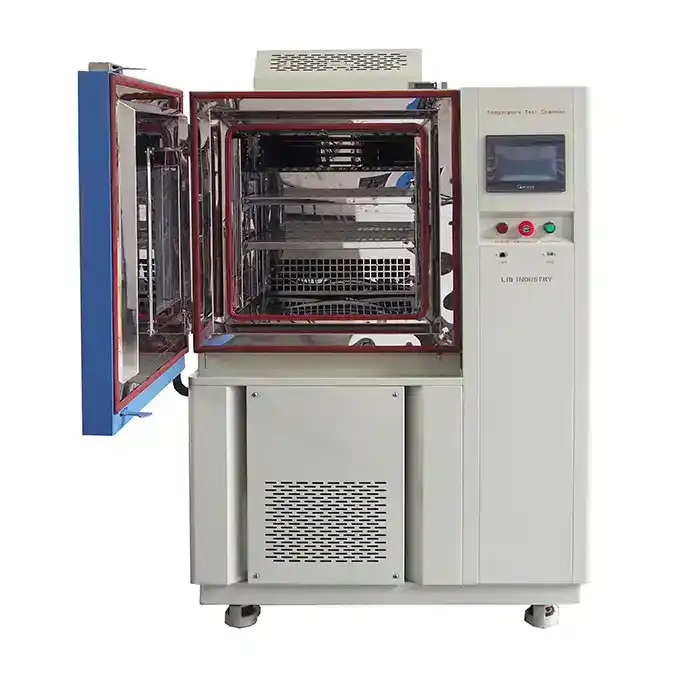
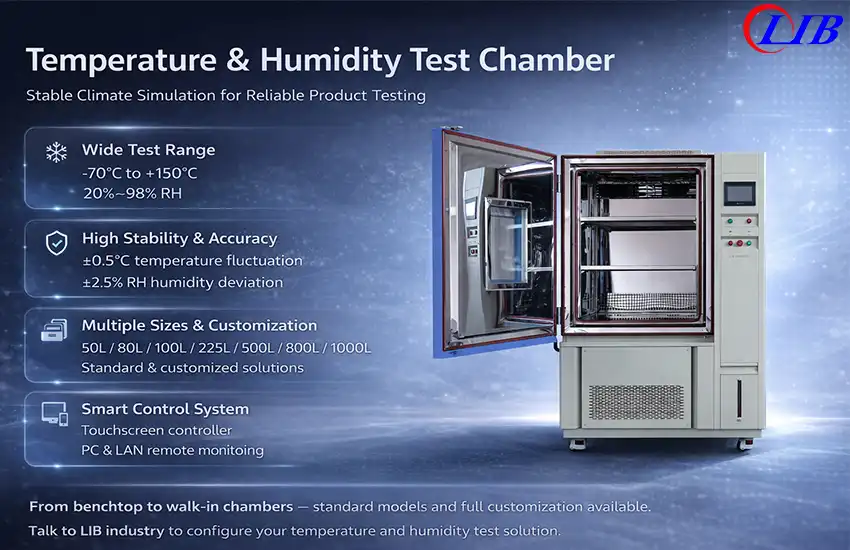
LIB Industry's cold temperature chambers accommodate diverse specimen geometries and testing requirements through customizable internal dimensions ranging from 100L to 1000L capacity. The modular design incorporates adjustable shelving systems, sample mounting fixtures, and cable access ports enabling simultaneous testing of multiple component configurations. Temperature range options extending from -20°C to -120°C address application-specific requirements, whether validating consumer products for temperate climates or aerospace components for extreme altitude conditions.
Precision Control Systems for Repeatable Results
Achieving reliable durability data demands exceptional temperature uniformity and stability throughout the test chamber volume. LIB's programmable color LCD touch screen controller maintains temperature fluctuation within ±0.5°C and spatial deviation under ±2.0°C, ensuring all specimens experience identical thermal exposure. The integrated PTR Platinum Resistance PT100Ω temperature sensors provide accurate feedback for the PID control algorithm, while the centrifugal circulation system eliminates thermal stratification that compromises data integrity.
Comprehensive Testing Capabilities and Support Services
Beyond standard cold exposure, LIB Industry chambers integrate humidity control spanning 20% to 98% RH for combined temperature-moisture testing protocols. The mechanical compression refrigeration system utilizing French TECUMSEH compressors delivers reliable cooling performance with 3°C/min cooling rates, accelerating testing throughput. Post-installation support includes calibration documentation, operator training, and technical consultation for test protocol development, ensuring customers maximize their investment through optimized testing strategies aligned with industry standards and application requirements.
Integration with Quality Management Systems
Modern manufacturing environments demand seamless data integration between testing equipment and enterprise quality systems. LIB's cold temperature chambers feature Ethernet connectivity enabling remote monitoring, automated data logging, and integration with LIMS (Laboratory Information Management Systems). Real-time alerts notify operators of out-of-specification conditions, while comprehensive test reports document temperature profiles, exposure durations, and conformance to programmed parameters. This digital integration supports ISO/TS 16949 automotive quality standards, FDA validation requirements for medical devices, and other regulatory frameworks demanding documented environmental testing evidence.
Conclusion
Validating rubber and plastic durability through controlled cold temperature exposure represents an essential investment in product quality, regulatory compliance, and market success. Sophisticated testing chambers replicate extreme environmental conditions, revealing material weaknesses before costly field failures occur. The combination of precise temperature control, programmable cycling capabilities, and multi-stress simulation enables comprehensive durability assessments aligned with real-world application demands. As material formulations advance and performance expectations increase, environmental testing infrastructure becomes increasingly critical to competitive product development.
FAQ
What temperature range is necessary for automotive rubber component testing?
Automotive applications typically require validation between -40°C and +125°C to cover extreme winter conditions and underhood thermal environments. Sealing components need particular focus on low-temperature flexibility retention and compression set resistance to ensure functionality across this range.
How long should polymer samples remain at target temperature before testing?
Thermal equilibration time depends on specimen geometry and thermal conductivity, but minimum soak periods of 4-24 hours ensure uniform temperature distribution throughout the sample thickness. Thick-walled components require extended stabilization to eliminate internal temperature gradients affecting results.
Can cold temperature chambers accommodate both flexibility and impact testing?
Advanced chambers include cable access ports and internal mounting systems enabling mechanical testing apparatus integration. This configuration allows compression set fixtures, tensile grips, or impact testing devices to operate within the controlled environment, providing true in-situ property measurement.
What distinguishes cascade refrigeration from single-stage cooling systems?
Cascade systems employ multiple refrigerant circuits optimized for different temperature ranges, achieving lower ultimate temperatures (-70°C to -120°C) with improved efficiency compared to single-stage systems limited to approximately -40°C. Application requirements dictate the appropriate refrigeration architecture.
Ready to enhance your polymer testing capabilities? LIB Industry, a leading environmental test chamber manufacturer and supplier, delivers customized cold temperature solutions backed by comprehensive technical support. Contact our specialists at ellen@lib-industry.com to discuss your specific durability validation requirements and discover how our chambers can accelerate your product development timeline.


