Cyclic Corrosion Testing for Metal Durability Analysis
Metal corrosion represents one of the most significant challenges in manufacturing, costing industries billions annually in material degradation and equipment failure. Cyclic corrosion testing has emerged as a transformative approach to predicting and preventing metal deterioration before products reach consumers. Unlike traditional single-environment testing methods, cyclic corrosion chambers simulate realistic environmental cycles - alternating between salt fog exposure, dry periods, humid conditioning, and ambient recovery phases. This comprehensive methodology reveals how materials respond to the varied weather patterns and temperature fluctuations they'll encounter in actual service. By accelerating corrosion processes through controlled environmental cycling, engineers gain deeper insights into material performance and durability. Organizations across automotive, aerospace, electronics, and maritime industries rely on this testing to ensure product longevity and safety. Modern cyclic corrosion chambers combine precision instrumentation with programmable controls, enabling manufacturers to evaluate material resilience with unprecedented accuracy and consistency.

Why Is Cyclic Corrosion Testing Used for Metal Durability?
The Limitations of Single-Environment Testing
Traditional salt spray testing - a staple in corrosion research for decades - exposes materials to continuous salt fog conditions. While this approach identifies baseline corrosion susceptibility, it fails to replicate the dynamic environmental shifts metals encounter in real-world applications. Single-environment testing cannot capture how materials behave during temperature swings, humidity fluctuations, or the critical transitions between wet and dry conditions. This limitation means products deemed acceptable in laboratory settings sometimes fail prematurely in field applications, damaging brand reputation and creating safety risks for end-users.
Realistic Environmental Simulation
Cyclic corrosion testing bridges this critical gap by reproducing authentic environmental sequences. Automotive components experience daily cycles of moisture exposure during morning dew, dry periods under sunlight, and potential salt application in winter months. Aerospace fixtures endure temperature extremes ranging from high-altitude cold to ground-level heat. Marine equipment faces constant salt spray alternating with dry Caribbean winds. By replicating these genuine conditions through programmed cycles, manufacturers obtain performance predictions that correlate directly with field experience, enabling accelerated product qualification timelines.
Accelerated Degradation Insights
The cyclic approach fundamentally accelerates material degradation compared to static testing environments. Salt crystallization during dry phases, followed by rehydration and electrochemical activity during humid exposure, creates intensified corrosion mechanisms. This acceleration compresses months or years of environmental exposure into weeks of laboratory testing, allowing manufacturers to evaluate material performance rapidly without sacrificing accuracy. Engineering teams gain actionable data about material behavior under stress conditions, enabling faster iteration cycles and more confident product launches.
Environmental Stress Factors Affecting Metal Degradation
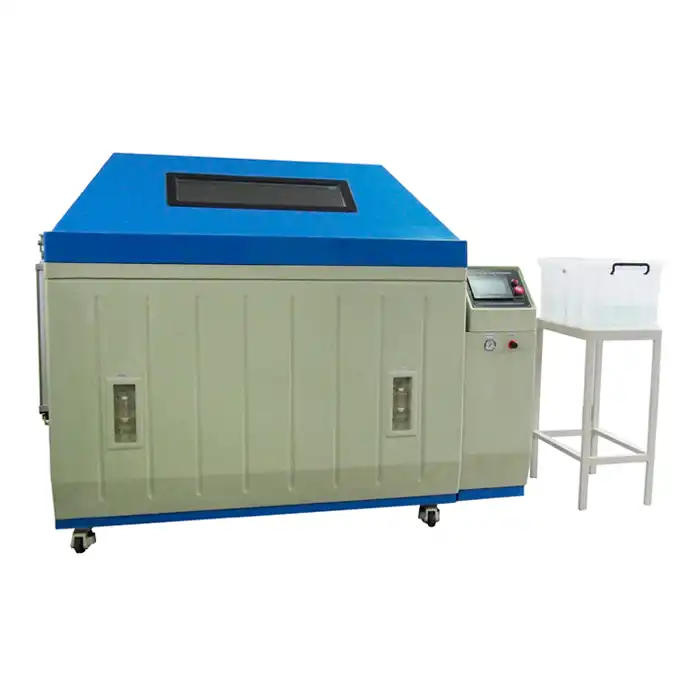
Temperature Dynamics and Thermal Cycling Effects
Temperature fluctuations profoundly influence corrosion rates through multiple mechanisms. Elevated temperatures accelerate chemical reactions, increasing electrochemical activity at metal surfaces by approximately two to three percent for every degree Celsius increase. Thermal cycling creates mechanical stress as different material layers expand and contract at varying rates, potentially generating micro-fractures that expose fresh metallic surfaces to corrosive agents. Precision temperature control becomes essential - modern cyclic corrosion chambers maintain accuracy within ±0.5°C, preventing artificial accelerations that might misrepresent real-world conditions. Temperature ranges from +10°C to +90°C in advanced systems enable comprehensive testing across seasonal variations and geographic extremes.
Humidity Control and Moisture Penetration
Moisture represents corrosion's primary catalyst, initiating electrochemical reactions that transform stable metal into vulnerable oxides and hydroxides. Humidity ranges spanning 30% to 98% RH in contemporary testing equipment simulate everything from arid desert conditions to tropical environments. The transition between dry and humid phases proves particularly damaging - as moisture condenses on cooling metal surfaces, it concentrates dissolved salts, intensifying localized corrosion. Controlling humidity deviation to within ±2-3% ensures that observed degradation patterns reflect genuine environmental stress rather than testing artifacts.
Salt Fog Deposition and Corrosive Chemistry
Salt fog deposition rates of 1-2 mL per 80 cm² per hour in chamber specifications establish consistent ionic concentrations within the testing environment. Different salt compositions - sodium chloride for NSS (Neutral Salt Spray), acetic acid-modified systems for AASS (Acetic Acid Salt Spray), or copper-enhanced formulations for CASS (Copper-Accelerated Acetic Acid Salt Spray) - target specific failure mechanisms relevant to product applications. The chemistry of deposited salts creates galvanic couples on alloy surfaces, generating localized attack that penetrates protective coatings. Advanced chambers enable SO₂ gas integration, simulating industrial atmospheric pollution that intensifies corrosion vulnerability in certain geographic regions.
Multi-Phase Testing for Accelerated Corrosion Simulation
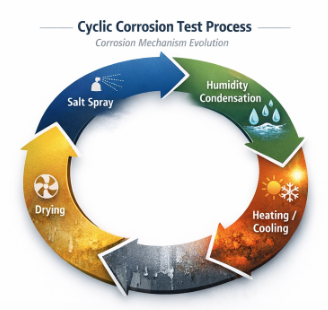
Salt Fog Exposure Phases
Salt fog exposure phases establish the primary corrosive environment within a cyclic corrosion test chamber during cycling protocols. During these intervals, atomizer towers generate consistent salt mist that saturates the chamber atmosphere, initiating electrochemical reactions on specimen surfaces. The duration of salt fog phases - typically ranging from 2 to 24 hours depending on material type and coating system - determines the intensity of initial corrosion attack. Engineers select exposure durations based on material specifications and industry standards (ASTM G85, VW PV 1210, GMW 14872), ensuring that accelerated testing produces results applicable to actual field performance predictions.
Dry Conditioning and Crystallization Cycles
Following salt fog exposure, dry conditioning phases allow moisture evaporation and salt crystallization on metal surfaces. This interval proves crucial because crystallized salts concentrate corrosive ions, dramatically intensifying localized attack when humidity returns. Drying phases typically span 16 to 20 hours, with controlled dehumidification systems reducing chamber humidity to 30-50% RH. The forced air circulation systems within advanced chambers enable rapid transitions from 100% RH to dry conditions - a capability that distinguishes premium equipment from basic alternatives and more accurately replicates natural weathering patterns.
Humid Conditioning for Accelerated Corrosion Progression
Humid conditioning phases reintroduce moisture to crystallized salt deposits, reactivating electrochemical reactions at dramatically accelerated rates. During these intervals, humidity climbs toward 98% RH while temperature remains precisely controlled, creating an environment where localized pitting corrosion and underfilm degradation progress rapidly. These phases typically last 4 to 8 hours, depending on coating type and material susceptibility. The combination of elevated moisture with residual salt deposits produces corrosion rates far exceeding those in single-environment salt spray testing, compressing realistic degradation timelines into manageable laboratory schedules.
How to Measure Corrosion Rate and Material Loss?
Gravimetric Analysis and Mass Loss Determination
Gravimetric analysis remains the foundational approach for quantifying corrosion through precise measurement of specimen mass loss. Before testing, samples are carefully weighed using analytical balances accurate to 0.1 milligrams. Following chamber exposure, specimens undergo cleaning protocols that remove corrosion products according to standardized procedures (ASTM G1 specifications), allowing accurate determination of base metal loss. Comparing initial and final masses yields direct quantification of material degradation, enabling engineers to calculate corrosion rates in micrometers per year - a metric directly comparable across different material systems and coating technologies.
Visual Assessment and Microscopic Evaluation
Beyond mass loss quantification, visual inspection reveals spatial corrosion distribution patterns essential for understanding failure mechanisms. Optical microscopy at magnifications from 10X to 100X reveals pitting depth, coating adhesion loss, and substrate exposure characteristics that gravimetric data cannot capture. Advanced systems employ scanning electron microscopy (SEM) for cross-sectional analysis, revealing subsurface corrosion progression beneath protective coatings. Photographic documentation throughout testing cycles creates visual records tracking degradation progression, providing compelling evidence of material performance that complements quantitative measurements.
Electrochemical Impedance Spectroscopy Integration
Modern corrosion evaluation increasingly incorporates electrochemical impedance spectroscopy (EIS) during chamber exposure, measuring coating integrity and protective film thickness without specimen removal. This non-destructive approach monitors changes in electrical resistance as corrosion processes alter surface chemistry, providing real-time insights into degradation kinetics. EIS measurements enable engineers to identify coating failure initiation points and substrate corrosion commencement with remarkable precision, creating comprehensive degradation profiles that inform material selection decisions and coating specification optimization.
Data Interpretation and Performance Evaluation Methods
Comparative Material Ranking and Selection
Cyclic corrosion test results enable direct quantitative comparison between competing material systems, coating formulations, and surface treatments. When multiple candidates undergo identical testing protocols, resulting mass loss data establishes clear performance hierarchies. Engineers can identify which material combinations deliver superior durability for specific applications, justifying material specification decisions to procurement teams and customers. Comparative data also reveals unexpected interactions between substrate alloys and coating systems, sometimes demonstrating that premium materials underperform when incompatible coating chemistries are applied - insights impossible to obtain through theoretical analysis alone.
Failure Mode Identification and Root Cause Analysis
Detailed specimen examination following cyclic corrosion testing reveals characteristic failure patterns diagnostic of degradation mechanisms. Uniform corrosion appears as generalized surface thinning, while pitting attack manifests as discrete penetration holes. Galvanic corrosion exhibits accelerated degradation adjacent to dissimilar metal contacts. Filiform corrosion beneath coatings creates characteristic thread-like patterns visible at coating edges. Identifying these failure modes guides engineers toward appropriate mitigation strategies - whether through alloy selection, coating system modifications, design geometry optimization, or application environment controls.
Accelerated Life Prediction and Field Correlation
Advanced corrosion laboratories establish correlations between cyclic corrosion chamber test durations and equivalent field service lives through long-term field monitoring programs. These correlations enable confident acceleration factors - typically ranging from 5:1 to 50:1 depending on material type, coating system, and environmental severity. An automotive component exhibiting 500 hours of cyclic corrosion testing equivalent to three years of North American winter salt exposure allows manufacturers to confidently predict field durability, supporting warranty strategies and customer communication regarding expected product lifespans.
Industry Applications for Metal Durability Testing
|
Industry |
Critical Components |
Key Testing Parameters |
Typical Service Environments |
|
Automotive |
Engine fasteners, suspension springs, brake lines |
Salt fog exposure, thermal cycling (-20°C to +80°C) |
Winter road salt, temperature extremes |
|
Aerospace |
Landing gear, structural fasteners, fuel system components |
Sustained salt fog, humidity control (85-95% RH) |
Marine and coastal airport locations |
|
Electronics |
Circuit board hardware, connector leads, PCB traces |
Controlled humidity (60-90% RH), temperature limits |
Industrial facilities, varying climates |
|
Marine |
Hull fasteners, rigging hardware, internal structures |
Extended salt fog, 100% humidity phases |
Continuous salt spray, UV exposure |
|
Infrastructure |
Bridge reinforcement, structural steel, fastening systems |
Long-duration cycling, temperature ranges |
Weather exposure, seasonal variations |
Automotive Components and Extended Service Requirements
Automotive manufacturers rely on cyclic corrosion testing to ensure component reliability across diverse geographic markets and seasonal conditions. Engine bay fasteners must withstand simultaneous exposure to road salt, engine heat, and moisture condensation. Suspension components experience alternating wet and dry conditions while supporting vehicle loads. Brake system lines must maintain integrity despite corrosive salt exposure and temperature cycling from subzero winter conditions to summer heat. Testing protocols developed for automotive applications (GMW 14872, VW PV 1210) establish aggressive cycling sequences that compress five to seven years of typical North American or European winter exposure into 500-1000 test hours.
Aerospace and Maritime Equipment Resilience
Aerospace landing gear represents perhaps the most demanding corrosion application, experiencing simultaneous salt spray exposure (from coastal airport locations), mechanical loading, and temperature extremes from ground-level heat to high-altitude cold. Marine equipment operating in tropical or subtropical coastal environments faces unrelenting salt spray combined with high humidity and ultraviolet radiation. Both industries establish extended testing protocols often exceeding 1000 hours, with SAE J2334 standards specifying rigorous cycling sequences. The consequences of premature failure in these applications - potential safety risks and extremely expensive replacement procedures - justify investment in comprehensive durability evaluation.
Electronic and Consumer Product Durability
Electronics manufacturers extending product portfolios into outdoor or coastal applications encounter corrosion challenges unfamiliar to traditional laboratory environments. Outdoor cameras, marine electronics, and coastal infrastructure monitoring equipment must maintain functionality despite salt spray exposure. Connector systems must resist corrosion-induced electrical contact degradation. Hybrid and electric vehicle battery terminals operate in engine bay environments combining moisture, heat, and road salt exposure. These applications drive development of testing protocols balancing accelerated degradation assessment with realistic environmental simulation, ensuring that consumer products maintain performance throughout their intended service lives.
LIB Industry Precision Chambers for Reliable Metal Durability Testing
|
|
|
| Corrosion-Resisitant Workroom | Modular grooves are used for holding samples |


|
salt spray tower |
cylinder |
spray collector |


Advanced Environmental Control Technology
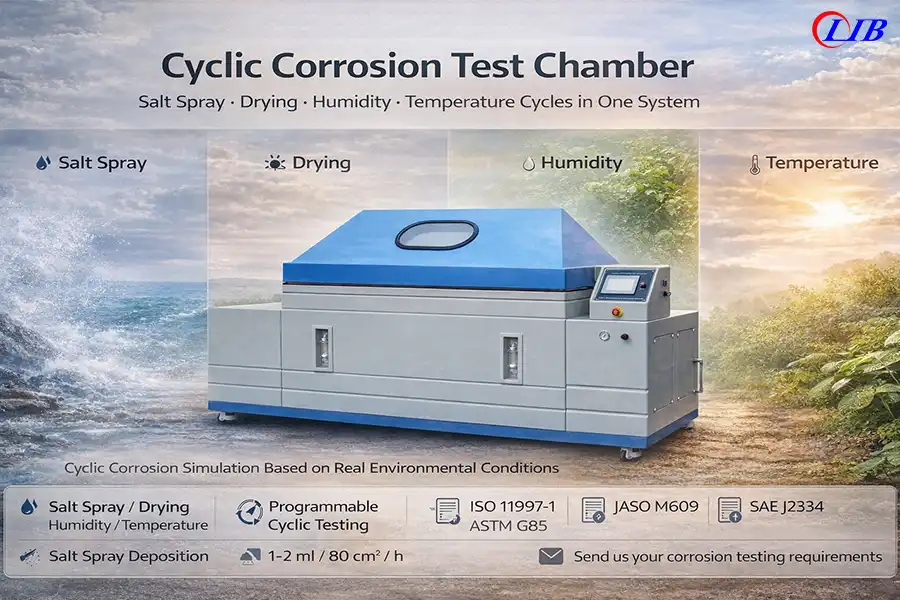
LIB Industry's cyclic corrosion chamber systems represent the pinnacle of environmental simulation precision, incorporating PT100 Class A temperature sensors coupled with sophisticated PID control algorithms. Temperature stability within ±0.5°C and humidity precision of ±2% RH ensures that observed corrosion patterns reflect material behavior rather than testing artifacts. The mechanical compression refrigeration system with air-cooled condensers maintains consistent conditions throughout extended testing cycles, while saturated air preheating systems ensure optimal salt fog generation. Three capacity configurations (780L, 1280L, and 1800L interior volumes) accommodate everything from small coupon testing to large component evaluation.
Programmable Flexibility and Standard Protocol Integration
The intuitive touchscreen controller supporting 120 independent programs with 100 steps each enables seamless implementation of major automotive and aerospace standards including ASTM G85 variants, NSS, AASS, CASS, VW PV 1210, GMW 14872, and SAE J2334. Pre-loaded standard library eliminates programming time while ensuring strict compliance with original equipment manufacturer specifications. Custom cycling sequences accommodate unique application requirements, whether combining specific salt fog durations with particular thermal ranges or integrating SO₂ gas exposure simulating industrial atmospheric conditions. This flexibility ensures that LIB chambers adapt to evolving industry standards and emerging application demands.
Comprehensive Support and Turnkey Solutions
LIB Industry's commitment extends beyond equipment provision to encompassing comprehensive turnkey solutions including research consultation, system design, production commissioning, installation, and operator training. The 3-year warranty with lifetime service support ensures consistent chamber performance throughout its operational life, while 24/7 global assistance reaches customers across 60 nations via 29 worldwide operators and regional service centers. Non-standard design expertise enables custom chamber configurations matching specific testing requirements, whether accommodating unusually large specimens, integrating specialized monitoring equipment, or modifying environmental parameters for unique applications. This comprehensive support philosophy positions LIB as a partner in customers' corrosion testing success rather than merely a supplier of equipment.
Conclusion
Cyclic corrosion testing represents a fundamental shift in durability evaluation philosophy, replacing single-environment limitations with comprehensive environmental simulation that produces field-relevant performance predictions. By systematically cycling between salt fog exposure, drying phases, humid conditioning, and thermal variations, manufacturers gain profound insights into material behavior under authentic service conditions. This accelerated evaluation methodology compresses months or years of environmental exposure into manageable laboratory timeframes, enabling rapid product development cycles while ensuring long-term field reliability. Organizations across automotive, aerospace, electronics, and marine industries increasingly recognize cyclic testing as essential for competitive product development. LIB Industry's advanced chambers provide the precision instrumentation, flexible programming capabilities, and comprehensive support necessary for confident corrosion durability assessment.
FAQ
How does cyclic corrosion testing differ from traditional salt spray testing?
Cyclic corrosion testing alternates between multiple environmental conditions (salt fog, dry periods, humid conditioning) to simulate realistic environmental cycles, whereas traditional salt spray maintains continuous exposure. This multi-phase approach produces corrosion patterns and acceleration factors that better correlate with field performance, enabling more accurate durability predictions for complex environmental applications.
What determines appropriate testing duration for cyclic corrosion chamber evaluation?
Testing duration depends on material type, coating system, application environment severity, and target field service life. Automotive components typically require 500-1000 hours equivalent to 3-7 years of winter salt exposure, while aerospace components may undergo 1000+ hours of extended cycling. LIB Industry's engineering team can calculate appropriate protocols based on your specific performance requirements and environmental exposure assumptions.
Can cyclic corrosion chambers accommodate large components or assemblies?
Yes, LIB Industry offers three chamber capacity configurations with interior volumes of 780L, 1280L, and 1800L, accommodating specimens ranging from small coupons to large automotive subassemblies. Custom design capabilities enable even larger component accommodation, and the company's turnkey solution approach includes engineering consultation to optimize chamber specifications for your specific component geometry and testing requirements.
LIB Industry - Your Trusted Cyclic Corrosion Chamber Manufacturer and Supplier
Transform your corrosion testing capabilities with LIB Industry's precision environmental chambers, engineered for metal durability analysis across global industries. As a leading factory and equipment supplier, we provide complete turnkey solutions from design consultation through operator training. Our advanced cyclic corrosion chambers deliver accurate environmental simulation, programmable flexibility, and reliable performance for accelerated durability evaluation. Contact our specialists today to discuss your specific testing requirements and discover how LIB chambers can advance your product development timelines while ensuring field reliability. Email: ellen@lib-industry.com