Design Considerations for Industrial Water Immersion Tanks
Designing industrial water immersion tanks requires careful consideration of multiple engineering and operational factors to ensure reliable performance in testing environments. These specialized systems must withstand significant pressure, maintain precise depth control, and deliver consistent results across various applications - from automotive component testing to aerospace certification. The design process involves balancing structural integrity, material selection, safety protocols, and user-friendly operation. Understanding these fundamental considerations helps manufacturers and procurement teams select or specify tanks that meet rigorous industry standards while optimizing long-term value and operational efficiency.
A customer in Vietnam recently shared positive feedback after extended use of the LIB industry R78-1000 IPX7/IPX8 Water Immersion Test Chamber. The system has been running continuously for routine waterproof testing, including IPX7 immersion and IPX8 pressure testing, while maintaining stable operation and reliable sealing performance.
After months of regular laboratory use, the customer commented: “After a period of use, your machine is still running very well.”The feedback demonstrates the chamber’s dependable control stability, consistent water pressure performance, and long-term reliability in daily waterproof testing applications.
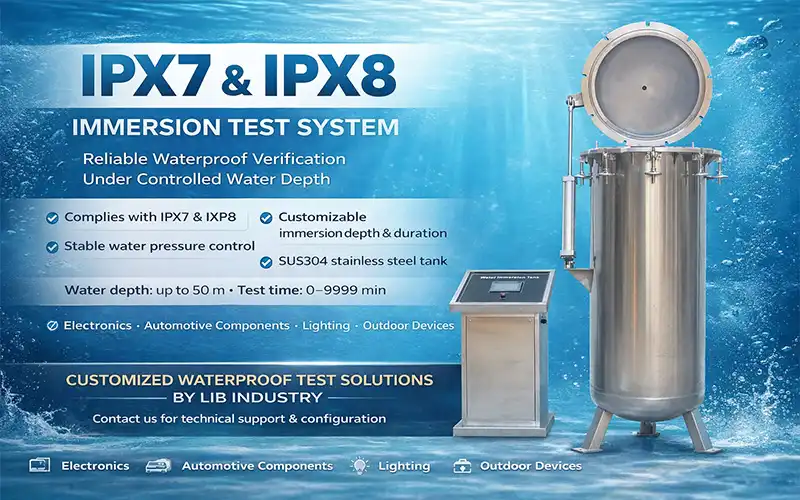
What Factors Influence Water Immersion Tank Design?
Application-Specific Testing Requirements
The intended testing application fundamentally shapes every aspect of tank design. Automotive manufacturers require tanks capable of simulating various water depth exposures for component durability testing, while aerospace applications demand precise pressure simulation at specific altitudes. Electronic product manufacturers need controlled environments for IP rating verification, and battery manufacturers require specialized configurations for safety testing. Each application dictates different pressure ranges, immersion durations, and sample accessibility requirements that directly influence tank dimensions, pressure capabilities, and control system sophistication.
Industry Standards and Compliance Frameworks
Regulatory compliance drives critical design parameters across different sectors. International standards such as IEC 60529 for ingress protection testing, MIL-STD specifications for military applications, and ISO certifications for quality management systems establish minimum performance criteria. Compliance requirements affect pressure rating specifications, measurement accuracy thresholds, documentation capabilities, and safety system redundancies. Designers must integrate features that facilitate third-party verification and maintain traceability throughout the testing process to meet certification requirements.
Environmental and Spatial Constraints
Installation environment significantly impacts design choices. Available floor space determines whether cylindrical or rectangular configurations work best. Ceiling height affects overall tank dimensions and lid opening mechanisms - pneumatic versus manual systems. Facility infrastructure including water supply capacity, drainage systems, and electrical power availability influences auxiliary system design. Temperature variations in the installation location may require additional insulation or climate control integration to maintain consistent testing conditions.
Structural Materials and Corrosion Resistance Requirements

Steel Grade Selection and Treatment Processes
Material selection balances strength requirements against corrosion resistance and cost considerations. A3 steel plate provides excellent structural integrity for pressure-bearing applications, particularly when treated with appropriate protective coatings. Wall thickness calculations must account for maximum operating pressure - 50m water depth pressure generates approximately 5 bar (72.5 psi) requiring 15mm thickness for adequate safety margins. Galvanized coatings on fastening components provide additional protection against moisture exposure, extending service life in demanding environments.
Stainless Steel Components for Critical Applications
Internal components exposed to constant water contact benefit from 304 stainless steel construction. Hydraulic rods, sample holders, and measurement probes fabricated from stainless steel resist corrosion from water chemistry variations and maintain dimensional stability through repeated pressure cycles. Mirror-finish surface treatments eliminate microscopic crevices where corrosion initiates, ensuring measurement accuracy remains consistent. The investment in stainless steel for critical components reduces maintenance frequency and prevents contamination of test samples.
Protective Coating Systems and Surface Preparation
Electrostatic powder coating provides superior corrosion protection compared to traditional paint systems. The electrostatic application process ensures uniform coverage on complex geometries, creating a durable barrier against moisture penetration. Proper surface preparation through sandblasting or chemical treatment removes mill scale and contaminants, allowing coatings to bond effectively. Multi-layer coating systems with epoxy primers and polyurethane topcoats offer enhanced protection in high-humidity environments or facilities using aggressive water treatment chemicals.
Tank Size, Load Capacity, and Customization Options
Internal Volume Calculations and Sample Clearance
Effective internal dimensions of a water immersion tank must accommodate test samples with adequate clearance for water circulation and pressure equalization. The R78-600 model provides 600 mm diameter and 1500 mm height, allowing samples positioned at least 1000 mm below the water surface to experience full pressure conditions. This configuration suits medium-sized components while maintaining manageable overall dimensions. Larger samples require proportionally scaled designs, with diameter increases affecting pressure vessel calculations more significantly than height adjustments due to hoop stress considerations.
Load-Bearing Capacity and Support Structures
Foundation design must support both the tank weight and water mass - a 600mm diameter tank filled to 1500mm height contains approximately 424 liters (424kg) of water. The cylindrical design distributes loads evenly, but tripod support systems require careful load distribution analysis to prevent settlement or instability. Adjustable feet allow leveling on uneven floors, maintaining proper sample orientation. Reinforced mounting points for sample fixtures must account for dynamic loads during pressure changes without inducing stress concentrations in tank walls.
Modular Design Approaches for Scalability
Scalable design frameworks enable manufacturers to address diverse customer requirements efficiently. Standardized component interfaces for control systems, pressure sensors, and water supply connections reduce engineering complexity when customizing tank dimensions. Modular lid designs accommodate various access requirements - full-diameter openings for large samples or smaller inspection ports for routine monitoring. This approach balances customization flexibility with manufacturing efficiency, reducing lead times and costs for specialized configurations while maintaining quality consistency.
|
Tank Configuration |
Internal Diameter |
Internal Height |
Maximum Sample Size |
Water Volume |
|
Compact |
400mm |
1000mm |
300mm × 800mm |
126L |
|
Standard (R78-600) |
600mm |
1500mm |
500mm × 1200mm |
424L |
|
Large-Capacity |
900mm |
2000mm |
800mm × 1700mm |
1272L |
How to Achieve Precise Control of Depth and Pressure?
Automated Water Level Management Systems
Precision testing requires consistent water depth maintenance throughout test cycles. Automated water supply systems incorporating storage tanks eliminate reliance on facility water pressure fluctuations. Float switches, ultrasonic level sensors, or pressure transducers provide real-time depth monitoring with submillimeter accuracy. Programmable controllers automatically compensate for evaporation or minor leaks, maintaining specified depths over extended test durations. This automation reduces operator intervention and ensures repeatability across multiple test runs.
Pressure Simulation and Monitoring Technologies
Achieving accurate pressure simulation requires understanding the relationship between water depth and pressure - each 10 meters of depth generates approximately 1 bar of pressure. For 50m depth simulation, tanks must maintain stable 5 bar internal pressure. Calibrated pressure transducers continuously monitor actual conditions, providing feedback to control systems. Some applications benefit from supplementary compressed air systems that can augment or reduce pressure independently of water level, enabling specialized test profiles beyond simple depth simulation.
PID Control Integration for Stability
Proportional-Integral-Derivative (PID) programmable controllers optimize system response to maintain target conditions. The proportional component responds to current deviations, integral function eliminates persistent offset errors, and derivative action dampens oscillations during transient conditions. Color LCD touchscreen interfaces simplify parameter adjustment, allowing operators to create complex test profiles with 120 programs containing 100 segments each. Ethernet connectivity enables remote monitoring and data logging, supporting quality management systems and regulatory documentation requirements.
Safety Systems and Operational Efficiency Features
Pressure Relief and Emergency Protocols
Overpressure protection represents a critical safety consideration in a water immersion tank with pressurized water systems. Mechanical pressure relief valves provide failsafe protection independent of electronic controls, automatically venting excess pressure before structural limits are reached. Emergency depressurization systems allow rapid pressure reduction if sample failures or equipment malfunctions occur. Clearly marked emergency stop controls immediately halt all automated functions, placing the system in a safe state. Regular calibration and testing of safety devices maintains reliability throughout the tank's operational life.
Pneumatic Lid Systems and Ergonomic Access
Pneumatic lid operation eliminates manual handling of heavy covers, reducing operator strain and injury risk. Controlled opening speeds prevent rapid pressure equalization that could disturb test samples or create safety hazards. Interlocks prevent lid operation while internal pressure exceeds safe thresholds, ensuring operators cannot access the chamber under dangerous conditions. Gas spring assistance or counterbalance systems maintain lids in open positions without additional support, facilitating sample loading and unloading operations.
User Interface Design and Training Considerations
Intuitive control interfaces reduce operator training time and minimize operational errors. Touch screen controllers with graphical programming interfaces allow technicians to visualize test profiles before execution. Context-sensitive help screens provide guidance without requiring extensive manual reference. Password-protected access levels prevent unauthorized parameter changes while allowing routine operation by qualified personnel. Comprehensive training programs covering normal operation, routine maintenance, and troubleshooting procedures ensure consistent results and extend equipment service life.
|
Safety Feature |
Function |
Activation Method |
Compliance Standard |
|
Pressure Relief Valve |
Overpressure protection |
Automatic (mechanical) |
ASME Section VIII |
|
Lid Interlock System |
Prevents unsafe access |
Pressure threshold sensor |
ISO 12100 |
|
Emergency Stop |
Immediate system shutdown |
Manual push-button |
IEC 60204-1 |
|
Water Level Alarm |
Low/high water detection |
Electronic sensor |
User-configurable |
Maintenance, Durability, and Lifecycle Considerations
Preventive Maintenance Schedules and Procedures
Establishing routine maintenance intervals maximizes equipment availability and prevents unexpected failures. Daily inspections verify proper water levels, check for visible leaks, and confirm control system functionality. Weekly maintenance includes seal inspection, pressure sensor verification, and water quality assessment. Monthly procedures involve calibration checks, valve operation testing, and coating condition evaluation. Annual comprehensive inspections examine structural integrity, replace wear components, and recertify safety systems. Documentation of all maintenance activities supports quality system requirements and provides data for lifecycle planning.
Component Wear Patterns and Replacement Planning
Understanding predictable wear patterns enables proactive component replacement before failures impact operations. Seals and gaskets typically require replacement every 12-24 months depending on usage intensity. Hydraulic rod seals show gradual degradation through pressure cycling, necessitating inspection during routine maintenance. Electronic components including sensors and control boards have defined service lives influenced by environmental conditions. Maintaining spare parts inventory for critical components minimizes downtime when replacements become necessary. Suppliers offering comprehensive parts support and technical assistance reduce operational risks.
Long-Term Value and Total Cost of Ownership
Evaluating water immersion tanks requires analysis beyond initial purchase price. Energy-efficient designs reduce operational costs through optimized water circulation and heating systems. Durable construction minimizes repair frequency and extends replacement intervals. Modular designs facilitate upgrades as testing requirements evolve, protecting initial investments. Comprehensive warranty coverage and responsive technical support reduce unexpected expenses. Tanks designed for easy disassembly and relocation protect value when facility modifications or expansions occur. Calculating total cost of ownership over expected 10-15 year service lives provides accurate comparison between different design approaches.
LIB Industry Engineered Water Immersion Tanks for Industrial Performance
Comprehensive Turn-Key Solutions
LIB Industry delivers complete environmental testing solutions encompassing research, design, manufacturing, commissioning, installation, and operator training. This integrated approach ensures water immersion tanks meet specific application requirements while seamlessly integrating with existing facility infrastructure. Collaborative design processes incorporate customer input throughout development, addressing unique testing protocols or space constraints. Factory acceptance testing validates performance before shipment, reducing installation delays. On-site commissioning by experienced technicians ensures proper operation and provides hands-on training for customer personnel.
Advanced Controller Technology and Connectivity
The R78-600 model incorporates sophisticated PID programmable color touch screen controllers offering exceptional flexibility. Creating 120 distinct programs with 100 segments each accommodates complex testing protocols including staged pressure increases, hold periods, and controlled depressurization sequences. Ethernet connectivity enables integration with laboratory information management systems (LIMS), facilitating automated data collection and analysis. Remote monitoring capabilities allow supervisory personnel to verify test progress without physically accessing equipment. This technological sophistication supports modern quality management practices and regulatory compliance documentation.
Global Support and Industry Expertise
Serving customers across automotive, aerospace, defense, navigation, military, telecommunications, electronics, photovoltaic, battery, and marine industries, LIB Industry understands diverse testing requirements. This broad experience informs design decisions, incorporating features that address common challenges across multiple sectors. Global support capabilities ensure technical assistance remains available regardless of installation location. Commitment to continuous improvement drives ongoing product development, incorporating customer feedback and emerging testing standards. Partnerships with component suppliers ensure access to latest sensor technology, control systems, and material innovations.
|
LIB Industry Advantage |
Customer Benefit |
Supporting Service |
|
Turn-key solution delivery |
Single-source accountability |
Project management throughout |
|
Custom engineering capability |
Application-specific optimization |
Collaborative design process |
|
Global service network |
Minimized downtime |
Remote diagnostics and support |
|
Multi-industry experience |
Proven reliability |
Reference installations available |
Conclusion
Designing effective industrial water immersion tanks requires balancing technical specifications, safety requirements, operational efficiency, and long-term value. Structural material selection, precise control systems, robust safety features, and maintainability fundamentally influence performance and total cost of ownership. Applications spanning automotive component validation to aerospace certification demand customized approaches that address specific testing protocols while maintaining regulatory compliance. Partnering with experienced manufacturers who understand these multifaceted requirements ensures installations deliver reliable results throughout extended service lives.
FAQ
What pressure capacity do I need for my water immersion tank?
Pressure requirements depend on testing standards applicable to your products. IP rating verification typically requires 1-3 meters depth (0.1-0.3 bar), while specialized applications may need 50+ meters simulation. Consult relevant industry standards or certification requirements to determine appropriate specifications.
How does tank size affect testing accuracy and sample capacity?
Adequate clearance around samples ensures proper water circulation and uniform pressure distribution. Minimum 100mm clearance on all sides prevents wall effects. Larger tanks accommodate multiple simultaneous samples but require proportionally increased water volume, heating capacity, and floor space for installation.
What maintenance intervals ensure reliable long-term operation?
Daily visual inspections, weekly seal checks, monthly calibration verification, and annual comprehensive examinations form effective maintenance schedules. Usage intensity, water quality, and environmental conditions influence specific intervals. Establishing documentation procedures supports predictive maintenance and regulatory compliance requirements.
Ready to discuss your water immersion tank requirements? LIB Industry, a leading environmental test chamber manufacturer and supplier, provides customized solutions backed by comprehensive engineering expertise and global support. Contact our technical team at ellen@lib-industry.com to explore how our water immersion tanks can enhance your testing capabilities.


