Evaluating Sensor Accuracy with Benchtop Humidity Tests
Sensor accuracy degrades silently over time due to environmental stressors, material fatigue, and contamination. Inaccurate humidity readings compromise product quality, safety, and regulatory compliance across pharmaceuticals, electronics, and food production. Benchtop humidity tests provide a controlled, repeatable method to validate and calibrate sensors under precise temperature-humidity combinations. These compact systems simulate real-world conditions, revealing performance drift before it causes costly failures. Regular validation with a benchtop environmental chamber ensures measurement integrity, extends sensor lifespan, and supports reliable decision-making in critical applications.
Why Humidity Calibration Matters for Sensor Performance?
The Hidden Drift Problem in Humidity Sensors
Humidity sensors experience gradual accuracy loss from chemical contamination, polymer relaxation, and electronic component aging. Capacitive polymer sensors absorb moisture irreversibly, shifting baseline readings. Resistive sensors develop oxide layers that alter conductivity. Even high-quality sensors can drift 2-5% RH annually in typical industrial environments. Without regular calibration, these small errors compound, leading to significant measurement deviations that undermine process control and product consistency.
Real-World Consequences of Inaccurate Readings
Pharmaceutical manufacturing relies on precise humidity control for drug stability; a 3% RH error can invalidate batch release testing. Electronics assembly faces electrostatic discharge risks when humidity falls below 40% RH, while condensation damage occurs above 60% RH in cooling cycles. Food packaging integrity depends on accurate moisture monitoring - inaccuracies cause spoilage or compromised barrier performance. These failures result in product recalls, regulatory citations, and damaged brand reputation.
Cost-Benefit of Regular Calibration
Investing in routine humidity calibration prevents exponentially higher costs from scrap, rework, and warranty claims. A single batch failure in biopharma can exceed $500,000, while consistent calibration using a benchtop chamber costs a fraction. Preventive calibration extends sensor life by 30-50%, delaying replacement expenses. The return on investment becomes evident when comparing annual calibration budgets against potential loss from undetected sensor drift in high-stakes environments.
Simulating Real-World Environmental Conditions in the Lab
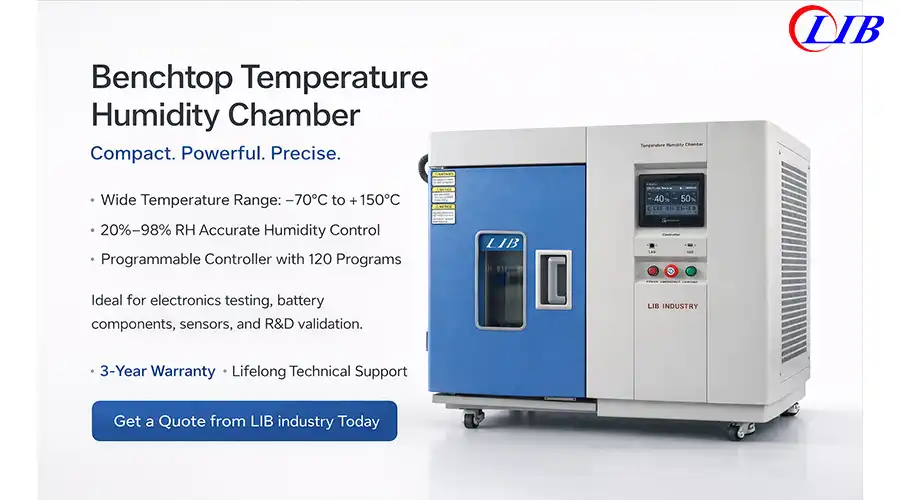
Replicating Extreme Climates with Compact Systems
Modern benchtop environmental chambers accurately mimic desert aridity (10% RH at 50°C) or tropical saturation (98% RH at 35°C) within a 50-liter workspace. The LIB Industry TH-50 model achieves this with a temperature range from -40°C to +150°C and humidity control precision of ±2.5% RH. This allows engineers to test sensors against the exact conditions they'll face in automotive, aerospace, or agricultural applications without field deployment risks.
Rapid Cycling for Accelerated Stress Testing
Benchtop chambers execute complex humidity ramps - from 20% to 90% RH in under 30 minutes - to simulate daily weather cycles or seasonal changes. This acceleration reveals failure modes that might take years to manifest outdoors. For instance, cycling sensors through dew point transitions tests condensation resistance, while sustained high-humidity exposure at elevated temperatures evaluates long-term material compatibility in tropical climates.
Controlled Moisture Introduction Techniques
Advanced chambers use steam injection or ultrasonic humidification to achieve rapid humidity changes without temperature destabilization. The water purification and recirculation system prevents mineral deposits that could contaminate test specimens or clog sensor ports. This level of control is impossible with simple humidity generators, making benchtop chambers indispensable for validation protocols requiring repeatable moisture profiles.
Table 1: Environmental Parameters Simulated for Sensor Testing
|
Application Scenario |
Temperature Range |
Humidity Range |
Test Duration |
Key Failure Mode |
|
Pharmaceutical Storage |
15-30°C |
30-70% RH |
72 hours |
Drift in critical control points |
|
Automotive Electronics |
-40 to +85°C |
10-95% RH |
1000 cycles |
Condensation-induced shorts |
|
Food Packaging |
5-40°C |
40-90% RH |
14 days |
Moisture transmission errors |
|
Industrial Process |
20-60°C |
20-80% RH |
500 hours |
Polymer sensor saturation |
|
Medical Devices |
10-40°C |
20-90% RH |
168 hours |
Biofouling in humid environments |
Temperature and Humidity Effects on Sensor Accuracy
Thermal Expansion and Material Response
Temperature fluctuations cause mechanical stress in sensor housings and sensing elements. Metal components expand at different rates than ceramics or polymers, altering calibration offsets. A sensor calibrated at 25°C may read +1.5% RH at 50°C due to dimensional changes in the capacitive gap. Benchtop chambers with ±0.5°C temperature stability isolate humidity effects from thermal interference, allowing pure humidity response characterization.
Condensation Risks at Dew Point Transitions
When surface temperatures drop below ambient dew point during rapid cooling, condensation forms on sensor elements. This temporarily shorts capacitive sensors or corrodes exposed contacts. Testing with programmed cooling rates (1°C/min in LIB chambers) identifies condensation thresholds. Sensors with hydrophobic coatings resist this failure mode, while unprotected designs require careful placement away from cold surfaces.
Long-Term Hysteresis in Polymer-Based Sensors
Polymer-based humidity sensors exhibit hysteresis - different readings when humidity rises versus falls - due to moisture absorption kinetics. Repeated cycling between 30% and 90% RH reveals whether hysteresis exceeds acceptable limits (typically <1% RH). The chamber's uniform environment ensures all test specimens experience identical moisture gradients, making hysteresis measurements statistically valid.
Common Failure Modes Detected During Humidity Testing
Sensor Drift Beyond Acceptable Tolerance
Calibration curves shift as sensing materials age. A sensor initially accurate at 50% RH might read 52% RH at high humidity and 48% at low humidity after 1000 test hours. Benchtop testing at multiple humidity points (20%, 50%, 80% RH) maps this drift across the operating range. Acceptable drift varies by application - laboratory instruments require <0.5% RH change, while industrial controls may tolerate 2% RH.
Mechanical Failure from Condensation Cycles
Repeated condensation and evaporation stress adhesive bonds, seals, and circuit boards. Microscopic inspection after 500 humidity cycles often reveals cracked conformal coatings or delaminated PCB layers. The benchtop environmental chamber's observation window with interior lighting allows visual monitoring without disturbing tests. Failures manifest as intermittent errors or complete sensor death, both detectable during programmed test sequences.
Electrical Shorts in High-Humidity Conditions
High humidity reduces insulation resistance, causing leakage currents between sensor terminals. This is critical for low-voltage sensors (3.3V or 5V systems). Testing at 95% RH and 40°C with powered sensors identifies insulation breakdown. LIB chambers include earth leakage protection and over-current safeguards during such tests, preventing damage to both test specimens and chamber electronics when failures occur.
Table 2: Failure Mode Identification Through Humidity Testing
|
Failure Mode |
Detection Method |
Test Parameter |
Acceptance Criteria |
|
Calibration Drift |
Multi-point calibration check |
20/50/80% RH at 25°C |
<1% RH deviation |
|
Condensation Damage |
Visual inspection + electrical test |
Cooling from 50°C to 10°C at 1°C/min |
No moisture ingress |
|
Hysteresis |
Ascending/descending humidity sweep |
30→90→30% RH cycle |
<1% RH difference |
|
Insulation Breakdown |
Megger test at high humidity |
95% RH at 40°C, powered |
>100 MΩ resistance |
|
Material Swelling |
Dimensional measurement |
90% RH for 168 hours |
<0.1% size change |
Standards and Test Methods for Sensor Validation
 ISO/IEC 17025 Calibration Requirements
This international standard mandates documented procedures, uncertainty analysis, and traceability for calibration labs. Benchtop chambers must demonstrate uniformity within ±1% RH across the test space to meet ISO 17025 humidity calibration requirements. The LIB chamber's ±2.5% RH deviation specification supports compliance when combined with proper mapping and uncertainty budgeting.
ASTM E337 Standards for Moisture Testing
ASTM E337 outlines methods for evaluating moisture effects on materials, including sensor validation. The standard specifies humidity equilibration times, temperature stabilization periods, and measurement intervals. Benchtop chambers execute these protocols through programmable sequences - maintaining 50±2% RH for 24 hours before measurement, then stepping through required humidity points with adequate dwell times.
Industry-Specific Validation Protocols
Medical device manufacturers follow IEC 60601-1-11 for humidity performance in home healthcare environments. Automotive suppliers use SAE J1211 for under-hood sensor durability. Each industry defines unique humidity profiles - pharmaceutical stability chambers operate at 75% RH±5% for drug testing, while agricultural sensors face 90%+ RH with condensation. Benchtop chambers accommodate these diverse protocols through customizable programming.
Enhancing Long-Term Reliability Through Environmental Testing
Accelerated Aging with Humidity Stress
Elevated temperature and humidity accelerate degradation mechanisms. The Arrhenius equation predicts that testing at 40°C and 90% RH approximates years of tropical exposure. By subjecting sensors to these conditions for 500 hours, engineers predict 5-year field performance. LIB benchtop environmental chambers reach -70°C to +150°C, enabling accelerated testing across all climate zones from arctic to desert.
Predictive Modeling from Test Data
Humidity test data feeds reliability prediction models like MIL-HDBK-217F. Failure rates derived from chamber testing inform warranty periods and maintenance schedules. For example, if 5% of sensors fail 1000-hour humidity testing, field failure rates might reach 0.5% per year. This quantitative approach replaces guesswork with data-driven reliability engineering.
Quality Control Integration in Production
Benchtop chambers move from R&D to production floors for incoming sensor inspection. Sampling each batch against humidity performance specifications catches supplier variations. The compact size fits beside assembly lines, while the touchscreen interface allows operators to run standard tests without engineering expertise. This inline validation prevents defective sensors from reaching final products.
LIB Industry Enables High-Precision Humidity Validation Testing
|
|
|
|||


Chamber Specifications for Sensor Testing
LIB Industry's benchtop chambers deliver the precision required for sensor validation. The TH-50 model maintains 20-98% RH with ±2.5% deviation across its 50-liter volume - sufficient for testing dozens of sensors simultaneously. Temperature stability of ±0.5°C eliminates thermal cross-sensitivity artifacts. The -40°C to +150°C range covers all operational environments from cold chain logistics to industrial ovens.
Safety Features for Hazardous Testing
Testing lithium-ion battery sensors requires explosion-proof designs. LIB chambers include over-temperature protection, earth leakage safeguards, and refrigerant high-pressure monitoring. The mechanical compression refrigeration system safely handles low-temperature testing without flammable refrigerants. These protections allow aggressive testing of sensors in hazardous applications without facility modifications.
Customization and Support Services
LIB Industry engineers modify chamber interiors for non-standard sensor sizes or mounting configurations. They develop custom humidity profiles matching specific geographic climate data. The 3-year warranty and 24/7 global support ensure minimal downtime. Training includes calibration procedures, data interpretation, and preventive maintenance - turning equipment into a long-term validation asset rather than a consumable tool.
Conclusion
Benchtop humidity testing transforms sensor validation from periodic checks to continuous quality assurance. These compact chambers deliver laboratory-grade environmental control in spaces as small as 820×1160×950 mm, making precision testing accessible to any development team. By revealing drift, hysteresis, and failure modes early, manufacturers prevent field failures and extend product lifespans. Investing in a reliable benchtop environmental chamber pays dividends through reduced warranty costs, regulatory compliance, and enhanced brand trust in measurement-critical applications.
FAQ
How frequently should humidity sensors be calibrated using a benchtop chamber?
Calibration intervals depend on application criticality. High-accuracy laboratory sensors require quarterly calibration, while industrial process sensors may need annual checks. Sensors in harsh environments (≥85% RH or rapid cycling) should be tested semi-annually. Always follow manufacturer guidelines and regulatory requirements for your industry.
Can a single benchtop chamber test all humidity sensor types?
Yes, a chamber with 10-98% RH range and -40°C to +150°C capability accommodates most sensor types - capacitive, resistive, thermal conductivity. Ensure chamber uniformity meets your sensor's accuracy specification. For ultra-precise <0.1% RH sensors, additional mapping and validation may be needed to confirm chamber performance.
What's the ROI of investing in a benchtop chamber for sensor testing?
ROI manifests through reduced scrap (catching bad sensors before assembly), avoided recalls (preventing field failures), and extended sensor life (proper calibration maintenance). A $15,000 chamber pays for itself by preventing one major batch failure in pharmaceuticals or electronics. Additional value comes from faster R&D cycles and compliance with ISO/ASTM standards.
Contact LIB Industry for Your Sensor Testing Needs
As a leading benchtop environmental chamber manufacturer, LIB Industry provides turn-key solutions for sensor validation worldwide. Our compact chambers feature 10-98% RH control, -86°C capability, and lithium-ion safety options. Contact our engineering team at ellen@lib-industry.com to discuss your specific humidity testing requirements and receive a customized configuration quote.