Heat Treatment Applications of Industrial Ovens Explained
Heat treatment applications of industrial ovens encompass a broad spectrum of thermal processes - annealing, tempering, stress relieving, curing, and aging - that alter the physical and mechanical properties of metals, polymers, and composites. An industry oven engineered for heat treatment provides programmable temperature curves, uniform airflow distribution, and precise thermal control within tolerances as tight as ±0.5°C. These capabilities enable manufacturers to achieve repeatable metallurgical transformations, drive off residual solvents, and cure coatings under exact conditions. From automotive powertrain components to aerospace alloy assemblies, industrial ovens serve as indispensable tools for refining material characteristics, boosting structural integrity, and meeting stringent quality benchmarks across global manufacturing sectors.
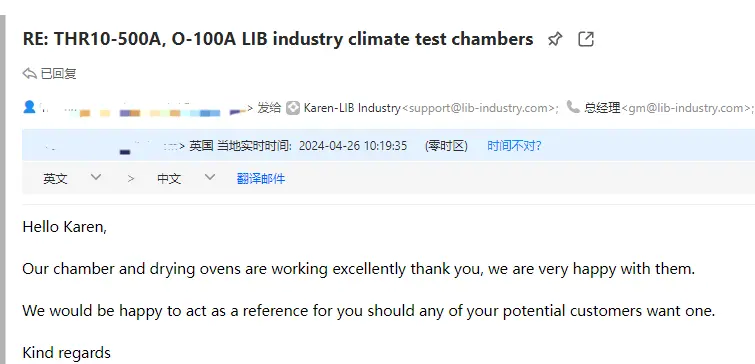
A leading electronics testing lab recently reported their experience with the LIB industry THR10-500A, highlighting the drying oven component: “The THR10-500A chamber and oven are performing excellently. We’re very satisfied with the results.”The oven’s consistent temperature control during prolonged testing enabled the team to run extended burn-in cycles and repeated rapid thermal changes without disruption. This dependable performance ensures accurate evaluation of automotive electronics, sensors, and control modules. Beyond electronics, the oven has proven highly effective for materials testing, aging of plastic components, and battery performance studies, allowing teams to reliably simulate real-world thermal conditions and improve product durability.
What Is Heat Treatment and Its Industrial Importance?
Defining the Heat Treatment Process
Heat treatment refers to controlled heating and cooling of materials - predominantly metals and alloys - to modify grain structure, relieve internal stresses, and enhance specific mechanical attributes. Unlike simple drying or baking, heat treatment demands exacting temperature ramp rates, soak durations, and cooling profiles. Each parameter influences phase transformations within the crystalline lattice, making the industry oven a precision instrument rather than a commodity appliance.
Sectors That Depend on Thermal Processing
Automotive, aerospace, medical device, energy, and tooling industries all rely on heat treatment to achieve target hardness, ductility, and fatigue resistance. Turbine blades undergo solution treatment above 1000°C; surgical implants receive stress-relieving cycles below 500°C. Polymer and composite manufacturers also utilize curing ovens to cross-link resins under programmable thermal profiles, broadening the definition of heat treatment beyond traditional metallurgy.
Economic Value of Controlled Thermal Cycles
Proper heat treatment extends component service life, reduces scrap rates, and lowers total cost of ownership for end products. A single miscalibrated oven cycle can render an entire batch of hardened gears unusable, incurring raw material losses and production delays. Investing in well-engineered thermal processing equipment safeguards yield and protects manufacturing margins across high-value supply chains.
Key Materials and Metals Suitable for Oven Heat Treatment
Carbon and Alloy Steels
Carbon steels respond predictably to austenitizing, quenching, and tempering sequences. Alloy steels containing chromium, molybdenum, or vanadium achieve deeper hardness penetration and elevated wear resistance through controlled oven cycles. Industrial ovens operating between ambient and +900°C accommodate the full austenitizing range for most structural steel grades used in automotive drivetrain and heavy machinery applications.
Non-Ferrous Alloys and Superalloys
Aluminum alloys undergo solution treatment and precipitation aging within narrower temperature bands - typically 150°C to 540°C - demanding exceptional uniformity. Nickel-based superalloys and titanium grades require extended soak periods at elevated temperatures to dissolve precipitates and homogenize composition. Temperature deviation must stay within ±2.0°C to avoid localized over-aging or incipient melting at grain boundaries.
Polymers, Composites, and Ceramics
Epoxy resin systems cure at 120°C to 200°C, while polyimide films demand post-cure bakes approaching 400°C. Advanced ceramic green bodies utilize debinding and sintering profiles that ramp slowly to prevent cracking. An industrial drying oven with multi-segment programmable curves and adjustable fan speeds accommodates these heat-sensitive materials without inducing thermal shock or surface defects.
Controlling Temperature Profiles for Consistent Results
|
Parameter |
Specification |
Relevance to Heat Treatment |
|
Temperature Accuracy |
±0.5°C |
Prevents over/under-treatment of critical alloys |
|
Temperature Uniformity |
±2.0°C |
Ensures homogeneous properties across full load |
|
Heating Rate |
6°C/min |
Matches prescribed ramp rates for metallurgical transforms |
|
Controller Type |
PID, programmable LCD touchscreen |
Enables multi-segment soak and ramp profiles |
|
Connectivity |
Ethernet and USB |
Supports remote monitoring and data logging |
Multi-Segment Programmable Curves
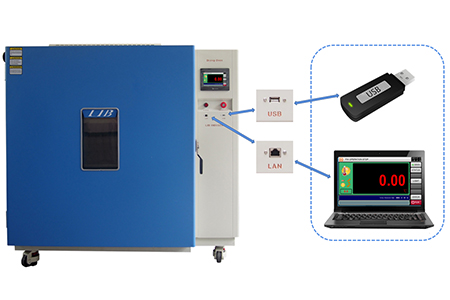
Complex heat treatment recipes often include multiple ramp, soak, and controlled-cooling stages. PID controllers with programmable color LCD touchscreens allow engineers to define each segment with discrete setpoints, durations, and transition rates. Ethernet and USB connectivity enable recipe upload from networked computers, eliminating manual entry errors and maintaining batch-to-batch consistency.
Thermocouple Placement and Calibration
Accurate temperature measurement depends on strategic thermocouple positioning within the working chamber. Placing sensors near the load, at exhaust ports, and at geometric extremes provides a comprehensive thermal map. Regular calibration against traceable standards ensures that the displayed values align with actual material temperatures, a critical prerequisite for aerospace and medical device qualification audits.
Remote Monitoring and Data Integrity
Remote control capability lets engineers observe live temperature data and adjust parameters from a connected computer without opening the chamber door. Continuous data logging generates timestamped records that satisfy traceability requirements mandated by AS9100, IATF 16949, and ISO 13485 quality management systems. This digital audit trail simplifies regulatory submissions and customer qualification packages.
Industrial Oven Designs for Efficient Thermal Processing
Chamber Construction and Insulation
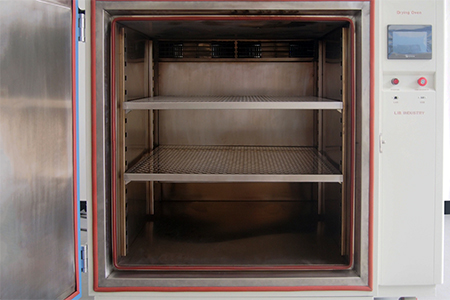
LIB Industry ovens employ SUS304 stainless steel interiors that resist oxidation and corrosion under sustained high-temperature exposure. The exterior uses reinforced A3 steel plate with a protective coating, while polyurethane foam insulation minimizes heat loss and stabilizes energy consumption. High-temperature silicone seals at the door perimeter maintain chamber integrity throughout prolonged thermal cycles.
Air Circulation Architecture
Horizontal and vertical airflow channels driven by a centrifugal fan deliver uniform heat distribution that eliminates hot spots and cold zones. Adjustable fan speed control protects lightweight components from excessive convective forces, while multi-layer heating elements provide rapid, even energy input across the full chamber volume. Punch-type sample holders further promote unobstructed air circulation around every workpiece.
Loading Configurations and Accessibility
Standard shelving supports 50 kg per shelf with 25 mm pitch adjustment; heavy-duty options handle up to 200 kg per shelf and aggregate loads reaching 2000 kg. Floor-level cart access simplifies handling of bulky assemblies. Models ranging from 100 L to 1000 L allow manufacturers to match chamber capacity to batch sizes, optimizing floor space and energy expenditure.
Evaluating Mechanical Properties After Heat Treatment
Hardness Testing and Microstructural Analysis
Post-treatment hardness measurements - Rockwell, Vickers, or Brinell - confirm that the prescribed phase transformation occurred uniformly. Metallographic cross-sections etched to reveal grain boundaries validate microstructural homogeneity and detect undesirable phases like retained austenite or bainite. These evaluations correlate directly with oven temperature uniformity; deviations exceeding ±2°C often manifest as hardness scatter across the treated batch.
Tensile Strength and Elongation Verification
Tensile coupons machined from heat-treated stock provide yield strength, ultimate tensile strength, and elongation data essential for structural certification. Consistent benchtop industrial oven performance ensures that coupon-to-coupon variation remains within acceptance bands defined by ASTM E8 or equivalent standards. Any drift in thermal processing parameters translates directly into measurable mechanical property divergence.
Fatigue and Impact Resistance Assessment
Rotating-beam fatigue tests and Charpy impact evaluations reveal how well the heat treatment cycle has refined toughness and endurance limits. Components destined for cyclic loading environments - crankshafts, landing gear fittings, pressure vessel nozzles - require documented fatigue performance validated against design S-N curves. Reliable oven temperature control underpins the reproducibility of these safety-critical test outcomes.
Process Optimization for Cost-Effective Heat Treatment
Energy Consumption Reduction Strategies
Superior insulation, efficient fan motors, and optimized heating element placement collectively reduce energy draw per cycle. Programming shorter soak times validated by metallurgical testing lowers kilowatt-hour consumption without compromising material properties. Data logged from Ethernet-connected controllers enables engineers to identify and eliminate energy-wasteful segments within legacy recipes.
Batch Scheduling and Throughput Maximization
Grouping parts with compatible thermal profiles into consolidated oven loads increases throughput and amortizes energy costs across more workpieces. Heavy-duty shelving and cart-access designs accommodate mixed loads of varying geometry and mass, enabling flexible batch scheduling. These loading capabilities prove especially valuable in job-shop environments handling diverse alloy grades and customer specifications.
Preventive Maintenance and Calibration Intervals
Scheduled replacement of heating elements, fan bearings, and door seals averts unplanned downtime that disrupts production flow. Calibrating thermocouples and verifying controller accuracy at defined intervals - typically quarterly - sustains the ±0.5°C precision that heat treatment protocols demand. Maintaining a documented maintenance log also satisfies auditor requirements during quality system surveillance visits.
Precise Temperature Control Tailored to Your Process Requirements - LIB Industry
|
Safety Feature |
Specification |
Benefit |
|
Over-Temperature Protection |
Dual-controller system |
Prevents equipment and specimen damage |
|
Automatic Exhaust Port |
Variable flow control |
Safe removal of process solvents |
|
Emergency Stop |
Instant shutdown |
Immediate operator protection |
|
Explosion-Proof Option |
ATEX compliance available |
Hazardous material processing capability |
 |
 |
Comprehensive Safety Architecture
LIB Industry industrial ovens integrate independent over-temperature protection through a dual-controller system, automatic exhaust ports with variable flow control for safe solvent removal, and emergency stop functionality for instantaneous shutdown. ATEX-compliant explosion-proof configurations address hazardous material processing needs. Heavy-duty locking mechanisms secure the chamber door against accidental opening during high-temperature cycles.
Scalable Product Range for Diverse Applications
With models spanning 100 L to 1000 L and temperature ceilings reaching +900°C, LIB Industry matches oven capacity and thermal capability to each customer's unique process envelope. Whether your application involves polymer curing at 180°C or alloy steel austenitizing at 850°C, the programmable PID controller and multi-layer heating architecture deliver the uniformity and repeatability your quality standards require.
Turnkey Support From Design Through Commissioning
LIB Industry delivers a complete solution encompassing research, design, production, commissioning, installation, and operator training. A global network of service agents ensures responsive technical assistance regardless of your facility location. This integrated approach minimizes equipment deployment risk and accelerates time-to-production for new heat treatment lines and laboratory installations.
Conclusion
Heat treatment applications demand industrial ovens capable of delivering programmable temperature curves, uniform airflow, and precise thermal control. From carbon steel tempering to polymer curing, the ability to maintain ±0.5°C accuracy and ±2.0°C uniformity across the chamber volume directly determines material quality and process yield. LIB Industry's range of ovens - spanning 100 L to 1000 L with temperature ceilings up to +900°C - addresses these requirements through robust construction, advanced PID control, and comprehensive safety systems. Selecting a purpose-engineered industry oven transforms heat treatment from a process variable into a competitive advantage.
FAQ
What temperature range does the LIB Industry oven cover for heat treatment?
LIB Industry ovens operate from ambient to +250°C, +400°C, or +900°C depending on model configuration, supporting processes ranging from low-temperature polymer curing to high-temperature alloy austenitizing.
How does the air circulation system maintain temperature uniformity?
A centrifugal fan drives airflow through horizontal and vertical channels, while multi-layer heating elements distribute energy evenly. This design keeps temperature deviation within ±2.0°C across the entire working volume.
Can the oven controller be operated remotely during heat treatment cycles?
Yes. Ethernet and USB connectivity allow engineers to upload recipes, monitor live temperature data, and adjust parameters from a connected computer without interrupting the ongoing thermal cycle.
Need a trusted industrial oven manufacturer, supplier, and factory partner for your heat treatment line? LIB Industry provides turnkey environmental testing and thermal processing solutions worldwide. Reach our engineering team at ellen@lib-industry.com to discuss specifications tailored to your production requirements.