Dust Chambers for Electronics Ingress Protection Testing
Dust chambers for electronics ingress protection testing are specialized environmental systems engineered to evaluate how well electronic enclosures resist fine particle intrusion. These chambers replicate harsh dusty conditions within a controlled laboratory setting, exposing devices to circulated talcum powder under defined temperature, humidity, and vacuum parameters. Equipment like the DI-2000 IP6X dust chamber conforms to IEC 60529, enabling manufacturers to validate IP5X and IP6X ratings with precision. By subjecting housings, connectors, and sealed assemblies to regulated dust exposure, engineers pinpoint sealing weaknesses before products reach end users - making this testing methodology indispensable across automotive, aerospace, telecommunications, and consumer electronics sectors where particle contamination triggers costly failures.
LIB industry’s IP6X dust test chambers are trusted by manufacturers worldwide for their capability to simulate dense dust environments with high precision. In practical use, these systems have proven to deliver stable and repeatable performance during routine laboratory operations.A Principal Engineer from Halcon R&D Laboratories in the UAE noted on September 23, 2025: “We frequently use the Rain and Dust Chambers, and after our recent annual calibration, everything continues to operate smoothly.”This kind of feedback underscores the chamber’s reliability in daily use, confirming its strong performance not only in controlled test conditions but also in continuous, high-demand industrial testing environments.

Why Is Dust Ingress a Critical Concern in Electronics?
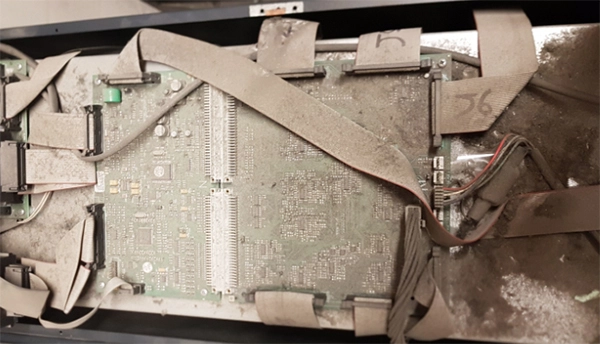
Microscopic Particles and Circuit Board Vulnerability
Fine particles under 75 micrometers penetrate gaskets, seals, and ventilation openings with surprising ease. Once lodged on printed circuit boards, these contaminants absorb moisture and create conductive bridges between traces, accelerating electrochemical migration. The resulting short circuits and signal degradation often remain latent until catastrophic field failures emerge, leaving manufacturers confronting unexpected liability exposure.
Thermal Management Disruption
Accumulated dust on heat sinks, fans, and thermal interface materials forms an insulating blanket that traps heat within enclosures. Components operating above rated junction temperatures experience accelerated electromigration and dielectric breakdown. Industries deploying electronics in arid or construction-adjacent environments face amplified thermal risks from relentless particle buildup that gradually degrades cooling efficiency over service life.
Economic Impact of Undetected Particle Intrusion
Warranty claims, product recalls, and reputational erosion stemming from dust-related failures carry substantial financial consequences. A single batch of inadequately sealed automotive ECUs returned from the field can generate costs exceeding the entire investment in proper ingress protection testing equipment. Proactive dust chamber evaluation eliminates this exposure and protects bottom-line profitability.
Understanding IP Ratings for Electronic Devices
|
IP Rating |
Dust Protection Level |
Description |
|
IP1X-IP4X |
Partial solid object protection |
Protection against objects larger than 1 mm |
|
IP5X |
Dust-protected |
Limited dust ingress permitted; no harmful deposits |
|
IP6X |
Dust-tight |
Complete protection against dust ingress |
The IEC 60529 Classification Framework
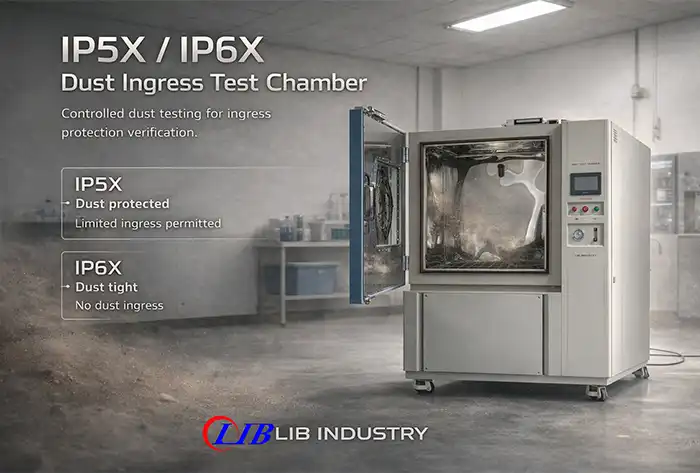
IEC 60529 defines ingress protection ratings through a two-digit code. The opening digit quantifies solid particle resistance on a scale from 0 to 6, while the closing digit addresses liquid protection. IP6X represents the highest solid particle tier, demanding that zero dust penetrates the enclosure during standardized chamber testing conducted under prescribed vacuum conditions and controlled particle circulation.
Distinction Between IP5X and IP6X Requirements
IP5X permits limited dust ingress provided it does not interfere with equipment operation or compromise safety margins. IP6X mandates absolute dust-tightness - no detectable particle penetration whatsoever. The testing methodology also diverges: IP6X requires continuous vacuum application to the enclosure interior, pulling dust-laden chamber air through any potential leak path at a defined negative pressure differential throughout the test duration.
Industry-Specific IP Mandates
Automotive manufacturers routinely specify IP6X for powertrain controllers, battery management systems, and sensor modules subjected to road dust. Medical device regulators demand equivalent protection for surgical robots and diagnostic imaging equipment. Each sector imposes unique qualification protocols built upon the IEC 60529 foundation, making versatile and standards-compliant dust test chambers an essential laboratory investment.
Dust Chamber Design for Controlled Particle Circulation
Internal Architecture and Material Selection
Effective dust chambers utilize SUS304 stainless steel interiors with mirror-polished surfaces that resist particle adhesion and simplify post-test cleaning. The DI-2000 IP6X dust chamber provides a 2000-liter work volume with internal dimensions of 1000×2000×1000 mm - ample space for large automotive and industrial enclosures. Sealed LED lighting inside permits specimen observation without breaking the chamber door seal.
Dust Circulation and Distribution Mechanisms
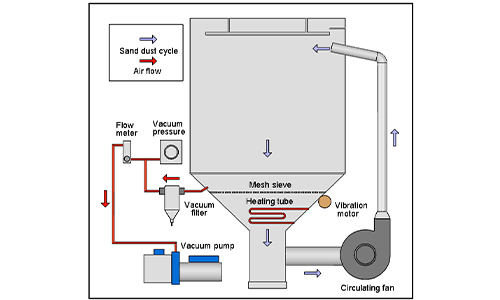
An electric circulation fan generates controlled airflow that suspends talcum powder uniformly throughout the test volume. Wire mesh screens with 50 μm wire diameter and 75 μm gap width regulate particle size distribution at injection points. Heating jackets dry the talcum powder before circulation commences, preventing clumping and maintaining consistent particle suspension across extended test durations in high-capacity chambers.
Programmable Environmental Controls
Modern chambers incorporate PLC-based controllers with color LCD touchscreens, allowing engineers to program blowing intervals, temperature setpoints, and vacuum profiles. Temperature ranges from ambient to +50°C alongside humidity below 30% RH replicate IEC 60529 conditions faithfully. Electromagnetic door locks plus over-temperature, over-current, earth leakage, and phase sequence protections safeguard both operator and specimen throughout every cycle.
Testing Procedures for Electronics Sealing Validation
Pre-Test Specimen Preparation
Engineers configure all intentional openings per the device's normal operating arrangement. Breathing holes, cable glands, and drainage ports remain in their as-shipped state. The specimen connects to the chamber's internal 16A dust-proof power outlet, enabling operation under electrical load during testing - a condition that generates internal heat and pressure differentials influencing dust migration pathways through the enclosure.
Vacuum Application and Dust Exposure Cycles
The vacuum system extracts air from the specimen interior at a regulated rate, producing negative pressure that draws dust-laden atmosphere through any sealing imperfections. A pressure gauge, air filter, and pressure regulator maintain precise differential pressure throughout programmed cycles. Durations and vacuum levels adhere to IEC 60529 clause-specific stipulations for IP5X or IP6X classification.
Post-Test Inspection and Acceptance Criteria
After completing the prescribed exposure period, technicians remove the specimen and perform visual plus gravimetric inspection of internal surfaces. For IP6X certification, no visible dust deposits may appear anywhere inside the enclosure. Any detectable particle penetration constitutes a test failure, triggering seal redesign and subsequent revalidation through additional chamber runs before production release.
Key Indicators of Dust-Related Failure Mechanisms
Insulation Resistance Degradation
Conductive dust films deposited between high-voltage traces reduce surface insulation resistance below acceptable thresholds. This degradation manifests as intermittent leakage currents that intensify under humid ambient conditions. Environmental stress screening through dust chamber evaluation reveals these vulnerabilities well before products enter distribution channels, preventing field-level dielectric failures.
Mechanical Wear in Moving Components
Abrasive particles infiltrating bearings, sliders, and actuators produce microscopic scoring that elevates friction coefficients over service life. Rotating equipment exposed to silica-rich environments demonstrates measurably shortened bearing longevity when sealing integrity falls below IP5X standards. Chamber testing quantifies this risk under reproducible, standards-compliant conditions using calibrated dust media.
Optical and Sensor Performance Loss
Dust accumulation on lenses, photodetectors, and LIDAR windows attenuates signal strength and introduces measurement scatter across detection ranges. Autonomous vehicle sensors and industrial machine vision systems demand IP6X-level protection to preserve calibration accuracy throughout their operational lifespan. Ingress protection testing validates optical path cleanliness under worst-case particle loading scenarios.
Enhancing Product Durability Through IP Testing
Design Iteration Guided by Test Data
Dust chamber results supply quantifiable feedback driving gasket material selection, seal compression ratios, and enclosure geometry refinements. Engineers correlate particle penetration locations with CAD models to pinpoint vulnerable joints and parting lines. This data-driven methodology compresses development timelines while reducing the number of prototype iterations required before production tooling commitment.
Regulatory Compliance and Market Access
Numerous international markets mandate documented IP ratings as prerequisites for product certification and sale. Automotive OEMs, railway operators, and military procurement agencies require test reports from IEC 60529-compliant chambers within supplier qualification packages. Investing in reliable dust testing equipment streamlines market entry across these heavily regulated sectors and expands revenue opportunities.
Long-Term Reliability and Brand Protection
Products validated through rigorous IP6X testing demonstrate superior field reliability, reducing warranty claim rates and reinforcing brand perception among discerning buyers. Customers operating in harsh environments - mining, agriculture, outdoor telecommunications - actively favor suppliers who furnish verifiable ingress protection documentation backed by accredited laboratory data and reproducible test methodologies.
Consistent Vacuum & Dust Distribution for Reliable IP Ratings - LIB Industry
|
Feature |
DI-1000 |
DI-1500 |
DI-2000 |
|
Useful Volume (L) |
1000 |
1500 |
2000 |
|
Temperature Range |
Ambient-50°C |
Ambient-50°C |
Ambient-50°C |
|
Humidity |
< 30% RH |
< 30% RH |
< 30% RH |
|
Wire Diameter |
50 μm |
50 μm |
50 μm |
|
Controller |
PLC Touchscreen |
PLC Touchscreen |
PLC Touchscreen |
|
Interior Materia |
SUS304 |
SUS304 |
SUS304 |
|
|
|


 |
 |
|
| Test Area | LAN and USB | Controller |


Mesh Sieve and Heating Tube
Multi-Port Vacuum Architecture
LIB Industry's DI-2000 IP6X dust chamber incorporates a multi-port vacuum system enabling simultaneous testing of two to three large assemblies. Automated pressure monitoring sustains the precise differential pressure required for IP6X compliance without manual intervention. This architecture eliminates operator variability and delivers repeatable test outcomes across production qualification batches, ensuring consistent data integrity.
High-Capacity Loading and Chamber Accessibility
A low-threshold door design paired with an optional test cart system accommodates heavy specimens without specialized lifting equipment. The reinforced floor platform supports loads up to 500 kg, while adjustable stainless steel shelving permits concurrent evaluation of multiple smaller assemblies. With more than 14 models ranging from 800 L to 2000 L, LIB Industry matches chamber capacity to diverse application requirements.
Automated Dust Recovery and Maintenance
One-touch powder recovery with vibration assistance reduces changeover time from hours to minutes when cycling large quantities of test media. Heating jackets pre-condition talcum powder before each run, eliminating moisture-induced clumping within the circulation system. These automated capabilities lower operational expenditure and boost daily test throughput for busy qualification laboratories managing high specimen volumes.
Conclusion
Dust ingress protection testing safeguards electronic products against particle-induced failures that compromise performance, safety, and market viability. Chambers built to IEC 60529 specifications - equipped with controlled vacuum systems, uniform dust circulation, and programmable environmental parameters - deliver the repeatable, standards-compliant results global regulatory bodies and OEM customers demand. The DI-2000 IP6X dust chamber from LIB Industry pairs 2000-liter capacity with automated dust management and multi-port vacuum architecture, addressing both high-volume production qualification and engineering development requirements across automotive, aerospace, medical, and telecommunications industries.
FAQ
What dust material does the DI-2000 IP6X dust chamber use for IEC 60529 testing?
The chamber uses talcum powder distributed through wire mesh screens with 50 μm wire diameter and 75 μm nominal gap width, matching the particle size stipulations defined in the IEC 60529 standard.
Can the dust chamber test powered specimens during the exposure cycle?
Yes. A built-in dust-proof 16A power outlet supplies electricity to operating specimens inside the work room, allowing realistic evaluation with active thermal loads and internal pressure differentials throughout the entire test.
How many specimens can be tested simultaneously in the DI-2000?
The multi-port vacuum system supports concurrent testing of two to three large enclosures, while adjustable stainless steel shelving within the 2000-liter volume accommodates multiple smaller assemblies during a single run.
Looking for a reliable dust chamber manufacturer, supplier, and factory partner? LIB Industry has delivered turnkey environmental testing solutions to global clients since 2009, serving leaders including Apple, IBM, and Mercedes-Benz. Contact our team at ellen@lib-industry.com for customized IP testing equipment tailored to your specifications.