Simulating Heavy Rain Conditions with R1 R2 Test Systems
Simulating heavy rain in a controlled laboratory setting demands precision equipment engineered to replicate nature's most punishing water exposure. JIS D 0203 R1 R2 rain test equipment delivers calibrated rainfall at defined flow rates, droplet sizes, and spray pressures - reproducing conditions that automotive lamps, electric cabinets, and sealed enclosures face during severe storms. The R1 mode generates moderate rainfall at 1.9 L/min through fine Φ0.5 mm nozzles, while R2 escalates intensity to 3.3 L/min, challenging seals and gaskets under heavier deluge conditions. By combining both modes within a single test chamber, engineers obtain a comprehensive evaluation of water ingress resistance without juggling multiple testing setups.
What Defines Heavy Rain in Automotive Testing?
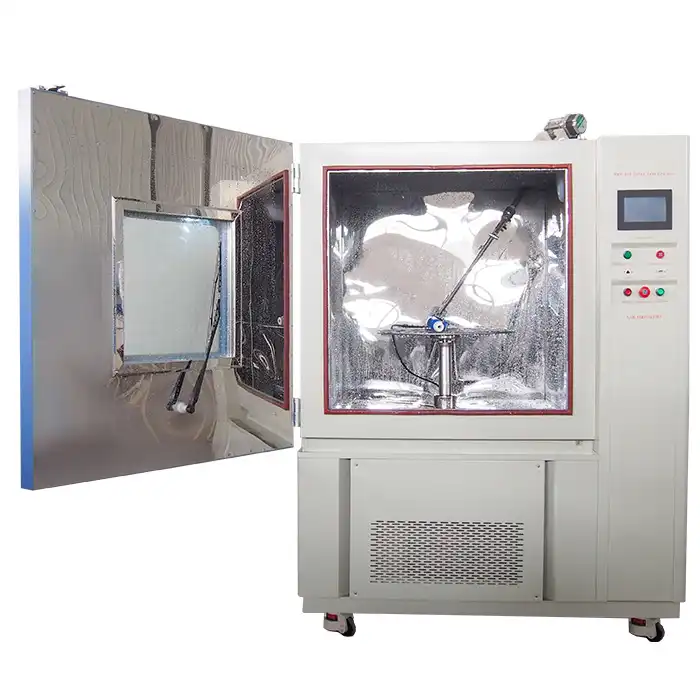
Rainfall Intensity Classifications in JIS D 0203
Heavy rain in the automotive context goes beyond simple weather descriptions. JIS D 0203 categorizes rainfall into distinct tiers - R1 and R2 - each defined by measurable flow rates, nozzle diameters, and spray distances. R1 mirrors steady moderate rainfall, while R2 emulates a more aggressive downpour. These classifications provide repeatable benchmarks, ensuring that every laboratory evaluating water resistance applies identical precipitation conditions regardless of geographic location or equipment brand.
Standardized Benchmarks for Water Exposure
International frameworks like IEC 60529, ISO 20653, and JIS D 0203 establish measurable thresholds for water ingress testing. Each standard specifies nozzle geometry, water pressure ranges, and test duration. JIS D 0203 stands apart by defining automotive-specific rain simulations that mirror the unique exposure patterns vehicles encounter - splashing from road surfaces, wind-driven rain at highway speeds, and prolonged parking lot downpours. Adhering to these benchmarks guarantees that test outcomes translate directly to real-world durability.
Correlating Laboratory Conditions to Actual Storms
Bridging the gap between a laboratory chamber and a tropical monsoon requires meticulous calibration. The 400 mm specimen-to-nozzle distance prescribed in JIS D 0203 replicates the rain impingement angle observed during natural precipitation events. Turntable rotation at 17 r/min ensures omnidirectional exposure, preventing any shielded "dry zones" on the sample. A product passing the R2 test can confidently withstand heavy rainfall encountered across diverse climates.
Overview of R1 and R2 Rain Test Parameters
R1 Rain Simulation Specifications
The R1 test mode employs two rain nozzles fitted with Φ0.5 mm orifices, delivering water at a steady 1.9 L/min. This flow rate simulates moderate, continuous rainfall - the type of precipitation that persists for hours and gradually probes seals and joints. Specimens rotate on a stainless steel turntable, exposing every surface to a uniform curtain of fine droplets. Water pressure at each nozzle is adjustable between 0.03 and 0.30 MPa for precise intensity tuning.
R2 Rain Simulation Specifications
R2 intensifies the challenge. Using the same Φ0.5 mm nozzle configuration, the flow rate jumps to 3.3 L/min - nearly double the R1 output. This heightened volume mimics a driving rainstorm capable of overwhelming inadequate drainage channels and marginal seals. The elevated water delivery rate stresses gasket interfaces and reveals latent manufacturing defects that gentler R1 testing might not uncover. Combined with adjustable nozzle pressure, R2 provides a rigorous upper-bound evaluation of enclosure integrity.
Side-by-Side Parameter Comparison
|
Parameter |
R1 Mode |
R2 Mode |
|
Rain Nozzles |
2 |
2 |
|
Nozzle Hole Diameter |
Φ0.5 mm |
Φ0.5 mm |
|
Water Flow Rate |
1.9 L/min |
3.3 L/min |
|
Water Pressure Range |
0.03-0.30 MPa |
0.03-0.30 MPa |
|
Turntable Speed |
17 r/min |
17 r/min |
|
Typical Application |
Moderate rain |
Heavy rain |
This table illustrates how R1 and R2 share identical nozzle hardware yet diverge in water volume. This architectural commonality enables rapid mode switching within a single test session, eliminating the need for mechanical reconfiguration between rain intensity levels.
Controlled Water Spray and Pressure Simulation
Pressure Range and Flow Rate Calibration
Accurate rain simulation in a rain test chamber hinges on precise pressure regulation. The system operates within a 0.03–0.30 MPa window, controlled through an inline flow meter that provides real-time feedback. Engineers can dial in exact pressures to replicate everything from a gentle drizzle to a forceful cloudburst. This granular control distinguishes laboratory rain testing from crude spray-down methods, offering quantifiable and reproducible data across multiple test iterations.
Multi-Stage Filtration and Water Delivery
Water purity directly affects test repeatability. Mineral deposits or particulate contamination can clog the Φ0.5 mm and Φ1.2 mm nozzle orifices, distorting spray patterns and invalidating results. The integrated water purification system removes dissolved solids and suspended particles before water reaches the nozzle array. A booster pump maintains consistent upstream pressure, while automatic water supply replenishment ensures uninterrupted test cycles even during extended evaluation protocols.
Turntable Dynamics and Specimen Orientation
The 304 stainless steel turntable rotates at a fixed 17 r/min, guaranteeing uniform water exposure across all specimen surfaces. Speed and angle adjustments accommodate components of varying geometry - from compact LED headlamps to large junction boxes. Secure fixturing prevents specimen displacement during rotation, preserving the calibrated 400 mm nozzle-to-sample distance critical for JIS D 0203 compliance.
Equipment Design for Accurate Rain Replication
Chamber Construction and Material Selection
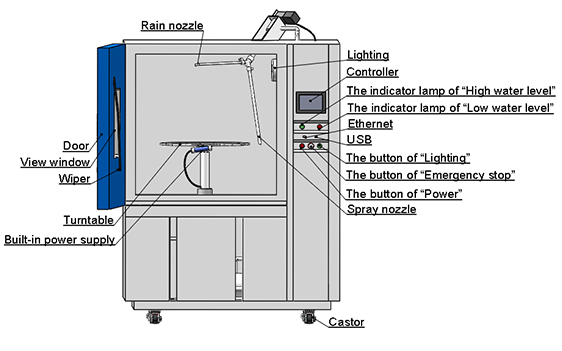
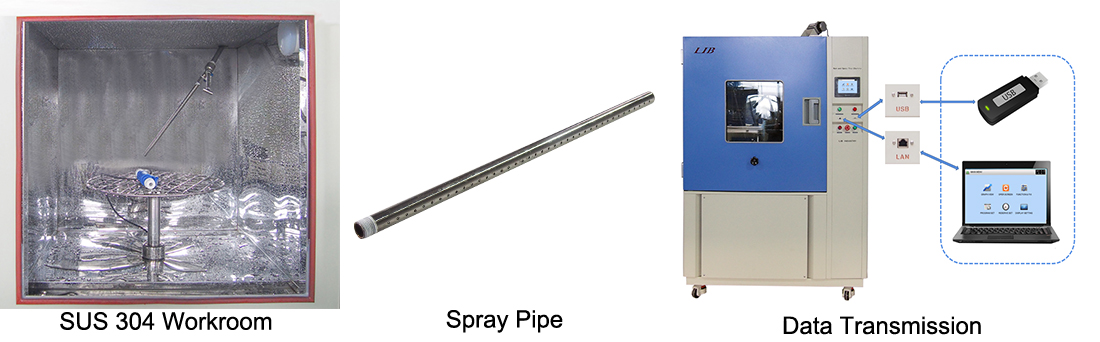
The R-1000JIS chamber features SUS304 stainless steel interior walls, chosen for exceptional corrosion resistance during prolonged water exposure. External panels use steel plate with a protective coating to withstand ambient humidity in laboratory environments. A built-in water tank measuring 370 × 375 × 950 mm supports self-contained operation, while a double-layer insulating observation window with an integrated wiper enables visual monitoring without interrupting the test cycle.
Arc-Shaped Nozzle Configuration
|
Specification |
Detail |
|
Internal Dimensions |
1000 × 1000 × 1000 mm (D × W × H) |
|
Interior Volume |
1000 L |
|
Rain Nozzles |
2 (Φ0.5 mm) |
|
Spray Nozzles |
40 (Φ1.2 mm) |
|
Controller |
Programmable LCD touchscreen, Ethernet, USB |
|
Power Supply |
380 V, 50 Hz |
|
Maximum Noise |
65 dBA |
|
Environmental Conditions |
5 °C to +35 °C, ≤85 % RH |
The arc-shaped nozzle layout distributes water along a geometrically optimized trajectory that mirrors natural rainfall angles. Each of the 40 spray nozzles undergoes individual calibration, ensuring uniform droplet size and consistent spatial distribution. This design eliminates concentrated "hot spots" that could skew ingress measurements.
Closed-Loop Water Circulation
The recirculating water system captures runoff from the chamber floor, filters it, and returns it to the supply reservoir. This closed-loop architecture reduces water consumption dramatically compared to single-pass designs. Advanced filtration removes contaminants that accumulate during testing, protecting both the nozzle orifices and the specimens under evaluation. The eco-conscious design lowers operational costs without sacrificing test fidelity.
Key Performance Indicators in Rain Testing
Water Ingress Detection Metrics
Quantifying water penetration requires systematic post-test inspection. Technicians examine internal surfaces for moisture traces, measure accumulated water volume in drainage traps, and assess whether any liquid reached electrically active zones. Pass/fail criteria depend on the IP rating under evaluation - IPX3 through IPX6 each impose progressively stricter allowable ingress thresholds. Detailed photographic documentation supports traceability and audit compliance.
Seal and Gasket Integrity Assessment
Rain testing reveals the weakest links in an enclosure's moisture barrier. Gaskets compressed beyond their elastic recovery limit, adhesive bonds degraded by thermal cycling, and improperly torqued fasteners all manifest as water ingress during R1 or R2 exposure. Identifying these failure modes early in the development cycle avoids costly field recalls and warranty claims.
Post-Test Functional Verification
A watertight enclosure means little if internal electronics malfunction after water exposure. Post-test protocols include dielectric withstand testing, insulation resistance measurement, and full operational verification of the enclosed device. These functional checks confirm that the product not only resists water entry but continues performing within specification after enduring simulated heavy rain conditions.
Enhancing Product Reliability Under Extreme Conditions
Multi-Standard Compliance Testing
A single JIS D 0203 R1 R2 rain test equipment chamber can address multiple ingress protection ratings in one enclosure. Combining IPX3, IPX4, IPX5, and IPX6 test capabilities eliminates the need for separate dedicated equipment. This consolidation accelerates qualification timelines and reduces capital expenditure, enabling manufacturers to certify products against IEC 60529, ISO 20653, and JIS D 0203 within the same facility.
Accelerated Aging Through Repeated Exposure
Running extended or repeated rain test cycles simulates years of field exposure within days. Cyclical water impingement at R2 flow rates stresses materials and joints, revealing fatigue-related failures that single-cycle testing cannot detect. This accelerated aging approach provides invaluable insight into long-term product durability and helps engineers refine material selection and sealing strategies before mass production.
Bridging Laboratory Data to Field Performance
Laboratory rain test data gains practical value when correlated with field failure records. By matching R1 and R2 test outcomes against warranty return data, engineering teams calibrate their acceptance criteria and identify which test parameters best predict real-world performance. This feedback loop transforms rain testing from a compliance checkbox into a genuine reliability engineering tool.
LIB Industry's Customizable Nozzle Arrays for Accurate R1/R2 Simulation
 |
 |
Tailored Chamber Dimensions and Configurations
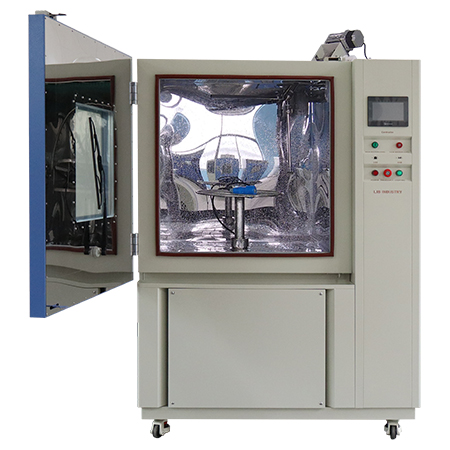
LIB Industry offers rain test chambers in 1000 L, 1500 L, and 2000 L capacities - and beyond - to accommodate specimens ranging from compact sensors to full-size enclosures. The engineering team specializes in non-standard designs, modifying internal dimensions, nozzle layouts, and turntable load ratings to match unique testing requirements. Every chamber ships with CE certification and undergoes third-party validation by SGS and TUV.
Programmable Control and Data Acquisition
|
Feature |
Rain Test (R1 / R2) |
Spray Test (S1 / S2) |
|
Nozzle Count |
2 |
40 |
|
Nozzle Hole Diameter |
Φ0.5 mm |
Φ1.2 mm |
|
Water Flow Rate |
1.9 / 3.3 L/min |
24.5 / 39.2 L/min |
|
Primary Standard |
JIS D 0203 R1/R2 |
JIS D 0203 S1/S2 |
The programmable color LCD touchscreen controller stores test sequences for rapid recall. Ethernet connectivity links the chamber to laboratory information management systems, while USB ports enable data export for offline analysis. Real-time monitoring of pressure, flow rate, and rotation speed ensures complete traceability for every test run.
Warranty and Global Service Infrastructure
Each rain test system from LIB Industry includes a three-year warranty and lifetime technical support. A 24/7 global service team provides remote diagnostics and on-site assistance. Should a unit prove irreparable within the warranty period, LIB Industry supplies a brand-new replacement at no additional cost - a commitment that underscores confidence in build quality and long-term reliability.
Conclusion
Simulating heavy rain in a laboratory environment requires more than a water spray and a timer. JIS D 0203 R1 R2 rain test equipment brings scientific rigor to water ingress evaluation by defining precise flow rates, nozzle geometries, and exposure distances that replicate authentic storm conditions. From the moderate persistence of R1 to the aggressive deluge of R2, each test mode targets specific vulnerability thresholds in automotive lighting, electrical enclosures, and sealed components. Investing in a well-engineered rain test chamber accelerates product development, reduces field failure rates, and provides the documented evidence that regulators and customers demand.
FAQ
What is the difference between R1 and R2 in JIS D 0203?
R1 simulates moderate rainfall at 1.9 L/min through Φ0.5 mm nozzles, while R2 increases flow to 3.3 L/min for heavier rain conditions. Both use the same nozzle configuration but differ in water volume delivery.
Can one chamber perform both R1/R2 rain and S1/S2 spray tests?
Yes. The R-1000JIS chamber integrates two rain nozzles and 40 spray nozzles, enabling IPX3, IPX4, IPX5, and IPX6 testing within a single enclosure without mechanical reconfiguration between test modes.
What safety features protect operators and specimens during testing?
Built-in protections include over-temperature, over-current, water shortage, earth leakage, and phase sequence safeguards. An electromagnetic door lock prevents chamber access during active test cycles, ensuring both operator safety and test integrity.
Ready to equip your laboratory? LIB Industry is a professional manufacturer and supplier of JIS D 0203 R1 R2 rain test equipment, delivering complete turnkey solutions - from design and production through installation and training. Contact us at ellen@lib-industry.com to discuss specifications tailored to your testing needs.