UV and Thermal Aging Chambers for Outdoor Products
Outdoor products endure relentless exposure to solar radiation and temperature extremes that progressively erode material integrity over months and years. An accelerated aging chamber condenses these prolonged environmental stresses into controlled laboratory cycles, enabling engineers to predict long-term weathering performance without waiting through actual seasonal exposure. By combining xenon arc or UV light sources with precise thermal regulation, these chambers replicate the photochemical and thermomechanical degradation mechanisms responsible for cracking, chalking, fading, and embrittlement in polymers, coatings, textiles, and composites. Compliance with standards such as ISO 4892, ASTM G154, and ASTM G155 ensures that test data carries scientific credibility, empowering manufacturers to refine formulations and select durable materials before committing to full-scale production.
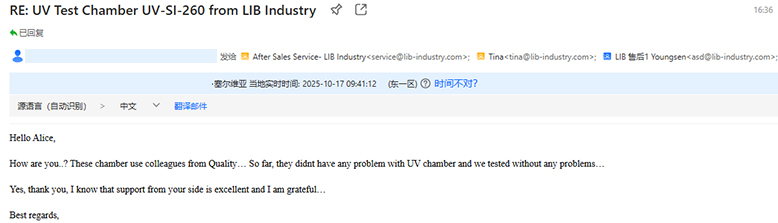
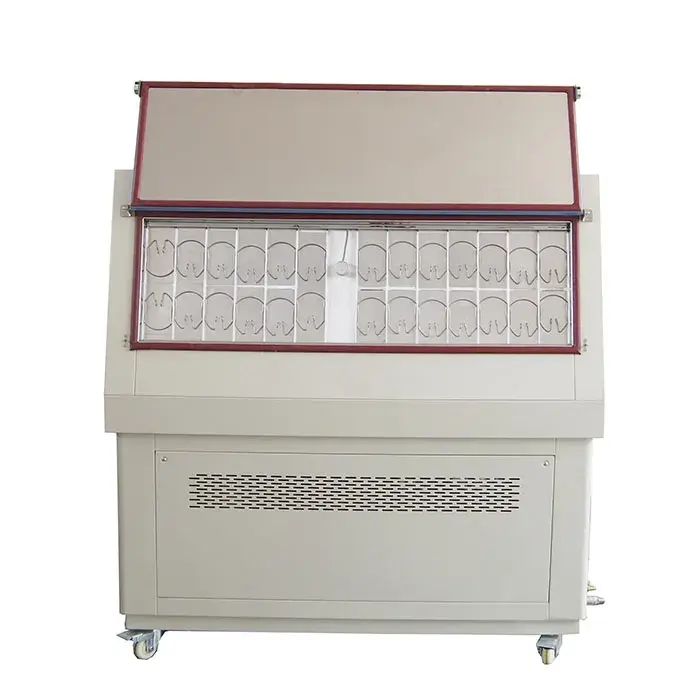
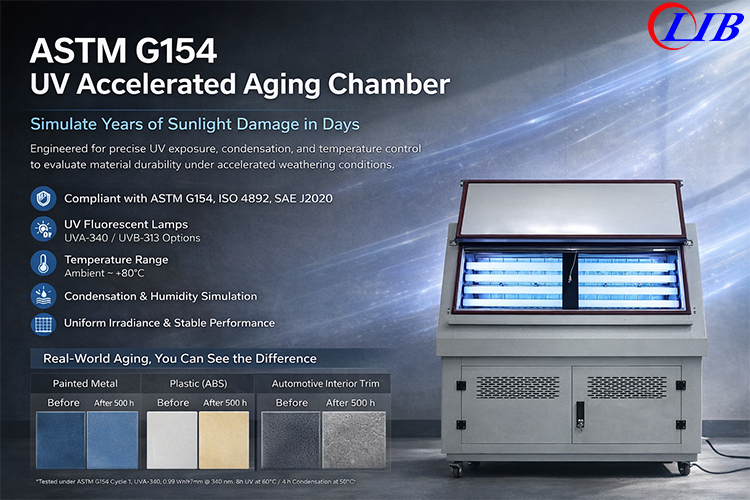
In Serbia, a polymer testing team put the LIB industry UV aging chamber through extensive trials to simulate long-term outdoor exposure. By combining intense UV radiation with cycles of heat and condensation, they could closely monitor material changes such as discoloration, surface cracking, and mechanical degradation. The chamber consistently delivered precise and repeatable results, even over prolonged testing periods.
The team praised the system’s robustness and the support from LIB industry, noting that setup and daily operation were seamless. The dependable performance allowed them to focus entirely on analysis, confident that the equipment would maintain stable conditions throughout every cycle.
The Destructive Impact of Ultraviolet Radiation and Extreme Heat on Exterior Materials
Photodegradation Pathways in Polymeric Substrates
Ultraviolet photons within the 290-400 nm band possess enough energy to cleave covalent bonds in polymer chains, initiating free-radical reactions that propagate molecular scission. This photodegradation manifests as surface chalking on painted panels, yellowing in transparent polycarbonates, and tensile strength loss in polyethylene geomembranes. The rate of bond rupture accelerates when chromophoric impurities or residual catalyst fragments absorb UV energy, making raw material purity a decisive factor in outdoor longevity.
Thermal Oxidation and Its Compounding Role
Elevated surface temperatures amplify oxidation kinetics by lowering the activation energy threshold for radical chain reactions. Dark-colored automotive trim components, rooftop membrane sheets, and playground equipment surfaces routinely reach 70-85 °C under direct sunlight. At these temperatures, oxygen diffusion into the polymer matrix intensifies, accelerating carbonyl group formation and crosslink density changes that stiffen or embrittle the material well before UV exposure alone would cause visible damage.
Real-World Failure Patterns in Outdoor Products
Outdoor furniture, signage fascia, agricultural films, and architectural cladding panels exhibit characteristic failure signatures: micro-crack networks on sun-facing surfaces, localized discoloration along drainage channels where moisture pools, and delamination at adhesive interfaces subjected to cyclic thermal expansion. Recognizing these patterns guides test protocol design, ensuring that accelerated aging chamber programs target the dominant degradation modes rather than applying generic exposure profiles that may underestimate actual field severity.
Why Is the Synergistic Effect of UV and Temperature Critical in Testing?
Coupled Photochemical-Thermal Mechanisms
UV radiation generates reactive species on material surfaces while heat accelerates their propagation through the bulk. Testing either factor in isolation underestimates true degradation rates by neglecting this synergy. Research on automotive clearcoats has demonstrated that specimens aged under simultaneous UV and thermal stress exhibit gloss loss rates up to three times higher than those exposed to each factor sequentially, underscoring the necessity of dual-mode accelerated aging chamber programs.
Moisture as a Tertiary Accelerant
Humidity and water spray cycles introduce hydrolysis - a bond-breaking mechanism particularly harmful to polyesters, polyurethanes, and nylon-based composites. When combined with UV-induced surface cracking, moisture penetrates deeper into substrates, extending degradation beyond the outermost layers. Modern accelerated aging test chambers integrate humidity control between 50% and 98% RH alongside adjustable spray cycles to reproduce rain and condensation phenomena that co-occur with sunlight and heat outdoors.
Reciprocity Considerations for Accurate Acceleration
Doubling irradiance does not always halve the time required to reach equivalent degradation. The Bunsen-Roscoe reciprocity law holds only within specific irradiance windows; exceeding these thresholds introduces artificial failure modes absent from natural weathering. Reputable test standards address this constraint by prescribing irradiance limits - typically 35-150 W/m² in the 300-400 nm band - to maintain fidelity between accelerated and real-world degradation patterns.
Table 1: Synergistic Degradation Factors and Their Effects
|
Environmental Factor |
Primary Degradation Mechanism |
Affected Material Properties |
|
UV Radiation (300-400 nm) |
Photolysis, free-radical chain scission |
Color stability, surface gloss, tensile strength |
|
Elevated Temperature |
Thermal oxidation, crosslink alteration |
Flexibility, impact resistance, dimensional stability |
|
Moisture / Humidity |
Hydrolysis, osmotic blistering |
Adhesion strength, barrier integrity, weight retention |
|
Combined UV + Heat + Moisture |
Synergistic photo-thermo-hydrolytic attack |
Accelerated total property deterioration |
Advanced Irradiance and Thermal Control within Modern Aging Chambers
Xenon Arc Lamp Spectral Fidelity
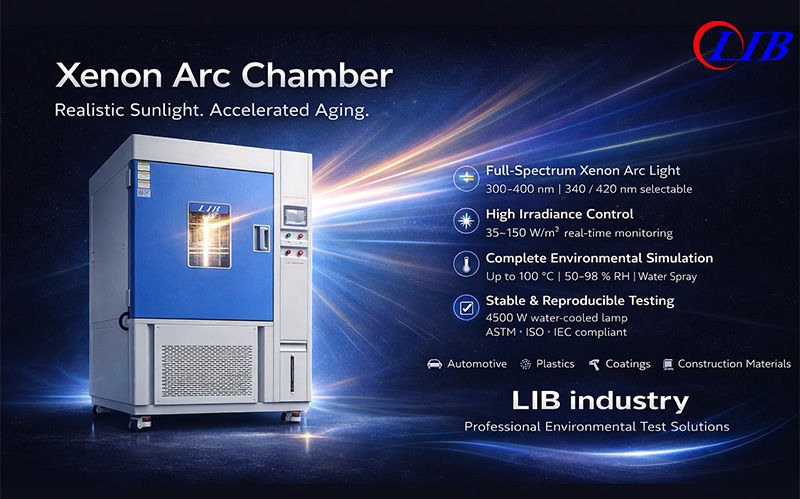
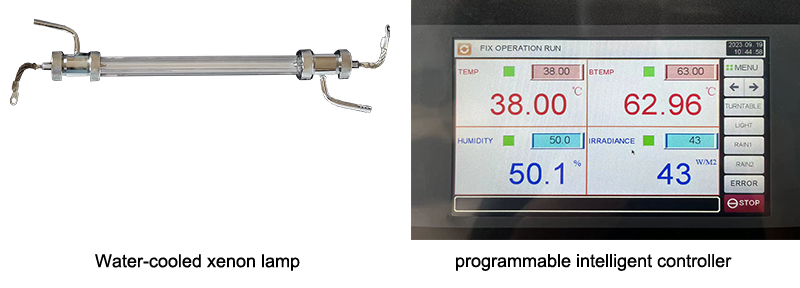
A 4500 W water-cooled xenon arc lamp produces a spectral power distribution closely matching natural sunlight across the UV, visible, and near-infrared regions. Optical filters tailor the output to replicate daylight through window glass or direct outdoor exposure, depending on the intended application. This spectral fidelity distinguishes xenon-based chambers from fluorescent UV testers, making them indispensable for evaluating color fastness and visual appearance changes in pigmented materials, dyed textiles, and printed substrates.
Black Panel Temperature Monitoring
Black panel temperature (BPT) sensors mounted at specimen plane height measure the thermal load that dark-surfaced specimens actually experience during irradiation. The XL-S-750 maintains BPT across a 35-85 °C range with ±2 °C precision, giving operators tight command over surface heating conditions. This accuracy prevents thermal overshoot artifacts that could generate misleading failure data and misguide material selection decisions for heat-sensitive product categories.
Closed-Loop Irradiance Regulation
A built-in UV radiometer with ±5% tolerance continuously measures spectral irradiance and feeds data back to the lamp power controller. The closed-loop system compensates for gradual lamp output decay, sustaining target irradiance levels throughout the lamp's operational lifespan - typically up to 1,600 hours. This automated correction eliminates the manual recalibration burden and ensures dose consistency from the beginning to the end of multi-thousand-hour aging campaigns.
Table 2: XL-S-750 Chamber Technical Specifications
|
Parameter |
Specification |
|
Model |
XL-S-750 |
|
Internal Dimensions |
950 × 950 × 850 mm |
|
Specimen Capacity |
42 pieces (95 × 200 mm holders) |
|
Irradiation Source |
1 × 4500 W water-cooled xenon arc lamp |
|
Irradiance Range |
35-150 W/m² |
|
Bandwidth Measurement |
300-400 nm (340 nm or 420 nm) |
|
Chamber Temperature Range |
Ambient-100 °C ±2 °C |
|
Black Panel Temperature |
35-85 °C ±2 °C |
|
Humidity Range |
50%-98% RH (±5% RH) |
|
Water Spray Cycle |
1-9999 H 59 M (Adjustable) |
|
Interior Material |
SUS304 Stainless Steel |
|
Cooling System |
Mechanical compression refrigeration |
How Do UV and Thermal Simulations Comply with International Weathering Standards?
ISO 4892 Series for Plastics Weathering
ISO 4892 prescribes exposure procedures using laboratory light sources - including xenon arc (Part 2), UV fluorescent (Part 3), and carbon arc (Part 4) - for evaluating color change, gloss reduction, and mechanical property shifts in plastics. The standard specifies irradiance set points, filter combinations, specimen orientation, and cycle programming, providing a universal framework that laboratories worldwide follow to generate comparable and reproducible data sets across different accelerated aging chamber installations.
ASTM G154 and G155 Protocols
ASTM G154 governs fluorescent UV exposure testing, while ASTM G155 addresses xenon arc exposure. Both standards define cycle structures alternating between light-only, light-plus-spray, and dark condensation phases to capture the full spectrum of outdoor weathering conditions. Laboratories accredited under ISO/IEC 17025 rely on these protocols to validate material warranties, support regulatory submissions, and furnish test reports that withstand technical peer review during commercial disputes.
Pre-Programmed Standard Modes
The programmable color LCD touchscreen controller on LIB Industry chambers stores preset cycle configurations aligned with ISO 4892, ASTM G154, ASTM G155, and SAE J2527. One-touch standard selection eliminates manual programming errors, reduces operator training time, and ensures that every test run executes with parameters verified against the published standard - an especially valuable feature for high-throughput laboratories running multiple material qualification campaigns concurrently.
Identifying Photo-Oxidation and Thermal Degradation Vulnerabilities Early in Design
Material Screening Before Tooling Commitment
Running candidate materials through accelerated UV and thermal aging cycles before finalizing injection mold tooling or extrusion die design prevents costly late-stage reformulation. Comparative exposure tests rank competing resin grades, stabilizer packages, and pigment systems by retention of critical properties such as elongation at break, Delta E color shift, and surface gloss units - all within weeks rather than the months required by outdoor exposure racks.
Stabilizer Efficacy Validation
Hindered amine light stabilizers (HALS) and ultraviolet absorbers (UVA) extend polymer service life by quenching free radicals and filtering harmful wavelengths. Accelerated aging chamber tests quantify stabilizer depletion rates under defined irradiance and temperature profiles, enabling formulators to optimize additive concentrations for target service life targets without over-engineering material cost. Dose-response curves generated from chamber data anchor predictive service life models used across the coatings, plastics, and textile industries.
Coating Adhesion and Substrate Compatibility Checks
Multi-layer coating systems applied to outdoor products - vehicles, marine vessels, structural steel - must maintain intercoat adhesion despite decades of photochemical and thermal stress. Cross-hatch adhesion tests performed at intervals during chamber aging reveal delamination onset and help coatings engineers adjust primer chemistry, cure schedules, or surface preparation methods to achieve robust long-term bonding performance across the entire environmental envelope.
Can Comprehensive Weathering Tests Significantly Reduce Field Failures?
Warranty Claim Mitigation
Manufacturers that integrate accelerated weathering into their quality assurance pipeline consistently report lower warranty claim rates on outdoor-rated products. Quantitative chamber data substantiates warranty duration claims and provides defensible evidence during dispute resolution, reducing both direct replacement costs and the reputational damage associated with premature product deterioration in the field.
Regulatory and Procurement Compliance
Government infrastructure projects, automotive OEM qualification programs, and building code certifications increasingly mandate weathering test data generated under recognized standard protocols. Presenting chamber-validated performance data strengthens tender submissions and accelerates procurement approvals, giving compliant manufacturers a tangible competitive edge in specification-driven markets.
Continuous Improvement Feedback Loops
Archived aging data spanning multiple product generations establishes trend baselines that highlight incremental improvements - or regressions - in material durability. Engineering teams leverage this historical repository to correlate formulation changes with performance outcomes, closing the loop between laboratory predictions and field performance observations documented through customer feedback and returned product failure analyses.
Table 3: Benefits of Accelerated Aging Testing on Product Lifecycle
|
Lifecycle Stage |
Testing Benefit |
|
Material Selection |
Objective ranking of candidate polymers and stabilizer systems |
|
Design Validation |
Early detection of coating adhesion or seal failures |
|
Production Quality Control |
Batch-to-batch consistency verification |
|
Warranty Support |
Data-backed service life claims and dispute evidence |
|
Continuous Improvement |
Long-term trend tracking across product generations |
LIB Industry's Dual-Function Chambers Simulating Real-World Outdoor Stress
Rotating Specimen Holder for Uniform Exposure
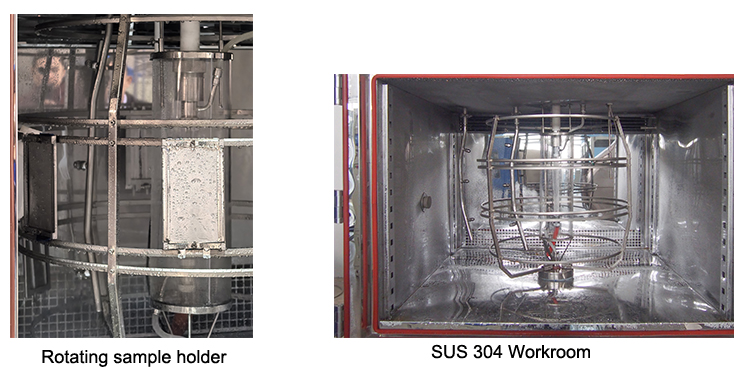
The XL-S-750 accelerated aging chamber employs a rotating specimen holder accommodating 42 specimens sized 95 × 200 mm. Continuous rotation ensures every sample receives identical cumulative irradiance and thermal dosage, eliminating positional bias and enabling statistically valid multi-specimen comparisons within a single test run. The SUS304 stainless steel construction resists corrosion from sustained humidity and water spray contact throughout extended aging campaigns.
Turnkey Project Delivery and Installation
LIB Industry manages the entire project lifecycle - from initial consultation and chamber engineering through manufacturing, shipping logistics, on-site installation, and hands-on operator training. This turnkey approach assigns single-source accountability for chamber performance, compresses laboratory readiness timelines, and frees client engineering resources to focus on interpreting test data rather than coordinating multiple equipment vendors and service contractors.
Robust Safety and Warranty Framework
Integrated safety protections encompass over-temperature cutoffs, over-current breakers, water shortage interlocks, earth leakage detection, and phase sequence monitoring. Every chamber ships with CE certification verified through independent SGS and TUV audits. A 3-year warranty - backed by lifetime global technical support and a full replacement guarantee for units deemed irreparable during the warranty period - demonstrates LIB Industry's enduring confidence in chamber build quality and long-term operational reliability.
 |
 |
Conclusion
UV radiation and thermal stress act in concert to degrade outdoor products through photo-oxidation, chain scission, and hydrolytic mechanisms that no single-factor test can adequately replicate. Modern accelerated aging chambers equipped with xenon arc lamps, precise BPT control, and programmable humidity cycles compress years of field exposure into manageable laboratory durations while maintaining spectral and thermal fidelity to natural weathering. LIB Industry's XL-S-750 chambers deliver this capability within a standards-compliant, safety-certified, and fully customizable platform, equipping manufacturers to identify material vulnerabilities early, substantiate warranty commitments, and bring more durable outdoor products to market with measurable confidence.
FAQ
What light source does the accelerated aging chamber use?
The XL-S-750 uses a 4500 W water-cooled xenon arc lamp producing full-spectrum irradiance between 35 and 150 W/m², measured across the 300-400 nm bandwidth to replicate natural sunlight exposure accurately.
Which international standards does the chamber satisfy?
The chamber complies with ISO 4892, ASTM G154, ASTM G155, and SAE J2527. Pre-programmed standard modes on the touchscreen controller enable one-touch protocol selection for consistent, audit-ready test execution.
How many specimens can be tested simultaneously?
The rotating specimen holder accommodates 42 specimens sized 95 × 200 mm. Continuous rotation ensures uniform irradiance and thermal exposure across all samples, supporting statistically valid multi-specimen comparisons within each run.
Searching for a trusted accelerated aging chamber manufacturer and supplier? LIB Industry delivers turnkey environmental testing solutions tailored to your specifications and compliance requirements. Reach out at ellen@lib-industry.com to discuss custom configurations, pricing, and project timelines.