Industrial Ovens for Composite Material Curing Processes
Composite materials - carbon fiber, fiberglass, aramid laminates - demand precise thermal treatment to achieve their renowned strength-to-weight ratio. An industry oven engineered for curing processes delivers controlled, uniform heat across the entire chamber, triggering the cross-linking reactions that transform uncured resin systems into rigid, load-bearing structures. Without accurate temperature profiling, composites develop porosity, residual stress, or incomplete polymerization that compromises mechanical performance. Modern industrial curing ovens accommodate programmable multi-stage ramp-and-soak cycles, adjustable airflow, and real-time data logging, giving process engineers full command over every phase of the cure. Selecting the right equipment directly influences part quality, production throughput, and long-term operational cost - making it one of the most consequential decisions in any composites manufacturing facility.
 |
 |
What Is Composite Material Curing and Why It Matters?
The Chemistry Behind Resin Cross-Linking
Curing converts a pliable resin matrix - epoxy, polyester, vinyl ester, or bismaleimide - into a thermoset polymer through exothermic chemical reactions. Heat energy drives molecular chains to form permanent cross-links, and the reaction rate depends on both temperature magnitude and dwell duration. Insufficient cure leaves unreacted monomers that weaken the laminate and reduce glass-transition temperature.
Mechanical Properties Defined During the Cure Window
Tensile strength, interlaminar shear, and fatigue resistance are all established during the thermal cycle. Composite parts cured outside the resin manufacturer's specified temperature envelope exhibit measurably lower performance metrics. An industrial oven with ±0.5 ℃ fluctuation and ±2.0 ℃ deviation keeps every region of a layup within the prescribed window, locking in predictable mechanical behavior.
Industry Sectors That Rely on Cured Composites
Aerospace, automotive, wind energy, marine, and sporting goods manufacturers all depend on cured composite structures. Each sector imposes distinct quality specifications - from FAA airworthiness directives to automotive crash-test criteria - reinforcing the need for curing equipment that delivers repeatable, documented thermal profiles batch after batch.
Types of Industrial Ovens Used for Composite Curing
Batch-Style Convection Curing Ovens
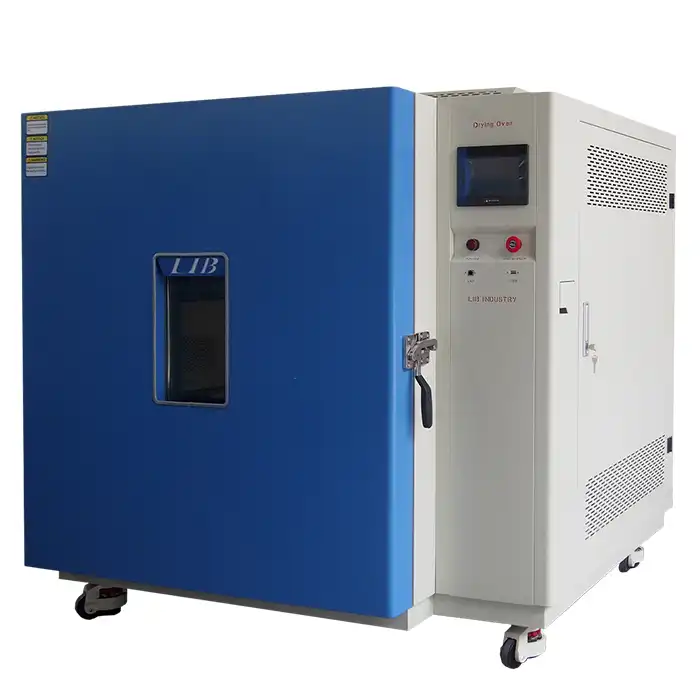
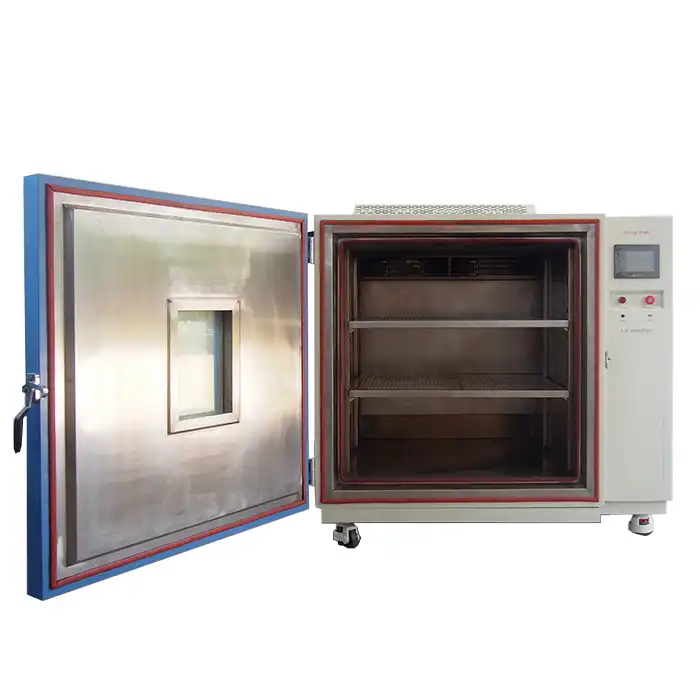
Walk-in or cabinet-format convection ovens remain the workhorses of composite fabrication. Hot air circulated by centrifugal fans envelops parts on adjustable shelving, accommodating varied geometries. LIB Industry offers models from 100 L to 1 000 L, covering small coupon testing through full-scale structural component curing.
Continuous Conveyor Ovens
High-volume production lines favor conveyor-style systems that transport parts through sequential heating zones at a controlled belt speed. Each zone operates at an independent setpoint, enabling graduated ramp rates without manual intervention. This configuration excels for pultruded profiles and flat-panel laminates produced in uninterrupted runs.
Vacuum-Assisted and Pressurized Oven Hybrids
Some advanced composites - particularly aerospace prepregs - require simultaneous vacuum bag consolidation and elevated temperature. Oven-vacuum systems merge convective heating with envelope pressure, yielding void contents below 1 % without the capital expenditure of an autoclave. These hybrid platforms bridge the gap between standard atmospheric-cure ovens and full autoclave processing.
Table 1 - LIB Industry Oven Model Overview
|
Model |
Internal Dimensions (mm) |
Interior Volume (L) |
Overall Dimensions (mm) |
|
O-100 |
400 × 500 × 500 |
100 |
750 × 880 × 850 |
|
O-225 |
500 × 600 × 750 |
225 |
800 × 950 × 1000 |
|
O-500 |
700 × 800 × 900 |
500 |
1100 × 1100 × 1300 |
|
O-800 |
800 × 1000 × 1000 |
800 |
1100 × 1450 × 1400 |
|
O-1000 |
1000 × 1000 × 1000 |
1000 |
1300 × 1400 × 1400 |
> All models feature SUS304 stainless-steel interiors, programmable color LCD touch-screen controllers with Ethernet and USB, polyurethane foam insulation, and a heating rate of 6 ℃/min.
Temperature and Pressure Control in Curing Processes
PID-Driven Temperature Regulation
A robust PID controller continuously adjusts heater output to match the programmed setpoint, compensating for thermal mass changes as parts absorb or release heat. LIB Industry equips every industrial drying oven with a programmable color LCD touch-screen controller that supports multi-segment temperature curves, enabling tailored ramp-soak-cool sequences for each resin system.
Airflow Management and Uniformity
Horizontal and vertical air-circulation channels paired with adjustable fan speed maintain uniform temperature distribution across shelving levels. Punch-type sample holders and perforated rack designs promote unobstructed airflow around complex part geometries, keeping deviation within ±2.0 ℃ even under full loading conditions.
Remote Monitoring and Data Acquisition
Modern curing protocols demand traceable thermal records. LIB Industry ovens feature Ethernet and USB connectivity, allowing engineers to monitor live temperature data, download cure logs, and adjust parameters from a networked computer - streamlining quality audits and regulatory compliance documentation.
Optimizing Cure Cycles for Structural Integrity
Ramp Rate and Exotherm Management
Ramping too aggressively triggers an uncontrolled exothermic spike that can char resin-rich zones or induce warpage. A calibrated heating rate - typically 1-3 ℃/min for thick aerospace laminates - paired with an oven capable of 6 ℃/min maximum ensures headroom to follow material data-sheet recommendations precisely.
Dwell Stages and Degree-of-Cure Verification
Multi-step dwell plateaus at intermediate temperatures allow volatiles to escape before the resin gels, reducing void content. After the final soak, differential scanning calorimetry (DSC) samples confirm that residual exotherm falls below the specified threshold, validating that the oven delivered the intended cure energy.
Post-Cure Thermal Conditioning
Many high-performance resin systems require an elevated post-cure at temperatures above the initial cure setpoint to push the glass-transition temperature higher. Industrial ovens rated up to +400 ℃ or +900 ℃ handle post-cure cycles that standard low-temperature equipment cannot reach, unlocking the full mechanical potential of advanced thermoset matrices.
Common Challenges in Composite Material Processing
Thermal Lag in Thick-Section Parts
Thick monolithic or sandwich-core laminates exhibit significant thermal lag between surface and interior plies when processed in a benchtop industrial oven. Without sufficient soak time, the core remains under-cured while the surface overcures. Programmable multi-segment controllers and embedded thermocouple feedback loops mitigate this risk by extending dwell periods until all monitored zones reach equilibrium.
Outgassing and Volatile Management
Residual solvents, moisture, and reaction by-products must vent safely during the cure. Automatic exhaust ports with variable flow control evacuate volatiles without disrupting chamber temperature, while explosion-proof designs - available with ATEX compliance - protect personnel and equipment when processing resins containing flammable diluents.
Dimensional Distortion and Spring-Back
Coefficient-of-thermal-expansion mismatch between fiber and matrix induces internal stresses that manifest as spring-back or warpage upon cool-down. Controlled, gradual cooling ramps programmed into the PID controller reduce thermal gradients that aggravate distortion, preserving dimensional tolerances critical for assembly fit.
Table 2 - Safety Features Integrated Into LIB Industry Ovens
|
Safety Feature |
Specification |
Benefit |
|
Independent Over-Temperature Protection |
Dual-controller system |
Prevents equipment and part damage |
|
Automatic Exhaust Port |
Variable flow control |
Safe volatile and solvent removal |
|
Emergency Stop Function |
Instant shutdown capability |
Immediate operator protection |
|
Explosion-Proof Design |
ATEX compliance available |
Hazardous material processing |
Enhancing Product Performance Through Controlled Curing
Achieving Repeatable Fiber-Volume Fractions
Consistent cure pressure and temperature yield predictable fiber-volume fractions - the primary determinant of composite stiffness. Ovens that maintain ±0.5 ℃ fluctuation eliminate batch-to-batch variability, enabling engineers to design to tighter safety margins and reduce overweight penalty in weight-sensitive applications.
Extending Fatigue Life and Impact Resistance
A fully cured matrix resists micro-cracking under cyclic loads, extending fatigue life by orders of magnitude compared to an under-cured counterpart. Impact damage tolerance likewise improves when the thermoset network achieves its maximum cross-link density - a condition attainable only through disciplined thermal processing.
Reducing Scrap and Rework Rates
Precise oven control translates directly into lower scrap rates. Parts that meet dimensional and mechanical specifications on the initial cycle do not require costly rework or secondary bonding repairs. Over a production campaign, the cumulative savings in material, labor, and lead time justify investment in high-performance curing equipment many times over.
Table 3 - Loading Capabilities Across LIB Oven Configurations
|
Loading Parameter |
Standard Shelving |
Heavy-Duty Option |
|
Per-Shelf Capacity |
50 kg |
200 kg |
|
Total Capacity |
Varies by model |
Up to 2 000 kg |
|
Shelf Adjustment Increment |
25 mm |
Custom spacing available |
|
Cart Access |
Floor-level loading |
Available on request |
LIB Industry's Uniform Heat Distribution Ensuring Consistent Cure Results
Advanced Centrifugal Fan Engineering
LIB Industry's centrifugal fan system generates laminar airflow that eliminates hot spots and cold zones throughout the workspace. Multi-layer heating elements wrap the industry oven perimeter, feeding energy into the circulating air stream and producing documented uniformity within ±2.0 ℃ regardless of load density.
Turnkey Service From Design to Commissioning
LIB Industry provides a comprehensive lifecycle approach - research, design, production, commissioning, delivery, installation, and operator training - ensuring that every industry oven arrives ready for validated service. Custom chamber dimensions, specialized atmosphere controls, and non-standard voltage configurations are all engineered to order.
Certified Quality and Global Support
Manufactured under an ISO 9001 quality management system, each unit undergoes audit by SGS and TUV and carries CE certification. A robust after-sales framework includes extended warranties, worldwide spare-parts availability, and responsive technical assistance - minimizing unplanned downtime and safeguarding production continuity across every time zone.
Conclusion
Composite material curing hinges on thermal accuracy, airflow uniformity, and programmable flexibility - qualities that define a well-engineered industrial oven. From resin cross-linking chemistry to volatile management and post-cure conditioning, every stage of the cure cycle benefits from equipment built to exacting standards. LIB Industry's oven portfolio spans 100 L bench-top units to 1 000 L production chambers, all featuring PID-controlled temperature precision, SUS304 stainless-steel interiors, and remote-monitoring connectivity. Investing in reliable curing equipment pays dividends in part quality, regulatory compliance, and long-term manufacturing efficiency.
FAQ
What temperature range is suitable for composite curing in an industrial oven?
Most thermoset composites cure between 120 ℃ and 250 ℃, while high-temperature resin systems - such as bismaleimide or polyimide - may require post-cure cycles up to 400 ℃ or above, depending on the manufacturer's data sheet.
How does airflow uniformity affect cured composite quality?
Uneven airflow creates temperature gradients that lead to localized under-cure or over-cure. Ovens with centrifugal fan systems and adjustable air-circulation channels maintain ±2.0 ℃ deviation, ensuring homogeneous cross-linking across every ply in the layup.
Can LIB Industry ovens accommodate large or heavy composite parts?
Yes. Heavy-duty shelving options support up to 200 kg per shelf and 2 000 kg total capacity. Custom chamber dimensions and floor-level cart access are available, allowing processing of full-scale structural components without compromise.
Need a dependable industry oven manufacturer and supplier for your composite curing line? LIB Industry delivers turnkey environmental testing solutions tailored to your exact specifications. Reach out at ellen@lib-industry.com to discuss your project requirements.