How 5G Electronics Benefit from Temperature Cycling Chambers?
Fifth-generation wireless technology introduces unprecedented complexity through millimeter-wave frequencies, massive MIMO antenna arrays, and densified base station deployments operating across extreme thermal environments. Temperature cycling test chambers provide essential validation infrastructure where 5G electronics undergo rapid thermal transitions exposing material incompatibilities, solder joint vulnerabilities, and thermal management inadequacies before field deployment. These specialized environmental systems replicate the harsh thermal stresses experienced by rooftop base stations enduring -40°C winter nights and +85°C solar-loaded enclosures, small cells cycling between air-conditioned interiors and outdoor mounting locations, and smartphones transitioning from pocket warmth to freezing ambient conditions. Through systematic thermal shock protocols, manufacturers identify failure mechanisms, validate design margins, and generate reliability data supporting warranty commitments for mission-critical 5G infrastructure and consumer devices.
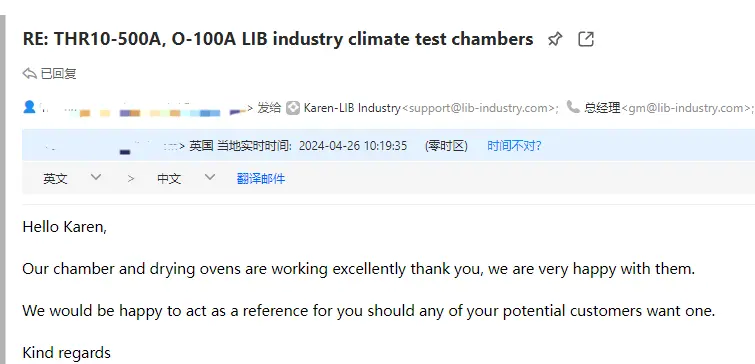
A testing lab using the LIB industry THR10-500A thermal cycling chamber reported that the equipment runs steadily and performs reliably, fully meeting their expectations.The chamber maintained smooth operation during continuous thermal cycling and rapid temperature changes, supporting long burn-in tests without interruption. It was used to evaluate automotive electronics such as sensors and control modules with stable and accurate results.It is also commonly applied in material aging, plastic parts, and battery testing, helping simulate real temperature conditions to improve product reliability.
Why Is Temperature Cycling Important for 5G Electronic Devices?
Millimeter-Wave Component Thermal Sensitivity
5G networks leverage frequencies extending from sub-6GHz bands to millimeter-wave spectrum approaching 40GHz, where component performance exhibits pronounced temperature dependence. Gallium nitride (GaN) power amplifiers, silicon-germanium low-noise amplifiers, and phase shifter arrays demonstrate frequency drift, gain variation, and phase error changes across operating temperature ranges. Temperature cycling chambers enable characterization of these thermal performance shifts, allowing RF engineers to implement calibration algorithms, select temperature-stable component grades, and design thermal management systems maintaining critical specifications throughout environmental exposure.
Coefficient of Thermal Expansion Mismatch
Modern 5G modules integrate diverse materials including organic substrates with CTE near 16ppm/°C, silicon dies at 2.6ppm/°C, copper interconnects at 17ppm/°C, and ceramic packages around 6ppm/°C. Rapid temperature transitions generate differential expansion creating interfacial shear stresses concentrated at solder joints, underfill boundaries, and die attach interfaces. Thermal cycling chambers programmed for aggressive transition rates (10-15°C/min) accelerate cumulative strain accumulation, revealing solder fatigue and delamination vulnerabilities requiring design optimization through improved materials selection, stress-relief geometries, or enhanced underfill formulations.
Field Deployment Environmental Extremes
5G infrastructure deployment spans diverse climates from Arctic installations to equatorial regions, outdoor macro cells to temperature-controlled data centers, and vehicle-mounted equipment experiencing engine compartment heat. This operational diversity demands validation across temperature ranges exceeding -40°C to +85°C with cycling frequencies matching diurnal patterns, seasonal transitions, or power cycling duty cycles. Environmental test chambers configured to application-specific thermal profiles ensure electronics survive worst-case deployment scenarios, reducing field failure rates and protecting manufacturers from costly warranty claims in global telecommunication networks.
Thermal Reliability Challenges in High-Frequency 5G Components

Ball Grid Array Solder Joint Fatigue
Advanced 5G processors, FPGAs, and RF transceivers utilize fine-pitch BGA packages with hundreds to thousands of solder interconnections vulnerable to thermomechanical fatigue. Temperature cycling induces cyclic strain as the silicon die and organic substrate expand at different rates, concentrating stress at peripheral solder balls experiencing maximum displacement. Temperature cycling test chambers executing 500-1000 thermal cycles between temperature extremes reveal failure distributions following Coffin-Manson relationships, enabling lifetime predictions and comparative evaluation of lead-free solder alloys, package underfill materials, and board-level stiffener reinforcements.
Multi-Layer PCB Delamination Risks
5G base station boards incorporate 12-20 copper layers within FR-4 or high-frequency laminates, creating z-axis CTE mismatch between copper planes and dielectric materials. Rapid thermal cycling generates shear stresses at layer interfaces, initiating delamination that compromises signal integrity through impedance discontinuities and creates moisture ingress pathways. Cross-sectional microsectioning of cycled test boards reveals incipient delamination before electrical failures manifest, validating laminate material selection, via-fill processes, and thermal relief geometries maintaining board integrity throughout accelerated aging equivalent to years of field operation.
Active Antenna System Thermal Management
Massive MIMO arrays integrating 64-256 active elements within compact enclosures generate substantial heat flux exceeding 0.5W/cm², demanding effective thermal dissipation to prevent performance degradation. Temperature cycling chambers equipped with power delivery through cable ports enable testing of complete antenna modules under operational RF transmission while subjecting enclosures to environmental temperature cycling. Thermal imaging during chamber testing reveals hot spot formation, validates heat sink effectiveness, and verifies that junction temperatures remain within semiconductor reliability limits during simultaneous high ambient temperature and maximum transmit power operation.
|
5G Component Type |
Critical Temperature Range |
Primary Thermal Failure Mechanism |
|
GaN Power Amplifiers |
-40°C to +125°C |
Threshold voltage drift, gain compression |
|
Silicon RF Transceivers |
-40°C to +105°C |
Phase noise degradation, oscillator instability |
|
BGA-Packaged Processors |
-40°C to +85°C |
Solder joint fatigue, underfill delamination |
|
Massive MIMO Arrays |
-40°C to +65°C (ambient) |
Junction overheating, thermal runaway |
Temperature Cycling Validation for 5G Communication Hardware
Small Cell Base Station Qualification
Small cells deployed on utility poles, building facades, and indoor venues experience rapid thermal transitions as electronics cycle between standby low-power states and peak traffic transmission modes while exposed to varying ambient conditions. Validation protocols subject complete small cell units to thermal cycling between -40°C and +65°C with programmed transitions simulating diurnal patterns and seasonal extremes. Continuous RF performance monitoring during cycling verifies that output power, error vector magnitude (EVM), and adjacent channel leakage ratio (ACLR) specifications remain compliant throughout environmental stress, ensuring network quality of service maintenance.
Customer Premises Equipment Environmental Testing
5G routers, femtocells, and fixed wireless access terminals installed in residences and businesses encounter diverse thermal environments from uninsulated attics reaching 70°C to basement installations near freezing temperatures. Thermal cycling chambers enable simultaneous testing of multiple CPE units executing standardized network traffic profiles while experiencing temperature transitions. Functional testing monitors throughput degradation, connection stability, and latency variations across thermal cycling, identifying thermal management deficiencies requiring improved ventilation design, component derating, or adaptive power management algorithms.
Automotive 5G Telematics Module Validation
Automotive integration subjects 5G communication modules to severe thermal cycling including -40°C cold soaks, +125°C under-hood temperatures, and rapid transitions during vehicle operation. AEC-Q100 automotive qualification standards mandate 1000+ thermal cycles between temperature extremes, with electrical parameter monitoring throughout cycling verifying continued functionality. Chamber testing reveals automotive-specific failure modes including connector thermal cycling degradation, encapsulant cracking from rapid transitions, and PCB warpage affecting module mounting interfaces, driving design hardening necessary for 15-year automotive service life requirements.
How Do Extreme Temperatures Affect 5G Signal Stability?
Phase-Locked Loop Frequency Drift
5G waveforms demand stringent frequency accuracy with phase noise specifications exceeding 4G requirements by 10dB or more to support higher-order modulation schemes like 256-QAM. Voltage-controlled oscillators and phase-locked loops exhibit temperature-dependent frequency drift through capacitor temperature coefficients, inductor thermal expansion, and semiconductor junction temperature effects. Temperature cycling test chambers with in-situ RF measurement capability enable characterization of frequency stability across operating temperature ranges, validating temperature compensation circuits and establishing operating margins ensuring compliance with 3GPP frequency error specifications below ±0.05ppm.
Signal-to-Noise Ratio Degradation Mechanisms
Low-noise amplifiers in 5G receivers must maintain noise figures below 2-3dB across millimeter-wave frequencies, with performance sensitive to bias current variations induced by temperature-dependent transistor characteristics. Chamber testing quantifies noise figure degradation as ambient temperature increases from -40°C to +85°C, revealing the thermal derating necessary to maintain sensitivity specifications. Additionally, thermal noise floor increases with absolute temperature following kTB relationships, establishing fundamental SNR limits that thermal management systems must address through active cooling in high-performance base station implementations.
Antenna Array Beam-Forming Accuracy
Phased array antennas achieving 5G beam steering through controlled phase shifts across array elements require phase accuracy better than ±5° to prevent beam squint and gain loss. Temperature gradients across large antenna arrays create differential phase shifts through transmission line length changes and phase shifter component variations. Environmental chambers large enough to accommodate complete antenna panels enable thermal gradient simulation, validating phase calibration algorithms that compensate for thermally-induced phase errors. Testing reveals whether real-time temperature sensing and adaptive calibration maintain beam-forming accuracy or whether passive thermal design achieving uniform temperature distribution proves necessary.
|
RF Performance Parameter |
Temperature Sensitivity |
Chamber Validation Method |
|
Frequency Error |
±0.05 ppm specification |
Continuous frequency counter monitoring |
|
Noise Figure |
0.01-0.03 dB/°C typical |
Network analyzer NF measurement |
|
Phase Shifter Accuracy |
0.5-1.0°/°C variation |
Vector network analyzer phase tracking |
|
Output Power |
0.01-0.02 dB/°C degradation |
Power meter continuous logging |
Accelerated Environmental Testing for 5G Infrastructure Equipment
Outdoor Macro Base Station Durability
Macro base stations mounted on towers and rooftops endure continuous outdoor exposure spanning decades, requiring exceptional long-term reliability despite daily thermal cycling and seasonal temperature extremes. Accelerated testing protocols compress 20-year deployment lifetimes into 6-12 month chamber programs through elevated cycling amplitude and increased transition rates. A typical protocol might execute 5000 cycles between -40°C and +75°C with 10°C/min transition rates, equivalent to approximately 15 years of daily diurnal cycling, validating that critical components including power supplies, RF modules, and cooling systems survive extended operational lifetimes.
IP-Rated Enclosure Seal Integrity
5G equipment enclosures rated IP65 or IP66 must maintain environmental sealing preventing moisture and dust ingress despite gasket compression set, thermal expansion of housing materials, and seal aging. Temperature cycling combined with humidity exposure reveals seal degradation mechanisms invisible in single-factor testing. Chambers program thermal cycles with high humidity during warm phases and condensation formation during cooling transitions, while enclosure internal monitoring detects moisture ingress indicating seal compromise. This testing validates gasket materials, compression retention, and enclosure design ensuring long-term environmental protection.
Power Supply Thermal Performance Verification
5G base stations incorporate high-efficiency power supplies converting AC mains or -48VDC telecom power to multiple regulated voltages supplying RF amplifiers, digital processors, and cooling systems. These power modules generate significant self-heating while simultaneously experiencing ambient temperature cycling, creating severe thermal stress conditions. Temperature cycling test chamber testing with full electrical loading enables junction temperature monitoring within power semiconductors, validating that thermal management maintains components below maximum rated temperatures. Cycling reveals capacitor degradation, transformer insulation breakdown, and thermal interface material pump-out requiring design improvements.
Reliability Assurance for 5G Modules Through Thermal Cycling
JEDEC Qualification Standards Compliance
Semiconductor industry standards including JESD22-A104 (temperature cycling) specify test conditions, sample sizes, and acceptance criteria for integrated circuit reliability qualification. 5G chipsets undergo 500-1000 cycles between -65°C and +150°C (or customer-specified temperature range) with specified dwell times and transition rates. Statistical analysis of failures versus cycle count generates Weibull distribution parameters supporting reliability predictions and field failure rate estimates. Passing JEDEC qualification establishes component credibility, facilitating customer acceptance and supporting warranty commitments for 5G infrastructure deployments.
Board-Level Reliability Testing Protocols
Complete 5G RF modules and baseband boards undergo board-level thermal cycling exceeding component-level testing severity to account for assembly-induced stresses from reflow soldering, conformal coating, and mechanical fixturing. IPC-9701 performance test methods specify cycling conditions between -40°C and +125°C for a minimum 500 cycles, with in-situ electrical testing detecting incipient failures before catastrophic opens or shorts occur. Resistance monitoring of daisy-chained test structures reveals solder joint cracking progression, enabling failure analysis correlation with microstructural damage mechanisms and validation of assembly process improvements.
Mean Time Between Failure Estimation
Accelerated thermal cycling data combined with field return statistics enables statistical MTBF calculations supporting warranty cost predictions and maintenance scheduling for deployed 5G networks. Arrhenius acceleration models and Coffin-Manson fatigue relationships translate chamber test results into field lifetime equivalence, accounting for temperature cycling amplitude, frequency, and mean temperature differences between test and deployment conditions. These quantitative reliability predictions inform business decisions regarding component derating, redundancy implementation, and preventive maintenance intervals optimizing total cost of ownership for telecommunication operators.
|
Test Protocol |
Temperature Range |
Cycle Count |
Application |
|
JEDEC JESD22-A104 |
-65°C to +150°C |
500-1000 cycles |
IC qualification |
|
IPC-9701 Level 3 |
-40°C to +125°C |
500+ cycles |
Board-level reliability |
|
AEC-Q100 Grade 2 |
-40°C to +105°C |
1000 cycles |
Automotive qualification |
|
Telcordia GR-63 |
-40°C to +65°C |
Custom profile |
Telecom equipment |
LIB Industry Temperature Cycling Chambers for High-Reliability 5G Electronics Testing
 |
 |
 |
 |
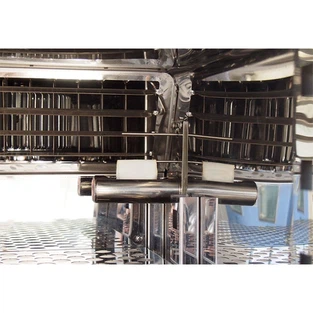 |
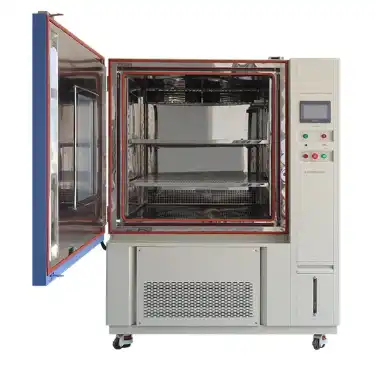
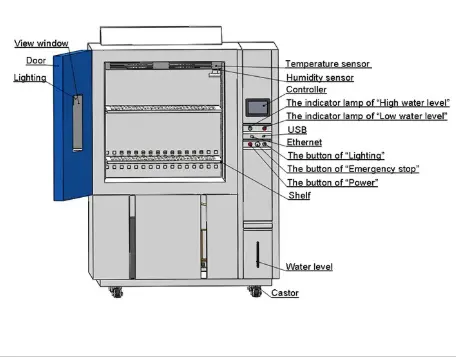
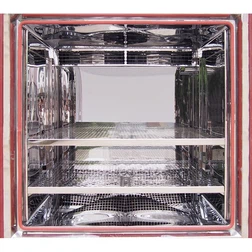
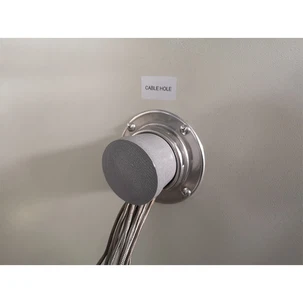
| Robust Workroom | Cable Hole | Temperature and Humidity Sensor |
Rapid Transition Rate Capabilities
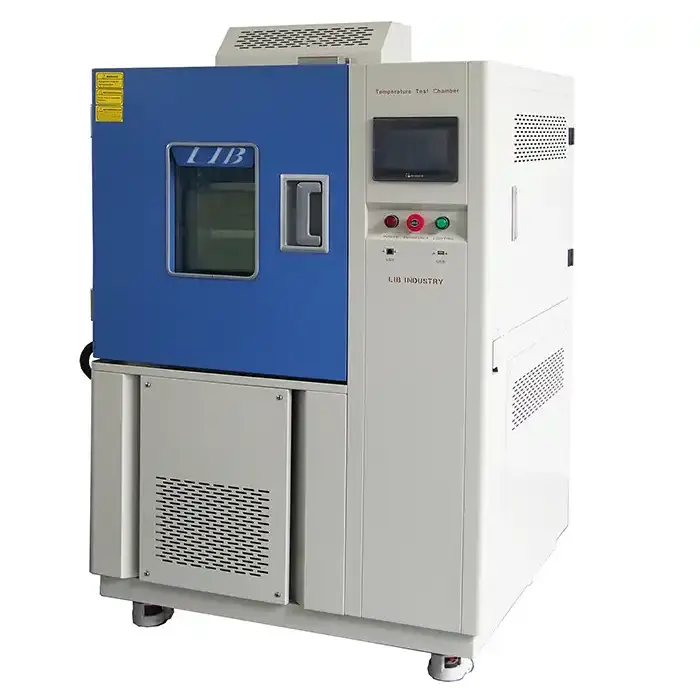
5G electronics testing demands aggressive thermal cycling transition rates matching or exceeding actual deployment scenarios including rapid power-state changes and environmental shock conditions. LIB Industry's TR5 series chambers achieve heating and cooling rates up to 15°C/min average throughout the chamber volume, with optional configurations supporting 20°C/min for extreme thermal shock applications. These rapid transitions compress testing timelines while imposing severe thermal stress conditions that reveal design vulnerabilities requiring multiple months of testing with conventional slower chambers. Programmable ramp rate control enables matching specific application thermal profiles from gradual diurnal cycling to rapid automotive ignition transients.
Precision Multi-Point Temperature Control
5G module testing requires exceptional temperature uniformity ensuring all test samples experience identical thermal stress despite chamber loading variations and self-heating from powered devices under test. LIB temperature cycling test chambers maintain temperature fluctuation within ±0.5°C and spatial deviation below ±2.0°C across chamber volumes ranging from 100L to 3000L capacity. High-precision PT100 Class A sensors with ±0.001°C resolution provide feedback for PID control algorithms, while optimized air circulation through centrifugal fan systems eliminates thermal stratification. This uniformity proves critical when conducting comparative reliability testing between component suppliers or design variants requiring statistically valid differentiation.
Programmable Complex Cycling Protocols
Modern 5G qualification testing executes elaborate multi-segment thermal profiles replicating field deployment patterns rather than simple two-point cycling between temperature extremes. LIB's programmable touchscreen controller stores up to 120 independent test programs, each containing 100 individual steps defining temperature setpoints, dwell times, transition rates, and repeat cycles. This flexibility enables programming of complex scenarios including seasonal temperature variations superimposed on diurnal cycling, intermittent high-temperature stress periods representing peak traffic loading, and extended cold-soak durations simulating overnight shutdown conditions. Automated program execution eliminates manual intervention throughout multi-month qualification campaigns.
Integrated Electrical Testing Capability
Functional performance validation throughout thermal cycling requires simultaneous electrical stimulation and measurement of devices under test. LIB chambers incorporate cable access ports supporting power delivery, RF signal routing, and data communication connections while maintaining thermal sealing integrity. Multiple ports accommodate testing configurations from simple DC power monitoring to complete automated test equipment integration measuring RF parameters, digital communication performance, and current consumption throughout cycling. Ethernet connectivity enables remote chamber monitoring and automated data correlation between environmental conditions and electrical performance measurements supporting comprehensive reliability characterization.
Conclusion
Temperature cycling validation has emerged as non-negotiable infrastructure supporting 5G electronics development, where thermal reliability determines network uptime, warranty costs, and competitive positioning in demanding telecommunications markets. Advanced thermal cycling chambers enable systematic characterization of temperature-dependent RF performance, accelerated aging revealing solder fatigue vulnerabilities, and qualification testing generating statistical reliability data. As 5G deployment expands globally across diverse climatic zones with increasingly complex millimeter-wave technologies, environmental simulation capabilities become essential differentiators between manufacturers delivering field-proven reliability versus those experiencing costly post-deployment failures.
FAQ
What thermal cycling profile best validates 5G base station outdoor deployment reliability?
Outdoor macro base station qualification typically requires 2000-3000 cycles between -40°C and +65°C with 5-10°C/min transition rates, incorporating periodic extended high-temperature dwells at +75°C representing solar loading conditions. This profile compresses approximately 8-10 years of daily thermal cycling into 6-9 month testing campaigns while maintaining correlation with field failure mechanisms.
How do temperature cycling chambers accommodate in-situ RF measurement of 5G devices?
Chambers provide cable access ports with flexible silicone seals or metal feed-through connectors supporting coaxial RF cables, fiber optic links, and multi-conductor power connections. Test fixtures within chambers position devices for optimal thermal exposure while maintaining RF connection integrity. Advanced configurations include internal RF-transparent windows enabling wireless over-the-air performance measurement.
Can temperature cycling testing predict solder joint reliability for fine-pitch 5G components?
Thermal cycling provides accelerated solder fatigue assessment following Coffin-Manson relationships where fatigue life correlates with temperature cycling amplitude and plastic strain per cycle. Testing fine-pitch BGAs through 500-1000 cycles generates failure distributions enabling statistical lifetime predictions. Correlation requires matching test cycling amplitude and mean temperature to anticipated field conditions.
What chamber volume accommodates complete 5G small cell or massive MIMO panel testing?
Individual small cell units fit within 225L-500L chambers, while massive MIMO antenna panels measuring 500mm × 500mm or larger require 800L-1000L chambers. Multi-unit parallel testing or complete cabinet-integrated base stations necessitate walk-in chambers spanning 2000L-5000L capacity with appropriate power delivery infrastructure supporting operational testing during environmental cycling.
Strengthen your 5G electronics reliability validation with advanced thermal cycling solutions from LIB Industry, a leading temperature cycling test chamber manufacturer and supplier serving global telecommunications equipment developers. Our engineering team delivers customized chamber configurations, application-specific thermal profile development, and comprehensive technical support ensuring your 5G products meet stringent reliability requirements. Contact our telecommunications testing specialists at ellen@lib-industry.com to discuss your thermal validation requirements and discover how our chambers accelerate reliable 5G product development.