How Do Solar Radiation Test Chambers Simulate UV and Heat Aging in Materials?
Materials exposed to solar environments face relentless degradation from two directions at once: ultraviolet radiation breaking molecular bonds, and elevated temperature accelerating the chemical reactions that follow. Solar panels, outdoor electronics, automotive components, and building materials must withstand decades of this combined assault without catastrophic failure. This article walks through how UV photons and thermal energy synergistically degrade polymers, coatings, and composite materials, the standards engineers test against, how degradation is actually measured, and what a solar radiation test chamber needs to deliver to produce trustworthy, standards-compliant data — closing with how LIB Industry's chamber platform and DHPV-04 photovoltaic configuration are built around these exact mechanisms.
Quick Answer
UV photons carry enough energy to sever polymer bonds directly, while heat multiplies the rate of every oxidation and hydrolysis reaction that follows through Arrhenius kinetics. Tested separately, a material can look stable. Tested together — as they always occur together outdoors — the same material can fail in a fraction of the time. That's why qualification standards for photovoltaic modules, automotive plastics, and building materials increasingly demand combined UV-heat(-humidity) exposure rather than isolated single-stress tests, and why solar radiation test chambers exist as a distinct equipment category from simple UV cabinets or heat ovens.
How UV Radiation Initiates Material Surface Degradation
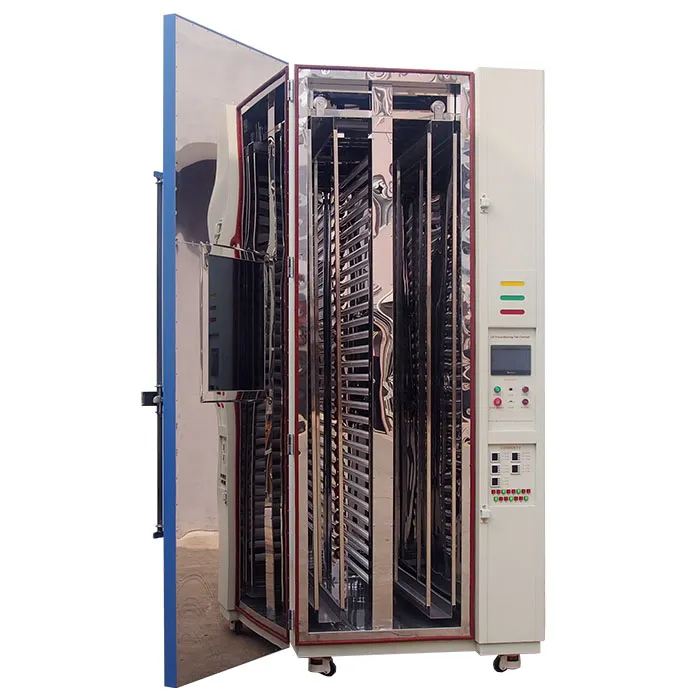 Photon energy and chemical bond cleavage. Ultraviolet radiation carries sufficient photon energy to directly break chemical bonds in polymer backbones and surface coatings. UV-B wavelengths (280–315nm) and UV-A wavelengths (315–400nm) possess energies ranging from roughly 300–400 kJ/mol, exceeding bond dissociation energies for carbon-hydrogen (~410 kJ/mol) and carbon-carbon (~350 kJ/mol) bonds. This photon absorption initiates chain-scission reactions that fragment long polymer molecules into shorter segments, immediately reducing molecular weight and mechanical strength.
Free radical generation and propagation. UV absorption creates highly reactive free radicals — molecular fragments with unpaired electrons seeking stabilization through reactions with neighboring molecules. These radicals propagate degradation throughout the material's surface layer through chain reactions. A single photon absorption event can trigger hundreds of subsequent bond-breaking reactions before radical termination occurs, which is why brief UV exposures cause disproportionate damage relative to the raw energy input.
Surface layer versus bulk material effects. UV radiation penetrates only micrometers into opaque materials, concentrating degradation in surface layers while leaving bulk properties initially unaffected. This creates a gradient structure: a severely degraded surface overlying a still-pristine interior. As surface layers embrittle and chalk away, fresh material is exposed to further UV attack. A solar radiation test chamber must run long enough to reveal this progressive erosion pattern — distinguishing superficial discoloration from structurally significant degradation.
Thermal Stress and Its Impact on Structural Stability
Temperature-dependent reaction kinetics. Elevated temperatures accelerate all chemical degradation processes through Arrhenius kinetics — reaction rates roughly doubling per 10°C increase. Materials tested at 85°C undergo oxidation, hydrolysis, and thermal decomposition at dramatically accelerated rates compared to ambient conditions, which is what allows years of outdoor exposure to be compressed into weeks of chamber testing, provided the underlying degradation mechanisms remain unchanged.
Glass transition and softening point considerations. Polymeric materials exhibit dramatic property changes at their glass transition temperature (Tg). Below Tg, polymers behave as rigid glasses; above Tg, they become flexible rubbers or viscous liquids. Solar exposure driving surface temperatures above Tg causes dimensional instability, creep deformation, and surface texture changes — coatings may flow and sag while structural plastics lose rigidity. A chamber range of -70°C to +150°C, as used in LIB's platform, encompasses the Tg boundaries of virtually all commercial polymers.
Thermal oxidation chain reactions. Atmospheric oxygen reacts with polymer chains at elevated temperatures through autoxidation. Thermal energy overcomes the activation barrier for oxygen insertion into carbon-hydrogen bonds, forming hydroperoxide intermediates. These unstable species decompose and generate additional free radicals that propagate oxidation throughout the material. Antioxidant additives interrupt these chain reactions, though their protective effect diminishes as stabilizers deplete — which is exactly what extended chamber testing is designed to quantify.
| Temperature Range | Dominant Mechanism | Typical Material Impact | Typical Chamber Duration |
|---|---|---|---|
| 25°C–50°C | UV photodegradation dominant | Surface discoloration, minor embrittlement | 1000–2000 hours |
| 50°C–85°C | Combined UV and thermal oxidation | Significant property loss, cracking | 500–1000 hours |
| 85°C–125°C | Thermal oxidation accelerated | Rapid degradation, potential melting | 100–500 hours |
| Above 125°C | Thermal decomposition initiated | Catastrophic failure, charring | Material-dependent |
Why UV and Heat Together Are Worse Than Either Alone
Multiplicative degradation acceleration. Combined UV and thermal exposure produces degradation exceeding the simple addition of individual effects. UV radiation creates reactive sites that thermal energy then exploits, while elevated temperatures increase oxygen diffusion rates that feed the oxidation reactions UV initiated. A material that survives UV exposure at cool temperatures, or heat without UV, can still fail rapidly once both stresses combine — which is exactly why solar simulation testing has to incorporate both factors together to reflect real outdoor conditions.
Photooxidation mechanisms. Photooxidation is the dominant degradation pathway for outdoor polymers: UV radiation initiates oxidation reactions that thermal energy then accelerates. Chromophoric impurities and degradation products absorb UV, creating excited states that react with oxygen. The hydroperoxides formed decompose thermally at rates that scale exponentially with temperature — this UV-temperature coupling is precisely why testing the two factors separately is inadequate for predicting combined-exposure performance.
Stabilizer depletion under combined stress. UV absorbers and hindered amine light stabilizers (HALS) protect polymers through complementary mechanisms — absorbers block UV penetration while HALS scavenge free radicals. Both stabilizer types deplete through consumption during protective action and through direct UV/thermal degradation, and combined UV-heat exposure accelerates that depletion beyond what either stress predicts alone. Tracking property retention throughout extended chamber exposure reveals the point where stabilizer exhaustion causes a sudden acceleration in degradation.
Encapsulant and adhesive interface vulnerabilities. Photovoltaic modules, electronic assemblies, and laminated structures rely on polymer encapsulants and adhesives to bond dissimilar materials. UV and heat combined attack these critical interfaces through differential thermal expansion generating mechanical stress, UV-initiated cross-linking causing embrittlement, and moisture-enhanced interfacial degradation. Chambers holding 85°C and 85% RH per IEC 61215 are specifically designed to stress these interfaces and reveal delamination and adhesion loss before it happens in the field.
Measuring Color Fading, Cracking, and Embrittlement
Colorimetric analysis of fading and yellowing. Spectrophotometric color measurement quantifies appearance change through CIE Lab* coordinates. The ΔE parameter represents total color change magnitude — values below 1.0 are barely perceptible while values exceeding 3.0 become obvious. UV exposure typically shifts polymer colors toward yellow through chromophore formation (increased b* values), while heat may darken materials (decreased L* values).
Surface crack density and propagation. Visual inspection under magnification reveals surface microcracking initiated by UV embrittlement. Digital image analysis quantifies crack density (cracks per unit area) and average crack depth, and periodic photography throughout testing documents crack initiation timing and propagation rate. Severe cracking indicates the surface layer has structurally failed — the material can no longer withstand applied stress without fracturing.
Gloss retention and surface roughness. Gloss meters measure specular reflectance at standardized angles (typically 60° or 20°), quantifying surface smoothness. UV degradation roughens surfaces through uneven erosion and microcracking, reducing gloss. Plotting gloss retention percentage versus exposure duration is a sensitive degradation indicator — even minor surface changes reduce gloss measurably before mechanical properties change. Materials retaining >80% gloss typically indicate good weathering resistance.
Mechanical property testing for embrittlement. Tensile testing reveals embrittlement through reduced elongation at break; severely UV-degraded polymers can fracture at minimal strain despite retaining tensile strength. Impact resistance testing measures brittleness directly. Periodic property measurement throughout chamber exposure establishes a degradation progression curve that supports service-life prediction.
| Property Measurement | Test Method | Significance | Typical Failure Criteria |
|---|---|---|---|
| Color change (ΔE) | Spectrophotometry | Aesthetic degradation | ΔE > 3–5 units |
| Gloss retention | Gloss meter at 60° | Surface integrity | <50% initial gloss |
| Crack density | Microscopy/imaging | Structural failure | Visible cracking |
| Tensile elongation | ASTM D638 | Embrittlement | <50% initial value |
| Impact strength | ASTM D256 | Brittleness | <70% initial value |
Standard Methods for UV and Heat Aging Evaluation
ASTM G154 – UV lamp accelerated weathering. Establishes protocols for fluorescent UV lamp exposure with condensation cycles. Cycle A (8 hours UV at 60°C, 4 hours condensation at 50°C) and Cycle B (4 hours UV at 60°C, 4 hours condensation at 50°C) are common selections. It doesn't reproduce full-spectrum solar radiation, but focused UV wavelengths accelerate photodegradation efficiently, and correlation studies relating G154 exposure to outdoor weathering support field-performance predictions.
ISO 4892 – artificial weathering methods. ISO 4892-2 specifies xenon arc lamp exposure providing broad-spectrum radiation matching natural sunlight — UV, visible, and infrared — producing degradation mechanisms closely resembling outdoor exposure. ISO 4892-3 addresses fluorescent UV lamps for cost-effective accelerated testing.
IEC 61215 – photovoltaic module qualification. Solar panel certification requires 15 kWh/m² UV preconditioning followed by 1000-hour damp-heat testing at 85°C/85% RH. This combined UV-heat-humidity exposure stresses encapsulants, backsheets, and interconnections, revealing degradation mechanisms active during decades of field deployment. LIB Industry's DHPV-04 chamber targets these requirements specifically, holding temperature fluctuation within ±0.5°C and humidity deviation within ±2.5% RH.
SAE J2527 – automotive weathering. Automotive exterior components undergo rigorous xenon-arc weathering per SAE J2527, which specifies irradiance levels, black-panel temperature, and water spray cycles replicating vehicle service conditions. Materials must demonstrate color stability, gloss retention, and mechanical property preservation — meeting these requirements demands precise environmental control, with temperature deviation held within ±2.0°C for repeatable results.
Choosing the Right Chamber: DHPV-04 vs. Standard UV Weathering Testers
| Capability | Standard Fluorescent UV Tester | LIB DHPV-04 Solar Radiation Chamber |
|---|---|---|
| Radiation source | Narrow-band UV only | Integrated UV, temperature, and humidity control |
| Temperature range | Typically ~60–70°C | -70°C to +150°C |
| Humidity control | Condensation cycling only | 10%–98% RH, independently programmable |
| Specimen size | Small coupons | Full PV panels up to 2M × 1M, 4–12 panels per run |
| Standards coverage | ASTM G154 | IEC 61215, ISO 4892, SAE J2527, plus custom multi-stage profiles |
| Best suited for | Material screening, R&D coupons | Full-module qualification, production QC, third-party certification |
For coupon-level material screening, a compact UV cabinet is often sufficient. Once testing moves to full-size photovoltaic modules, automotive assemblies, or products requiring formal IEC/ISO qualification data, an integrated chamber becomes necessary to reproduce combined UV-heat-humidity stress on real components rather than small samples.
Enhancing Material Durability Based on Aging Test Results
UV absorber and stabilizer optimization. Chamber testing comparing formulations with varying UV stabilizer packages identifies the optimal protective system. Benzotriazole and benzophenone UV absorbers prevent photon penetration, while HALS scavenge degradation-initiating free radicals; synergistic combinations often outperform individual stabilizers, and testing quantifies exactly how much. Loading optimization then balances cost against performance to find the minimum effective concentration.
Pigment selection for photostability. Pigments profoundly affect UV resistance. Titanium dioxide provides excellent UV screening but may catalyze polymer degradation through photocatalytic activity unless surface-treated. Carbon black offers superior UV protection through complete light absorption. Organic pigments vary widely in photostability, so comparative weathering testing of candidate pigments is what actually guides color selection for outdoor applications.
Surface coating and barrier layer strategies. Sacrificial UV-resistant coatings — fluoropolymers, polysiloxanes, ceramic layers — protect underlying substrates by absorbing damaging radiation before it reaches vulnerable material. Chamber testing validates coating adhesion under thermal cycling and UV-induced embrittlement resistance, and helps determine the minimum viable coating thickness that still delivers protection.
Material substitution and engineering polymer selection. Testing may reveal that commodity polymers can't adequately resist combined UV-heat exposure for a given application. Engineering polymers like polycarbonates, polyetherimides, or liquid crystal polymers offer superior durability at a premium price — chamber data is what justifies (or avoids) that upgrade with a defensible cost-benefit case.
LIB Industry's Solar Radiation Chamber Platform
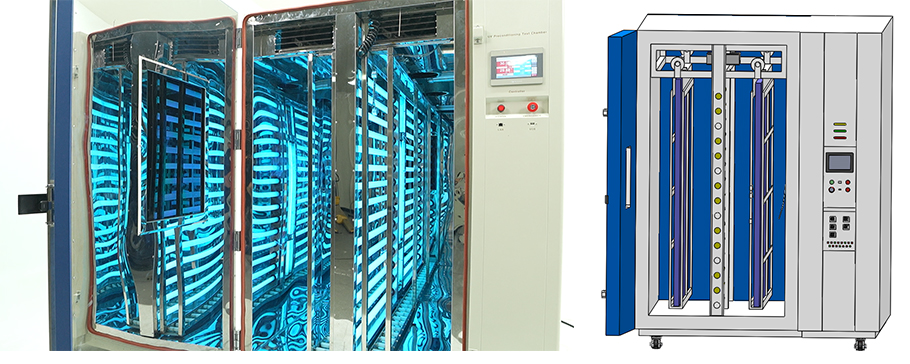
LIB Industry designs its solar radiation test chambers around the UV-heat coupling described above, rather than treating radiation, temperature, and humidity as separate add-ons.
Comprehensive environmental control across -70°C to +150°C and 10%–98% RH within a single system, eliminating the specimen transfer between separate chambers that breaks continuous stress exposure.
DHPV-04 photovoltaic configuration — a 1220L internal volume accommodating panels up to 2M × 1M, with 4/6/8/10/12-panel capacity, adjustable SUS304 stainless steel shelving, and standard cable ports (50mm, 100mm, or 200mm) for live electrical performance monitoring during exposure.
PT-100 Class A temperature sensing delivering 0.001°C resolution real-time monitoring, holding temperature fluctuation within ±0.5°C across 1000-hour test durations.
Programmable multi-stage exposure profiles for UV preconditioning followed by damp heat, thermal cycling interspersed with UV exposure, or step-stress protocols — executed automatically without manual intervention.
Energy-efficient operation, with advanced insulation (polyurethane foam and insulation cotton) and optimized refrigeration/heating systems that reduce operating cost across extended 1000-hour-plus test campaigns.
Turn-key delivery — specification consultation, custom configuration, manufacturing, installation commissioning, operator training, and ongoing global technical support.
| LIB Chamber Feature | Specification | Testing Advantage |
|---|---|---|
| Temperature range | -70°C to +150°C | Covers all material Tg and decomposition temperatures |
| Temperature accuracy | ±0.5°C fluctuation, ±2.0°C deviation | Ensures repeatable degradation kinetics |
| Humidity range | 10% to 98% RH | Enables damp-heat and hygrothermal testing |
| Humidity accuracy | ±2.5% RH deviation | Maintains consistent moisture stress |
| Panel capacity | 4–12 pieces (2M × 1M) | Supports statistical validation testing |
| Test duration | 1000+ hours continuous | Meets IEC 61215 requirements |
Recommended LIB Products
|
DHPV-04 Solar Radiation Test Chamber – Full PV-module UV/heat/humidity qualification, 4–12 panel capacity, IEC 61215-ready. |
– Broad-spectrum solar simulation for ISO 4892-2 and SAE J2527 material and component testing. |
– For qualifying larger assemblies or multiple products simultaneously under combined temperature/humidity stress. |


FAQ
How do xenon arc lamps differ from fluorescent UV lamps in material aging testing? Xenon arc lamps provide broad-spectrum radiation (UV, visible, infrared) closely matching natural sunlight's spectral distribution, producing degradation mechanisms resembling outdoor exposure. Fluorescent UV lamps emit narrow-band UV wavelengths, maximizing photodegradation acceleration but potentially missing degradation pathways activated by visible/IR radiation. Xenon testing offers superior field correlation while UV lamps provide faster, lower-cost screening.
What exposure duration in solar simulation chambers equates to one year of outdoor weathering? Acceleration factors vary dramatically by material, geography, and chamber conditions — there is no universal conversion. Arizona desert exposure (high UV, elevated temperature) degrades materials faster than Nordic climates. Typical acceleration factors range from 3× to 10×, meaning 1000 chamber hours might represent 1–3 years outdoors. Establishing material-specific correlations requires parallel chamber and outdoor exposure testing.
Can solar radiation chambers test materials other than photovoltaic panels? Yes — solar chambers test any material facing outdoor UV-heat exposure, including automotive plastics, building materials, outdoor electronics, roofing membranes, textile fabrics, and coatings. While LIB's DHPV-04 optimizes for photovoltaic panels, the temperature-humidity-UV control principles apply universally; LIB's engineering team can adjust chamber dimensions and mounting for non-panel specimens.
What after-sales support does LIB provide once a chamber is installed? LIB's support covers installation commissioning, operator training, calibration guidance, and ongoing technical assistance through a global service network — so customers running long-duration, multi-stage test campaigns aren't left to troubleshoot equipment issues on their own during a 1000-hour test.
Which other LIB chambers pair well with solar radiation testing? Customers frequently combine solar radiation testing with LIB's thermal shock chambers (for rapid hot/cold cycling stress on the same materials) and salt spray/corrosion chambers (for coastal or industrial-atmosphere qualification), building a fuller weathering and durability profile from a single equipment supplier.
Conclusion
Understanding UV and heat aging mechanisms — bond cleavage, free-radical propagation, Arrhenius-accelerated oxidation, and the multiplicative effect of running both stresses together — is what enables intelligent material selection and formulation optimization for outdoor applications. Solar radiation test chambers compress decades of exposure into weeks of controlled testing, providing the data needed to predict field performance rather than discover failures after the fact. If you're specifying a chamber for photovoltaic qualification, automotive components, or general outdoor material validation, LIB Industry's engineering team can help match chamber configuration, standards coverage, and test protocol to your product. Contact our weathering test specialists at ellen@lib-industry.com to discuss your UV and heat aging evaluation needs.