How Do Climatic Test Chambers Evaluate Plastic Material Aging?
Plastic materials degrade silently over time — sunlight breaks molecular bonds, moisture infiltrates polymer matrices, and temperature fluctuations accelerate chemical reactions that compromise mechanical properties. For engineers and procurement teams, the real question is simple: how do you predict years of field failure before a product ever ships?
This article answers that question by walking through the science of plastic aging, the climatic test chamber methods used to simulate it, the international standards that govern testing, and how LIB Industry's climatic test chambers help manufacturers turn accelerated aging data into confident material and formulation decisions. Along the way you'll find comparison tables, real test parameters, a customer case, and answers to the questions engineers ask most.
Why Do Climatic Conditions Accelerate Plastic Material Degradation?
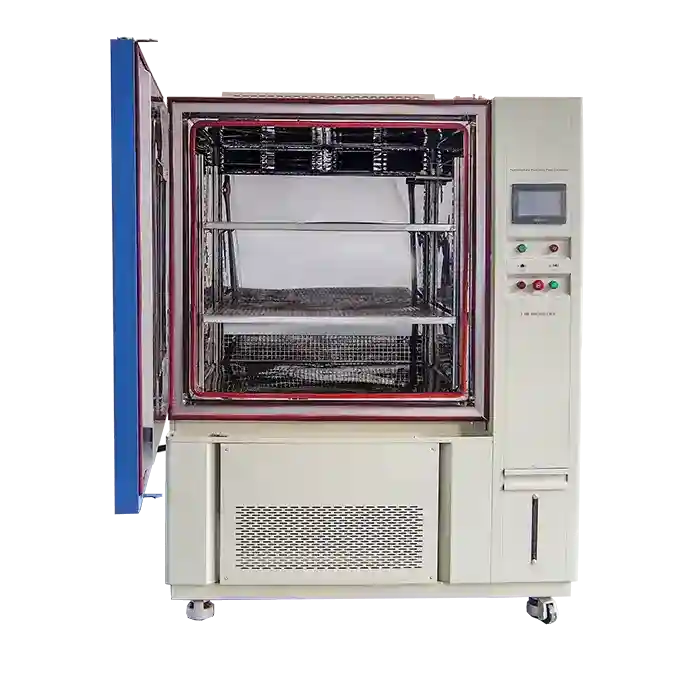 Short answer: heat, humidity, oxygen, and UV radiation each trigger a distinct chemical degradation pathway, and climatic test chambers combine them in controlled, repeatable doses to compress years of aging into weeks.
Arrhenius Relationship: Why Temperature Speeds Up Plastic Failure
Polymer degradation broadly follows Arrhenius kinetics — reaction rates roughly double for every 10°C increase in temperature. This is the physical basis for all accelerated aging testing. Running polypropylene at 80°C for 1,000 hours can approximate several years of degradation at room temperature. Climatic test chambers exploit this principle by holding elevated temperatures precisely while degradation is tracked, but the acceleration factor is material-specific and depends on each polymer's activation energy.
Hygrothermal Aging: How Heat + Humidity Break Down Polymer Chains
Combined temperature and moisture exposure drives hydrolysis, which cleaves polymer chains — especially in condensation polymers like polyesters, polyamides, and polycarbonates. Water molecules attack ester linkages, shortening chains and reducing both molecular weight and mechanical strength. This hygrothermal effect is minimal at low temperatures but escalates sharply once heat and humidity combine, which is why damp-heat protocols at 85°C/85% RH are an industry benchmark for hydrolytic stability.
Oxidative Degradation: The Role of Environmental Oxygen
Atmospheric oxygen reacts with polymer chains to form carbonyl groups, cross-links, and chain scission. Higher temperatures lower the activation energy barrier, so oxidative attack intensifies as chamber temperature rises. Antioxidant packages delay this process by scavenging free radicals — but only testing under realistic climatic conditions reveals how fast that protection depletes and at what temperature threshold oxidation starts to dominate.
How Do UV, Temperature, and Humidity Together Damage Polymer Structure?
Photodegradation: What UV Radiation Does to Polymer Backbones
UV radiation carries enough energy to break carbon-carbon and carbon-hydrogen bonds. Wavelengths below 400nm trigger free-radical reactions that propagate through the material, causing surface embrittlement and discoloration while the interior stays comparatively protected. UV stabilizers intercept this damage, but their effectiveness fades over time — which is exactly what accelerated UV/climatic testing is designed to quantify.
Glass Transition Temperature Shift: Why Humidity Makes Plastic "Soft"
Moisture absorption plasticizes polymer matrices, lowering the glass transition temperature (Tg) and changing mechanical behavior. Polyamides are a striking example — absorbing several percent water by weight and shifting from rigid to rubbery well below their dry-state Tg. Climatic chambers that sweep humidity from 20% to 98% RH expose this sensitivity across the full operational envelope.
Thermal Cycling Stress: How Expansion and Contraction Cause Cracking
Temperature cycling drives repeated expansion and contraction. In multi-material assemblies combining polymers with metal or ceramic, differential expansion builds interfacial stress that accumulates as fatigue damage. Wide swings — for example -40°C to +150°C — accelerate this stress buildup and reveal delamination or cracking risks far faster than constant-condition exposure.
| Environmental Factor | Primary Degradation Mechanism | Affected Polymer Types | Typical Testing Range |
|---|---|---|---|
| UV radiation | Photodegradation, chain scission | Polypropylene, polystyrene, PVC | Ambient to +60°C |
| High temperature | Thermal oxidation, chain scission | Polyolefins, polyesters | +80°C to +150°C |
| High humidity | Hydrolysis, plasticization | Polyamides, polyesters, polycarbonates | +40°C to +85°C at 85% RH |
| Temperature cycling | Thermal fatigue, interfacial stress | Multi-material assemblies | -40°C to +125°C cycling |
What Are the Key Indicators Engineers Should Track During Plastic Aging Tests?
Tensile strength & elongation at break — the most direct mechanical indicator. Strength typically falls as chain scission reduces molecular weight; elongation usually drops even faster as the material embrittles.
Molecular weight reduction — tracked via GPC (gel permeation chromatography), this reveals chain scission extent and correlates strongly with mechanical loss.
Surface discoloration and gloss loss — yellowing, chalking, and gloss reduction are visible screening signals that track with subsurface degradation.
Dimensional stability and warpage — moisture swelling and thermal expansion create internal stress gradients, especially problematic in glass-filled composites with anisotropic expansion.
Which Climatic Chamber Test Methods Best Simulate Long-Term Plastic Exposure?
| Test Protocol | Conditions | Typical Duration | Primary Application |
|---|---|---|---|
| Damp heat | 85°C / 85% RH constant | 1,000 hours | Hydrolysis resistance |
| Thermal aging | +125°C dry constant | 500–2,000 hours | Thermal oxidation stability |
| Temperature-humidity cycling | -40°C to +85°C/85% RH | 200–500 cycles | Multi-stress durability |
| Step-stress | Progressive temperature increase | Variable | Failure threshold identification |
|
|
|||

Correlating chamber results with real-time outdoor exposure (per ASTM D1435) is what validates the acceleration factor — well-designed testing should reproduce natural degradation mechanisms, not introduce artificial failure modes from over-aggressive conditions.
Which Standards Govern Plastic Aging and Environmental Durability Testing?
ISO 4892 (Parts 2 & 3) — xenon arc and fluorescent UV lamp exposure simulating natural sunlight, specifying irradiance, temperature, and moisture patterns.
ASTM D1435 — outdoor weathering procedures used as the ultimate real-world validation benchmark.
IEC 60068-2-78 — damp heat steady-state testing at 85°C/85% or 93% RH from 96 hours to several thousand hours, widely applied to plastic enclosures.
SAE J1960 — automotive exterior material testing combining UV, heat, and moisture spray; interior trims are additionally tested per ISO 105 colorfastness standards.
How Do LIB Climatic Test Chambers Solve Real-World Plastic Aging Testing Challenges?
 |
 |
|
|
|
|
|
|
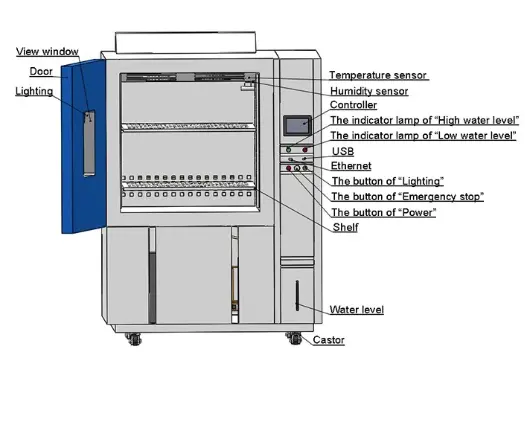
| Robust Workroom | Cable Hole | Temperature and Humidity Sensor | PID controller | |


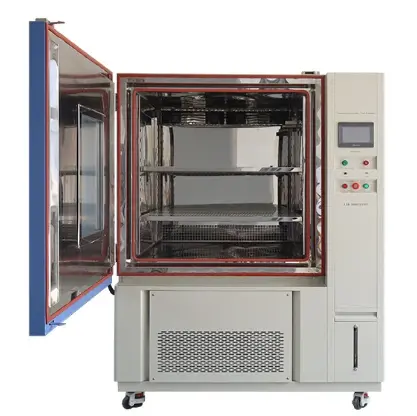
Meeting these standards in a lab setting requires more than a temperature-controlled box — it requires precision, repeatability, and flexibility across a wide range of specimen sizes and test protocols. This is where LIB Industry climatic test chambers are purpose-built for polymer and material aging validation:
Wide environmental range: -86°C to +150°C temperature, 10%–98% RH humidity — covering everything from arctic cold storage to tropical damp-heat qualification in a single system.
Tight control tolerances: ±0.5°C temperature stability and ±2.5% RH humidity deviation, using French TECUMSEH compressors and ceramic-core nichrome heaters, so aging mechanisms proceed consistently across long test campaigns.
Flexible chamber sizing: five standard models from 100L to 1,000L, accommodating everything from material coupons to full automotive assemblies.
Advanced programmability: color LCD touchscreen supporting 120 programs with 100 segments each, enabling complex cycling and step-stress profiles, with multilingual interfaces and Ethernet/USB data logging.
Layered safety protection: dry-combustion protection, over-temperature protection, refrigerant high-pressure protection, water-shortage protection, and earth leakage protection — built for unattended multi-week runs.
Contamination-free humidity generation: integrated water purification and stainless-steel surface evaporation humidifier design to protect specimens from mineral deposit contamination.
LIB Chamber Model Comparison
| Model | Internal Dimensions (mm) | Volume (L) | Temperature Range | Humidity Range | Typical Application |
|---|---|---|---|---|---|
| TH-100 | 400 × 500 × 500 | 100 | -20/-40/-70°C to +150°C | 20%–98% RH | Small components, material coupons |
| TH-225 | 500 × 600 × 750 | 225 | -20/-40/-70°C to +150°C | 20%–98% RH | Electronic housings, connectors |
| TH-500 | 700 × 800 × 900 | 500 | -20/-40/-70°C to +150°C | 20%–98% RH | Automotive components, appliance parts |
| TH-800 | 800 × 1000 × 1000 | 800 | -20/-40/-70°C to +150°C | 20%–98% RH | Large assemblies, multiple specimens |
| TH-1000 | 1000 × 1000 × 1000 | 1000 | -20/-40/-70°C to +150°C | 20%–98% RH | Complete systems, furniture components |
Small chamber vs. large-volume chamber — which do you need? A TH-100 or TH-225 suits R&D teams screening candidate formulations or running material coupon comparisons, where sample volume is small but test throughput matters. A TH-800 or TH-1000 fits production QA or automotive suppliers validating full assemblies or multiple parallel specimens under identical conditions. Choosing the right size avoids paying for chamber capacity you don't need while ensuring your largest test article actually fits with adequate airflow clearance.
Customer Case: Validating Automotive Trim Durability with a LIB TH-500
An automotive interior trim supplier needed to qualify a new polypropylene compound against SAE J1960 exterior aging requirements ahead of a model-year launch. LIB's engineering team specified a TH-500 chamber configured for -40°C to +85°C/85% RH cycling, then supported on-site installation and operator training. Over a 500-cycle test campaign, the supplier tracked tensile retention and surface gloss at scheduled intervals, catching an antioxidant formulation gap early enough to reformulate before tooling was finalized. LIB's after-sales team remained available throughout the campaign to support controller programming and calibration questions.
LIB Recommended Products for Plastic Aging and Weathering Testing
Beyond the standard climatic chamber sizes above, plastic aging programs often call for complementary equipment covering UV, xenon-arc, and thermal-shock exposure. LIB's product line covers each of these test needs:
|
— fluorescent UV-lamp exposure per ISO 4892-3, purpose-built for photodegradation, discoloration, and gloss-loss evaluation without the cost of a full xenon system. |
Xenon Arc Weathering Test Chamber — broadband UV-visible-IR exposure per ISO 4892-2, simulating full-spectrum sunlight for automotive exterior and outdoor-product qualification where correlation with natural weathering matters most. |
— rapid hot/cold transfer testing for multi-material assemblies where thermal-cycling fatigue and interfacial cracking (rather than gradual chemical aging) is the primary failure mode. |
Salt Spray / Corrosion Test Chamber — commonly paired with climatic aging for automotive and appliance components that must withstand combined humidity and corrosive exposure. |
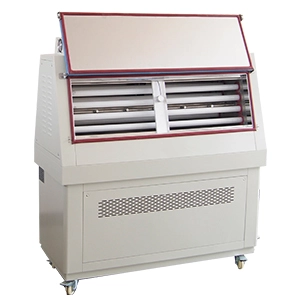
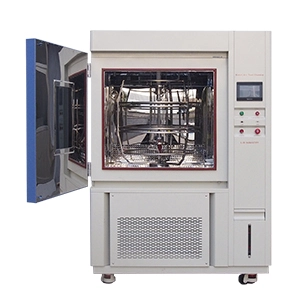


Each product page includes full technical specifications, and LIB's engineering team can also combine two or more of these test methods into a single custom system — for example, a climatic chamber with an integrated UV module — when your test plan calls for combined-stress exposure in one chamber.
FAQ
1. How do I determine the right acceleration factor for plastic aging tests?
Acceleration factors are derived from the Arrhenius equation, comparing degradation rates at test versus service temperature using the material's activation energy (typically 80–120 kJ/mol for polymer oxidation). Testing at multiple temperatures lets you calculate this experimentally, and correlating results against real-time field or outdoor exposure data is essential to confirm accuracy.
2. Can a climatic chamber combine UV exposure with temperature and humidity control?
Yes. Advanced chambers integrate xenon arc UV systems with programmed temperature-humidity control to reveal synergistic effects, where UV-initiated damage accelerates under heat and moisture. LIB's engineering team designs custom integrated systems for this combined exposure testing.
3. What is the minimum test duration for meaningful plastic aging results?
It depends on the material and required confidence level. IEC 60068-2-78 uses 1,000 hours of damp heat as a baseline. Highly stable engineering plastics may need 2,000–5,000 hours, while commodity polymers often show measurable change within 500–1,000 hours. Testing at multiple timepoints builds a degradation curve for extrapolation.
4. Does LIB provide after-sales support and warranty coverage for climatic test chambers?
Every LIB chamber is backed by a 3-year warranty with lifetime service support, so you're covered well beyond initial installation. LIB's global service centers in Malaysia, Canada, the UK, and the US, plus 29 international distributors, ensure fast local technical response.
5. Can LIB deliver a fully non-standard or custom climatic chamber for unusual test requirements?
Yes — LIB's engineering team regularly designs non-standard chambers, including modified dimensions, integrated UV exposure modules, and specialized specimen fixtures. This is supported end-to-end through LIB's one-stop service model: consultation, custom configuration, manufacturing, installation, commissioning, and operator training all handled by one team.
6. Is LIB equipped to manufacture at scale for large or repeat orders?
Yes. LIB operates a full production line under ISO 9001 quality management, with CE certification and third-party validation from SGS and TUV, so procurement teams sourcing multiple units or recurring orders get consistent build quality across the entire batch.
Ready to Validate Your Plastic Formulation?
Reliable plastic aging data starts with precise, repeatable climatic testing. Whether you need a compact chamber for formulation screening or a full-scale system for production qualification, LIB Industry's engineering team can help you specify the right chamber, protocol, and test plan for your standard — from ISO 4892 to IEC 60068-2-78 to SAE J1960.
Contact LIB's materials testing specialists at ellen@lib-industry.com to request a quote, technical proposal, or custom chamber configuration for your plastic aging evaluation needs.