Why Do Temperature Fluctuations Cause Product Degradation?


Temperature is rarely static in the real world. A vehicle dashboard alternates between frigid winter mornings and scorching summer afternoons. A circuit board inside a satellite endures cryogenic darkness and intense solar radiation in minutes. Every material in a product - polymer, metal, ceramic, adhesive - responds to these shifts differently, and that mismatch is where degradation originates.
Differential Thermal Expansion Creates Hidden Stress
Every solid material has a coefficient of thermal expansion (CTE). When two bonded materials - say, a copper trace on an FR4 board - have diverging CTEs, heating pulls them in different directions. Over many cycles, this hidden mechanical stress accumulates at interfaces, eventually initiating cracks invisible to routine inspection.
Chemical Kinetics Accelerate at Elevated Temperatures
The Arrhenius relationship confirms that every 10°C rise roughly doubles the rate of electrochemical reactions. Oxidation, corrosion, and polymer chain scission all accelerate under heat excursions, meaning a product that looks pristine after assembly may harbor accelerating degradation invisible until catastrophic failure.
Moisture Absorption Amplifies Thermal Damage
Many polymers and composite materials absorb atmospheric moisture. When temperature spikes, entrapped moisture vaporizes rapidly - a phenomenon engineers call "popcorning" in semiconductor packages. The resulting pressure pulse can delaminate layers and fracture encapsulants without any external mechanical load being applied.
Thermal Expansion and Contraction Effects on Materials
Understanding how different material classes respond to temperature change is essential before designing any thermal cycling protocol. The damage mechanisms vary significantly between metals, polymers, and composite assemblies.
| Material Class | Typical CTE (ppm/°C) | Primary Failure Mode | Relevant Industry |
|---|---|---|---|
| Copper (conductive traces) | 17 | Solder joint fatigue | Electronics |
| FR4 PCB substrate (Z-axis) | 50–70 | Plated through-hole cracking | Electronics |
| Aluminium alloy | 23 | Fretting at fastener interfaces | Aerospace / Automotive |
| Silicone elastomer | 150–300 | Compression-set, seal loss | Medical / Automotive |
| Carbon-fibre composite | 0–2 (fibre dir.) | Matrix microcracking | Aerospace |
| Soda-lime glass | 9 | Edge chipping from CTE mismatch | Optics / Automotive |
Intermetallic Growth at Solder Joints
Repeated heating drives tin-copper and tin-silver intermetallic compound growth at solder interfaces. These brittle layers degrade joint ductility over time, making assemblies increasingly susceptible to vibration-induced fracture - a compounding failure pathway particularly dangerous in automotive electronics.
Polymer Viscoelastic Creep
Thermoplastic housings soften at elevated temperatures and relax under sustained load, a process called creep. Upon cooling, the material re-solidifies in a deformed state, causing dimensional drift that can misalign optical components, compromise connector retention, or open gaps in weather seals.
Composite Microcracking Networks
Carbon-fibre-reinforced polymers exhibit near-zero CTE along fibres but significant expansion transverse to them. Cyclic stress accumulates in the matrix resin between fibres, generating microcrack networks that progressively reduce structural stiffness and create pathways for fluid ingress in aerospace structures.
Key Parameters in Thermal Cycling Test Procedures
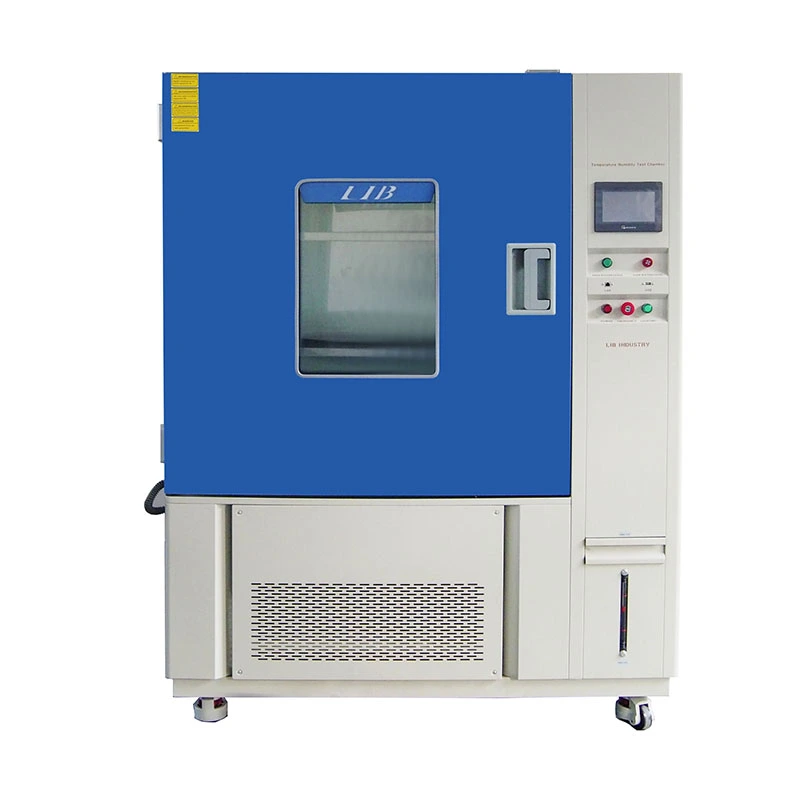 A thermal cycling test is only as meaningful as the parameters governing it. Selecting inappropriate ramp rates or soak durations can either under-stress a product - missing real failure modes - or over-stress it artificially, generating failures irrelevant to actual service conditions.
Temperature Range and Extremes
LIB Industry's TR5 series supports three standard ranges: −20°C to +150°C (Type A), −40°C to +150°C (Type B), and −70°C to +150°C (Type C). The choice depends on the product's operational environment. Automotive under-hood electronics typically need −40°C coverage; avionics and satellite subsystems often require −70°C or beyond.
Ramp Rate Selection
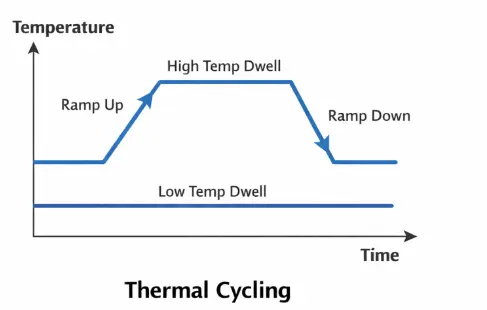
Ramp rate - how quickly the thermal cycling equipment transitions between temperature extremes - governs the mechanical severity of each cycle. LIB Industry chambers offer selectable ramp rates of 5°C/min, 10°C/min, and 15°C/min. Faster ramps amplify thermal gradient stresses within components but may not represent real-world exposure for slow-cycling environments like pharmaceutical cold chains.
Soak Time and Cycle Count
Soak time - the dwell period at each temperature extreme - allows the specimen to reach thermal equilibrium throughout its mass. Insufficient soak time means internal stress never fully develops, reducing test severity. Cycle count is determined by the desired acceleration factor relative to field use, often guided by Coffin-Manson fatigue models for solder joints.
| Parameter | Typical Range (LIB TR5 Series) | Governing Standard Reference |
|---|---|---|
| Low temperature limit | −20°C / −40°C / −70°C | IEC 60068-2-14, MIL-STD-810 |
| High temperature limit | +150°C | IEC 60068-2-14 |
| Temperature ramp rate | 5 / 10 / 15 °C/min (selectable) | JESD22-A104 |
| Temperature stability | ±0.5°C | IEC 60068-3-5 |
| Uniformity deviation | ±2.0°C | IEC 60068-3-5 |
| Interior volume | 100L to 1000L (standard) | Customer specification |
 |
||
Simulation of Repeated Temperature Transitions in Test Chambers
Modern thermal cycling chambers are precisely engineered environments - not simply refrigerators with heaters bolted on. Achieving reliable, repeatable results demands careful attention to airflow design, refrigeration architecture, and control algorithms.
Programmable Controller with Ethernet Connectivity
LIB Industry chambers feature a programmable colour LCD touchscreen controller with Ethernet connectivity and PC Link software. Engineers can pre-define multi-segment temperature profiles - ramp, soak, loop, and alarm conditions - that execute autonomously. Data logging via USB allows post-test analysis without disrupting active experiments.
Dual-Stage Refrigeration for Deep Cold Performance
Reaching −70°C reliably requires a cascaded mechanical compression refrigeration system. LIB Industry integrates French TECUMSEH compressors, selected for their documented reliability under continuous duty cycles. The cascaded architecture - one refrigerant circuit pre-cooling the second - provides the sustained cooling capacity needed without the instability of single-stage systems at extreme low temperatures.
Centrifugal Air Circulation for Uniform Specimen Exposure
Temperature uniformity within the working volume is non-negotiable. LIB Industry chambers use centrifugal wind fans to maintain ±2.0°C spatial deviation across the working volume, ensuring every test specimen - regardless of position on the SUS304 stainless steel shelves - experiences the same thermal profile. Hotspots or cold zones would produce inconsistent failure data, undermining the entire test rationale.
Detection of Fatigue, Cracking, and Material Deformation
One of the primary values of thermal cycling testing is its ability to surface failure modes that only emerge after repeated mechanical loading - the kind of gradual damage that neither a one-time thermal shock test nor a visual inspection can reliably uncover.
In-Situ Electrical Monitoring
A standard 50 mm cable feedthrough (expandable to 100 mm or 200 mm on LIB Industry chambers) allows continuous electrical monitoring during the test. Resistance measurements of solder joints, signal continuity checks for connectors, and leakage current monitoring for insulators can all run uninterrupted through cycling, capturing the precise cycle at which a fault first appears.
Post-Test Cross-Section Analysis
After cycling, specimens are typically cross-sectioned and examined under scanning electron microscopy (SEM) or optical microscopy to quantify crack propagation depth, intermetallic thickness, and void formation. This post-mortem analysis transforms qualitative observations into measurable failure metrics that feed directly into design improvement cycles.
Vibration-Superimposed Cycling for Compounding Stress
For automotive and aerospace applications, thermal cycling is sometimes combined with vibration loading on a slip table or electrodynamic shaker. This compounding approach reveals interactions between thermally induced micro-damage and mechanically driven crack propagation that neither test alone would expose - a closer representation of real service loading on vehicle or aircraft components.
"Thermal cycling does not cause failure - it reveals failures that already exist in embryonic form. The thermal cycling equipment simply accelerates the timeline from hidden defect to observable fault, compressing years of field exposure into days of controlled laboratory testing."
Reliability Evaluation and Product Life Prediction Through Thermal Cycling
Beyond detecting defects, well-designed thermal cycling programs generate quantitative data that underpins probabilistic life predictions - the core output that product engineers and quality managers ultimately need to make go/no-go decisions.
Acceleration Factor Calculation
The Norris-Landzberg model and Coffin-Manson relationships quantify how many field cycles one laboratory cycle represents, accounting for temperature range, mean temperature, and dwell time. This acceleration factor transforms laboratory cycle counts into field service life predictions with defined confidence bounds - typically validated against fleet return data over product generations.
Weibull Analysis of Failure Populations
When multiple specimens are cycled simultaneously, failures occur at different cycle counts, generating a failure distribution. Weibull analysis of this distribution yields characteristic life (η) and shape parameter (β) values. β greater than 1 indicates wear-out failure - as opposed to random or infant-mortality modes - which confirms that the thermal stress mechanism is genuine and predictable.
Design Margin Quantification
Comparing the predicted field life against the product's specified service life defines the design margin. A margin of at least 2× is common in automotive electronics; aerospace structures may demand 4× or higher. Where margins are insufficient, thermal cycling data pinpoints which joint, material interface, or geometry is limiting life - giving designers actionable guidance rather than a vague failure report.
Wide Temperature Range with High Uniformity - LIB Industry
|
|
 |
||||
| Name | Temperature Cycle Chamber | ||||
|
Model |
TH-100 |
||||
|
Internal dimension (mm) |
400*500*500 |
||||
|
Overall dimension (mm) |
860*1050*1620 |
||||
|
Capacity |
100L |
||||
|
Temperature range |
-20℃ ~+150 ℃ |
||||
|
Low type |
A: -40℃ B:-70℃ C -86℃ |
||||
|
Humidity Range |
20%-98%RH |
||||
|
Temperature deviation |
± 2.0 ℃ |
||||
|
Heating rate |
3 ℃ / min |
||||
|
Cooling rate |
1 ℃ / min |
||||
|
Controller |
Programmable color LCD touch screen controller, Multi-language interface, Ethernet , USB |
||||
|
Refrigerant |
R404A, R23 |
||||
|
Exterior material |
Steel Plate with protective coating |
||||
|
Interior material |
SUS304 stainless steel |
||||
|
Standard configuration |
1 Cable hole (Φ 50) with plug; 2 shelves |
||||
|
Timing Function |
0.1~999.9 (S,M,H) settable |
||||

|
|
|
|
| Robust Workroom | Cable Hole | Temperature and Humidity Sensor |


LIB Industry has engineered the TR5 series specifically to meet the demands of customers across aerospace, automotive, electronics, and pharmaceutical sectors - industries where test chamber performance directly determines the validity of reliability conclusions.
Scalable Chamber Volumes for Any Test Programme
Standard interior volumes span 100L, 225L, 500L, 800L, and 1000L, with custom configurations available up to 3000L. Smaller 100L thermal cycling equipment suit component-level testing and R&D; the 1000L and above accommodate fully assembled subassemblies, racks of servers, or automotive modules - making the TR5 series adaptable across product development stages without requiring separate equipment investments.
Comprehensive Safety Architecture
LIB Industry integrates over-temperature protection, over-current protection, refrigerant high-pressure protection, and earth leakage protection as standard. Optional explosion-proof configurations include reinforced doors, anti-static viewing windows, smoke detectors, audible alarms, and an automatic water-spray fire suppression system - essential when cycling battery cells, flammable coatings, or energized assemblies.
Turn-Key Service from Commissioning to Training
LIB Industry's value proposition extends well beyond the chamber itself. The company provides a complete turn-key solution encompassing research, design, manufacture, factory acceptance testing, delivery, on-site installation, and operator training. Ethernet connectivity and compatibility with local laboratory software systems mean the chamber integrates cleanly into existing quality management infrastructure from day one of operation.
Conclusion
Thermal cycling testing transforms reliability from a hopeful assumption into a measured, defensible engineering outcome. By exposing products to repeated, controlled temperature excursions - governed by precise ramp rates, accurate temperature uniformity, and programmable multi-segment profiles - engineers can detect latent defects, quantify failure mechanisms, and predict service life before a product ever leaves the factory. The LIB Industry TR5 series delivers this capability across a broad spectrum of volumes and temperature ranges, backed by a turn-key service model that supports customers from initial specification through to ongoing operation.
FAQ
What is the difference between thermal cycling and thermal shock testing?
Thermal cycling transitions between temperature extremes at a controlled ramp rate (e.g., 5–15°C/min), allowing gradual stress accumulation in materials. Thermal shock testing transfers specimens instantaneously between hot and cold zones, imposing severe, near-instantaneous temperature gradients that reveal brittle fracture modes which slower cycling may not expose. Both methodologies serve distinct reliability qualification purposes and are often used together.
How many thermal cycles are typically required to validate a product's reliability?
Cycle count depends on the acceleration factor between laboratory conditions and field exposure, the target service life, and the applicable industry standard. Common requirements range from 500 cycles for consumer electronics (IEC 60068-2-14) to 1,000–2,000 cycles for automotive components (AEC-Q100/Q200) and beyond for aerospace subsystems, with statistical failure analysis guiding the minimum sample size needed for valid conclusions.
Can thermal cycling chambers be used for testing lithium-ion batteries?
Yes, but battery testing requires explosion-proof chamber configurations with enhanced safety systems. LIB Industry offers optional explosion-proof doors, viewing windows, smoke detectors, and automatic water-spray fire suppression to safely accommodate energized lithium-ion cells and battery packs during thermal cycling programmes, complying with applicable safety standards for electrochemical energy storage testing.
Partner with a Trusted Thermal Cycling Equipment Manufacturer
LIB Industry is a professional environmental test chamber manufacturer, supplier, and factory serving global clients. From standard TR5 chambers to fully customised turn-key solutions, our engineering team is ready to support your reliability programme from specification through commissioning. Contact Us: ellen@lib-industry.com