How Xenon Test Chambers Validate Automotive Interior Durability?
Automotive interior durability validation relies heavily on xenon test chambers to simulate years of real-world exposure in controlled laboratory conditions. These chambers use xenon arc lamps to replicate the full solar spectrum, exposing dashboard materials, upholstery, and trim components to UV radiation, heat cycles, and humidity variations that vehicles experience throughout their service life. By accelerating the aging process through intensified light exposure and temperature control, manufacturers can predict how interior materials will perform after 5-10 years of use within just weeks or months of testing. This validation process ensures color stability, prevents premature cracking, and reduces costly warranty claims before vehicles reach consumers.
Key Failure Modes in Automotive Interior Weathering
Photodegradation and Polymer Chain Breakdown
UV radiation from sunlight penetrates through vehicle windows and attacks the molecular structure of polymeric materials commonly used in automotive interiors. This photodegradation process breaks down polymer chains in plastics, causing embrittlement and loss of mechanical properties. Dashboard components manufactured from polypropylene or ABS materials are particularly vulnerable to this degradation mechanism, which manifests as surface chalking and reduced impact resistance over time.
Color Fading and Appearance Deterioration
Automotive interior aesthetics depend on consistent color retention across multiple material types. Dyes and pigments embedded in fabrics, leathers, and plastics undergo photochemical reactions when exposed to UV wavelengths between 300-400nm. This wavelength range causes chromophore degradation, resulting in noticeable color shifts that can occur unevenly across different surfaces. Premium vehicle interiors with dark-colored materials face accelerated fading risks due to higher heat absorption.
Surface Cracking and Structural Weakening
Thermal cycling combined with UV exposure creates a synergistic degradation effect on automotive interior surfaces. Materials expand and contract repeatedly as cabin temperatures fluctuate between extreme cold and heat exceeding 80°C on sunny days. This mechanical stress, when combined with UV-induced material weakening, leads to micro-crack formation that propagates into visible surface crazing. Instrument panels and door trim components show particular susceptibility to this combined stress mechanism.
Simulating Sunlight and Heat Inside Vehicle Cabins
|
|
 |
Full-Spectrum Xenon Arc Technology
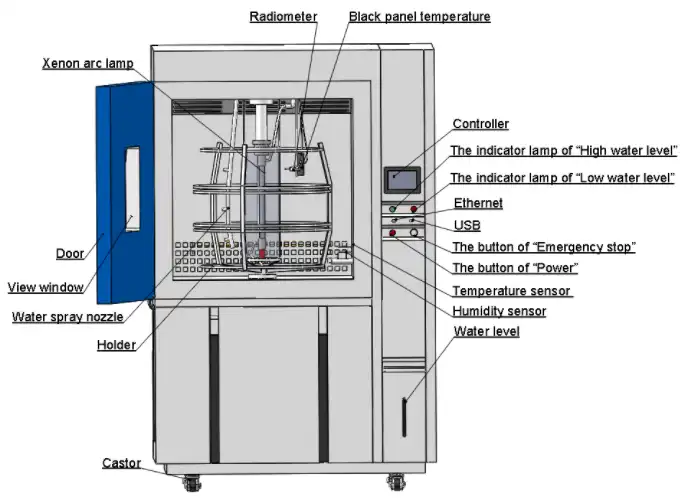
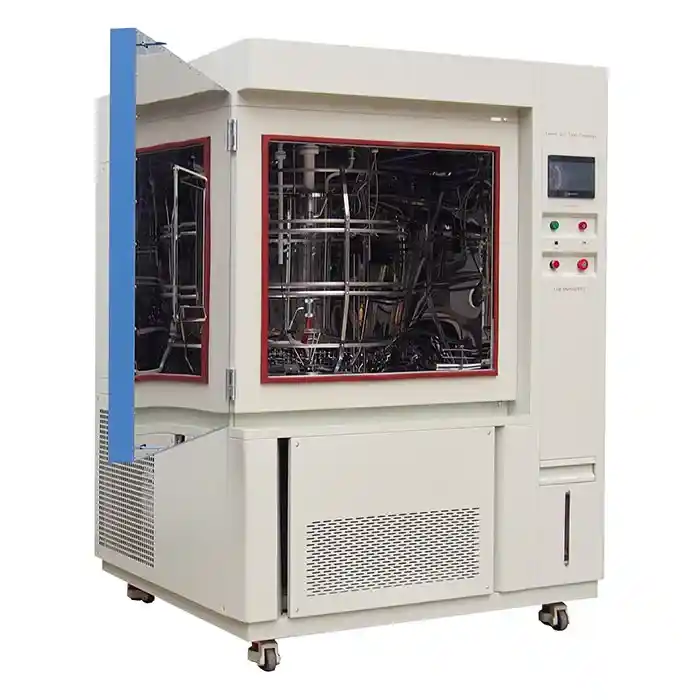
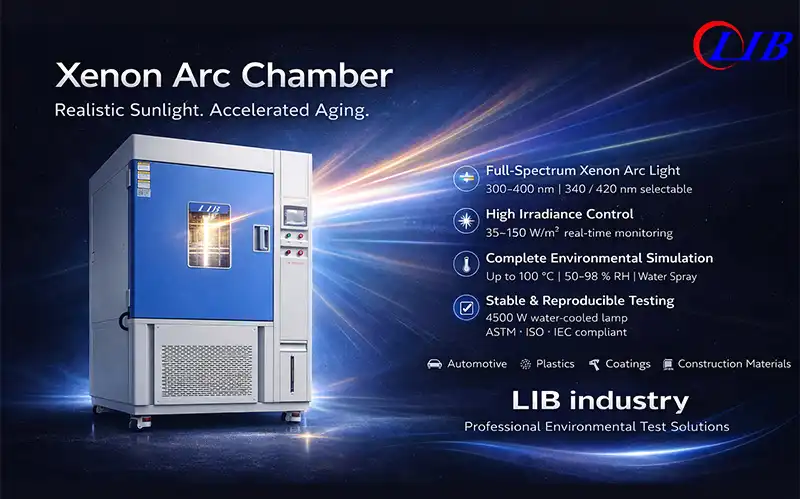
The xenon arc lamp produces a spectral power distribution that closely matches natural sunlight across UV, visible, and infrared wavelengths. Unlike fluorescent UV lamps that only replicate narrow UV bands, xenon sources deliver comprehensive spectral accuracy essential for automotive testing. The 4500W water-cooled xenon light system generates sufficient intensity to compress months of outdoor exposure into accelerated test cycles while maintaining spectral fidelity through advanced optical filter systems.
Black Panel Temperature Control Systems
Cabin surface temperatures differ significantly from ambient air temperatures due to solar radiation absorption. Black panel temperature (BPT) sensors replicate the actual surface temperature of dark-colored automotive components exposed to sunlight. Modern xenon chambers maintain BPT ranges between 35-85°C with ±2°C accuracy, matching the temperature extremes experienced by dashboard surfaces during summer months. This precise thermal control ensures test conditions accurately represent real-world cabin environments.
Humidity and Moisture Cycling
Vehicle interiors experience significant humidity variations from morning condensation, passenger respiration, and climate system operation. Advanced xenon test chambers incorporate programmable spray cycles and humidity control systems maintaining 50-98% RH ranges. This moisture simulation tests adhesive bond stability, leather grain tightness, and fabric dimensional stability under combined hygrothermal stress conditions. The water spray function replicates rain exposure through open windows or sunroof condensation scenarios.
Table 1: Comparison of Real-World vs. Accelerated Exposure Conditions
|
Parameter |
Real-World Cabin Exposure |
Xenon Chamber Simulation |
|
UV Intensity |
35-50 W/㎡ (peak midday) |
35-150 W/㎡ (adjustable) |
|
Temperature Range |
-20°C to 85°C |
35-100°C (controlled) |
|
Humidity Variation |
20-95% RH |
50-98% RH (programmable) |
|
Annual UV Dose |
150-200 kWh/㎡ |
Achievable in 500-1000 hours |
|
Testing Duration |
5-10 years |
4-12 weeks (accelerated) |
Material Selection for Long-Term UV Resistance
UV Stabilizers and Light Absorbers
Material formulation plays a critical role in automotive interior longevity. Hindered amine light stabilizers (HALS) and UV absorbers are incorporated into polymeric materials during manufacturing to intercept damaging radiation before it causes molecular degradation. Xenon testing validates the effectiveness of these additives by measuring retention of mechanical properties after extended UV exposure. Materials with inadequate stabilization show rapid property loss within the first 500 hours of accelerated testing.
Pigment Selection and Colorant Stability
Organic versus inorganic pigment selection dramatically affects color retention performance. Inorganic pigments generally demonstrate superior lightfastness but offer limited color palette options compared to organic alternatives. Xenon test chamber testing using spectrophotometric measurement tracks color shifts expressed as ΔE values throughout exposure cycles. Automotive OEM specifications typically require ΔE < 3.0 after 1000 hours of xenon exposure to ensure acceptable color retention.
Material Compatibility and Multi-Component Assembly Testing
Automotive interiors comprise multiple materials assembled together - plastics, elastomers, adhesives, textiles, and coatings. These materials respond differently to UV exposure and thermal stress, potentially creating visual mismatches or mechanical failures at interfaces. Xenon testing of complete assemblies rather than individual materials reveals compatibility issues such as differential expansion, adhesive delamination, or color mismatch development that wouldn't appear in single-material testing.
Accelerated Aging Standards Used in Automotive Testing
ISO 4892 International Weathering Standards
The ISO 4892 standard series provides comprehensive methodologies for accelerated weathering testing using xenon arc lamps. ISO 4892-2 specifically addresses xenon arc lamp exposure procedures, defining light source specifications, filter types, and exposure cycle parameters. Automotive manufacturers reference this standard when establishing internal test protocols, ensuring global consistency across different testing facilities and enabling reliable comparison of material performance data.
ASTM G155 and Automotive-Specific Protocols
ASTM G155 establishes xenon arc light exposure procedures with specific provisions for automotive interior applications. This standard defines irradiance measurement wavelengths at 340nm or 420nm depending on material sensitivity, exposure cycles combining light and dark periods, and moisture introduction timing. Many automotive OEMs develop proprietary test methods based on ASTM G155 frameworks, adjusting intensity levels and cycle durations to match their specific durability targets.
SAE J2412 and J2527 Automotive Interior Testing
The Society of Automotive Engineers (SAE) publishes automotive-specific accelerated exposure standards addressing interior component testing. SAE J2412 covers controlled accelerated exposure testing for automotive interior trim components, while SAE J2527 addresses performance-based specifications for seat fabrics. These standards define acceptance criteria, test durations, and evaluation methods specifically tailored to automotive quality requirements rather than generic weathering applications.
Table 2: Common Automotive Xenon Testing Protocols
|
Standard |
Irradiance Level |
Black Panel Temp |
Cycle Structure |
Typical Duration |
|
ISO 4892-2 |
60 W/㎡ @ 340nm |
65°C |
102 min light / 18 min spray |
1000-2000 hours |
|
ASTM G155 |
0.51 W/㎡ @ 420nm |
70°C |
102 min light / 18 min spray |
500-1500 hours |
|
SAE J2412 |
0.55 W/㎡ @ 420nm |
89°C |
100 min light / 20 min spray |
450-900 kWh/㎡ |
|
SAE J2527 |
0.55 W/㎡ @ 340nm |
70/89°C |
Continuous or cyclic |
300-600 hours |
Evaluating Color Stability and Surface Cracking
Spectrophotometric Color Measurement Techniques
Quantitative color stability assessment in a xenon test chamber uses spectrophotometric instrumentation measuring reflectance across the visible spectrum. The CIELAB color space provides standardized metrics for color change evaluation, calculating ΔE values representing total color difference from original samples. Measurements taken at regular intervals throughout xenon exposure (every 100–250 hours) track degradation progression and identify acceleration points where color shift rates increase due to protective additive depletion.
Visual Grading and Gray Scale Comparison
Subjective visual assessment complements instrumental color measurement through standardized gray scale comparison methods. Trained evaluators compare exposed samples against unexposed controls under controlled lighting conditions (D65 illuminant), assigning numerical grades corresponding to perceptibility thresholds. This approach captures appearance changes that numerical color data might not fully represent, such as gloss reduction, surface texture changes, or inhomogeneous degradation patterns.
Crack Detection and Mechanical Property Retention
Surface crack formation represents critical failure for automotive interior components. Visual inspection under magnification identifies crack initiation, while mechanical testing quantifies property degradation. Flexural testing, tensile strength measurement, and impact resistance evaluation performed on xenon-exposed samples determine retention percentages compared to unexposed controls. Automotive specifications typically require >80% property retention after accelerated exposure to ensure adequate service life performance.
How Xenon Testing Reduces Warranty and Recall Risks?
Early Detection of Material Incompatibilities
Comprehensive xenon testing during product development identifies material and design weaknesses before production commitment. Testing complete interior assemblies under accelerated conditions reveals problems such as adhesive failures, color mismatches, or premature degradation that would generate warranty claims years after vehicle sale. The relatively modest investment in thorough pre-production testing prevents exponentially higher costs associated with field failures and customer satisfaction issues.
Validation of Cost-Reduction Material Substitutions
Automotive manufacturers continually seek cost reductions through alternative material sourcing and supplier changes. Xenon chamber validation ensures replacement materials meet original durability specifications despite formulation differences. Side-by-side testing of incumbent and proposed materials under identical exposure conditions provides objective performance comparison, preventing inadvertent quality degradation that could compromise long-term reliability and brand reputation.
Regulatory Compliance and Consumer Protection
Government regulations and consumer protection standards increasingly address product durability and longevity expectations. Documented xenon testing demonstrates due diligence in product validation, providing legal protection against claims of inadequate testing or premature failure. Test records showing compliance with industry standards support defense against warranty disputes and demonstrate manufacturer commitment to quality assurance.
Table 3: Cost Impact of Xenon Testing vs. Field Failures
|
Scenario |
Pre-Production Testing Cost |
Field Failure Cost (per incident) |
Break-Even Point |
|
Material validation |
$15,000-30,000 |
$200-500 (warranty claim) |
60-150 claims prevented |
|
Complete interior assembly |
$50,000-100,000 |
$50,000-200,000 (recall campaign) |
1-2 recalls prevented |
|
Supplier qualification |
$25,000-50,000 |
$1M-10M (widespread failure) |
Single major issue prevented |
LIB Industry Xenon Chambers Deliver High-Precision Automotive Aging Simulation
 |
 |
|
|
|


xenon lamp and filters
Advanced Spectral Control and Irradiance Monitoring
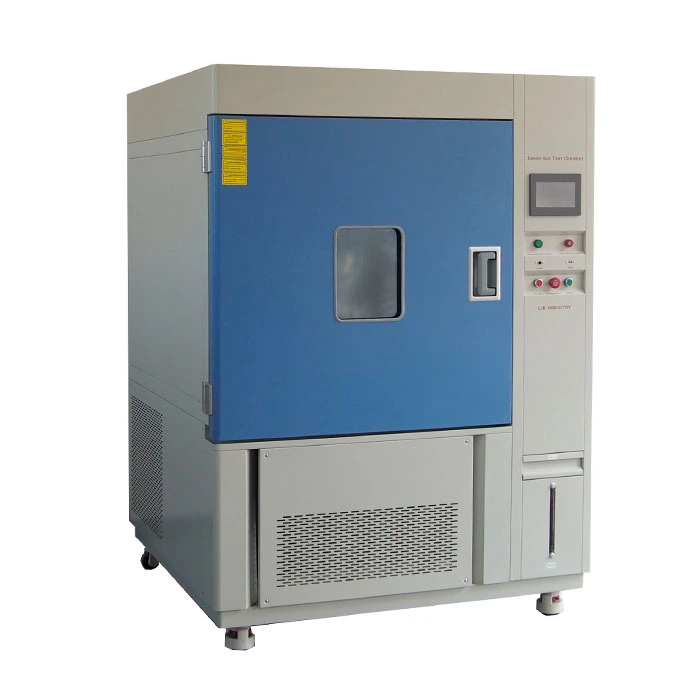
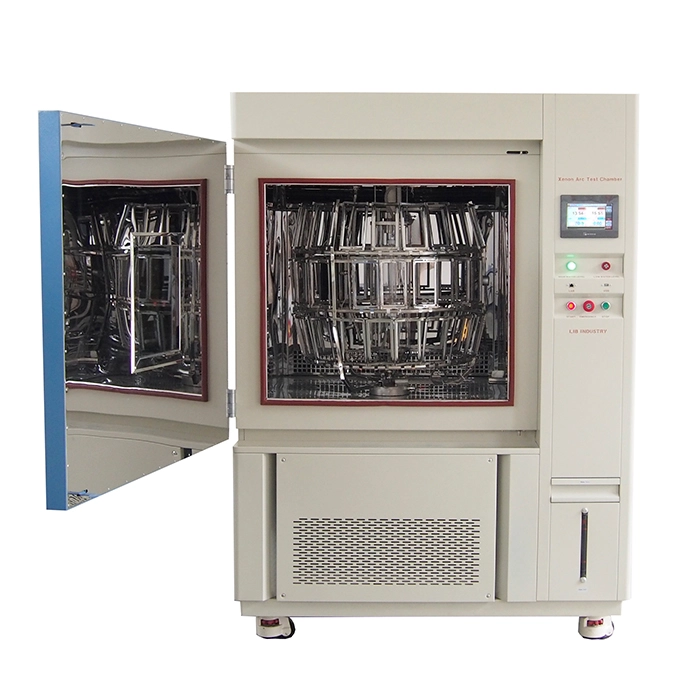
LIB Industry's XL-S-750 xenon test chamber incorporates Solar Eye technology providing closed-loop irradiance control throughout extended test campaigns. This intelligent monitoring system continuously compensates for lamp aging, maintaining consistent UV exposure levels across multi-thousand-hour test programs. The bandwidth measurement capability at 300-400nm with specific monitoring at 340nm or 420nm ensures compliance with both ISO 4892 and ASTM G155 automotive testing standards.
Uniform Sample Exposure and High Throughput
The rotating sample rack system accommodates 42 specimens simultaneously (95×200mm size), ensuring equivalent exposure for all test samples through continuous rotation. This design eliminates position-dependent variations common in static sample configurations, delivering statistically valid results across multiple material variants. High specimen capacity enables comprehensive material screening and comparative evaluation essential for automotive development programs with tight timelines.
Precise Environmental Control for Automotive Conditions
LIB Industry chambers replicate extreme automotive interior environments through integrated control systems managing temperature (ambient to 100°C), black panel temperature (35-85°C with ±2°C accuracy), and humidity (50-98% RH). The programmable spray cycle system (1-9999H59M adjustability) simulates moisture exposure patterns matching real-world scenarios. This comprehensive environmental control delivers testing conditions that authentically replicate vehicle cabin stress factors rather than simplified laboratory approximations.
Quality Assurance and Global Support Infrastructure
Every LIB Industry xenon chamber undergoes rigorous quality validation following ISO 9001 Quality Management System protocols, with CE certification and third-party verification by SGS and TUV. The 3-year warranty coverage and lifetime service commitment provide long-term operational security for critical automotive testing programs. Global 24/7 support infrastructure ensures minimal downtime, maintaining testing schedule integrity essential for time-sensitive automotive development cycles. The closed-loop water circulation system with multi-stage filtration reduces operational costs while supporting sustainability objectives through water conservation.
Conclusion
Xenon test chambers represent indispensable tools for validating automotive interior durability, compressing years of real-world exposure into weeks of controlled testing. Through precise simulation of solar radiation, thermal cycling, and moisture exposure, these chambers identify material weaknesses before production, enabling informed material selection and design optimization. Compliance with international standards like ISO 4892 and ASTM G155 ensures global consistency, while advanced features like closed-loop irradiance control and uniform sample rotation deliver reliable, repeatable results that protect manufacturers from costly warranty claims and recalls.
FAQ
How long does xenon testing take to simulate 5 years of vehicle interior aging?
Accelerated xenon testing typically compresses 5 years of real-world exposure into 500-1000 hours of chamber operation, depending on intensity settings and geographic solar radiation baselines. Testing protocols using 0.55 W/㎡ irradiance at 340nm with elevated black panel temperatures can achieve this acceleration factor while maintaining correlation with outdoor weathering results.
Can xenon test chambers evaluate all automotive interior materials simultaneously?
Yes, modern xenon chambers accommodate multiple material types including plastics, fabrics, leathers, and coatings in single test runs. The 42-specimen capacity of chambers like the LIB XL-S-750 enables comprehensive material screening, though evaluation methods may differ - spectrophotometry for color, mechanical testing for structural properties, and visual inspection for surface degradation across various substrates.
What maintenance requirements ensure xenon chamber accuracy over time?
Regular xenon lamp replacement (typically 1500-2000 operating hours), radiometer calibration verification (annually or per manufacturer specifications), and filter inspection maintain testing accuracy. Water purification system maintenance ensures spray quality, while temperature and humidity sensor calibration confirms environmental control precision. Proper maintenance preserves correlation between accelerated and real-world exposure throughout the chamber's service life.
Partner with LIB Industry for Automotive Testing Excellence
LIB Industry stands as a leading xenon test chamber manufacturer and supplier, delivering turn-key environmental testing solutions globally. Our expertise spans research, design, production, commissioning, installation, and training tailored to automotive validation requirements. Contact our technical team at ellen@lib-industry.com to discuss how our high-precision xenon chambers can strengthen your material qualification processes and accelerate your product development timeline.