IEC 60529 IPX9K Equipment for Automotive Component Testing
Automotive manufacturers face a relentless challenge: ensuring every component - from headlights to engine control units - withstands the brutal, high-pressure assault of automated car washes, engine bay steam cleaning, and off-road water fording. The IEC 60529 IPX9K rating is the definitive validation for this extreme exposure. Specialized IEC 60529 IPX9K equipment replicates these conditions with precise, repeatable high-pressure, high-temperature water jets. This testing is not optional for modern vehicle development; it's the critical filter that separates components that will fail in the field from those that will earn customer trust through years of reliable service in the wettest, dirtiest conditions.
Understanding IPX9K Requirements in Automotive Standards
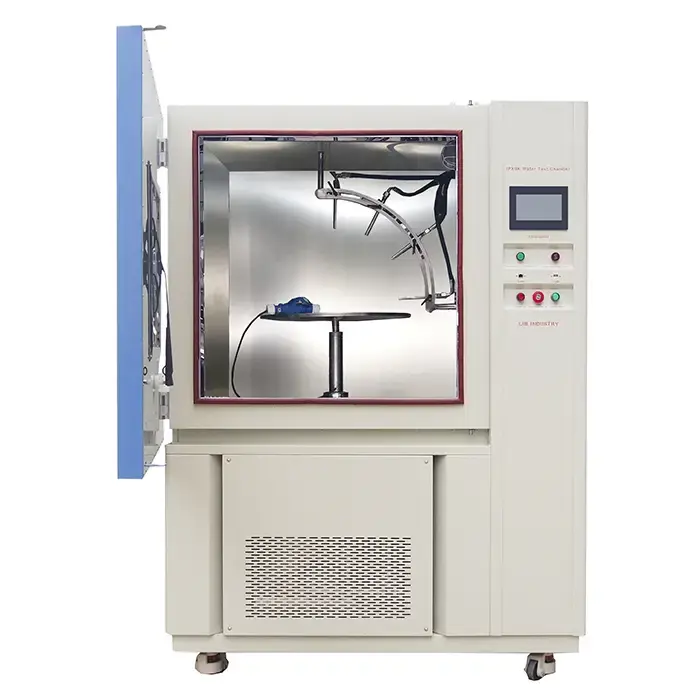
Decoding the IP Code: What "9K" Truly Means
The IP (Ingress Protection) code's second digit indicates liquid protection. IPX9K represents the highest water protection level, specifically designed for "high-pressure, high-temperature water jets." The "K" suffix denotes this is a separate, more severe test than the standard IPX9 test. For automotive, this translates to withstanding water jets at 8,000-10,000 kPa (80-100 bar) pressure and 80±5°C temperature from a distance of 100-150mm, with the test object rotating. This simulates the most intense industrial washing processes and extreme environmental exposure.
Why IPX9K is Non-Negotiable for Modern Vehicles?
The shift toward higher vehicle electrification and sophisticated electronics has intensified the stakes. A compromised seal on an LED headlight can lead to internal condensation, lens damage, and premature failure. Water ingress into a sensor housing can cause erratic readings or complete failure. For autonomous driving systems reliant on camera and radar cleanliness, internal fogging is catastrophic. IPX9K validation ensures these critical enclosures maintain integrity under the most demanding wash-down scenarios, protecting both safety systems and costly electronics.
The Regulatory and Specification Landscape
Automotive OEMs mandate IPX9K testing through internal specifications that often exceed the base IEC 60529 standard. These may include specific spray patterns, durations per nozzle position, and acceptance criteria like "no water ingress" or "ingress limited to non-critical areas." Suppliers must demonstrate compliance not just to the standard, but to the specific OEM test protocol. This makes the precision and programmability of the testing equipment - like LIB's four-nozzle, 30-second-per-position system - a cornerstone of qualification.
Table 1: Key IPX9K Test Parameters vs. Common Automotive Applications
|
Parameter |
IEC 60529 IPX9K Spec |
Typical Automotive Application Focus |
|
Water Pressure |
8,000 - 10,000 kPa |
Engine bay component cleaning, heavy-duty truck wash systems |
|
Water Temperature |
80±5°C (min. 15°C rise) |
Simulates hot engine bay steam cleaning, hot road spray |
|
Nozzle Angles |
0°, 30°, 60°, 90° from vertical |
Tests all potential spray angles encountered in car washes and fording |
|
Spray Distance |
100-150mm |
Replicates close-proximity high-pressure spray nozzles |
|
Turntable Speed |
5±1 rpm |
Ensures uniform exposure of all surfaces on complex geometries |
|
Test Duration |
Minimum 30 sec per nozzle position |
Adequate time for water to penetrate potential seal weaknesses |
High-Pressure High-Temperature Water Jet Test Conditions
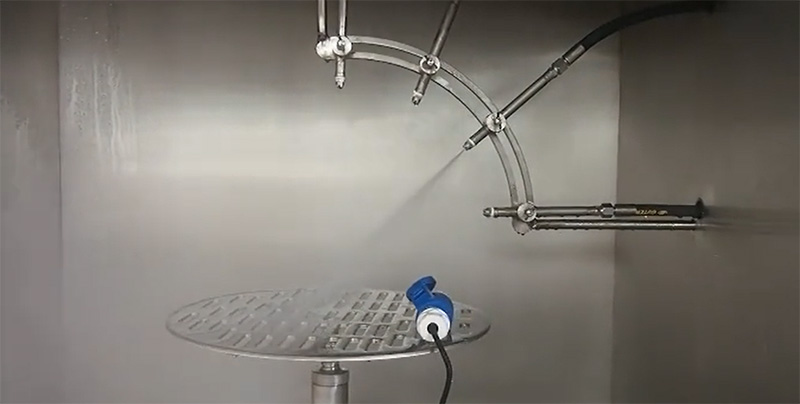
The Physics of the Assault: Pressure, Temperature, and Impact
The core of the IPX9K test is the synergistic effect of extreme pressure and heat. At 10,000 kPa, the water jet possesses significant kinetic energy, capable of forcing its way past imperfect seals or through microscopic cracks. The 88°C temperature (as adjustable in LIB's system) softens many sealing polymers (like EPDM or silicone), reducing their elasticity and closing force, while simultaneously lowering water's surface tension, enhancing its ability to wet and penetrate surfaces. This combination is far more aggressive than cold-water pressure washing.
Precision Control of the Four-Nozzle System
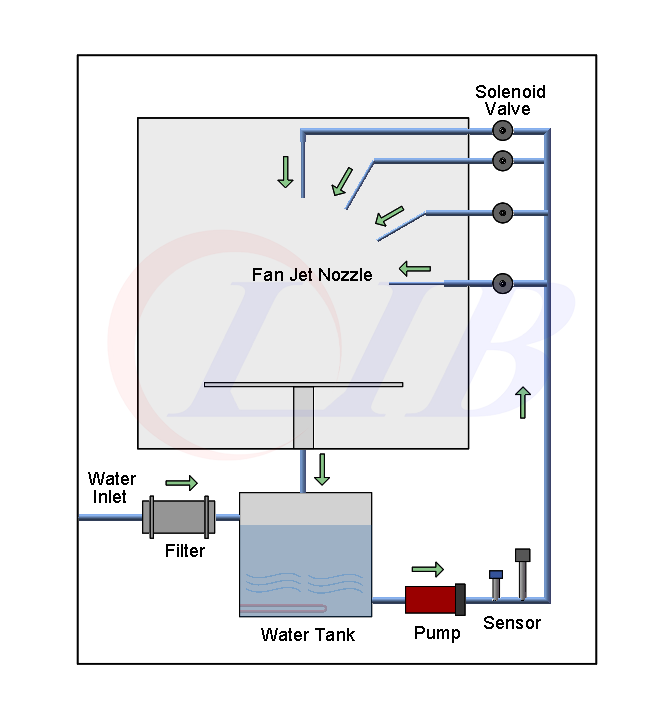
A compliant test uses four nozzles positioned at the cardinal angles (0°, 30°, 60°, 90°). The test specimen rotates at 5±1 rpm on a turntable. Each nozzle sprays for 30 seconds in sequence. This choreography ensures every square millimeter of the specimen's surface experiences the full jet impact from multiple directions. LIB's IEC 60529 IPX9K equipment precisely controls this sequence via its programmable touchscreen controller, with real-time monitoring of pressure and temperature to guarantee no deviation invalidates the test. The adjustable spray distance (10-15cm) must be strictly maintained, as force dissipates rapidly with distance.
The Critical Role of the Turntable and Fixturing
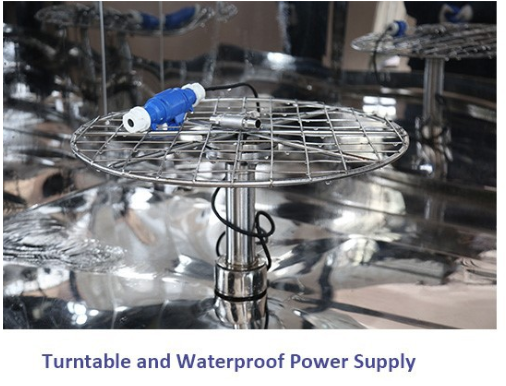
The rotating platform is not merely a convenience; it's a test requirement. A stationary part would only be tested on its facing surfaces. Rotation exposes sidewalls, recesses, and the backside of protrusions to the jet stream. The turntable must be robust (LIB's handles up to 50kg standard, 200kg optional) and maintain exact speed under load. Fixturing must hold the part securely without shielding any area and must not itself degrade or shed particles that could be mistaken for test specimen failure. The 600mm diameter platform in the R9K-1200 model accommodates large automotive modules like headlamp assemblies or ECU housings.
Table 2: IPX9K Test Sequence and Parameter Verification
|
Test Phase |
Action |
Parameter to Verify |
Acceptance Criteria |
|
Setup |
Mount specimen centered on turntable |
Alignment, fixturing security |
No part movement, no shielding |
|
Pre-test |
Measure water temperature at nozzle |
≥80°C |
80-88°C (adjustable setpoint) |
|
Pre-test |
Measure water pressure at nozzle |
8,000-10,000 kPa |
Within range, stable |
|
Test Cycle 1 |
Nozzle 1 (0°) sprays for 30s |
Spray pattern, pressure, temp |
Consistent jet, no fluctuation |
|
Rotation |
Turntable rotates during spray |
Speed |
5±1 rpm |
|
Test Cycle 4 |
Nozzle 4 (90°) sprays for 30s |
Repeat all parameters |
Identical to Cycle 1 |
|
Post-test |
Inspect specimen immediately |
Visual for water ingress |
No water droplets inside enclosure |
|
Post-test |
Internal inspection after drying |
Moisture indicators, corrosion |
No residue, no corrosion |
Key Automotive Components Requiring IPX9K Validation
Lighting Systems: Headlights, Taillights, and Fog Lights
Modern sealed-beam and multi-LED headlight assemblies are complex, with intricate housings, lenses, and multiple seals. The high-pressure jet can exploit the smallest defect in a gasket or a pin-hole in a housing weld. IPX9K testing verifies that no water enters the lamp cavity, which would cause immediate fogging, long-term corrosion of reflective surfaces, and LED driver failure. The test also validates the durability of polycarbonate or glass lenses against surface etching from prolonged jet impact.
Sensors and Cameras: The Eyes of the Vehicle
Advanced Driver Assistance Systems (ADAS) rely on cameras, radar, and lidar sensors. Their housings must be perfectly sealed. A single drop of water on a camera lens can blind the system. Water ingress into a radar housing can detune the antenna. IPX9K testing subjects these critical sensors to the most severe wash-down scenario, ensuring the sealing system (often a combination of gaskets and adhesive bonds) can withstand the pressure and temperature without allowing vapor or liquid ingress that would cause fogging or short circuits.
Electrical and Electronic Control Units (ECUs)
Under-hood and in-cabin ECUs, battery management systems, and charging controllers face a harsh environment. While not directly hit by car wash jets, they encounter high-pressure steam cleaning during service and intense spray in off-road or flood conditions. Their connectors and housing seams must prevent water entry. The IPX9K test's high temperature also simulates the thermal cycling these components experience, testing seal compression set and housing material warpage under combined thermal and mechanical stress.
Exterior Trim and Functional Ornaments
Chrome-plated badges, grille inserts, and decorative trim often have hidden cavities and are made from multiple materials (plastic, metal, adhesive). Water trapped in these cavities can cause galvanic corrosion between dissimilar metals or degrade adhesives, leading to delamination. IPX9K testing with its forceful jets and heat ensures these components remain visually pristine and structurally sound over the vehicle's life, protecting brand aesthetics.
Evaluating Seal Integrity and Housing Durability Performance
The Water Ingress Detection Protocol
The test's outcome is binary: pass or fail based on water ingress. However, the evaluation method is nuanced. Immediately after testing, the specimen is opened and inspected for free water. More critically, it is dried and then examined for moisture indicators (like cobalt chloride paper placed inside before the test) or signs of water trails leading to sensitive areas. For electronics, a functional test follows to check for operational impairment. LIB's IEC 60529 IPX9K equipment design, with its large viewing window and interior lighting, allows for real-time observation of spray patterns and initial responses.
Quantifying Seal Performance Under Stress
Beyond the pass/fail, test data informs engineering. By testing multiple seal designs (e.g., different durometer EPDM, silicone with or without fabric reinforcement, or lip geometry variations), engineers quantify performance. A seal that shows no ingress at 8,000 kPa but fails at 8,500 kPa defines its operational limit. Testing at different water temperatures reveals the seal's compression set resistance. This data feeds directly into design specifications and supplier quality agreements.
Housing Material and Construction Integrity
The high-pressure jet is a mechanical stressor. It can reveal weaknesses in housing welds, thin-walled sections, or poor mold transitions. Cracks or crazing may appear after repeated cycles. The test also evaluates the durability of coatings and platings - peeling or blistering under the jet indicates poor adhesion. For plastic housings, the test assesses material toughness and resistance to impact wear from the water droplets themselves. The 88°C water temperature additionally tests for thermal softening or distortion of the housing material.
Table 3: Failure Mode Analysis in IPX9K Testing
|
Failure Mode |
Likely Root Cause |
Affected Component Type |
Detection Method |
|
Water in cavity |
Seal extrusion, inadequate compression |
Gasketed joints, connector seals |
Internal moisture indicator, visual inspection |
|
Seal tearing/ cracking |
Material not rated for temperature/pressure, sharp edge |
Dynamic seals, boot seals |
Post-test seal inspection |
|
Housing crack |
Stress concentration, material defect, thermal shock |
Plastic housings, welded seams |
Visual inspection, dye penetrant |
|
Coating blister/peel |
Poor adhesion, trapped moisture under coating |
Painted or plated surfaces |
Visual inspection, tape test |
|
Connector pin corrosion |
Ingress into connector, capillary action |
Electrical connectors |
Electrical continuity test, pin inspection |
|
Lens etching/fogging |
Surface damage from jet impact, seal failure |
Polycarbonate/glass lenses |
Visual inspection, light transmission test |
Common Failure Modes in Automotive Waterproof Testing
Seal Extrusion and Compression Set
Under high pressure, a soft seal can be forced (extruded) into the gap it's meant to seal, permanently deforming and losing its sealing force. After the pressure is removed, a seal with poor compression set resistance does not return to its original shape, leaving a gap. Both lead to immediate or delayed ingress. Testing with different seal materials and groove designs identifies the optimal combination. The high temperature (88°C) accelerates this failure mechanism, making the test a severe screening tool.
Inadequate Seal Groove Design
The seal's groove (the channel it sits in) is as important as the seal itself. If the groove is too shallow, the seal is under-compressed. If too deep, it's over-compressed and strained. Sharp corners in the groove can cut the seal. The IPX9K jet's force magnifies any design flaw. Testing prototypes with different groove dimensions and radii quickly identifies the most robust design before tooling is finalized.
Material incompatibility and Galvanic Corrosion
A seal material may be compatible with the housing polymer but degrade when in contact with a metal fastener or a different plastic. The hot, pressurized water can accelerate this incompatibility, causing the seal to swell, shrink, or become sticky. Furthermore, if water does ingress and pools around dissimilar metals (e.g., steel screw in aluminum housing), galvanic corrosion can rapidly destroy the fastener or housing, a secondary failure the test can reveal.
Housing Warpage and Dimensional Instability
Injection-molded plastic housings can warp during cooling or under thermal cycling. The IEC 60529 IPX9K equipment used for IPX9K testing imposes a hot water jet that creates rapid, localized thermal shock. This can cause a marginally warped housing to shift enough to open a seal gap. Testing multiple production batches of housings from different mold cavities or after different molding parameters (cooling time, pack pressure) identifies processes that yield dimensionally stable parts.
Improving Vehicle Reliability Through IPX9K Certification
Reducing Warranty Costs and Field Failures
Water-related electrical failures are a top cause of warranty claims. A single failed sensor or ECU can trigger multiple dashboard warnings, leading to a dealership visit, diagnosis, and part replacement. The cost per incident, including logistics and labor, can exceed the part's value. IPX9K testing at the component level catches sealing defects before assembly, preventing these cascading warranty costs. The data provides objective evidence for supplier negotiations and design holds.
Enabling Aggressive Design and Marketing Claims
Achieving IPX9K certification is a powerful marketing tool. It allows automakers to market "pressure washer safe" exterior components, "engine bay certified" electronics, or "off-road ready" sensor suites. This technical validation translates directly into consumer confidence and can justify premium pricing. For suppliers, being an "IPX9K certified" vendor is often a prerequisite for bidding on certain programs, opening doors to high-volume contracts.
Informing Design for Serviceability
The test also informs how components should be serviced. If a seal is designed to be replaceable, the IPX9K test can verify that the replacement procedure (involving disassembly, cleaning, and reassembly) does not compromise the new seal's integrity. It can also identify if a component's design makes it prone to water trapping during service, suggesting a need for drainage holes or different assembly sequences.
LIB Industry IPX9K Solutions for Automotive High-Pressure Validation
 |
 |
|
SUS 304 workroom |
 |

Engineering Built for Automotive-Grade Rigor
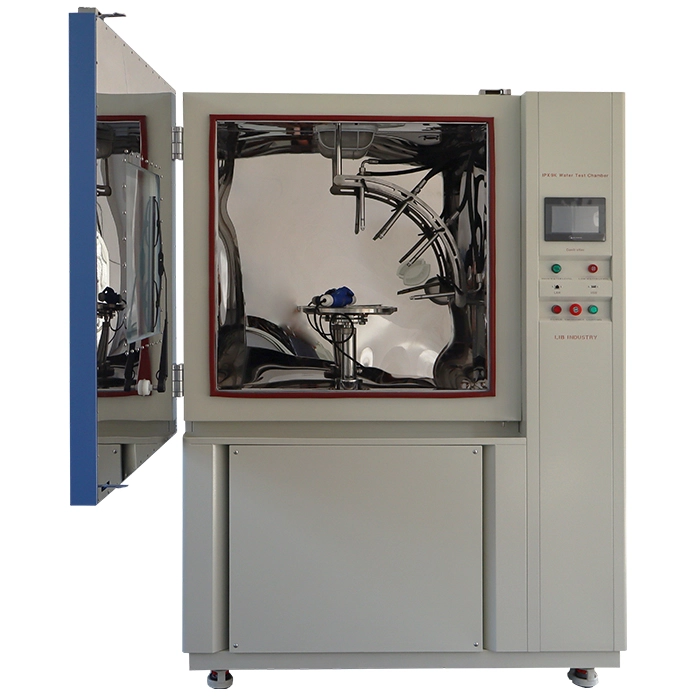
LIB's IEC 60529 IPX9K equipment is engineered around the specific demands of automotive validation. The 1000L (1m³) interior volume accommodates large assemblies like complete headlight units or under-hood modules. The 1000x1000x1000mm chamber dimensions provide ample space for proper specimen mounting and rotation without splash interference. The four-nozzle system with adjustable angles (0°, 30°, 60°, 90°) and individual 30-second spray timing fully complies with IEC 60529's requirement for comprehensive angular coverage.
Uncompromising Control and Data Integrity
The programmable color LCD touchscreen controller is the brain. It allows engineers to create and store complex test profiles, automatically executing the precise nozzle sequence and turntable synchronization. Ethernet connectivity enables integration with laboratory data management systems for automated result logging and audit trails - essential for ISO/IEC 17025-accredited labs. Real-time monitoring of water pressure (8000-10000 kPa) and temperature (Ambient ~88°C) ensures the test never drifts out of specification, which would invalidate a multi-thousand-hour certification campaign.
Safety and Sustainability in Design
Testing at 10,000 kPa and 88°C is inherently hazardous. LIB integrates multiple safeguards: an electromagnetic door lock that prevents opening during pressurization, over-temperature and water shortage protection, and earth leakage protection. The double-layer insulating glass observation window with wiper allows safe monitoring. The closed-loop water circulation system with purification not only saves water but also maintains consistent water quality, preventing nozzle clogging from mineral deposits that would alter spray patterns - a critical factor for repeatable results.
Global Support and Customization for Unique Challenges
Automotive testing often involves unique fixtures for complex geometries or proprietary test cycles. LIB's customization expertise means they can modify the turntable, add special specimen clamps, or adjust the control software for a specific OEM's test protocol. With service centers globally and a 3-year warranty backed by a lifetime service commitment and a promise of replacement if repair isn't possible, they de-risk the investment. This turn-key approach - from consultation through installation and training - makes them a partner in achieving and maintaining IPX9K certification.
Conclusion
IEC 60529 IPX9K equipment provides the definitive, laboratory-controlled method to validate automotive components against the most severe high-pressure, high-temperature water exposure. This testing transforms guesswork into quantifiable data on seal and housing integrity, directly preventing field failures, reducing warranty costs, and enabling bold marketing claims. For automotive engineers and quality managers, investing in a precise, reliable IPX9K test system like LIB's is an investment in product integrity, brand reputation, and ultimately, customer safety and satisfaction in the face of the world's harshest cleaning and environmental conditions.
FAQ
How long does a standard IPX9K test cycle take for an automotive headlight?
The core test sequence for one full rotation (all four nozzles) is 2 minutes (4 nozzles x 30 seconds). However, standards often require multiple rotations or extended exposure. A typical validation test might run for 5-10 minutes total, but the full test protocol including setup, pre-checks, and post-inspection can take 30-60 minutes per specimen.
Can the LIB IPX9K chamber test a complete car door assembly?
The R9K-1200 model has a 1000mm cubic interior and a 600mm diameter turntable. A complete door assembly would likely be too large. Testing requires representative sub-assemblies (e.g., door module, window regulator housing, lock mechanism) or a custom oversized chamber. LIB offers customization for such applications.
What is the main difference between IPX9K and IPX6/IPX7 testing?
IPX6 tests resistance to powerful water jets (100 kPa, 3 minutes) from any direction, simulating heavy seas or strong rain. IPX7 tests immersion (1m depth, 30 minutes). IPX9K is far more severe, combining much higher pressure (80-100 bar vs. 1 bar for IPX6) with high temperature (80°C+), specifically for high-pressure wash-down scenarios. Passing IPX9K inherently satisfies IPX6 and IPX7.
Contact LIB Industry for Automotive IPX9K Testing Solutions
As a global manufacturer and supplier of IEC 60529 IPX9K equipment, LIB Industry delivers turn-key high-pressure water jet testing systems for automotive validation. Our chambers feature 8000-10000 kPa pressure, 88°C temperature, and four-nozzle programmable control. Contact our engineering team at ellen@lib-industry.com to discuss your specific automotive component testing requirements and receive a customized configuration.