Industrial Ovens for Powder Coating and Drying
Industrial ovens for powder coating and drying represent critical equipment in modern manufacturing processes, delivering precision heat treatment that transforms powder particles into durable, attractive finishes. These specialized thermal systems maintain exact temperature parameters essential for complete curing, ensuring molecular bonding between coating materials and substrate surfaces. From automotive components to architectural metalwork, powder coating ovens enable consistent quality across production batches while reducing environmental impact compared to traditional liquid finishing methods. Advanced circulation technology distributes thermal energy uniformly, preventing defects and maximizing adhesion strength throughout every curing cycle.
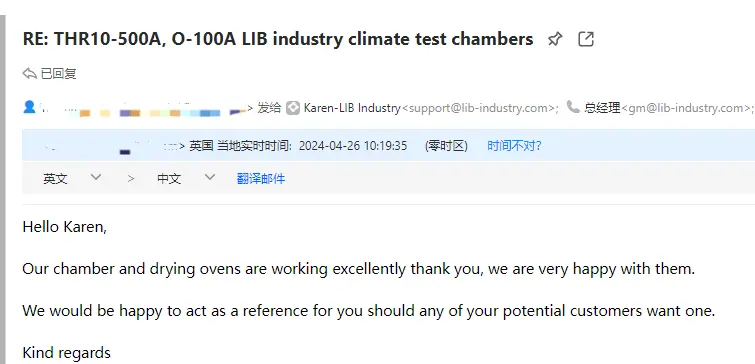
A leading electronics testing lab highlighted the oven performance of the LIB industry THR10-500A:
“The THR10-500A chamber and oven are performing excellently. We’re very satisfied with the results.”
The oven stands out for its consistent and precise temperature control, maintaining stability throughout extended burn-in cycles and repeated thermal changes without interruption. This reliability ensures accurate testing of automotive electronics, sensors, and control modules. In addition, the oven is highly effective for materials aging and battery performance testing, enabling teams to simulate real-world thermal conditions with confidence and improve overall product durability.
How Powder Coating Benefits from Controlled Oven Heating?
Enhanced Molecular Cross-Linking
Controlled thermal environments facilitate complete polymer chain formation within powder coatings. When thermosetting powders reach specific activation temperatures, chemical reactions initiate cross-linking processes that create permanent molecular structures. This transformation differs fundamentally from simple drying, requiring precise heat input to achieve full mechanical properties. The industry oven delivers consistent thermal energy across all coated surfaces, ensuring uniform cure depth and preventing under-polymerized zones that compromise coating integrity.
Optimal Flow and Leveling Characteristics
Temperature progression directly influences how powder particles melt and coalesce into smooth films. Gradual heating allows particles to soften progressively, enabling proper flow across substrate contours before final gelation occurs. Rapid temperature ramps may trap air bubbles or create orange-peel textures, while insufficient heat prevents complete leveling. Advanced circulation systems within industrial thermal equipment maintain stability within ±0.5°C, supporting ideal viscosity transitions throughout the fusion phase.
Reduced Energy Consumption Through Efficiency
Modern powder coating ovens incorporate polyurethane foam insulation and precision controls that minimize thermal losses. Unlike overdimensioned heating systems, properly specified equipment matches heat input to actual load requirements, reducing operational costs significantly. Programmable temperature curves eliminate wasteful overshooting, while optimized air circulation ensures every joule of energy contributes to productive curing rather than dissipating into the environment.
Temperature and Timing Considerations for Powder Coating
Critical Temperature Zones Explained
Powder coating chemistry dictates specific thermal requirements across different material formulations. Epoxy-based powders typically cure between 160-200°C, while polyester systems may require 180-220°C for complete reaction. The temperature range of ambient to +250°C or +400°C provided by LIB equipment accommodates diverse coating chemistries. Understanding substrate thermal mass proves equally important - thicker metal sections require extended exposure to reach target temperature throughout their cross-section, affecting total cycle duration.
Time-at-Temperature Requirements
Achieving full cure demands maintaining parts within specified temperature windows for predetermined durations. Most powder coatings require 10-20 minutes at cure temperature, though this varies with film thickness and formulation. Insufficient dwell time yields soft, under-cured films susceptible to scratching and chemical attack. The heating rate of 6°C/min enables predictable temperature progression, allowing operators to calculate accurate cycle times based on part geometry and loading density.
Monitoring and Documentation Protocols
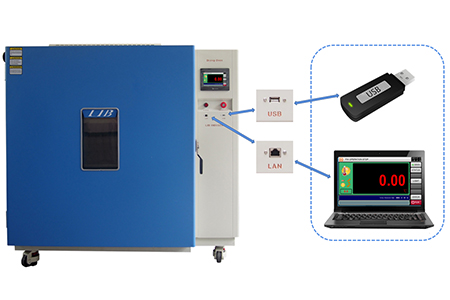
Quality assurance demands verifiable temperature records throughout production runs in an industrial drying oven. Programmable color LCD touch screen controllers with Ethernet and USB connections enable comprehensive data logging, creating audit trails that demonstrate compliance with specifications. Temperature fluctuation within ±0.5°C and deviation of ±2.0°C ensure consistent results batch after batch, while real-time monitoring identifies potential issues before they affect product quality.
|
Coating Type |
Cure Temperature |
Time at Temperature |
Application Sectors |
|
Epoxy |
160-180°C |
12-15 minutes |
Industrial equipment |
|
Polyester |
180-200°C |
10-12 minutes |
Architectural applications |
|
Hybrid |
170-190°C |
12-18 minutes |
Automotive components |
|
High-Performance |
200-220°C |
15-20 minutes |
Aerospace parts |
Oven Types for Efficient Coating Curing and Drying
Batch Ovens for Versatile Production
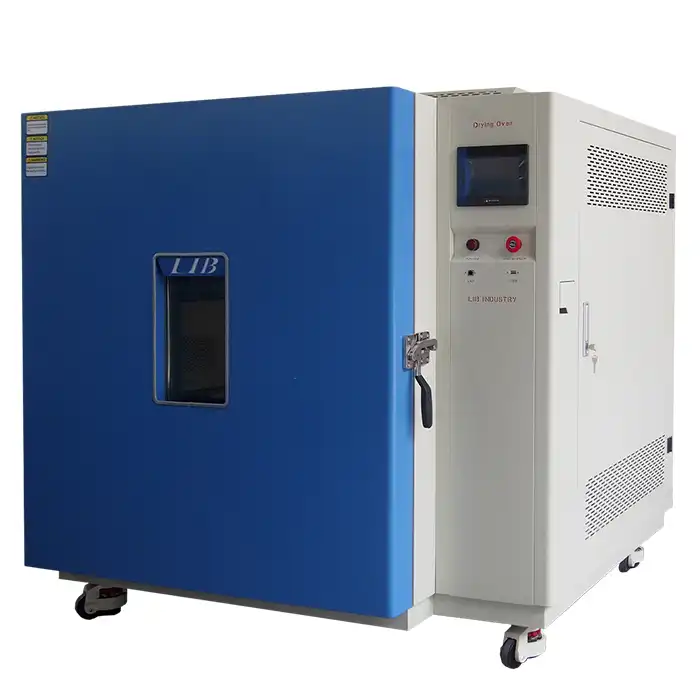
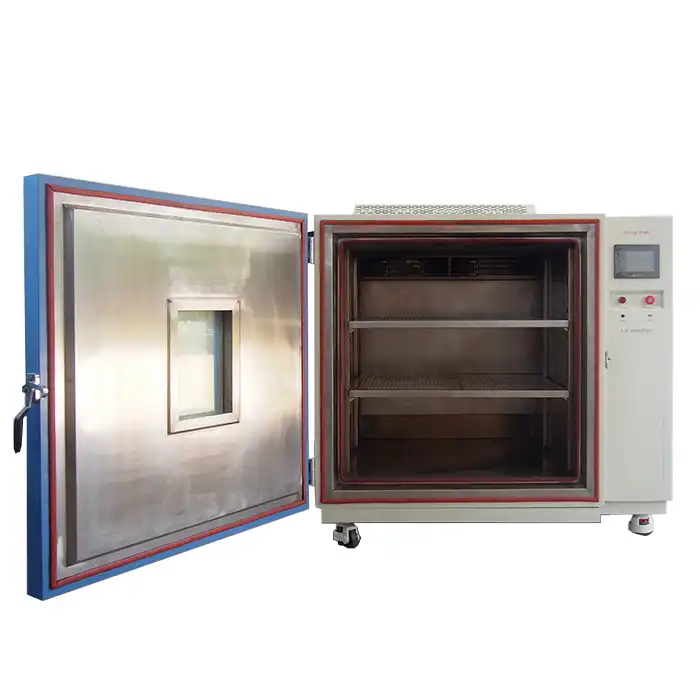
Batch configuration suits operations with varying part sizes and production volumes. These systems accommodate internal dimensions ranging from 400×500×500mm (O-100, 100L capacity) to 1000×1000×1000mm (O-1000, 1000L volume), providing flexibility across diverse manufacturing requirements. Punch-type sample holders ensure adequate air circulation around suspended parts, promoting uniform heat exposure regardless of loading arrangement. The heavy-duty locking mechanisms maintain chamber integrity while facilitating efficient loading and unloading cycles.
Convection vs. Infrared Technologies
Forced convection remains the dominant heating method for powder coating applications due to its ability to uniformly heat complex geometries. The advanced air circulation system featuring horizontal and vertical channels eliminates thermal stratification, ensuring consistent temperature exposure across all surfaces. While infrared systems offer rapid heating for certain applications, convection technology provides superior control over temperature uniformity, particularly critical for thermosetting powder chemistries requiring precise cure conditions.
Compact Footprint Solutions
Space constraints in manufacturing facilities demand efficient equipment layouts. LIB models balance internal capacity with external dimensions - the O-225 provides 225L volume within an 800×950×1000mm footprint, maximizing usable space while minimizing floor area requirements. The view window size of 120×150mm enables process observation without compromising thermal efficiency, supporting quality control efforts without disrupting production cycles.
Preventing Surface Defects Through Proper Heat Management
Eliminating Orange Peel and Texture Issues
Surface texture defects originate from inadequate flow during the melting phase. When powder particles fail to coalesce completely, the resulting film retains visible particle boundaries resembling orange peel. Proper heat distribution eliminates this problem by ensuring simultaneous particle melting across entire surfaces. The multi-layer heating elements within industrial thermal systems deliver uniform radiant energy, while adjustable fan speed control prevents excessive air velocity that might disturb partially melted coatings.
Preventing Outgassing and Pinholes
Trapped volatiles within substrate materials or coating formulations can create surface pinholes during cure. Controlled temperature ramps allow gases to escape before film gelation traps them beneath the surface. The automatic exhaust port with variable flow control removes evolved vapors efficiently, maintaining clean chamber atmospheres that prevent contamination and support defect-free finishes.
Avoiding Color Variations and Gloss Differences
Temperature inconsistencies across large parts or between production batches cause visible color and gloss variations. Even minor thermal deviations alter pigment dispersion and surface texture development during cure. Superior heat distribution technology featuring precision airflow management systems maintains uniformity within ±2.0°C throughout industrial ovens, even when fully loaded. This consistency ensures color matching across production runs and eliminates costly rework from appearance defects.
|
Defect Type |
Root Cause |
Prevention Method |
Oven Feature Required |
|
Orange Peel |
Incomplete flow |
Uniform heating |
Multi-layer elements |
|
Pinholes |
Trapped volatiles |
Controlled outgassing |
Exhaust port system |
|
Color Shift |
Temperature variation |
Stable conditions |
±0.5°C accuracy |
|
Poor Adhesion |
Insufficient cure |
Adequate time-temp |
Programmable profiles |
Quality Control in Powder Coating Applications
Real-Time Process Monitoring
Contemporary industrial ovens integrate sophisticated monitoring capabilities that transform quality assurance practices. Continuous temperature recording through programmable controllers creates verifiable documentation of every thermal cycle. This data proves invaluable during customer audits or troubleshooting quality issues, providing objective evidence of process compliance. Remote control functionality allows supervisors to monitor multiple ovens simultaneously from centralized locations, optimizing resource allocation and response times.
Validation and Calibration Procedures
Maintaining temperature accuracy requires periodic calibration against traceable standards. The dual-controller system employed in independent over-temperature protection also supports validation efforts by providing redundant measurement points. Temperature sensors positioned throughout working chambers verify uniformity claims, while systematic calibration schedules ensure long-term accuracy. Documentation of these activities demonstrates commitment to quality management system requirements.
Testing Cured Coating Performance
Ultimate validation occurs through physical testing of cured coatings. Adhesion testing via cross-hatch or pull-off methods confirms proper bonding, while pencil hardness evaluates cure completeness. Impact resistance and chemical exposure tests assess coating durability under service conditions. Consistent oven performance translates directly into predictable coating properties, reducing quality variation and customer complaints.
Statistical Process Control Integration
Capturing temperature data enables statistical analysis that identifies trends before they cause defects. Control charts plotting temperature uniformity or cycle times reveal process drift requiring corrective action. The Ethernet and USB connections facilitate seamless integration with manufacturing execution systems, supporting real-time decision-making and continuous improvement initiatives throughout production operations.
Improving Coating Durability with Optimized Drying Processes
Achieving Complete Solvent Removal
Even powder coatings may contain minimal residual solvents from manufacturing processes. Thorough drying prior to final cure prevents defects caused by volatile entrapment. Optimized air circulation ensures efficient vapor removal from all surfaces, while controlled temperature progression prevents surface sealing before internal moisture escapes. This attention to drying fundamentals directly impacts long-term coating performance and environmental resistance.
Moisture Elimination from Substrates
Metal substrates may harbor surface moisture from cleaning processes or atmospheric exposure. Heating parts above 100°C drives off water before powder application and cure, preventing adhesion failures and corrosion initiation beneath coatings. The heating rate of 6°C/min allows gradual moisture release without thermal shock to delicate components, while maintaining productivity through reasonable cycle times.
Thermal Stress Management
Coefficient of thermal expansion mismatches between coatings and substrates create internal stresses during heating and cooling. Controlled temperature ramps minimize stress accumulation, while gradual cooling prevents crack formation in brittle coatings. Programming capability within advanced controllers enables customized heating and cooling profiles matched to specific coating-substrate combinations, maximizing adhesion and flexibility throughout service life.
|
Process Stage |
Temperature Target |
Duration |
Quality Impact |
|
Moisture Removal |
120-140°C |
5-8 minutes |
Prevents blistering |
|
Powder Melting |
140-160°C |
3-5 minutes |
Ensures flow |
|
Chemical Cure |
180-200°C |
10-15 minutes |
Maximizes properties |
|
Controlled Cooling |
Below 60°C |
15-20 minutes |
Reduces stress |
Reliable Thermal Performance for Flawless Coating Adhesion - LIB Industry
|
Model |
O-100 |
O-225 |
O-500 |
O-800 |
O-1000 |
|
Interior Volume |
100L |
225L |
500L |
800L |
1000L |
|
Temperature Range |
A: Ambient ~+250 ℃ B: Ambient ~+400 ℃ C: Ambient ~+900 ℃ |
||||
|
Temperature Fluctuation |
± 0.5 ℃ |
||||
|
Temperature Deviation |
± 2.0 ℃ |
||||
|
Heating Rate |
6 ℃ / min |
||||
|
Heating Element |
Nichrome heater |
||||
|
Controller |
Programmable color LCD touch screen controller, Ethernet connection |
||||
|
Safety Device |
Over-temperature Protection; Over-current Protection; Phase Sequence Protection; Earth leakage Protection |
||||
|
Interior Material |
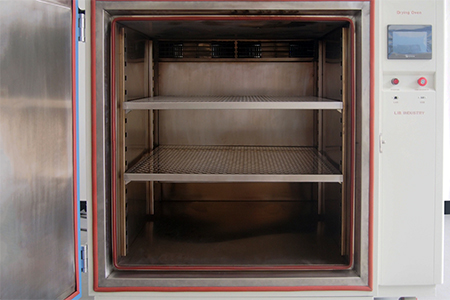
SUS304 stainless steel |
||||
|
Thermal Insulation |
Polyurethane foam (Refractory brick) |
||||
|
Observation Window |
Interior lighting, double-layer thermo stability silicone rubber sealing |
||||
|
Standard Configuration |
2 shelves |
||||
 |
 |
Precision Engineering for Demanding Applications
LIB Industry concentrates on providing turn-key solutions for environmental testing, integrating research, design, production, commissioning, delivery, installation, and training into comprehensive packages. This holistic approach ensures industrial oven matches application requirements precisely, from chamber sizing to control sophistication. The SUS304 stainless steel interior construction resists corrosion from coating vapors and cleaning chemicals, maintaining pristine conditions throughout equipment service life.
Customization Capabilities for Unique Requirements
Standard models accommodate most powder coating operations, yet specialized applications demand tailored solutions. Heavy-duty shelving options supporting up to 200kg per shelf enable processing of large automotive assemblies or industrial machinery components. Custom spacing arrangements optimize chamber utilization for specific part geometries, while explosion-proof designs meeting ATEX compliance permit safe processing of solvent-containing materials.
Comprehensive Support Throughout Equipment Lifecycle
Purchasing industrial thermal equipment represents a significant investment demanding reliable performance over decades. LIB provides complete commissioning services ensuring proper installation and operator training, while ongoing technical support addresses questions and optimization opportunities. The A3 steel plate exterior with protective coating withstands demanding production environments, while accessible service points simplify routine maintenance activities that preserve performance specifications.
Advanced Features Supporting Modern Manufacturing
Integration capabilities distinguish contemporary equipment from legacy systems. Remote connectivity enables predictive maintenance through performance monitoring, while data logging satisfies quality system requirements automatically. Multi-segment programmable temperature curves accommodate complex coating chemistries requiring specific thermal profiles, expanding process capability beyond simple set-point control. These features position operations for future demands while delivering immediate productivity benefits.
Conclusion
Industrial ovens designed specifically for powder coating and drying applications deliver the precise thermal control essential for durable, attractive finishes. Understanding temperature requirements, selecting appropriate equipment configurations, and implementing proper process management transforms coating operations from inconsistent handicraft into predictable manufacturing processes. Investment in quality thermal equipment pays dividends through reduced rework, enhanced product performance, and satisfied customers receiving consistently superior coated products.
FAQ
What temperature range should I select for standard powder coating applications?
Most commercial powder coatings cure effectively between 180-200°C. Equipment offering ambient to +250°C capability accommodates standard formulations while providing headroom for specialized high-temperature coatings. Verify specific powder manufacturer recommendations before finalizing equipment specifications to ensure compatibility.
How does oven size affect powder coating quality and efficiency?
Chamber dimensions must accommodate parts with adequate clearance for air circulation - typically 75-100mm minimum spacing. Undersized ovens create hot spots and cold zones compromising cure uniformity, while oversized equipment wastes energy heating unused space. Match internal volume to actual production requirements for optimal performance and economy.
Can the same oven handle both drying and curing operations?
Absolutely. Programmable controllers enable different temperature profiles for moisture removal, powder melting, and final cure within the same equipment. Sequential programming automates transitions between stages, ensuring complete processing without manual intervention. This versatility maximizes equipment utilization across diverse coating operations.
Ready to elevate your powder coating operations? Contact LIB Industry, a leading manufacturer and supplier of precision industrial ovens, to discuss your specific requirements. Our experienced team designs complete solutions tailored to your production needs. Reach out today at ellen@lib-industry.com to begin your journey toward flawless coating quality.