How DI-2000 Dust Chamber Ensures Sealed Enclosure Reliability?
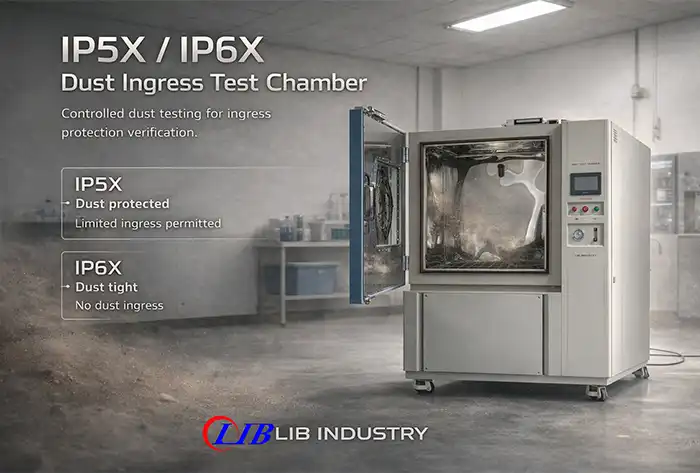
The DI-2000 IP6X dust chamber ensures sealed enclosure reliability through precise simulation of harsh particulate environments that electronic and electrical products encounter during their operational lifespan. By circulating calibrated talcum powder particles with 50-micron wire diameter specifications throughout a controlled 2000-liter testing volume, this equipment validates whether enclosures meet the stringent "dust-tight" requirements defined in IEC 60529. The chamber's automated vacuum system, programmable temperature control up to 50°C, and uniform airflow distribution replicate extreme conditions that expose sealing vulnerabilities. Through systematic exposure cycles lasting up to 99 hours and 59 minutes, manufacturers identify design weaknesses before products reach consumers, preventing field failures and protecting brand reputation.
Manufacturers across the globe rely on LIB industry’s IP6X dust test chambers for their precision in replicating harsh, dust-laden environments. Designed for continuous laboratory and industrial use, these systems consistently demonstrate stable operation and highly repeatable results under demanding conditions.
A Principal Engineer at Halcon R&D Laboratories in the UAE shared their experience on September 23, 2025:
"We use both the Rain and Dust Chambers regularly, and following our latest annual calibration, they continue to run flawlessly."
Such endorsements highlight not just the chambers’ accuracy in controlled testing scenarios, but also their durability and dependable performance in everyday, high-volume testing routines—proving LIB industry’s equipment is built for both reliability and long-term operational excellence.

What Are the Core Features of the DI-2000 Dust Chamber?
Expansive Testing Capacity for Diverse Applications
The 2000-liter internal volume accommodates substantial electrical enclosures, automotive components, and industrial housings that smaller chambers cannot handle. With internal dimensions measuring 1000mm x 2000mm x 1000mm, engineers can test complete assemblies rather than individual subcomponents. This full-scale validation proves particularly valuable for outdoor electrical cabinets, railway signal equipment, and marine instrumentation where real-world dimensions matter. The reinforced floor platform supports loads up to 500kg, eliminating the need to disassemble heavy test specimens into smaller sections.
Programmable Environmental Control Architecture
The color LCD touchscreen controller enables precise programming of dust exposure sequences matching specific test protocols. Operators define fight time (dust circulation duration) and blowing time (settlement period) independently, creating custom profiles that replicate geographical dust conditions from desert sandstorms to industrial manufacturing environments. Temperature regulation from ambient to 50°C simulates thermal expansion effects on gasket materials and seal compression. The Ethernet connectivity integrates test data directly into laboratory information management systems, streamlining quality documentation workflows.
Advanced Material Construction Standards
The SUS304 stainless steel interior resists chemical interaction with test dusts while maintaining dimensional stability across thousands of test cycles. Unlike painted surfaces that flake and contaminate subsequent tests, the mirror-finished stainless construction ensures long-term cleanliness. The A3 steel exterior cabinet with protective coating provides structural rigidity while the polyurethane insulation maintains temperature uniformity. Double-layer thermally stable silicone rubber sealing around the observation window prevents dust leakage during operation, maintaining test integrity and operator safety.
Precision Dust Simulation and Airflow Control Systems
Calibrated Particle Distribution Mechanisms
The DI-2000 IP6X dust chamber employs an electric circulation fan engineered to maintain homogeneous particle suspension throughout the test volume. Unlike passive settling systems, active circulation ensures every surface of the test specimen experiences consistent dust exposure regardless of its orientation or position within the chamber. The nominal 50-micron wire diameter specification matches IEC 60529 requirements for IP6X testing, where particles must penetrate the smallest potential ingress paths. The 75-micron gap width between distribution wires creates the precise particle density necessary for reliable pass/fail determinations.
Differential Pressure Control for Vacuum Testing
Many sealed enclosures incorporate pressure equalization vents or breathing mechanisms that function under operational pressure differentials. The integrated vacuum system features a pressure gauge, air filter, pressure regulator, and connecting tubes that create controlled negative pressure conditions inside test specimens. This multi-port configuration allows simultaneous testing of 2-3 large components, significantly improving laboratory throughput. Automatic pressure monitoring maintains the exact differential required by test protocols, eliminating manual adjustments and reducing operator-induced variability.
Humidity Management for Realistic Conditions
Maintaining humidity below 30% RH prevents particle clumping that would artificially alter dust penetration characteristics. Atmospheric moisture causes talcum powder to agglomerate into larger clusters that cannot navigate the microscopic pathways through gaskets and seal interfaces. The built-in dehumidification system ensures test dust remains in its specified particle size distribution throughout extended exposure cycles. This controlled low-humidity environment distinguishes professional dust chamber from improvised chambers that produce inconsistent results.
|
Environmental Parameter |
Specification |
Testing Significance |
|
Temperature Range |
Ambient ~ 50°C |
Simulates thermal expansion of sealing materials |
|
Humidity Control |
< 30% RH |
Prevents dust particle agglomeration |
|
Dust Particle Size |
50μm wire diameter |
Matches IEC 60529 IP6X requirements |
|
Gap Width |
75μm nominal |
Ensures proper particle distribution density |
|
Circulation Time |
0 ~ 99H59M programmable |
Replicates long-term exposure scenarios |
How Does IP6X Testing Validate Sealed Enclosures?
Understanding the IP Rating Framework
The International Protection (IP) code defined in IEC 60529 provides a globally recognized classification system for degrees of protection against solid particle and liquid ingress. The first characteristic numeral ranges from 0 to 6, with "6" representing the highest level of dust protection. IP6X designation signifies "dust-tight" performance where no ingress of dust occurs during eight hours of continuous exposure under specified test conditions. This rigorous standard applies to critical applications including medical devices, aerospace electronics, and subsea equipment where even minimal particle intrusion causes catastrophic failures.
Dust-Tight Versus Dust-Protected Classifications
Many manufacturers mistakenly believe IP5X (dust-protected) provides adequate sealing for harsh environments. IP5X allows limited dust ingress that does not interfere with equipment operation, whereas IP6X permits zero dust entry. The distinction becomes critical when fine particles can accumulate on optical sensors, contaminate lubricants, or create conductive pathways across electrical contacts. Testing in the DI-2000 chamber definitively establishes whether designs achieve true dust-tight performance rather than merely dust-resistant characteristics.
Test Duration and Exposure Intensity
IEC 60529 specifies eight continuous hours of dust exposure for IP6X validation, though the programmable controller allows extended testing up to 99 hours and 59 minutes. Longer exposure durations reveal time-dependent failure modes such as seal compression set, gasket relaxation, or adhesive degradation. The adjustable dust injection quantity from 0-10kg enables incremental testing protocols that progressively stress enclosures. This graduated approach identifies the exact failure threshold, providing engineers with quantitative data for design optimization rather than simple pass/fail outcomes.
Performance Metrics for Enclosure Integrity Evaluation
Visual Inspection Protocols Post-Exposure
After completing the programmed dust cycle, technicians carefully remove test specimens and disassemble them according to documented procedures. Any visible dust accumulation on internal components, circuit boards, or optical surfaces constitutes IP6X test failure. The double-layer observation window with interior LED lighting allows real-time monitoring during testing, though definitive assessment requires complete teardown. Photographic documentation at multiple magnifications creates traceable quality records that support certification submissions and customer audits.
Quantitative Particle Counting Methods
Advanced validation employs particle counting techniques where internal surfaces undergo tape-lift sampling or vacuum collection. Laboratory analysis using microscopy or laser particle counters determines the exact number and size distribution of particles that penetrated sealing systems. This quantitative approach proves especially valuable when comparing competitive designs or evaluating incremental seal improvements. Even when enclosures technically pass visual inspection, particle count data reveals which designs provide superior protection margins.
Functional Performance Verification
The 16A dust-proof power socket inside the dust proof chamber allows energizing electronic specimens during dust exposure, validating operational integrity under realistic conditions. This live testing identifies failures that static examination might miss - moisture sensors giving false readings due to dust contamination, cooling fans binding from particle accumulation, or connector contact resistance increasing beyond acceptable limits. Combining environmental stress with functional testing provides comprehensive reliability data that accelerates product development cycles.
|
Evaluation Method |
Detection Capability |
Application |
|
Visual Inspection |
Gross dust accumulation |
Initial pass/fail screening |
|
Particle Counting |
Quantitative ingress measurement |
Design optimization, competitive comparison |
|
Functional Testing |
Operational degradation |
Electronic assemblies, moving components |
|
Seal Compression Analysis |
Gasket recovery post-test |
Long-term sealing performance prediction |
Identifying Weak Points in Sealing and Assembly Design
Common Failure Modes in Gasketed Enclosures
Even premium silicone or EPDM gaskets develop dust ingress pathways when compression force distributes unevenly across sealing surfaces. The DI-2000's rigorous testing reveals inadequate fastener torque specifications, warped mounting flanges, or incompatible material pairings. Corner transitions where continuous gaskets must bend 90 degrees frequently exhibit gaps that allow particle penetration. Testing exposes these geometric vulnerabilities that theoretical design reviews overlook, enabling corrective action before tooling investment.
Cable Gland and Connector Interface Challenges
Electrical penetrations represent the most common IP6X failure points. Cable glands rely on compression fittings that must accommodate varying wire diameters while maintaining dust-tight seals. Multi-pin connectors incorporate numerous individual seal points where manufacturing tolerances accumulate. The chamber's vacuum-assisted testing option subjects these interfaces to differential pressure that exacerbates sealing deficiencies. Dust particles trace the exact leakage paths, showing engineers whether to modify gland selection, adjust compression torque, or apply additional sealing compounds.
Ventilation and Pressure Equalization Strategies
Many enclosures require air exchange to prevent condensation buildup or equalize internal pressure during altitude changes. Protective vents incorporating hydrophobic membranes or tortuous pathway designs claim dust exclusion while permitting airflow. Testing in the DI-2000 validates these competing requirements under controlled conditions. The programmable temperature cycling from ambient to 50°C creates thermal pumping effects that challenge vent performance. Failures often result from membrane pore size mismatches, inadequate vent sizing, or improper installation orientations that allow particle settling.
Supporting Long-Term Reliability with Dust Testing Data
Accelerated Life Prediction Modeling
Single eight-hour IP6X tests establish baseline dust-tight performance, yet extended exposure cycles generate data supporting lifetime reliability projections. Testing at elevated temperatures while cycling vacuum conditions accelerates seal aging mechanisms including polymer hardening, adhesive curing, and gasket compression set. The programmable controller's 99-hour maximum duration enables weekend-long unattended operation. Plotting seal performance degradation across multiple exposure intervals creates mathematical models predicting field service life under various deployment environments.
Design Validation for Harsh Operating Environments
Mining equipment, agricultural machinery, and construction vehicles encounter dust concentrations far exceeding standard test conditions. Custom protocols using increased talcum powder quantities or extended circulation times simulate these extreme applications. The 10kg dust injection capacity accommodates repeated testing without frequent replenishment. Manufacturers developing products for desert climates, cement plants, or grain handling facilities employ these intensified protocols to validate design margins beyond minimum IP6X compliance thresholds.
Quality Assurance Across Production Batches
Beyond initial design validation, ongoing production testing ensures manufacturing processes maintain sealing integrity. Changes in gasket suppliers, fastener specifications, or assembly procedures may compromise IP ratings without visual indication. Periodic sampling of production units through the DI-2000 chamber detects these process drifts before customers experience field failures. The sample shelf configuration accommodates multiple smaller units, enabling statistical sampling protocols that balance testing costs against quality assurance objectives.
Rigorous Sealing Validation Backed by LIB Industry's Turnkey Expertise
|
Feature |
DI-1000 |
DI-1500 |
DI-2000 |
|
Useful Volume (L) |
1000 |
1500 |
2000 |
|
Temperature Range |
Ambient-50°C |
Ambient-50°C |
Ambient-50°C |
|
Humidity |
< 30% RH |
< 30% RH |
< 30% RH |
|
Wire Diameter |
50 μm |
50 μm |
50 μm |
|
Controller |
PLC Touchscreen |
PLC Touchscreen |
PLC Touchscreen |
|
Interior Materia |
SUS304 |
SUS304 |
SUS304 |
|
|
|


 |
 |
|
| Test Area | LAN and USB | Controller |


Mesh Sieve and Heating Tube
Comprehensive Global Support Infrastructure
Since establishing operations in 2009, LIB Industry has delivered dust chamber solutions to technology leaders including Apple, IBM, Amazon, and Mercedes-Benz. This client roster reflects the exacting standards our equipment must satisfy. The global network spanning 29 agents and service centers across Malaysia, Canada, the United Kingdom, and the United States ensures responsive technical support regardless of deployment location. When production schedules depend on test chamber availability, having local spare parts inventory and certified technicians becomes critical infrastructure rather than optional convenience.
Customization Capabilities for Specialized Requirements
The standard DI-2000 configuration satisfies most IEC 60529 testing needs, yet specialized applications often demand modifications. LIB Industry's engineering team collaborates with clients to develop chambers with alternative dust types matching specific environmental conditions - coal dust for mining equipment, cement particulates for construction materials, or synthetic fibers for textile machinery. The modular design philosophy allows integrating custom specimen fixtures, modified circulation patterns, or specialized monitoring instrumentation. This flexibility transforms standardized equipment into application-specific solutions without complete custom engineering.
Integrated Training and Certification Programs
Operating dust chambers according to IEC 60529 protocols requires understanding test setup procedures, calibration verification, and results interpretation. LIB Industry provides comprehensive operator training covering chamber functionality, maintenance schedules, and troubleshooting procedures. Technicians learn proper talcum powder handling, vacuum system adjustments, and documentation requirements satisfying ISO 17025 laboratory accreditation standards. This knowledge transfer ensures clients maximize equipment capabilities while maintaining test data integrity that withstands certification audits.
|
LIB Industry Advantage |
Client Benefit |
Business Impact |
|
14+ chamber models (800L-2000L+) |
Right-sized equipment investment |
Optimized cost per test cycle |
|
Global service network (29 locations) |
Minimized downtime |
Protected production schedules |
|
Custom engineering capability |
Application-specific solutions |
Enhanced testing relevance |
|
Fortune 500 client base |
Proven reliability |
Reduced procurement risk |
Conclusion
The DI-2000 IP6X dust chamber delivers the precise environmental control, uniform particle distribution, and comprehensive monitoring capabilities essential for validating sealed enclosure reliability. Through programmable exposure cycles, calibrated dust specifications, and integrated vacuum systems, this equipment identifies design vulnerabilities before products enter service. The combination of 2000-liter capacity, temperature control, and automated humidity management addresses the complete range of dust ingress testing requirements defined in IEC 60529 and related international standards.
FAQ
How much talcum powder is required for a complete IP6X test cycle in the DI-2000 chamber?
The standard eight-hour IP6X test typically consumes 2-3 kilograms of talcum powder depending on circulation intensity settings and chamber loading configuration. The DI-2000 includes 5kg of calibrated talcum powder with initial purchase, sufficient for 2-3 complete test cycles. The one-touch recovery system with vibration assist reclaims approximately 70-80% of powder for reuse in subsequent tests.
Can the chamber accommodate multiple test specimens simultaneously without compromising result validity?
The 2000-liter volume and uniform circulation system support testing multiple specimens concurrently, provided adequate spacing prevents airflow shadowing. The adjustable stainless steel shelving allows positioning up to 8-10 medium-sized enclosures or 2-3 large assemblies. Each specimen requires separate vacuum connection when differential pressure testing is specified. Simultaneous testing dramatically improves laboratory throughput for production quality sampling programs.
What calibration frequency is recommended to maintain IEC 60529 compliance for certification testing?
Annual calibration of temperature sensors, humidity measurement systems, and particle size verification ensures continued compliance with IEC 60529 specifications. High-utilization laboratories conducting daily testing may require semi-annual verification. The vacuum system pressure gauge needs calibration every 12 months or 500 test cycles, whichever occurs sooner. LIB Industry provides calibration services traceable to national metrology institutes.
Partner with LIB Industry for Dust Testing Solutions
As a leading manufacturer and supplier of environmental test chambers, LIB Industry provides turnkey solutions encompassing equipment design, installation, operator training, and lifetime technical support. Our global service infrastructure and proven track record with Fortune 500 clients ensure your testing program receives expert guidance. Contact our technical team at ellen@lib-industry.com to discuss how our dust chambers enhance your product development and quality assurance processes.


