Salt Fog Testing for Protective Coatings and Plating Systems
Salt fog testing is an accelerated corrosion evaluation method that validates the durability of protective coatings, electroplated finishes, and conversion layers under simulated marine and industrial atmospheres. By exposing coated specimens to a fine saline mist at controlled temperature and humidity inside a salt fog test machine, engineers can predict long-term corrosion resistance within hours rather than years. This technique proves indispensable across automotive, aerospace, electronics, and hardware sectors where coating failure carries serious safety and financial consequences. The process reveals adhesion loss, blistering, scribe creep, and substrate oxidation - delivering actionable data to refine formulations, adjust plating parameters, and verify compliance with ASTM B117, ISO 9227, and other global standards.
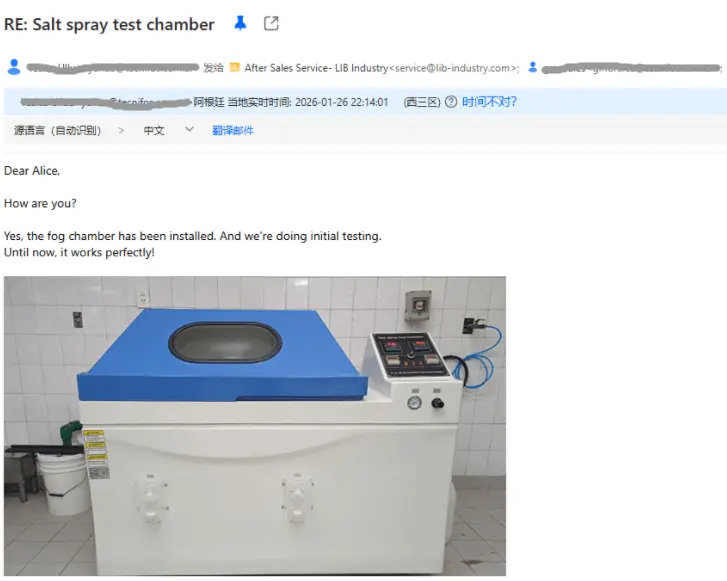
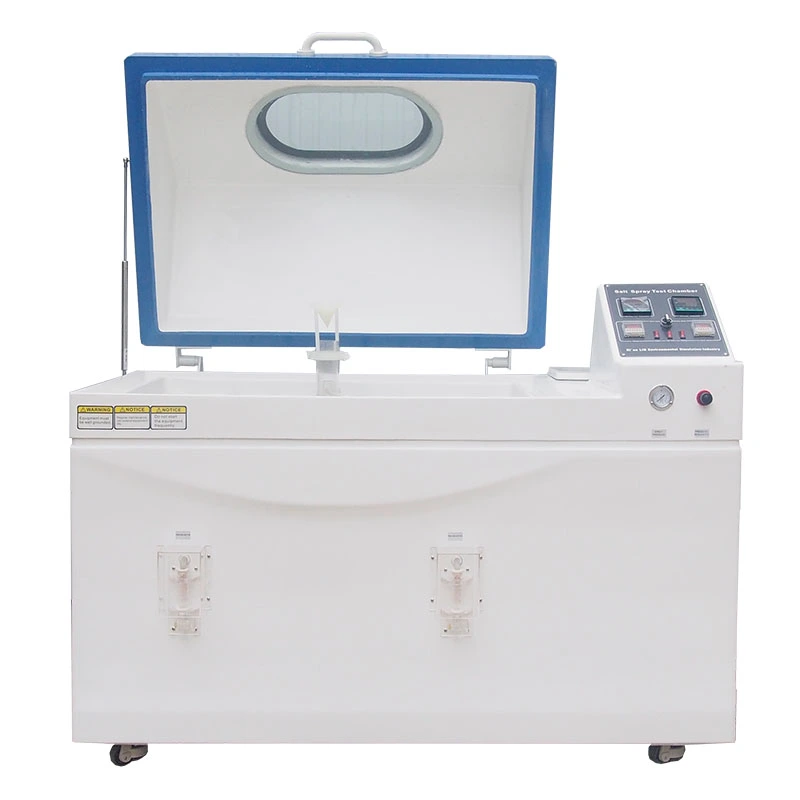
A coatings manufacturer in Argentina recently shared their experience with the LIB industry S-150 salt fog test system. After installation, their team quickly initiated trial runs and confirmed that the equipment was operating smoothly and reliably from the start.
Currently, they are conducting continuous salt fog exposure tests to evaluate the durability and corrosion resistance of various paint coatings. The consistent test environment and precise control capabilities enable accurate monitoring of coating performance over long durations.The customer emphasized the system’s stable operation and dependable performance in daily testing. This positive feedback demonstrates the practical value of the S-150 in delivering repeatable corrosion results and supporting laboratories in achieving reliable, real-world testing outcomes.
Why Protective Coatings Require Corrosion Resistance Validation?
The Economic Impact of Coating Failures
Corrosion-related damage costs the global economy an estimated 3.4% of GDP annually, according to NACE International's IMPACT study. A substantial portion of that loss traces back to premature coating or plating degradation. Warranty claims, product recalls, and structural repair expenditures compound the financial burden. Salt fog corrosion testing enables manufacturers to catch vulnerabilities before products reach the field, mitigating downstream liability.
Regulatory and Industry Compliance Demands
Automotive OEMs, defense contractors, and electronics manufacturers mandate corrosion resistance thresholds within their procurement specifications. Without validated test results from a recognized salt spray protocol, suppliers risk disqualification. Regulatory bodies reference ASTM and ISO salt fog standards as baseline evidence of coating adequacy - making laboratory corrosion testing a non-negotiable step in quality assurance workflows.
Bridging the Gap Between Lab and Field Performance
Real-world corrosion unfolds over months or years, driven by humidity cycling, UV exposure, pollutant deposition, and temperature fluctuations. A salt fog test machine compresses these degradation pathways into accelerated timeframes, yielding comparative data that correlates with outdoor exposure. While no single lab test perfectly replicates nature, salt fog chambers deliver a standardized, repeatable benchmark that product engineers rely on worldwide.
Salt Fog Corrosion Mechanisms Affecting Coating Systems
Chloride Ion Penetration and Substrate Attack
Sodium chloride solution atomized inside the chamber deposits onto coated surfaces, and chloride ions migrate through micro-pores and defects in the coating film. Once these ions reach the metal substrate, they trigger anodic dissolution - forming soluble metal chlorides that further amplify electrochemical attack. This mechanism proves especially aggressive on steel substrates protected by thin organic films.
Osmotic Blistering and Adhesion Loss
Trapped chloride at the coating-substrate interface generates osmotic pressure differentials that draw moisture beneath the film. The resulting blisters progressively undermine adhesion; even coatings that appear visually intact can lose significant pull-off strength. Salt fog exposure renders these latent blisters visible, enabling quantitative grading per ASTM D714.
Galvanic Interactions in Multi-Layer Plating
When dissimilar metals coexist in a plating stack - such as copper-nickel-chromium - the saline electrolyte establishes galvanic cells at layer boundaries. Noble layers remain cathodically protected while sacrificial layers corrode preferentially. A salt fog machine exposes these galvanic dynamics, helping plating engineers adjust layer thickness ratios and select appropriate sealants.
Testing Standards for Protective Coatings and Plated Surfaces
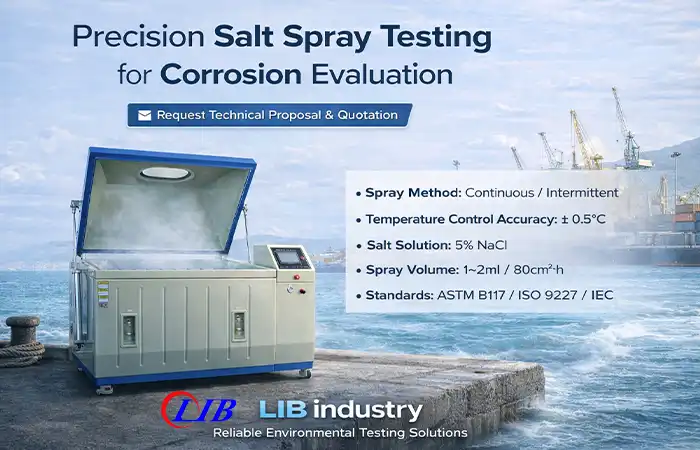
Table 1: Comparison of Major Salt Fog Testing Standards
|
Standard |
Test Atmosphere |
Solution Composition |
Chamber Temperature |
Typical Duration |
|
ASTM B117 |
Neutral salt spray (NSS) |
5% NaCl, pH 6.5-7.2 |
35 °C ± 2 °C |
24-5000 h |
|
ISO 9227 NSS |
Neutral salt spray |
5% NaCl, pH 6.5-7.2 |
35 °C ± 2 °C |
Per specification |
|
ISO 9227 AASS |
Acetic acid salt spray |
5% NaCl + acetic acid, pH 3.1-3.3 |
35 °C ± 2 °C |
Per specification |
|
ISO 9227 CASS |
Copper-accelerated acetic acid |
5% NaCl + CuCl₂ + acetic acid, pH 3.1-3.3 |
50 °C ± 2 °C |
Per specification |
|
ASTM G85 Annex A5 |
Cyclic salt fog / dry |
5% NaCl |
35 °C / ambient |
Varies by OEM |
ASTM B117 - Neutral Salt Spray Protocol
ASTM B117 remains the most widely referenced salt spray standard globally. It specifies continuous exposure to a 5% sodium chloride fog at 35 °C, with a required fog deposition rate of 1-2 ml per 80 cm² per hour. Although this protocol lacks real-world cycling, it offers a universal baseline for comparative ranking of coatings and platings across industries.
ISO 9227 - NSS, AASS, and CASS Methods
ISO 9227 broadens testing flexibility by defining three distinct atmospheres. The NSS method mirrors ASTM B117, while the AASS variant lowers pH to intensify attack on anodized aluminum. The CASS method incorporates copper chloride to evaluate decorative chromium plating with heightened severity. Choosing the correct variant hinges on coating type and end-use application.
Cyclic Corrosion Standards (ASTM G85, SAE J2334)
Cyclic protocols alternate salt fog exposure with drying and high-humidity phases, more closely replicating outdoor weathering patterns. ASTM G85 Annex A5 and SAE J2334 are favored by automotive manufacturers worldwide. These tests demand a salt fog test machine capable of programmable multi-stage operation with precise transitions between temperature, humidity, and spray intervals.
Salt Fog Test Machines for Accelerated Corrosion Simulation
Chamber Architecture and Material Construction
Premium salt spray chambers employ glass fiber reinforced plastics (FRP) to withstand continuous saline exposure without structural degradation. Seamless welded construction prevents electrolyte leakage into electrical systems. A water-seal design effectively blocks mist escape - shielding adjacent laboratory equipment from corrosive contamination. These structural attributes extend chamber service life well beyond conventional metal enclosures.
Precision Temperature and Humidity Control
Accurate corrosion simulation demands tight environmental regulation. Advanced salt fog test machines maintain temperature within ±0.5 °C fluctuation across a range of ambient to +60 °C, with humidity held between 95% and 98% RH. PT100 A-grade sensors paired with PID controllers ensure continuous, drift-free operation - an essential attribute when tests run uninterrupted for thousands of hours.
Spray Uniformity and Deposition Monitoring
Uniform fog distribution governs test validity. Dual-regulation systems control both air intake and spray pressure simultaneously, while precision quartz glass nozzles resist crystallization and clogging. Built-in fog collectors and graduated cylinders allow operators to verify deposition rates of 1-2 ml per 80 cm² per hour, exactly as mandated by ASTM B117 and ISO 9227.
Performance Evaluation of Paint, Zinc Plating, and Alloy Coatings
Table 2: Typical Salt Fog Endurance for Common Coating Systems
|
Coating Type |
Substrate |
Typical NSS Endurance (Hours) |
Primary Failure Mode |
|
Epoxy primer + polyurethane topcoat |
Steel |
1000-3000 |
Scribe creep, blistering |
|
Electrogalvanized zinc (8 µm) |
Steel |
96-200 |
White rust, red rust at edges |
|
Hot-dip galvanized (45 µm) |
Steel |
500-1500 |
White rust, eventual red rust |
|
Zinc-nickel alloy (8-15 µm) |
Steel |
720-1500+ |
Delayed red rust onset |
|
Anodized aluminum (20 µm, sealed) |
Aluminum |
336-1000 |
Pitting at seal defects |
|
Decorative Cr/Ni/Cu plating |
Steel / Zamak |
24-96 (CASS) |
Pitting through pores |
Organic Paint and Powder Coat Assessment
Salt fog exposure reveals how well organic films resist undercutting at intentional scribes and natural defects. Evaluators measure creepage distance from scribe lines per ASTM D1654 and rate blistering density per ASTM D714. Powder coatings generally outperform solvent-borne paints on comparable substrates due to their cross-linked polymer network and the absence of solvent-escape pinholes.
Zinc and Zinc-Nickel Plating Durability
Zinc sacrificially protects steel by corroding preferentially, producing white corrosion products before any red rust emerges. Alloying zinc with 12-16% nickel substantially extends the protective window. Salt fog testing quantifies hours to white rust and hours to red rust - metrics that plating facilities track rigorously to validate bath chemistry and deposition parameters.
Anodized Aluminum and Chromium Coatings
Anodic oxide layers on aluminum derive corrosion resistance from pore sealing quality. AASS testing per ISO 9227 is particularly suited to evaluate sealing integrity under acidified conditions. Decorative chromium plating on steel or zinc die-cast parts undergoes CASS testing, where copper chloride accelerates pore-site corrosion and rapidly differentiates coating quality tiers.
Improving Coating Reliability Through Corrosion Testing
Identifying Weak Points Before Mass Production
Salt fog chambers enable batch sampling during pilot production to detect process deviations - insufficient pretreatment, contaminated rinse water, or under-cured powder coatings - before defective products ship. Early detection prevents costly field failures and safeguards brand reputation. Engineers can trace root causes to specific process steps using structured test matrices.
Optimizing Coating Thickness and Pretreatment
Increasing coating thickness beyond a critical threshold yields diminishing corrosion resistance returns. Salt fog testing across multiple thickness levels establishes the optimal specification that balances material cost with protective performance. Pretreatment variables - phosphating weight, chromate conversion coating, or silane chemistry - can be isolated and ranked under controlled salt spray conditions.
Accelerating Product Development Cycles
Rather than waiting months for outdoor exposure results, R&D teams use accelerated salt fog protocols to screen candidate coatings in days. While correlation with real-world performance requires historical validation data, comparative rankings from salt spray chambers guide formulation decisions rapidly - shortening time-to-market for novel coating technologies.
Customizable Test Cycles to Meet Global Standards (ASTM, ISO) - LIB Industry
Table 3: LIB Industry Salt Fog Test Machine Model Specifications
 |
 |
||||
|
Model |
Internal Dimensions (mm) |
Interior Volume (L) |
Temp. Range |
Humidity |
Deposition Rate |
|
S-150 |
590 × 470 × 400 |
110 |
Ambient-60 °C |
95-98% RH |
1-2 ml/80 cm²·h |
|
S-250 |
1000 × 640 × 500 |
320 |
Ambient-60 °C |
95-98% RH |
1-2 ml/80 cm²·h |
|
S-750 |
1100 × 750 × 500 |
410 |
Ambient-60 °C |
95-98% RH |
1-2 ml/80 cm²·h |
|
S-010 |
1000 × 1300 × 600 |
780 |
Ambient-60 °C |
95-98% RH |
1-2 ml/80 cm²·h |
|
S-016 |
900 × 1600 × 720 |
1030 |
Ambient-60 °C |
95-98% RH |
1-2 ml/80 cm²·h |
|
S-020 |
1000 × 2000 × 800 |
1600 |
Ambient-60 °C |
95-98% RH |
1-2 ml/80 cm²·h |
Multi-Stage Programming for Complex Protocols
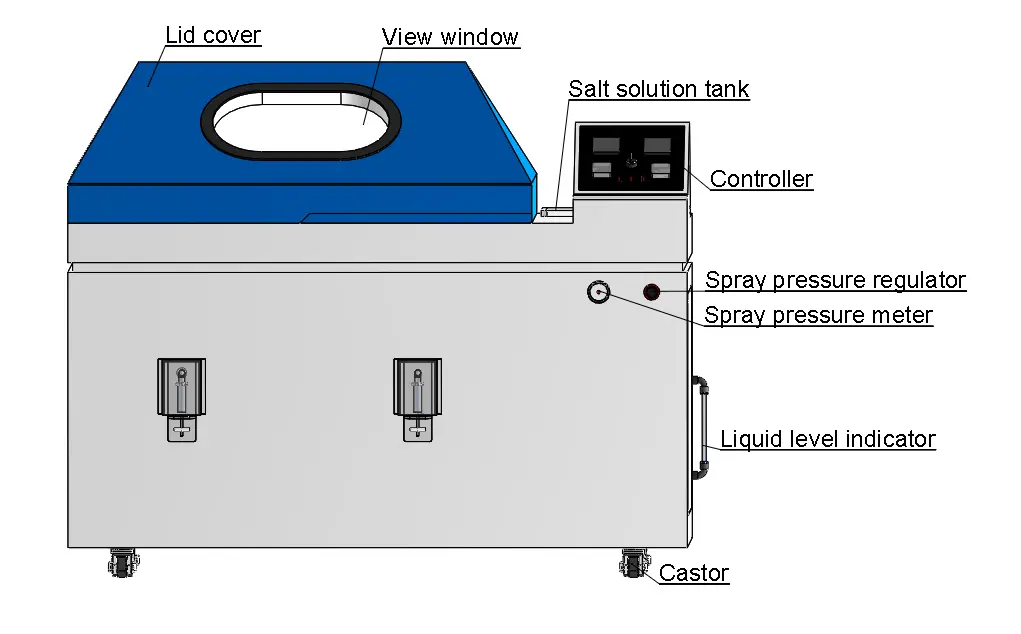
LIB Industry's salt fog test machines feature intuitive touchscreen controllers supporting multi-stage programming with real-time data logging. Engineers can configure cyclic sequences - alternating salt spray, dry-off, and high-humidity phases - within a single automated run. USB data export enables comprehensive documentation for audit trails and regulatory compliance submissions.
Scalable Chamber Volumes for R&D and Production
The product lineup spans 110 L to 1600 L, accommodating small coupon-based R&D evaluations and full-scale production part validation alike. Adjustable spray towers and adaptable test rack systems support diverse specimen geometries while preventing shadowing effects. Each chamber carries CE certification and undergoes SGS and TÜV third-party verification.
Turnkey Solutions with Global Support
LIB Industry delivers end-to-end service encompassing research, design, manufacturing, commissioning, installation, and operator training. Every salt fog test machine includes a 3-year warranty with lifetime service coverage and 24/7 global technical support. Custom configurations address non-standard test requirements, unique specimen dimensions, or facility-specific integration challenges.
Conclusion
Salt fog testing remains a cornerstone methodology for validating protective coatings and plating systems against corrosive degradation. By selecting appropriate standards - whether ASTM B117, ISO 9227 NSS/AASS/CASS, or cyclic protocols - and pairing them with a well-engineered salt fog test machine, manufacturers gain reliable, repeatable data to optimize coating performance. From organic paints and powder coats to zinc-nickel alloys and anodized aluminum, each coating system reveals its true durability under controlled saline exposure. Investing in accelerated corrosion testing safeguards product quality, streamlines development timelines, and ensures compliance with the exacting specifications global markets demand.
FAQ
How long should a salt fog test run for zinc-plated steel parts?
Duration depends on the applicable specification. ASTM B117 tests for electrogalvanized steel typically span 96 to 200 hours for white rust evaluation, while thicker hot-dip galvanized coatings may require 500 hours or longer.
Can a salt fog test machine run cyclic corrosion protocols?
Yes. Advanced chambers with multi-stage programmable controllers alternate between salt spray, drying, and humidity phases - fulfilling cyclic standards such as ASTM G85 and SAE J2334 within a single automated sequence.
What routine maintenance does a salt fog test chamber need?
Regular maintenance includes cleaning spray nozzles to prevent crystallization, replenishing the salt solution tank, calibrating temperature and humidity sensors, and inspecting water seals against mist leakage.
Looking for a reliable salt fog test machine manufacturer? LIB Industry is your trusted supplier and factory partner for turnkey environmental testing solutions worldwide. Contact us at ellen@lib-industry.com to discuss your corrosion testing requirements and receive a customized proposal tailored to your specifications.


