How Thermal Cycling Simulates Long-Term Product Aging?
Thermal cycling simulates long-term product aging by repeatedly exposing specimens to controlled temperature extremes, compressing years of field wear into days or weeks of laboratory testing. Each heating and cooling cycle induces expansion and contraction across bonded materials with differing coefficients of thermal expansion (CTE), generating cumulative mechanical stress that mirrors the gradual degradation products undergo over their service life. Thermal cycling equipment orchestrates precise ramp rates - commonly 5 °C/min or 10 °C/min - and programmable dwell times to replicate seasonal shifts, operational heat buildup, and cold-environment exposure. The result is a data-rich, accelerated portrait of fatigue, microcrack propagation, solder joint weakening, and adhesion loss that would otherwise remain hidden until warranty claims surface in the field.
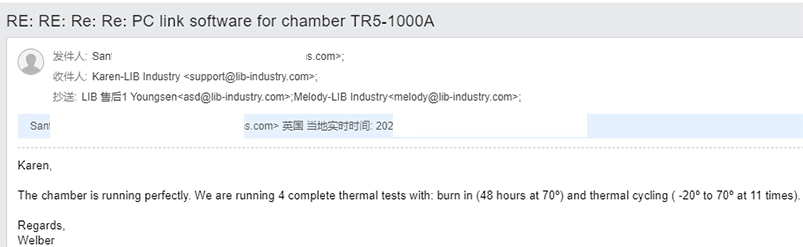
An automotive electronics manufacturer in Italy shared positive feedback on their experience with a LIB Industry rapid temperature change chamber: “The chamber is running perfectly. We conducted four complete test cycles, including a 48-hour burn-in at 70 °C and thermal cycling from –20 °C to 70 °C repeated 11 times.”
Throughout these demanding tests, the chamber maintained stable and reliable performance, enabling the team to carry out long-duration burn-in and repeated thermal cycling with confidence. Its precise temperature control and consistent transition rates ensured accurate test conditions, helping engineers efficiently assess the durability and reliability of electronic modules under real-world thermal stress.
What Is the Principle Behind Thermal Cycling Acceleration Testing?
The Arrhenius Model and Acceleration Factors
Accelerated aging hinges on the Arrhenius relationship, which establishes that chemical reaction rates - and associated degradation mechanisms - roughly double with every 10 °C rise in temperature. By widening the temperature delta and increasing cycle frequency, engineers compress real-world aging into a manageable test window. Acceleration factors derived from the Arrhenius equation allow laboratories to translate chamber cycle counts into equivalent months or years of field exposure with quantifiable statistical confidence.
Coffin-Manson Fatigue Life Correlation
The Coffin-Manson model connects the plastic strain range experienced during each temperature swing to the number of cycles required for fatigue failure. A larger temperature excursion produces greater plastic deformation in solder joints, wire bonds, and polymer interfaces, reducing cycles to failure. This correlation enables engineers to design test profiles that target specific fatigue-life endpoints, ensuring validation results map accurately onto anticipated product lifetimes.
Stress-Strain Accumulation Across Repeated Cycles
Each thermal cycle deposits a small increment of irreversible strain in materials subjected to CTE mismatch. Over hundreds or thousands of cycles, this incremental damage accumulates until cracks nucleate and propagate to critical lengths. The controlled repeatability of modern environmental chambers makes it possible to track damage evolution cycle by cycle, yielding failure-progression curves that inform both design improvements and quality control screening.
Temperature Stress as a Driver of Material Fatigue

CTE Mismatch Between Bonded Layers
When two materials with different thermal expansion coefficients are bonded together - such as a silicon die on a copper substrate - every temperature change generates shear and peel stresses at the interface. The magnitude of these stresses scales with the temperature delta and the elastic modulus of the constraining layer. Repeated cycling drives interfacial crack growth that eventually compromises electrical continuity or structural integrity.
Polymer Chain Scission and Embrittlement
Polymers used as encapsulants, gaskets, and insulation coatings undergo chain scission when exposed to repeated thermal stress. Alternating expansion and contraction break molecular chains, reducing elongation-at-break and increasing brittleness. This embrittlement makes components vulnerable to vibration-induced fracture and moisture ingress, underscoring the importance of pre-qualifying polymer materials through rigorous cycling protocols.
Metallurgical Evolution in Solder Alloys
Lead-free solder alloys such as SAC305 experience grain coarsening and intermetallic compound growth during thermal cycling. These microstructural changes reduce ductility and concentrate stress at grain boundaries, accelerating fatigue crack initiation. Monitoring the progression of these metallurgical changes under controlled chamber conditions provides actionable guidance for alloy selection and reflow-profile optimization.
Table 1: Material-Level Degradation Mechanisms Accelerated by Thermal Cycling
|
Material Type |
Degradation Mechanism |
Observable Consequence |
|
Solder alloy |
Grain coarsening, IMC growth |
Joint cracking, open circuits |
|
Polymer encapsulant |
Chain scission, embrittlement |
Delamination, moisture ingress |
|
Ceramic substrate |
Micro-fracture propagation |
Dielectric failure |
|
Adhesive bond |
Cohesive/adhesive failure |
Component detachment |
|
Metal trace/conductor |
Electromigration under thermal gradient |
Resistance increase, open failure |
Key Test Parameters for Accelerated Aging Simulation
Temperature Range Selection
Selecting the appropriate temperature range determines both the acceleration factor and the relevance of the test to actual service conditions. A thermal cycling test chamber capable of spanning -70 °C to +150 °C covers most automotive, aerospace, and electronics requirements. Profiles aligned with industry standards - such as -40 °C to +125 °C for consumer electronics - ensure results are comparable across suppliers and test houses.
Ramp Rate and Dwell Time Configuration
Ramp rate governs the thermal gradient within the specimen and influences the dominance of different failure modes. A controllable ramp rate of 5 °C/min, 10 °C/min, or 15 °C/min lets engineers balance between stress severity and test duration. Dwell time at each temperature extreme allows the specimen to reach thermal equilibrium, ensuring uniform stress distribution throughout the test article.
Cycle Count and Statistical Sample Size
The total number of cycles must be sufficient to drive statistically meaningful failure distributions. Weibull analysis of cycle-to-failure data yields shape and scale parameters that characterize product reliability. Larger sample sizes tighten confidence intervals and enhance the predictive power of the resulting life models, making cycle count planning a critical part of test design.
Table 2: Typical Thermal Cycling Profiles by Industry
|
Industry |
Temp. Range |
Ramp Rate |
Typical Cycle Count |
|
Automotive electronics |
-40 °C to +125 °C |
10 °C/min |
1,000-3,000 |
|
Aerospace avionics |
-55 °C to +125 °C |
5 °C/min |
500-2,000 |
|
Consumer electronics |
-20 °C to +85 °C |
10 °C/min |
500-1,500 |
|
LED / optoelectronics |
-40 °C to +100 °C |
15 °C/min |
1,000-5,000 |
|
Pharmaceutical packaging |
-20 °C to +60 °C |
5 °C/min |
200-500 |
Identifying Microcracks, Delamination, and Structural Weaknesses
Scanning Acoustic Microscopy for Sub-Surface Defects
After cycling, scanning acoustic microscopy (SAM) sends ultrasonic pulses through specimens to detect voids, delaminations, and cracks that remain invisible on the surface. Reflection patterns reveal the exact depth and lateral extent of internal damage, making SAM an indispensable companion to thermal cycling tests in power electronics and multi-layer PCB validation.
Cross-Sectional Metallographic Analysis
Metallographic cross-sections expose crack paths, intermetallic layer thickness, and grain structure changes at solder joints and bond interfaces. Polishing and etching techniques, combined with optical and electron microscopy, deliver high-resolution images that trace the failure trajectory from initiation site to final fracture. These images form the evidentiary backbone of root-cause investigation reports.
Electrical Parametric Drift Monitoring
Continuous or interval-based electrical measurements during cycling catch subtle resistance increases, leakage current changes, and capacitance shifts that signal progressive degradation. Real-time data logging - supported by programmable controllers with Ethernet and USB connectivity - enables engineers to correlate electrical drift with specific cycle counts, establishing clear damage-onset thresholds for pass/fail criteria.
Thermal Cycling Equipment for Lifecycle Reliability Assessment
  |
  |
|||||||
|
|
|
|
| Robust Workroom | Cable Hole | Temperature and Humidity Sensor |


Chamber Volume and Specimen Capacity
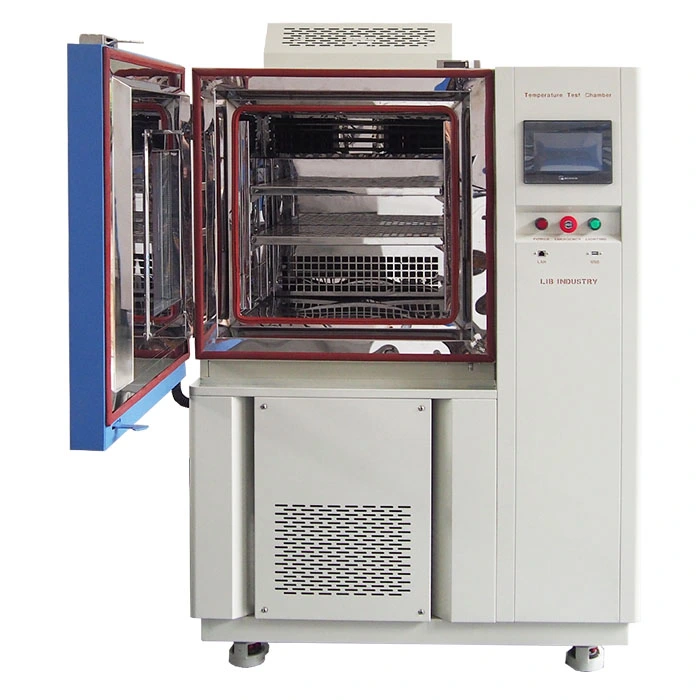
Choosing the right chamber volume ensures representative loading without crowding that restricts airflow. Capacities ranging from 100 L to 1,000 L accommodate individual components, populated circuit boards, and complete sub-assemblies. Proper specimen spacing maintains uniform temperature distribution and avoids localized hot or cold spots that could skew results.
Programmable Controllers and Remote Monitoring
A programmable color LCD touch-screen controller of thermal cycling machine enables engineers to define complex multi-step profiles with variable ramp rates, dwell durations, and cycle counts. Ethernet connectivity allows remote test monitoring from any networked workstation, while USB ports facilitate convenient data download. These features reduce operator attendance and enhance traceability throughout long-duration test campaigns.
Integrated Safety Systems
Comprehensive safety provisions - including over-temperature protection, over-current shutdown, refrigerant high-pressure detection, and earth-leakage safeguards - protect both personnel and equipment during unattended overnight runs. Explosion-proof doors, smoke detectors, and water-spray fire-suppression options further reinforce safe operation when testing specimens that may off-gas under thermal stress.
Table 3: LIB Industry Thermal Cycling Equipment Specifications
|
Model |
TR5-100 |
TR5-225 |
TR5-500 |
TR5-800 |
TR5-1000 |
|
Interior Volume |
100 L |
225 L |
500 L |
800 L |
1,000 L |
|
Internal Dimensions (mm) |
400×500×500 |
500×600×750 |
700×800×900 |
800×1000×1000 |
1000×1000×1000 |
|
Temperature Range |
-70 °C to +150 °C |
-70 °C to +150 °C |
-70 °C to +150 °C |
-70 °C to +150 °C |
-70 °C to +150 °C |
|
Ramp Rate (Cooling/Heating) |
5 °C/min |
5 °C/min |
5 °C/min |
5 °C/min |
5 °C/min |
|
Temperature Fluctuation |
± 0.5 °C |
± 0.5 °C |
± 0.5 °C |
± 0.5 °C |
± 0.5 °C |
|
Interior Material |
SUS304 SS |
SUS304 SS |
SUS304 SS |
SUS304 SS |
SUS304 SS |
Predicting Long-Term Product Performance Through Environmental Testing
Weibull Distribution and Failure Forecasting
Plotting cycle-to-failure data on a Weibull probability chart yields shape (β) and characteristic-life (η) parameters that describe the failure distribution of a component population. A steep β value indicates a tight failure mode, while a shallow β suggests mixed or early-life dominant failure. These statistical models underpin warranty cost projections and preventive maintenance scheduling for fielded products.
Correlation Between Lab Results and Field Returns
Establishing a robust lab-to-field correlation requires matching acceleration factors with actual environmental duty cycles harvested from product telemetry. When laboratory thermal cycling profiles accurately mirror real operational extremes, the correlation between predicted and observed field-failure rates tightens significantly. This alignment builds confidence among quality teams, design engineers, and end customers.
Continuous Improvement via Iterative Test-Design Loops
Each round of thermal cycling reveals new failure modes or validates corrective actions implemented after previous rounds. Feeding test outcomes back into design iterations - modifying material choices, geometry, or manufacturing parameters - drives continuous reliability improvement. This iterative loop transforms environmental testing from a pass/fail gate into a strategic product-development tool.
Efficient Airflow Systems for Realistic Stress Testing - LIB Industry
Centrifugal Fan Circulation Architecture
LIB Industry thermal cycling test equipment employ centrifugal wind fans that maintain vigorous, uniform air circulation throughout the test volume. This forced-convection architecture eliminates stagnant zones, ensuring every specimen surface experiences the same temperature ramp and dwell conditions. Uniform airflow translates directly into tighter temperature deviation - within ± 2.0 °C across the usable workspace.
Polyurethane Foam and Insulation Cotton Thermal Barrier
A dual-layer insulation system combining rigid polyurethane foam with insulation cotton minimizes heat exchange between the chamber interior and the ambient laboratory environment. This thermal barrier reduces compressor duty cycling, lowers energy consumption, and stabilizes interior conditions during extended test runs that may span several weeks.
Turnkey Service from Concept to Commissioning
LIB Industry provides a complete turnkey solution - from initial consultation and chamber design through manufacturing, delivery, on-site installation, and operator training. Custom configurations accommodate unique specimen geometries, cable-hole placements (50 mm / 100 mm / 200 mm), and optional humidity control. This full-spectrum service model guarantees that each chamber is optimized for its intended application from day one.
Conclusion
Thermal cycling compresses years of environmental wear into controlled laboratory timelines, revealing fatigue, microcrack propagation, delamination, and parametric drift that would otherwise emerge only after prolonged field deployment. By calibrating ramp rates, temperature ranges, dwell times, and cycle counts against physics-of-failure models, engineers extract statistically robust life predictions from accelerated test data. The insights gained through these tests empower design teams to iterate rapidly, improve material selections, and deliver products that withstand the rigors of real-world thermal environments across their full intended lifespan.
FAQ
How does thermal cycling differ from thermal shock testing?
Thermal cycling applies controlled, gradual ramp rates (e.g., 5-15 °C/min), while thermal shock testing transfers specimens abruptly between pre-conditioned hot and cold zones, achieving temperature transitions within minutes for more severe stress exposure.
What ramp rate should I select for accelerated aging tests?
Ramp rate depends on the target application and failure mode. LIB Industry thermal cycling equipment supports controllable rates of 5 °C/min, 10 °C/min, and 15 °C/min to match industry-specific standards.
Can thermal cycling chambers accommodate humidity testing simultaneously?
Yes. LIB Industry offers an optional humidity control system that enables combined temperature-humidity cycling, broadening the scope of environmental stress screening within a single chamber platform.
Need a dependable thermal cycling equipment manufacturer and supplier? LIB Industry offers turnkey environmental testing solutions customized to your reliability validation requirements. Reach out at ellen@lib-industry.com to discuss chamber specifications, custom configurations, and project timelines.