Thermal Shock Testing in EV Powertrain Component Validation
Thermal shock testing plays a pivotal role in validating EV powertrain components against the extreme temperature swings encountered during real-world driving. Electric motors, inverters, onboard chargers, and power controllers all endure rapid thermal cycling - from sub-zero cold starts to intense heat generated under sustained high-power operation. A thermal shock test chamber recreates these abrupt transitions by transferring specimens between hot and cold zones in under five minutes, exposing hidden weaknesses in solder joints, insulation layers, encapsulants, and structural bonds. By subjecting components to controlled temperature extremes ranging from -70 °C to +200 °C, engineers can identify early-life failures and design flaws before mass production, protecting both vehicle performance and passenger safety across the entire operational lifespan.
A Russian aerospace testing facility recently incorporated a LIB Industry thermal shock chamber into its reliability evaluation process. By leveraging rapid temperature transitions from -70 °C to +200 °C, engineers successfully replicated the extreme thermal stresses encountered during high-altitude operations.
This advanced testing exposed micro-cracks and structural weaknesses in turbine components that had gone undetected in conventional testing methods. The team also noted that the system operates with exceptional stability and requires minimal manual intervention, delivering highly consistent and repeatable results. As a result, the chamber has become an essential tool for improving component design and ensuring the safety and reliability of mission-critical aerospace applications.

What Thermal Challenges Do EV Powertrain Components Face?
Rapid Temperature Cycling During Acceleration and Regenerative Braking
EV powertrains experience sharp temperature fluctuations during aggressive acceleration and regenerative braking events. Power semiconductor modules inside inverters can swing from ambient to over 150 °C within seconds, then cool rapidly when load decreases. These abrupt transitions generate coefficient-of-thermal-expansion (CTE) mismatches between bonded materials, ultimately driving crack initiation in solder interfaces and wire bonds.
Cold-Climate Start-Up Stresses
In regions where ambient temperatures plummet below -30 °C, powertrain electronics must transition from deep cold to full operating temperature within minutes. Condensation, ice formation, and contraction-induced mechanical stress combine to challenge encapsulants, conformal coatings, and PCB laminates. Validating performance under these conditions demands environmental testing that faithfully reproduces sub-zero extremes.
Heat Accumulation in Enclosed Motor Housings
Electric motor stators and rotors operate inside sealed housings with limited convective airflow. Continuous high-torque demands push winding temperatures well above 180 °C, while coolant channels maintain surrounding structures near 60 °C. This persistent temperature gradient accelerates insulation degradation, bearing lubricant breakdown, and magnet demagnetization if materials have not been rigorously qualified.
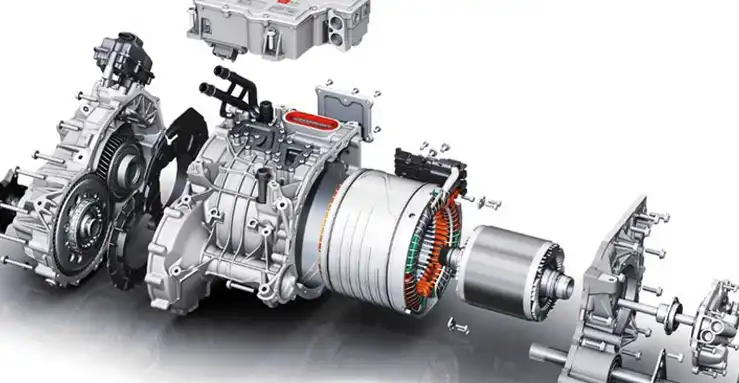
Table 1: Common EV Powertrain Components and Their Thermal Challenges
|
Component |
Typical Temp. Range |
Primary Thermal Risk |
|
Inverter Power Module |
-40 °C to +175 °C |
Solder joint fatigue, bond-wire lift-off |
|
Electric Motor Stator |
-30 °C to +200 °C |
Insulation degradation, partial discharge |
|
Onboard Charger PCB |
-40 °C to +125 °C |
Encapsulant delamination, component cracking |
|
DC-DC Converter |
-40 °C to +150 °C |
Capacitor dielectric breakdown |
|
Battery Management Controller |
-40 °C to +85 °C |
Conformal coating adhesion loss |
Thermal Stress Risks in Electric Motors, Inverters, and Controllers
Solder Joint Fatigue in Power Modules
Solder interconnects between silicon dies and direct-bonded copper (DBC) substrates are particularly susceptible to thermomechanical fatigue. Repeated thermal cycling causes plastic strain accumulation in solder layers, leading to void coalescence and eventual open-circuit failure. Thermal shock testing reveals the cycle-to-failure threshold, enabling engineers to select higher-reliability solder alloys or sintered-silver die-attach alternatives.
Insulation Breakdown in Stator Windings
Stator winding insulation - typically polyimide film or enamel coatings - degrades when subjected to recurring thermal expansion and contraction. Micro-cracks propagate through insulation layers, reducing dielectric strength and increasing partial discharge activity. Accelerated thermal shock protocols in a controlled chamber expose latent insulation defects that would otherwise surface only after thousands of operating hours in the field.
Encapsulant Delamination in Control Units
Electronic control units (ECUs) rely on epoxy or silicone encapsulants for moisture protection and mechanical damping. CTE mismatch between the encapsulant and the PCB substrate can trigger delamination under rapid temperature swings, permitting moisture ingress and corrosion. Testing in a thermal shock chamber quantifies delamination onset and guides material selection for robust, long-lasting protection.
Industry Testing Standards for EV Powertrain Thermal Shock
.jpg "blog-1-1")
IEC 60068-2-14 (Test N: Change of Temperature)
IEC 60068-2-14 defines procedures for evaluating components subjected to rapid temperature changes. It specifies soak times, transfer durations, and severity levels applicable to automotive-grade electronics. EV powertrain suppliers frequently reference this standard when qualifying power modules, sensors, and connectors for production release.
AEC-Q100 and AEC-Q101 Qualification Flows
The Automotive Electronics Council's AEC-Q100 (integrated circuits) and AEC-Q101 (discrete semiconductors) qualification standards mandate thermal shock endurance as a core reliability gate. Components must survive a defined number of cycles - often 500 to 1,000 - between -65 °C and +150 °C with zero parametric drift beyond specified limits.
OEM-Specific Thermal Shock Profiles
Many automakers impose proprietary thermal profiles that exceed baseline industry standards. These profiles mirror field-data-driven worst-case scenarios unique to each vehicle platform, demanding customized chamber programming, extended cycle counts, and post-test electrical characterization. Flexible chamber controllers with Ethernet connectivity streamline execution of complex, multi-step profiles.
Table 2: Key Thermal Shock Testing Standards for EV Components
|
Standard |
Scope |
Typical Cycle Requirement |
|
IEC 60068-2-14 |
General electronic components |
Varies by severity level |
|
AEC-Q100 |
Automotive integrated circuits |
500-1,000 cycles (-65 °C to +150 °C) |
|
AEC-Q101 |
Automotive discrete semiconductors |
500-1,000 cycles |
|
OEM-specific profiles |
Vehicle-platform-tailored validation |
Custom, often exceeding AEC baselines |
Simulating Extreme Temperature Fluctuations in Vehicle Operation
Basket-Transfer Mechanism for Rapid Specimen Transition
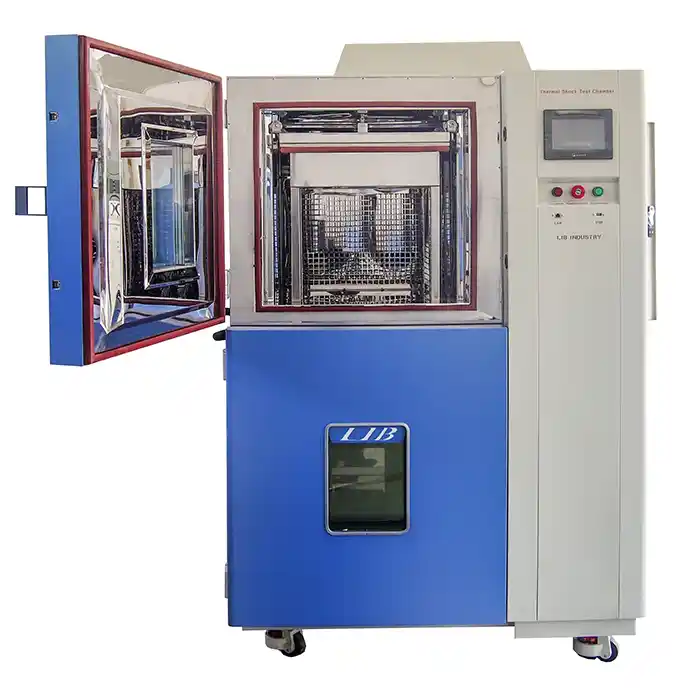
Modern thermal shock chambers employ a basket-transfer mechanism that slides specimens vertically between pre-conditioned hot and cold zones. This approach achieves temperature recovery within five minutes, closely mirroring the abrupt thermal transients powertrain components encounter during actual driving events. The basket rail system ensures smooth, repeatable motion without mechanical impact on delicate test samples.
Programmable Multi-Step Temperature Profiles
Advanced programmable color LCD touch-screen controllers allow engineers to configure multi-step dwell, ramp, and soak sequences that replicate mission profiles derived from vehicle telemetry. Ethernet connectivity enables remote monitoring and data logging, reducing manual intervention while enhancing traceability. This programmability proves essential for correlating laboratory results with field-failure data.
Wide Operating Envelope from -70 °C to +200 °C
A broad temperature range - spanning -70 °C in the cold compartment to +200 °C in the hot compartment - in a thermal shock machine covers virtually every thermal extreme an EV powertrain component might encounter. Mechanical compression refrigeration with environmentally friendly refrigerant ensures stable low-temperature performance, while robust heating elements maintain uniform high-temperature conditions across the test volume. Temperature fluctuation remains within ±0.5 °C.
Durability Testing for Power Electronics and Insulation Systems
Accelerated Aging of IGBT and SiC Modules
Insulated-gate bipolar transistor (IGBT) and silicon carbide (SiC) power modules serve as the backbone of EV inverters. Subjecting these modules to thousands of thermal shock cycles accelerates aging mechanisms - including bond-wire lift-off and substrate cracking - within weeks rather than years. Test results feed directly into physics-of-failure models that predict field lifetime with statistical confidence.
Dielectric Endurance of High-Voltage Insulation
High-voltage busbars, cable terminations, and motor phase connectors demand verified dielectric integrity after thermal stress. Post-shock hipot (high-potential) and partial-discharge measurements confirm that insulation systems retain adequate margins. This combined mechanical-electrical test methodology catches failures invisible to visual inspection alone.
Conformal Coating and Potting Compound Qualification
Conformal coatings and potting compounds shield PCBs from humidity, vibration, and chemical exposure. Thermal shock cycles reveal adhesion loss, cracking, or bubble formation in these protective layers. Qualifying coatings under chamber-simulated extremes ensures they maintain protective function across the vehicle's anticipated 15-year design life.
Ensuring Long-Term Reliability of EV Powertrain Components Through Testing
Correlating Lab Cycles to Field Service Life
Acceleration factors derived from Arrhenius and Coffin-Manson models enable engineers to translate laboratory cycle counts into equivalent years of real-world service. A well-characterized thermal shock test protocol can compress a decade of field exposure into a few thousand chamber cycles, providing rapid confidence in component durability without waiting for fleet-level feedback.
Failure Analysis and Root-Cause Investigation
When specimens fail during thermal shock testing, cross-sectional microscopy, scanning acoustic microscopy (SAM), and energy-dispersive X-ray (EDX) analysis identify precise failure sites and mechanisms. These insights close the loop between testing and design improvement, driving iterative enhancements to materials, geometries, and manufacturing processes.
Continuous Improvement Through Data-Driven Design
Aggregated thermal shock data across product generations reveals reliability trends and informs design-for-reliability (DfR) guidelines. Statistical process control (SPC) applied to test outcomes flags early manufacturing drift, enabling corrective action before defective components reach the assembly line. This feedback loop underpins the quality frameworks modern EV programs depend upon.
Robust Performance Testing for High-Voltage Automotive Systems - LIB Industry
Turnkey Solutions from Research to Production
LIB Industry delivers turnkey environmental testing solutions covering research, design, production, commissioning, installation, and training. This end-to-end approach simplifies procurement and guarantees seamless integration of thermal shock test chambers into existing validation workflows for EV powertrain programs.
Versatile Chamber Configurations for Diverse Test Needs
With models ranging from the compact 22 L TS-162 to the spacious 505 L TS-1000, LIB's lineup accommodates everything from individual power modules to full inverter assemblies. Loading capacities from 20 kg to 60 kg and an observation window with interior lighting support hands-on specimen monitoring without interrupting the test cycle.
Comprehensive Safety and Environmental Compliance
Every LIB thermal shock test chamber integrates over-temperature protection, over-current safeguards, refrigerant high-pressure detection, and earth-leakage shutdown. Environmentally friendly refrigerants paired with energy-efficient French TECUMSEH compressors align with evolving global sustainability regulations, making these chambers a responsible choice for forward-thinking OEMs and Tier 1 suppliers.
|
LIBAir-to-Air Thermal Shock Chamber |
|
|||||||||


|
|
|
|
Test Basket |
The Controller |
|
|
|
|
Cable Hole |
Castor |


Table 3: LIB Thermal Shock Test Chamber Specifications
|
Specification |
TS-162 |
TS-340 |
TS-500 |
TS-1000 |
|
Interior Volume |
22 L |
72 L |
211 L |
505 L |
|
Internal Dimensions (mm) |
300×300×250 |
450×450×360 |
650×650×500 |
850×850×700 |
|
Loading Capacity |
20 kg |
30 kg |
50 kg |
60 kg |
|
Temperature Range |
-70 °C to +220 °C |
-70 °C to +220 °C |
-70 °C to +220 °C |
-70 °C to +220 °C |
|
Temperature Recovery Time |
Within 5 min |
Within 5 min |
Within 5 min |
Within 5 min |
|
Interior Material |
SUS304 Stainless Steel |
SUS304 Stainless Steel |
SUS304 Stainless Steel |
SUS304 Stainless Steel |
Conclusion
Thermal shock testing stands as an indispensable pillar of EV powertrain validation, catching latent material and assembly defects long before vehicles reach consumers. By replicating the punishing temperature transitions that motors, inverters, and controllers endure throughout their service life, engineers gain actionable reliability data that informs smarter material choices, refined manufacturing processes, and more durable product designs. Investing in capable thermal shock testing equipment is not merely a compliance exercise - it is a strategic move that safeguards brand reputation, reduces warranty exposure, and accelerates time-to-market for next-generation electric vehicles.
FAQ
Why is thermal shock testing critical for EV powertrain validation?
Thermal shock testing exposes hidden failures - such as solder fatigue, insulation cracking, and delamination - caused by rapid temperature swings, ensuring powertrain components meet reliability and safety targets before mass production.
What temperature range is suitable for EV powertrain thermal shock testing?
Most EV powertrain tests require a range of -65 °C to +200 °C, covering cold-climate start-ups through peak operating temperatures. LIB chambers offer -70 °C to +220 °C for comprehensive coverage.
How quickly should specimens transfer between hot and cold zones?
Industry best practice targets temperature recovery within five minutes. LIB's basket-transfer mechanism achieves this threshold, faithfully replicating the abrupt thermal transients encountered during vehicle operation.
Looking for a reliable thermal shock test chamber manufacturer and supplier? LIB Industry provides turnkey environmental testing solutions tailored to your EV powertrain validation needs. Contact us today at ellen@lib-industry.com to discuss chamber configurations, custom profiles, and project timelines.