Water Immersion Tank Testing for Marine Equipment
Marine equipment operates under some of the most demanding conditions imaginable - constant exposure to saltwater, extreme hydrostatic pressures, and relentless environmental stresses that can compromise even the most robust designs. Water immersion tank testing has become indispensable for manufacturers seeking to validate the reliability and waterproof integrity of navigation systems, underwater sensors, submersible components, and shipboard electronics. By replicating real-world submersion scenarios in controlled laboratory environments, these specialized testing chambers enable engineers to identify potential failure points before deployment, ensuring that critical marine equipment performs flawlessly when lives and missions depend on it. This comprehensive approach to validation not only meets stringent international standards but also delivers the confidence that equipment will withstand years of oceanic service.
Why Is Water Immersion Testing Critical for Marine Equipment?
Preventing Catastrophic Equipment Failures at Sea
Marine equipment failures don't just result in financial losses - they can endanger lives, compromise missions, and damage marine ecosystems. A water immersion tank provides controlled verification that sealed enclosures, electronic housings, and protective casings maintain their integrity when submerged. Testing reveals microscopic seal defects, material degradation points, and design vulnerabilities that visual inspection cannot detect. Manufacturers who skip comprehensive immersion validation risk catastrophic field failures that could have been prevented through systematic laboratory testing.
Regulatory Compliance and Certification Requirements
Maritime authorities worldwide mandate rigorous waterproofing standards for equipment deployed in ocean environments. International Electrotechnical Commission (IEC) standards, military specifications, and classification society requirements all reference specific immersion testing protocols. A water immersion tank enables manufacturers to demonstrate compliance with IP67, IP68, and higher ingress protection ratings. Documentation from controlled immersion testing provides the evidence required for certification, insurance coverage, and customer acceptance in maritime markets.
Cost Reduction Through Early Design Validation
Identifying waterproofing weaknesses during the design phase costs significantly less than addressing failures after production or deployment. Immersion testing chambers allow iterative testing of prototypes, seal configurations, and material selections before committing to full-scale manufacturing. Engineers can evaluate multiple design variations systematically, optimizing for both performance and manufacturability. This front-loaded validation approach prevents expensive redesigns, warranty claims, and reputation damage that accompany field failures.
Harsh Marine Environments and Corrosion Challenges

Saltwater Penetration and Electrochemical Degradation
Seawater contains approximately 35,000 parts per million of dissolved salts, creating an aggressive electrolyte that accelerates corrosion and electrical degradation. Even microscopic breaches in protective housings allow saltwater ingress that initiates devastating electrochemical reactions. Immersion testing chambers equipped with saline solution capability replicate this corrosive environment, revealing how quickly seals degrade and which materials resist galvanic corrosion. Testing with actual seawater composition provides realistic degradation timelines that pure water testing cannot replicate.
Pressure-Induced Seal Compression and Failure
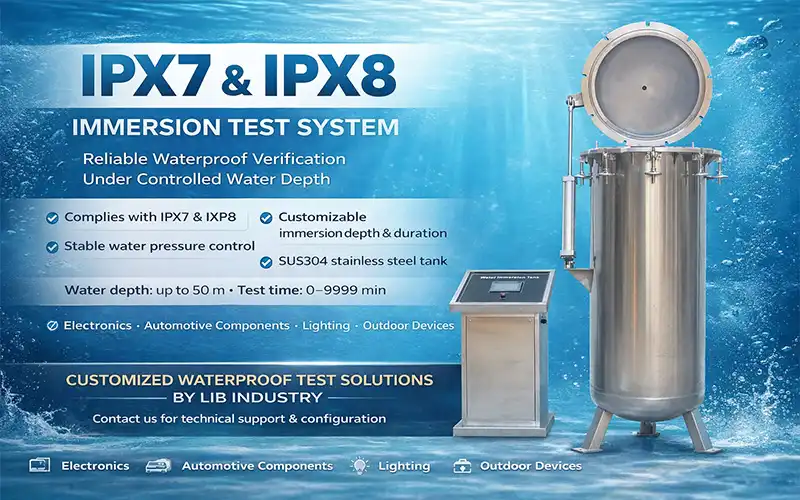
Marine equipment operating at depth experiences tremendous hydrostatic forces that compress seals, distort housings, and force water through microscopic gaps. A water immersion tank with pressure simulation capabilities replicates the forces encountered at operational depths up to 50 meters or beyond. O-rings, gaskets, and mechanical seals that appear adequate at atmospheric pressure may fail dramatically when subjected to sustained hydrostatic loading. Pressure testing identifies the exact depth ratings where seal integrity becomes compromised.
Temperature Cycling and Thermal Expansion Differentials
Ocean temperatures vary dramatically between tropical surface waters and cold deep-sea environments, causing materials to expand and contract at different rates. These thermal cycles create gaps in assemblies designed with inadequate thermal compensation. Advanced immersion testing chambers incorporate temperature control systems that cycle between temperature extremes while maintaining submersion, revealing thermal-mechanical weaknesses. Materials selection proves critical when components must maintain watertight integrity across 40°C temperature swings.
Simulation of Submersion and Saltwater Exposure
Replicating Authentic Oceanic Conditions
Laboratory testing must accurately mirror the complex interactions of pressure, salinity, temperature, and duration that equipment encounters in actual marine service. A water immersion tank configured for marine testing incorporates controlled saline concentration, adjustable hydrostatic pressure, and programmable immersion cycles. The R78-600 model, with its 1500mm internal height and 50-meter depth pressure capability, provides sufficient volume for substantial marine components while maintaining precise environmental control. Authenticity in testing conditions directly correlates with predictive accuracy for field performance.
Extended Duration Testing for Long-Term Reliability
Marine equipment often operates continuously for months or years between maintenance intervals. Short-duration immersion tests may miss progressive seal degradation, material swelling, or cumulative fatigue effects. Extended immersion protocols ranging from 72 hours to several weeks reveal time-dependent failure mechanisms that accelerated testing overlooks. Programmable controllers enable automated cycling between submersion and atmospheric exposure, simulating repeated dive profiles or tidal variations that stress seals through repeated compression and relaxation cycles.
Post-Immersion Functional Verification
Waterproof integrity represents only one dimension of marine equipment reliability - the device must also maintain full operational capability after immersion exposure. Comprehensive testing protocols include electrical continuity verification, sensor calibration checks, and functional performance testing immediately following tank removal. Moisture intrusion measurement using precision humidity sensors or weight comparison detects even minimal water ingress. This holistic approach ensures that equipment doesn't just exclude water but continues performing its intended function flawlessly after environmental exposure.
How Do Tanks Replicate Real Marine Operating Conditions?
Pressurization Systems and Depth Simulation
Table 1: Pressure Equivalents for Marine Depth Simulation
|
Water Depth |
Pressure (Bar) |
Pressure (PSI) |
Typical Applications |
|
10 meters |
2.0 |
29 |
Shallow submersibles, hull sensors |
|
25 meters |
3.5 |
51 |
Recreational diving equipment, shallow ROVs |
|
50 meters |
6.0 |
87 |
Professional diving gear, mid-depth instruments |
|
100 meters |
11.0 |
160 |
Deep submersibles, oceanographic sensors |
|
300 meters |
31.0 |
450 |
Deep-sea research equipment, subsea infrastructure |
Precision pressure control systems within immersion tanks gradually increase hydrostatic forces to simulate specific operational depths. Pneumatic lid mechanisms on models like the R78-600 ensure safe containment during pressurization cycles. Pressure transducers monitor real-time conditions while programmable controllers maintain setpoints within narrow tolerances. Gradual pressurization rates prevent shock loading that could invalidate test results by causing failures unrealistic to actual deployment scenarios.
Automated Water Quality and Temperature Management
Marine testing requires consistent water chemistry throughout extended test durations. Integrated water supply systems with storage tanks ensure continuous availability while filtration systems remove particulates that could interfere with seal surfaces. Temperature control capabilities range from near-freezing conditions simulating Arctic waters to elevated temperatures replicating tropical deployments. The programmable color LCD touchscreen controller enables complex thermal profiles with up to 120 programs of 100 segments each, facilitating sophisticated test protocols that mirror actual mission profiles.
Safety Features and Operational Reliability
Industrial-grade water immersion tanks incorporate multiple safety mechanisms protecting both operators and test specimens. Reinforced A3 steel plate construction with 15mm wall thickness withstands internal pressurization without deformation. Galvanized coatings and electrostatic treatments on fastening valves prevent corrosion that could compromise structural integrity. Hydraulic rods manufactured from 304 stainless steel with mirror-finish surfaces resist corrosion from moisture exposure. Ethernet connectivity enables remote monitoring and automated alerts when parameters deviate from specifications, ensuring test validity and operational safety.
Standards for Marine Equipment Waterproof Testing
International Electrotechnical Commission (IEC) Guidelines
IEC 60529 establishes the globally recognized Ingress Protection (IP) rating system defining protection levels against solid particles and water intrusion. Marine equipment typically requires IP67 (temporary immersion up to 1 meter) or IP68 (continuous immersion under manufacturer-specified conditions). Testing protocols specify immersion depth, duration, and water temperature ranges. A water immersion tank meeting IEC specifications includes calibrated depth control, precise timing mechanisms, and documented water quality parameters. Certification bodies require traceable calibration certificates and validated test procedures for official IP rating attestation.
Military and Defense Specifications
Defense applications demand waterproofing standards exceeding commercial requirements due to mission-critical reliability needs. MIL-STD-810 Method 512 specifies immersion procedures for military equipment, including preparation, conditioning, and post-test verification protocols. Naval applications reference additional specifications addressing saltwater exposure, shock during immersion, and operational functionality under submersion. Military-grade testing chambers incorporate features supporting these stringent requirements, including rapid pressurization capabilities, extended depth simulation, and integrated functional testing interfaces.
Classification Society and Maritime Industry Standards
Table 2: Common Marine Equipment Testing Standards
|
Standard/Specification |
Organization |
Application Focus |
Key Requirements |
|
IEC 60529 |
International Electrotechnical Commission |
IP rating verification |
Defined immersion depths and durations |
|
MIL-STD-810 Method 512 |
U.S. Department of Defense |
Military equipment immersion |
Functional testing during/after immersion |
|
ISO 20653 |
International Organization for Standardization |
Road vehicles (adapted for marine) |
Enhanced protection classification |
|
NEMA 250 |
National Electrical Manufacturers Association |
Enclosure waterproofing |
Type ratings for environmental protection |
|
DNV-GL Standards |
Det Norske Veritas |
Maritime equipment certification |
Seawater resistance and pressure testing |
Classification societies like Lloyd's Register, DNV-GL, and American Bureau of Shipping establish standards governing equipment installed on certified vessels. These standards address not only initial waterproof integrity but also maintained performance throughout service life. Testing documentation becomes part of vessel certification packages, requiring traceable calibration, witnessed testing, and certified test reports. Manufacturers serving maritime markets must maintain testing capabilities aligned with multiple classification society requirements.
Custom Testing Solutions for Large and Complex Equipment
Scalability for Oversized Marine Components
Standard water immersion tanks accommodate most electronics and sensors, but specialized marine equipment often exceeds typical chamber dimensions. Submersible pumps, large sensor arrays, autonomous underwater vehicles, and hull-mounted systems require custom-sized testing solutions. The cylindrical design of industrial immersion tanks allows diameter and height customization while maintaining structural integrity under pressure. Tripod support systems distribute load safely for tanks exceeding standard footprints. Manufacturers should specify internal dimensions matching their largest anticipated test specimens with adequate clearance for mounting fixtures and cable routing.
Multi-Specimen Testing and Throughput Optimization
Production environments benefit from immersion tanks designed for simultaneous testing of multiple units. Internal rack systems position specimens at consistent depths while maintaining adequate spacing for water circulation. Programmable controllers coordinate complex test sequences cycling different specimens through varied protocols within the same chamber. This approach maximizes capital equipment utilization and accelerates testing throughput. Quality control departments testing incoming components or validating production batches particularly benefit from multi-specimen configurations that maintain individual test integrity while sharing infrastructure.
Integration with Functional Test Equipment
Comprehensive validation requires maintaining electrical connections and sensor interfaces during immersion testing. Penetration fittings in tank lids accommodate cables, pneumatic lines, and fiber optics while maintaining chamber integrity. External instrumentation monitors electrical parameters, measures sensor outputs, and logs functional data throughout immersion cycles. This integrated approach verifies not just waterproof integrity but continued operational capability under environmental stress. Advanced test protocols might include communication protocol validation, power consumption measurement, or sensor accuracy verification while equipment remains submerged at pressure.
LIB Industry Heavy-Duty Immersion Tanks for Marine Environment Testing
 |
 |
 |
 |
Robust Construction for Demanding Applications
LIB Industry specializes in manufacturing industrial-grade water immersion tanks engineered specifically for rigorous marine equipment validation. The R78-600 model exemplifies robust construction principles with A3 steel plate fabrication and 15mm wall thickness providing exceptional pressure resistance and longevity. Overall dimensions of 800mm diameter by 1800mm height accommodate substantial marine components while maintaining laboratory footprint efficiency. The pneumatic lid opening mechanism ensures safe access and reliable sealing across thousands of test cycles. Galvanized coatings and electrostatic treatments deliver corrosion resistance matching the harsh environments being simulated.
Advanced Control Systems and Connectivity
Table 3: R78-600 Water Immersion Tank Specifications
|
Specification |
Details |
|
Model |
R78-600 |
|
Internal Dimensions |
Ø600mm × H1500mm |
|
Overall Dimensions |
Ø800mm × H1800mm |
|
Maximum Pressure |
50m water depth equivalent |
|
Construction Material |
A3 steel plate, 15mm wall thickness |
|
Controller |
PID programmable color touchscreen, 120 programs × 100 segments |
|
Connectivity |
Ethernet network interface |
|
Water System |
Integrated storage tank with automatic supply |
|
Opening Mechanism |
Pneumatic lid with hydraulic rods |
|
Internal Surface |
304 stainless steel, mirror finish, corrosion-resistant |
Modern marine testing demands sophisticated control and documentation capabilities. LIB Industry equips immersion tanks with PID programmable color touchscreen controllers offering intuitive operation and complex protocol development. The ability to create 120 distinct programs with 100 segments each enables simulation of elaborate mission profiles including multi-depth excursions, thermal cycling, and extended duration holds. Ethernet connectivity facilitates integration with laboratory information management systems, enabling automated data logging, remote monitoring, and centralized test documentation that supports quality management system requirements.
Turnkey Solutions and Technical Support
LIB Industry provides comprehensive turnkey solutions extending beyond equipment supply to include installation, commissioning, operator training, and ongoing technical support. Experienced applications engineers collaborate with customers to optimize chamber configurations for specific testing requirements, recommending accessories, fixture designs, and protocol development. Global service capabilities ensure responsive support regardless of installation location. This partnership approach helps manufacturers establish reliable, efficient testing operations that deliver consistent, defensible validation data throughout the product lifecycle - from initial design verification through ongoing production quality control.
Conclusion
Water immersion tank testing represents an essential validation step for marine equipment manufacturers committed to delivering reliable, waterproof products capable of withstanding harsh oceanic environments. From preventing catastrophic failures and ensuring regulatory compliance to enabling early design optimization, controlled immersion testing provides irreplaceable insights that field deployment cannot safely or economically deliver. By investing in robust testing infrastructure equipped with pressure simulation, environmental control, and advanced monitoring capabilities, manufacturers protect their reputations, satisfy demanding customers, and contribute to maritime safety across commercial, defense, and research applications.
FAQ
What depth pressure capability is required for testing marine electronics used in recreational vessels?
Most recreational marine electronics operate near the surface or at shallow depths, requiring immersion tanks capable of simulating 10-25 meters. A water immersion tank rated for 50-meter depth pressure provides substantial margin for these applications while accommodating occasional deeper-rated specialty equipment without requiring multiple chambers.
How long should immersion testing continue to adequately validate seal integrity?
Testing duration depends on application requirements and relevant standards, but marine equipment typically undergoes minimum 30-minute immersion at rated depth per IEC 60529. Extended protocols of 24-72 hours reveal progressive failures and time-dependent degradation mechanisms. Mission-critical applications benefit from week-long immersion cycles replicating extended deployment scenarios.
Can the same immersion tank test both freshwater and saltwater applications?
Modern immersion tanks accommodate both environments through water system configuration changes. Freshwater testing uses standard municipal or purified water, while marine testing requires saline solution preparation matching oceanic salinity levels. Thorough flushing between test types prevents cross-contamination. Stainless steel internal surfaces resist corrosion from saltwater exposure during marine testing protocols.
Ready to enhance your marine equipment validation capabilities? LIB Industry, a leading water immersion tank manufacturer and supplier, delivers turnkey environmental testing solutions tailored to your specific requirements. Contact our technical team at ellen@lib-industry.com to discuss your marine testing needs and discover how our expertise can elevate your product reliability.