Water Immersion Testing for Automotive Components
Water immersion testing for automotive components verifies whether parts can resist water ingress during flooding, road splash, deep puddles, washing, condensation, and long-term humid exposure. A water immersion tank places samples under controlled water depth and pressure so engineers can detect leakage, sealing weakness, electrical malfunction, corrosion risk, and enclosure failure before parts reach vehicles. For automakers, EV battery suppliers, electronics manufacturers, lamp producers, and Tier 1 component suppliers, this test supports safer designs, fewer warranty claims, and stronger compliance with waterproofing expectations. When the tank is programmable, pressure-capable, and repeatable, it becomes a practical validation tool for both R&D laboratories and production quality assurance.
Why Is Water Immersion Testing Essential in Automotive Validation?

Water Ingress Is a Real Vehicle Risk
Vehicles rarely operate in dry, ideal conditions. Rainstorms, standing water, snowmelt, pressure washing, mud, salt spray, and road splash expose components to water from multiple angles. Immersion testing helps engineers understand what happens when a part is fully submerged rather than only sprayed. This is especially important for low-mounted electrical modules, connectors, sensors, lighting assemblies, battery housings, and underbody components.
Small Leaks Can Create Large Failures
A tiny seal gap may not look serious during visual inspection, yet it can allow water to reach circuits, terminals, bearings, or adhesives. Once moisture enters, failures may appear later through corrosion, short circuits, fogging, dielectric breakdown, or mechanical seizure. Immersion testing reveals these latent defects early, when design changes are less expensive and supplier communication is easier.
Validation Builds Confidence Across the Supply Chain
Automotive validation is not only about passing one test. It builds a defensible record showing that a product was evaluated under known, repeatable conditions. Test data helps OEMs, Tier suppliers, and laboratories compare batches, improve gasket design, confirm assembly quality, and support customer audits. A controlled immersion process turns waterproofing claims into measurable evidence.
|
Automotive Exposure Scenario |
Typical Risk to Components |
Why Immersion Testing Helps |
|
Flooded roads |
Enclosure leakage, connector wetting |
Simulates full submersion and pressure load |
|
Pressure washing after driving |
Seal disturbance, water migration |
Reveals weak interfaces after wet exposure |
|
EV underbody exposure |
Battery case or vent sealing risk |
Supports water ingress validation |
|
Lamp submersion |
Fogging, lens seal failure |
Detects water paths around joints |
|
Navigation or telematics units |
PCB corrosion, signal failure |
Confirms enclosure protection |
Common Automotive Components Subject to Immersion Testing
Electrical and Electronic Modules
Modern vehicles contain dozens of electronic control units, sensors, relays, cameras, antennas, and communication modules. Many are installed near wheel wells, under seats, behind bumpers, or in underbody areas where water exposure is credible. Immersion tests evaluate housings, cable glands, breather membranes, connector seals, and potting compounds. Functional checks before and after immersion help identify moisture-sensitive designs.
Lighting, Connectors, and Harness Assemblies
Headlamps, rear lamps, turn signals, connectors, fuse boxes, and wiring harnesses must resist water intrusion while maintaining optical, electrical, and mechanical performance. Water entry can cause lamp fogging, corrosion at terminals, and unstable signals. Testing verifies sealing at lens joints, screw points, harness exits, rubber grommets, and ultrasonic-welded seams. It also supports root-cause analysis after field returns.
EV Battery and Energy Components
Electric vehicles raise the stakes for waterproof validation. Battery packs, busbar compartments, cooling connectors, photovoltaic-related components, and energy storage interfaces need robust protection against water ingress. Immersion testing is often combined with insulation resistance checks, pressure decay checks, and post-test visual inspection. The goal is not only dry interiors, but also stable electrical safety after exposure.
Environmental Simulation of Flooding and Wet Conditions
Water Depth and Hydrostatic Pressure
When a vehicle enters deep water, pressure increases with depth. This pressure can force water through small gaps that survive ordinary spray tests. LIB's R78-600 water immersion equipment is designed for 50m water depth pressure simulation, which supports demanding ingress evaluation. The test space allows the sample to be positioned so there is at least 1m from the bottom of the sample to the water surface, supporting meaningful submersion conditions.
Temperature, Moisture, and Material Behavior
Seals and housings do not behave identically at every temperature. Rubber can stiffen, plastics can expand, adhesives can relax, and metal interfaces can shift. A controlled tank environment helps engineers keep immersion conditions stable while assessing whether material selection is suitable. For automotive programs, immersion may be paired with thermal aging, vibration, dust, or temperature cycling to create a fuller environmental profile.
Static and Dynamic Test Conditions
Some components only need static submersion checks. Others require electrical operation, pressure hold, or functional monitoring during immersion. A programmable controller allows users to build test profiles with defined filling, holding, pressure, and drainage steps. This reduces operator variation and makes comparison between design revisions more credible. Repeatability matters when small sealing changes decide pass or fail status.
|
Test Parameter |
Validation Purpose |
Practical Consideration |
|
Water depth |
Confirms submersion resistance |
Match expected vehicle exposure or standard requirement |
|
Pressure hold |
Challenges seals and joints |
Use calibrated pressure monitoring |
|
Soak time |
Detects slow leakage |
Include inspection after drainage |
|
Functional operation |
Finds live electrical failures |
Monitor current, signal, insulation, or communication |
|
Post-test inspection |
Identifies hidden ingress |
Open enclosure only according to lab procedure |
How Do Tanks Ensure Accurate and Repeatable Results?
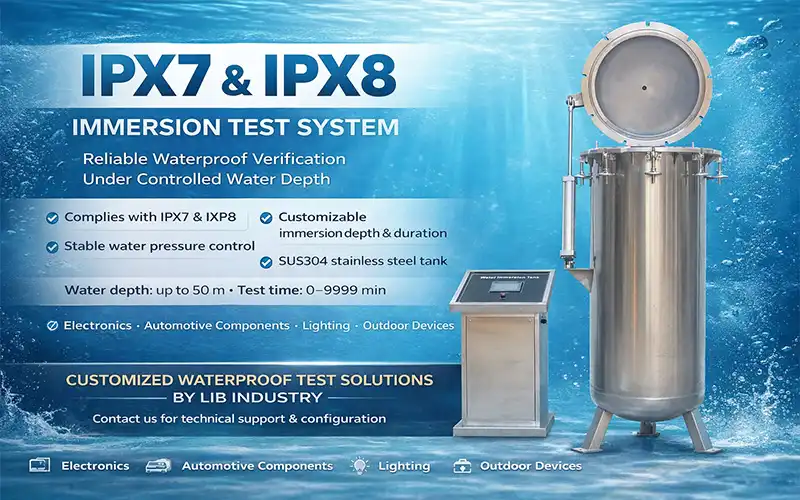
Stable Mechanical Construction
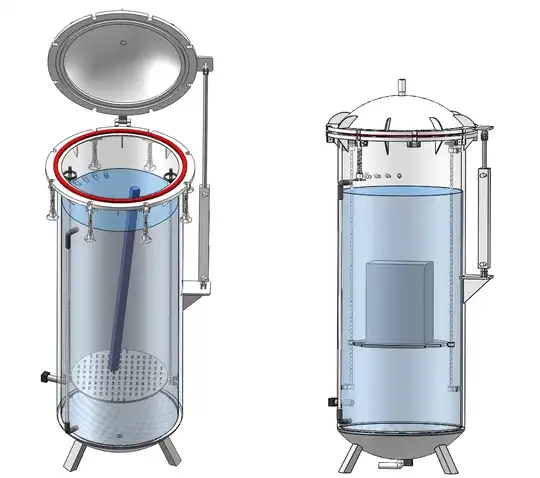
A dependable water immersion tank needs a rigid body, secure sealing, and safe access. The LIB R78-600 uses a cylindrical design with A3 steel plate construction and 15mm wall thickness. The bottom is supported by a tripod structure for stability. A pneumatic lid improves opening convenience and helps operators handle test samples more efficiently, especially during frequent batch validation.
Programmable Control and Data Consistency
Manual testing can introduce inconsistent timing, filling levels, or operator judgment. A programmable color LCD touchscreen controller helps standardize procedures. The LIB system uses a PID programmable touchscreen controller with Ethernet connection and can create 120 programs with 100 segments. This is useful for laboratories running different automotive components, each with its own submersion duration, pressure setting, and acceptance criteria.
Water Supply and Internal Durability
Automatic water supply reduces downtime and supports repeatable filling. The LIB water immersion tank configuration includes a storage water tank and an automatic water supply system. Product details also include a fastening valve made from A3 steel plate with galvanized coating and electrostatic treatment. The hydraulic rod uses 304 stainless steel with a mirror surface, supporting rust resistance in high-moisture operating conditions.
|
LIB R78-600 Feature |
Specification |
Benefit for Automotive Testing |
|
Internal dimension |
Diameter 600mm × height 1500mm |
Suitable for many modules, lamps, connectors, and assemblies |
|
Overall dimension |
Diameter 800mm × height 1800mm |
Practical laboratory footprint |
|
Pressure |
50m water depth pressure |
Supports rigorous ingress simulation |
|
Open mode |
Pneumatic lid |
Easier sample loading and unloading |
|
Controller |
Color LCD touchscreen, Ethernet |
Program control and data connectivity |
|
Water system |
Storage tank, automatic supply |
Stable and efficient operation |
Automotive Standards for Waterproof and Leak Testing
IP Ratings and Road Vehicle Protection Codes
Waterproof testing is often linked to ingress protection ratings. IEC 60529 defines IP codes for enclosures, while ISO 20653 adapts protection levels for road vehicles. These documents describe water exposure categories, including immersion-related conditions. A lab should select the rating based on component location, customer specification, and actual vehicle risk rather than using the most severe test without justification.
Environmental Loads for Electrical Equipment
ISO 16750 is widely used for electrical and electronic equipment in road vehicles. Its environmental testing framework helps engineers define exposure conditions related to temperature, humidity, water, and other service stresses. Immersion testing may be part of a broader validation plan rather than a stand-alone proof. Good practice links immersion results with function checks and post-test diagnostics.
OEM and Tier Supplier Requirements
Automakers often add internal specifications beyond public standards. These can include special soak times, energized operation, saltwater exposure, pressure profiles, or post-immersion electrical insulation limits. Suppliers should confirm acceptance criteria before testing starts. The most reliable validation plan is built from applicable standards, vehicle mounting position, field history, and customer engineering requirements.
Integration of Immersion Testing in Vehicle QA Processes
R&D Design Verification
During development, immersion testing helps teams compare seal materials, housing geometries, weld quality, vent designs, and connector layouts. Failed samples provide valuable evidence. Where did water enter? Was the gasket compressed evenly? Did the housing deform under pressure? These answers guide design corrections before tooling locks, reducing expensive late-stage revisions.
Production Quality Monitoring
Once production starts, testing shifts toward process control. Sampling plans may check batches of lamps, connectors, electronic housings, or battery-related assemblies. Consistent tank programs support fair comparison across production lots. When an abnormal leak appears, engineers can review assembly torque, adhesive cure, ultrasonic welding parameters, gasket placement, and supplier material changes.
Failure Analysis and Warranty Reduction
Field-return analysis benefits from controlled immersion. A returned component can be tested against known pressure and soak conditions to reproduce leakage. This helps separate design weakness from installation damage, handling issues, or misuse. For global manufacturers, reliable water ingress testing supports lower warranty cost, better supplier accountability, and faster corrective action.
LIB Industry Custom Water Immersion Systems for Automotive Validation
 |
 |
 |
Turn-Key Solution Approach
Turn-Key Environmental Test Chamber Support
LIB Industry provides turn-key environmental testing solutions, covering research, design, production, commissioning, delivery, installation, and training. For automotive customers, that means the equipment is not treated as an isolated machine. The project can include test requirement review, system configuration, operator instruction, and ongoing technical support based on actual component size, pressure demand, and workflow.
Built for Global Automotive Laboratories
Automotive suppliers work across multiple regions, standards, and OEM expectations. LIB's water immersion tanks are suitable for automotive, aerospace, national defense, navigation, lamps, telecommunications, electronic products, photovoltaic panels, batteries, ship industry, and energy applications. This cross-industry experience is helpful when a customer needs one robust platform for several waterproof validation programs.
Customization for Specific Components
Not every sample fits a generic fixture. LIB can support customized testing needs around sample placement, clamping, connection routing, water supply, pressure profile, and control settings. Whether the target is a lamp housing, EV battery subassembly, sealed connector, or underbody controller, the goal is the same: reproducible immersion conditions, safe operation, and practical data for engineering decisions.
Conclusion
Water immersion testing helps automotive manufacturers verify sealing quality, waterproof performance, and long-term component reliability under credible wet-service conditions. With controlled pressure, stable construction, programmable operation, and clear data records, the test becomes a strong part of design validation and production QA. For vehicle electronics, lamps, connectors, EV components, and energy systems, reliable immersion testing reduces field failures and strengthens customer trust.
FAQ
What automotive parts are commonly tested in a water immersion tank?
Common samples include lighting assemblies, sealed connectors, electronic control units, sensors, battery housings, harness exits, and underbody modules. These parts face rain, flooding, splash, washing, and condensation, so immersion testing helps verify enclosure sealing and functional reliability.
How does immersion testing differ from spray testing?
Spray testing checks resistance to directed water exposure, while immersion testing evaluates full submersion and hydrostatic pressure effects. Some seal gaps only leak when water pressure builds around the enclosure, making immersion valuable for deeper ingress validation.
Can LIB customize immersion systems for automotive QA labs?
Yes. LIB Industry can configure immersion systems around sample dimensions, pressure requirements, test profiles, water supply, controls, and fixture needs. The team supports design, manufacturing, delivery, installation, commissioning, and operator training for global automotive testing laboratories.
Looking for a dependable water immersion tank manufacturer and supplier for automotive validation? lib industry provides B-end turn-key environmental testing solutions from design to installation and training. Contact our factory team at ellen@lib-industry.com to discuss your component size, pressure range, and test standard requirements.