Key Features of High-Performance Dust Simulation Chambers
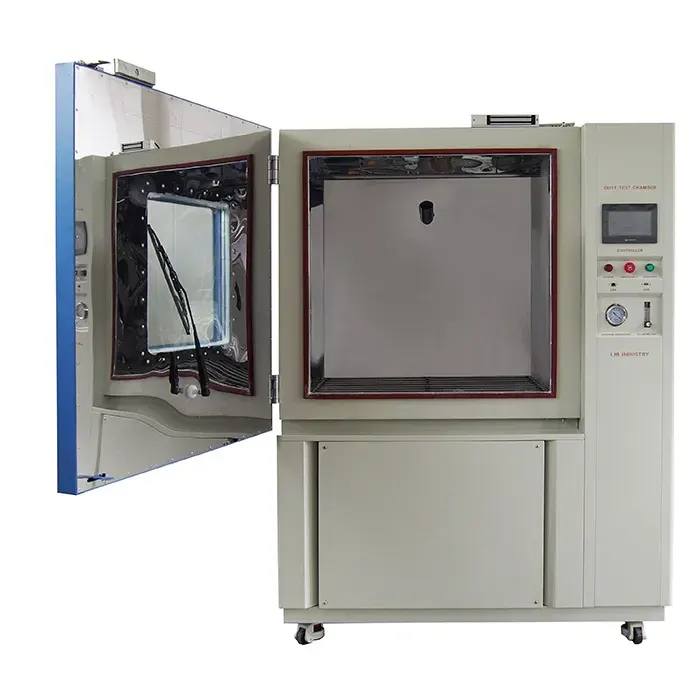
High-performance dust simulation chambers distinguish themselves through precision engineering that ensures accurate, repeatable ingress protection testing according to international standards like IEC 60529 and ISO 20653. These advanced environmental testing systems incorporate sophisticated airflow management, automated pressure control, intelligent monitoring capabilities, and robust construction materials that collectively deliver laboratory-grade accuracy with industrial reliability. Critical features include vertical circulation systems maintaining uniform particle distribution, heated chambers preventing moisture-induced clumping, integrated vacuum systems achieving the 2kPa pressure differential required for IP6X certification, and programmable touchscreen controllers managing complex test sequences. Superior chambers balance measurement precision with operational efficiency, combining wear-resistant components, rapid changeover capabilities, and comprehensive safety systems that protect both test specimens and laboratory personnel throughout extended certification programs.
What Defines a High-Performance Dust Simulation Chamber?
Standards Compliance and Certification Capabilities
A high-performance dust simulation chamber must deliver precise compliance with IEC 60529 specifications governing IP code verification, particularly the demanding requirements for IP5X (dust protected) and IP6X (dust tight) classifications. The controller features one-touch presets for these standards, eliminating manual parameter entry errors that could compromise certification validity. ISO 20653 compliance for automotive applications adds specialized requirements addressing vibration exposure and extended environmental stress protocols unique to transportation industries.
The integrated vacuum system automatically maintains the required 2kPa pressure differential for IP6X dust-tight testing, ensuring products pass certification on the initial attempt without repeated testing cycles. This automated pressure management proves essential because manual vacuum control introduces variability affecting test repeatability. Third-party testing laboratories and certification bodies recognize equipment meeting these exacting standards, accepting test results without additional verification requirements.
Measurement Accuracy and Environmental Control
Precision particulate testing demands environmental parameters remaining within narrow tolerances throughout test durations extending hours or days. Temperature control ranging from ambient to +50℃ prevents thermal variations that alter dust particle behavior and specimen breathing characteristics. Humidity maintenance below 30% RH proves critical because moisture absorption transforms free-flowing talcum powder into clumped aggregates that cannot penetrate sealing interfaces, producing false passing results for inadequately sealed products.
The normal wire diameter specification of 50μm with nominal gap width of 75μm defines the filtration mesh establishing IP5X testing criteria. This precision screening separates particles capable of penetrating typical sealing systems from larger aggregates, creating standardized exposure conditions matching real-world contamination scenarios. Maintaining these exact particle size distributions requires regular verification and dust replacement when degradation occurs.
Operational Efficiency and Laboratory Integration
Superior chambers streamline testing workflows through programmable fight time (0~99H59M) and blowing time (0~99H59M) parameters accommodating diverse protocol requirements from brief verification tests through extended qualification studies. The programmable color LCD touchscreen controller with Ethernet connection integrates with laboratory information management systems (LIMS), enabling centralized test scheduling, automated data collection, and comprehensive documentation supporting regulatory submissions.
Multi-language support accommodates international teams operating across geographic regions, while remote access capabilities allow expert oversight of testing conducted at distributed facilities. USB data download functionality and PC connectivity facilitate integration with broader quality management systems, creating seamless information flow from raw test data through final certification documentation.
Advanced Airflow Design and Dust Circulation Systems
Vertical Circulation Architecture Principles
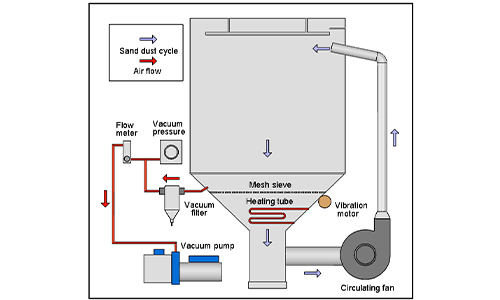
The vertical dust circulation system creates smooth airflow patterns that deliver particles throughout the working dust simulation chamber without generating turbulent dead zones where dust accumulates unevenly. This circulation methodology maintains consistent particulate concentration across the entire test volume, ensuring all specimen surfaces receive equivalent exposure regardless of position within the chamber. Computational fluid dynamics modeling optimizes internal baffling and airflow velocities, balancing particle suspension against excessive turbulence that would create non-uniform exposure conditions.
The sloped bottom chamber facilitates gravitational return of settled particles to the circulation intake, maintaining sustained airborne concentration throughout extended test cycles. Traditional flat-bottom designs allow dust accumulation in corners and low-velocity zones, progressively reducing airborne particle concentration and creating time-dependent exposure variability. The sloped geometry prevents this degradation, supporting stable test conditions from initial exposure through final test completion.
Heated Chamber Technology Preventing Clumping
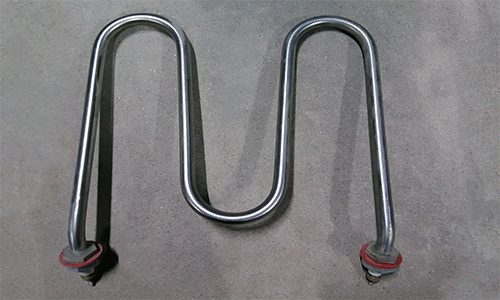
Our multi-stage circulation system incorporates heated chambers addressing the problematic hygroscopic nature of talcum powder used in dust testing. Atmospheric moisture absorption causes particle agglomeration, transforming free-flowing powder into clumps that cannot penetrate sealing interfaces or maintain airborne suspension. This common failure mode ruins test validity because clumped particles no longer match specified size distributions, producing unreliable certification results.
The 75μm mesh filtration system works synergistically with heated circulation chambers, maintaining particles consistently dry and flowing throughout test durations. Temperature-controlled airflow strips absorbed moisture from particle surfaces, restoring flowability and preventing progressive degradation during extended multi-specimen testing campaigns. This innovation eliminates test failures caused by moisture absorption while ensuring uniform distribution throughout every cycle.
|
Dust Circulation System |
Heating Tube |
Wear-Resistant Fan Design and Component Protection
Traditional dust chambers suffer premature failure from fan wear and dust blockages accumulating in circulation pathways. Abrasive particles eroding fan blade surfaces alter airflow characteristics, progressively degrading circulation performance and measurement accuracy. Our wear-resistant fan design utilizes hardened materials and strategic positioning that minimize particle impact velocities while maintaining required circulation rates.
Critical components receive protective placement shielding them from direct particle impingement while preserving airflow efficiency. Maintenance access panels enable rapid inspection and cleaning without complete chamber disassembly, reducing downtime during routine servicing. The quick-release drainage system allows complete dust changeover in just 5 minutes without equipment disassembly, supporting protocols requiring fresh talcum powder or different particle formulations between test sequences.
|
Circulation Feature |
Standard Chamber |
High-Performance LIB Chamber |
|
Airflow Pattern |
Random turbulent mixing |
Optimized vertical circulation |
|
Dust Distribution |
Variable, position-dependent |
Uniform throughout volume |
|
Moisture Control |
None, progressive clumping |
Heated chambers maintain dryness |
|
Component Protection |
Minimal, rapid wear |
Strategic positioning, extended life |
|
Changeover Time |
30+ minutes with disassembly |
5 minutes, quick-release system |
Precision Control of Dust Concentration and Distribution
Automated Particle Density Management
Maintaining consistent dust concentration throughout test duration proves essential for repeatable results and interlaboratory comparison validity. Real-time monitoring displays particle concentration with automated adjustments compensating for gravitational settling and circulation pathway deposition. Optical sensors or gravimetric measurement systems quantify airborne particle density, triggering circulation rate increases when concentration drops below target levels.
The standard configuration includes 5kg talcum powder providing sufficient material for multiple test cycles before requiring replenishment. Consumption rates vary based on chamber volume, test duration, and specimen configuration, with larger enclosures demanding proportionally greater dust quantities maintaining target concentrations. Automated alerts notify operators when particle levels decline toward depletion, preventing incomplete tests from insufficient dust availability.
Uniform Exposure Across Test Volume
Temperature consistency mapping techniques applied to dust distribution verify uniform particle exposure throughout the usable dust simulation chamber volume. Multi-point collection arrays positioned at various heights and radial distances from chamber centerline capture airborne particles during calibration runs, quantifying spatial concentration variations. High-performance chambers demonstrate minimal position-dependent exposure differences, typically maintaining ±10% concentration uniformity across the test zone.
The reinforced stainless steel rack system supports heavy loads while positioning specimens optimally within the circulation pattern. Adjustable shelf configurations accommodate varying product sizes from small consumer electronics through large automotive components. Specialized cable ports with dust-proof sealing allow powered testing without contamination risk to laboratory environments, enabling operational verification under energized conditions matching field deployment.
Pressure Differential Control for IP6X Testing
The vacuum system equipped with pressure gauge, air filter, pressure regulator, and connecting tube achieves the precise 2kPa pressure differential specified for IP6X dust-tight certification. This negative pressure simulates breathing effects caused by temperature cycling during real-world operation, drawing dust through gasket compression points, threaded interfaces, and ventilation pathways that might otherwise resist particle penetration.
Automated pressure regulation maintains the 2kPa setpoint throughout test duration, compensating for minor leaks in specimen sealing or vacuum system components. Manual systems require constant monitoring and adjustment, introducing operator-dependent variability affecting test repeatability. The automated approach ensures consistent exposure conditions across multiple test specimens and sequential testing campaigns, supporting high-volume certification programs demanding exceptional reproducibility.
How Do Chambers Ensure Repeatability and Test Accuracy?
Standardized Particle Characterization
Test repeatability begins with precisely characterized talcum powder meeting documented particle size distributions verified through sieve analysis. The 50μm wire diameter with 75μm gap spacing represents filtration mesh specifications rather than particle dimensions, establishing the threshold particles must penetrate during IP5X testing. Actual talcum powder contains distribution of particle sizes, with quality control protocols ensuring consistency batch-to-batch maintaining test comparability.
Contamination from previous test specimens or environmental exposure degrades particle characteristics over time, necessitating periodic replacement maintaining certification validity. Visual inspection identifies discoloration or obvious contamination, while performance monitoring tracking test-to-test variability flags subtle degradation requiring intervention. Documented particle replacement schedules become part of quality system procedures, ensuring sustained measurement accuracy throughout chamber operational life.
Environmental Parameter Stability
Temperature fluctuations alter specimen dimensions through thermal expansion, changing sealing interface geometries and introducing test variability. The temperature range of ambient to +50℃ with precise control prevents these dimensional changes from masking or exaggerating sealing inadequacies. Humidity below 30% RH maintains talcum powder dryness, preventing the moisture-induced clumping that compromises particle size distribution and airflow characteristics.
Pre-programmed test sequences guarantee repeatable results by eliminating manual parameter entry errors and ensuring identical exposure protocols across multiple specimens. Automated fault detection prevents equipment malfunctions from contaminating test data, halting testing when anomalous conditions arise rather than generating invalid results requiring expensive retesting. The system alerts maintenance needs through predictive monitoring, addressing developing problems before they compromise test integrity.
Calibration and Verification Protocols
Regular calibration of temperature sensors, humidity measurement systems, pressure transducers, and airflow velocity indicators maintains measurement traceability to national standards. Annual verification against reference instruments documents ongoing accuracy, identifying gradual sensor drift requiring adjustment or replacement. Calibration certificates become part of quality documentation supporting certification submissions to regulatory authorities worldwide.
Performance verification runs using reference specimens with known IP ratings validate complete system functionality beyond individual component calibration. These end-to-end checks confirm that calibrated subsystems function correctly when integrated, detecting issues like circulation pattern changes or filtration degradation that might escape component-level verification. Trending analysis comparing current performance against historical baselines identifies progressive degradation requiring corrective maintenance.
|
Accuracy Factor |
Control Method |
Verification Frequency |
Impact on Repeatability |
|
Particle Size |
Sieve analysis, batch certification |
Each new powder batch |
High - defines penetration threshold |
|
Temperature |
Calibrated sensors, PID control |
Annual calibration |
Moderate - affects specimen dimensions |
|
Humidity |
Dehumidification, continuous monitoring |
Annual calibration |
High - prevents clumping |
|
Pressure |
Automated vacuum regulation |
Semi-annual verification |
Critical for IP6X testing |
|
Airflow |
Velocity measurement, fan monitoring |
Annual mapping study |
Moderate - affects distribution |
Durable Construction for Harsh Testing Environments
Interior Material Selection and Surface Treatment
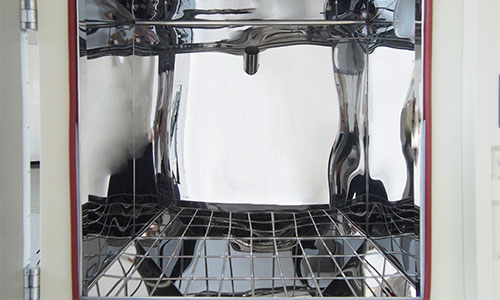
SUS304 stainless steel interior construction resists corrosion from talcum powder exposure and cleaning chemical applications required maintaining dust simulation chamber hygiene. The mirror surface finish prevents particle adhesion in surface irregularities, facilitating complete dust removal during changeover procedures. Smooth, crevice-free welding eliminates contamination traps where residual particles from previous tests might compromise subsequent testing accuracy.
Stainless steel's inherent corrosion resistance proves essential because dust testing environments combine particulate abrasion with periodic moisture exposure during cleaning and decontamination. Carbon steel alternatives suffer progressive oxidation creating surface roughness that alters airflow characteristics and provides particle retention sites. The SUS304 specification ensures decades of reliable service without performance degradation from material deterioration.
Structural Integrity for Heavy Sample Testing
The reinforced rack system accommodates large automotive components, industrial equipment, or multiple samples simultaneously without deflection that would alter their position within the circulation pattern. Structural calculations account for maximum rated loads distributed uniformly or concentrated at individual support points, ensuring safety factors appropriate for laboratory environments. Adjustable shelf spacing provides configuration flexibility supporting diverse product portfolios without requiring multiple dedicated chambers.
The A3 steel plate exterior with protective coating treatment delivers industrial-grade strength while resisting impact damage from laboratory equipment movement and accidental contact. Powder coating provides chemical resistance protecting against cleaning solutions, laboratory solvents, and atmospheric corrosives present in industrial testing facilities. The robust construction supports transportation without specialized packaging, reducing installation costs for multi-site laboratory networks.
Observation Window Engineering
The double-layer thermo stability silicone rubber sealing prevents particle escape through observation window interfaces while maintaining visual access throughout test cycles. Interior lighting with LED technology illuminates the chamber without generating excessive heat that would compromise temperature control. The 8cm thick tempered glass construction withstands accidental impact while providing thermal insulation preventing external condensation that obscures specimen visibility.
Visual inspection during testing verifies specimen positioning stability, monitors powered equipment operation status, and identifies anomalous conditions requiring test interruption. The observation window eliminates blind testing where problems go undetected until post-test inspection reveals compromised results. Photographic documentation through the window creates permanent records supporting certification submissions and failure analysis investigations.
Automation, Monitoring, and Data Logging Capabilities
 |
 |
Intelligent Touchscreen Controller Interface
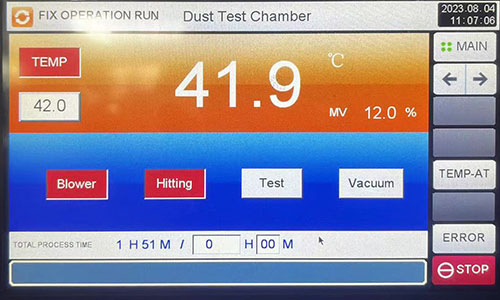
The programmable touchscreen interface eliminates complexity from testing protocols through intuitive menus organizing test parameters logically. Real-time monitoring displays dust concentration, pressure levels, and exposure duration with automatic data logging supporting certification documentation requirements. Graphical trend displays reveal parameter variations throughout test cycles, identifying transient excursions that might escape notice with simple numerical readouts.
Pre-programmed test sequences stored in controller memory ensure consistent execution across multiple operators and testing shifts. Access control features restrict parameter modification to authorized personnel, preventing accidental protocol changes that would compromise test validity. Audit trail functionality documents all parameter modifications, test starts/stops, and alarm acknowledgments, creating tamper-evident records satisfying regulatory scrutiny.
Remote Monitoring and Laboratory Integration
Ethernet connectivity enables remote monitoring of test progress from engineering offices, quality laboratories, or global headquarters overseeing distributed testing operations. Email or SMS alerts notify responsible personnel when tests complete, alarms activate, or maintenance intervention becomes necessary. This remote oversight reduces laboratory staffing requirements while ensuring prompt response to conditions requiring attention.
Integration with local laboratory software creates unified test management platforms coordinating environmental testing across multiple chamber types and testing disciplines. Centralized scheduling prevents resource conflicts, optimizes chamber utilization, and tracks specimen progression through qualification protocols spanning weeks or months. Automated report generation compiles data from multiple test sequences, producing comprehensive certification packages ready for regulatory submission.
Automated Safety and Diagnostic Systems
Electromagnetic door locks prevent accidental chamber opening during active testing cycles, protecting test integrity while maintaining operator safety. The multi-layer door sealing system contains all dust particles inside the dust simulation chamber, maintaining clean laboratory conditions while providing constant test environments. Attempting door access during testing triggers alerts and optional test suspension, preventing compromised results from environmental disruption.
Comprehensive safety frameworks monitor electrical current, temperature, phase sequence, and ground fault conditions safeguarding both operators and test samples. Over-temperature protection prevents specimen damage from control system failures, while over-current protection guards against electrical hazards. Earth leakage protection and phase sequence monitoring ensure electrical safety meeting international laboratory standards for personnel protection.
|
Automation Feature |
Capability |
Benefit |
|
Touchscreen Controller |
120 programs, multi-step sequences |
Eliminates protocol errors |
|
Remote Monitoring |
Ethernet/WiFi, mobile alerts |
Reduces staffing requirements |
|
Data Logging |
Continuous recording, CSV export |
Simplifies certification documentation |
|
Safety Interlocks |
Electromagnetic locks, multi-sensor |
Protects personnel and specimens |
|
Predictive Maintenance |
Component monitoring, usage tracking |
Minimizes unexpected downtime |
LIB Industry High-Performance Chambers with Advanced Airflow and Control
|
|
|
Comprehensive Model Range Addressing Diverse Applications
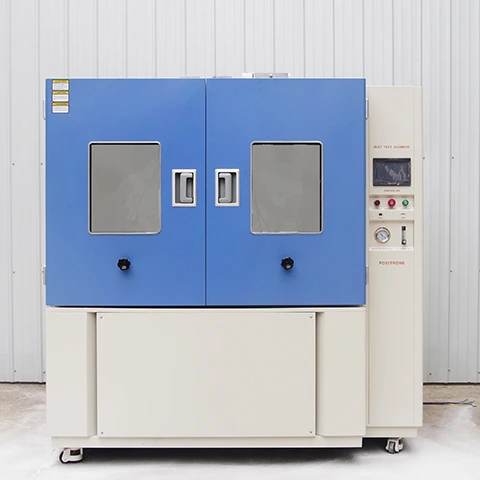
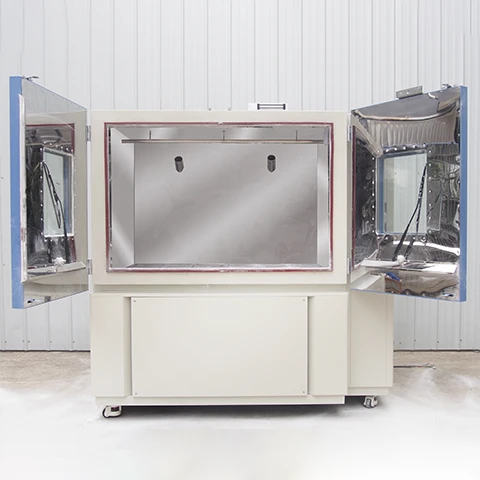
LIB Industry offers dust simulation chambers spanning 800L through 2000L usable volumes, accommodating applications from small consumer electronics through large automotive assemblies. The DI-800 model (800×1000×1000mm internal dimensions) suits compact laboratories with limited floor space, while the DI-2000 (1000×2000×1000mm) supports high-throughput testing programs processing multiple specimens simultaneously. This model diversity enables precise capacity matching, optimizing capital investment against testing demand.
More than 14 models provide configuration options addressing specialized requirements including extended temperature ranges, enhanced humidity control, or integrated vibration capabilities simulating combined environmental stressors. Custom sizing accommodates unique specimen geometries that standard chambers cannot accommodate efficiently. The modular design philosophy allows chamber upgrades adding capabilities as testing requirements evolve, protecting initial equipment investments.
Proven Performance with Global Industry Leaders
LIB Industry's 16-year track record serving partners including Apple, Intel, and Mercedes-Benz validates performance claims through real-world certification programs demanding exceptional accuracy and reliability. These partnerships encompass product development testing, production quality verification, and supplier qualification programs where measurement precision directly impacts product commercialization timelines and market success.
Customer relationships spanning multiple product generations demonstrate equipment longevity, measurement stability, and ongoing technical support quality. Testimonials from certification laboratories, automotive tier-one suppliers, and consumer electronics manufacturers confirm chambers meet the exacting standards these demanding applications require. Third-party validation through SGS and TUV testing authorities provides independent verification of specification compliance.
Turn-Key Solutions and Custom Integration Services
LIB concentrates on providing turn-key solutions encompassing research, design, production, commissioning, delivery, installation, and training. Complete IP testing laboratories incorporating dust chambers, water ingress testing equipment, and mechanical impact systems deliver comprehensive certification capabilities within unified facilities. This integrated approach ensures component compatibility, streamlined workflows, and coordinated technical support addressing complex qualification protocols.
Custom services include specialized testing software matching proprietary certification procedures, reinforced sample holders accommodating unusual product configurations, and laboratory layout optimization maximizing testing efficiency within available floor space. Building complete IP laboratories represents LIB's comprehensive solution philosophy, delivering operational facilities ready for immediate certification work without customer integration burdens.
Conclusion
High-performance dust simulation chambers combine precision airflow engineering, automated environmental control, intelligent monitoring systems, and durable construction materials creating reliable platforms for IEC 60529 and ISO 20653 certification testing. Critical features including vertical circulation systems, heated chambers preventing clumping, integrated vacuum control, and programmable interfaces distinguish superior equipment from basic chambers offering nominal compliance. LIB Industry chambers exemplify these performance characteristics through proven designs serving global industry leaders across consumer electronics, automotive, and industrial equipment sectors.
FAQ
What chamber features most significantly impact dust test repeatability?
Automated pressure control maintaining the 2kPa differential for IP6X testing, heated circulation preventing moisture-induced clumping, and uniform particle distribution throughout the test volume represent the most critical repeatability factors. Additionally, standardized talcum powder with verified particle size distribution and environmental parameter stability ensure consistent results across multiple test cycles and specimens.
How often require dust chambers require preventive maintenance and calibration?
Annual calibration of temperature, humidity, and pressure sensors maintains measurement traceability, while semi-annual performance verification confirms system-level accuracy. Dust replacement occurs every 20-30 test cycles depending on contamination accumulation. Comprehensive maintenance including fan inspection, seal verification, and circulation system cleaning should occur quarterly for high-utilization laboratories.
Can dust simulation chambers accommodate powered testing of energized products?
Yes, the specimen power outlet providing dust-proof 16A socket enables powered operation during testing. This capability proves essential verifying that thermal expansion from operational heating doesn't compromise sealing effectiveness. Specialized cable ports with dust-proof sealing allow electrical connections without laboratory contamination risks, supporting realistic testing matching field deployment conditions.
Transform your ingress protection testing capabilities with precision-engineered dust simulation chambers. LIB Industry, a leading environmental testing equipment manufacturer and supplier, delivers high-performance solutions ensuring first-pass certification success for IP5X and IP6X validation. Contact our application specialists at ellen@lib-industry.com for detailed specifications and customized chamber recommendations.