What is the standard for temperature cycling test?
Need a temperature cycling chamber for a specific test standard? Request a quote within 24 hours.
Get chamber specifications, testing recommendations, and customization options from LIB Industry.
Temperature cycling test standards define how products are repeatedly exposed to changing temperature conditions in a temperature cycling chamber. Standards from organizations such as IEC, MIL-STD, JEDEC, and automotive qualification bodies specify requirements including temperature limits, transition rates, dwell times, and cycle quantities.
The objective is to accelerate thermal stress and identify potential failure mechanisms before products enter the field.
Different industries follow different requirements. Electronics manufacturers commonly reference IEC 60068-2-14, semiconductor testing frequently uses JEDEC JESD22-A104, military and aerospace equipment may require MIL-STD-810, while automotive electronics are often qualified according to AEC-Q100.
LIB Industry has specialized in environmental simulation testing equipment since 2009, providing temperature cycling chambers for electronics, automotive, battery, aerospace, semiconductor, and industrial applications.
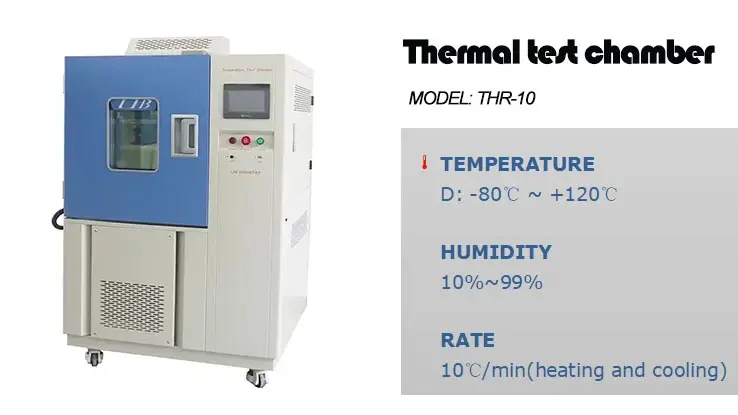
Temperature Cycling Test Standards
Understanding the applicable standard is the first step in selecting the correct testing equipment. Different standards may use similar temperature ranges but impose different requirements for transition speed, dwell time, cycle quantity, or test methodology.
IEC 60068-2-14
IEC 60068-2-14 is one of the most widely used international standards for temperature change testing of electrical and electronic components and equipment.
It includes different test methods, including:
Test Na: Rapid change of temperature by transferring the specimen between environments.
Test Nb: Change of temperature using a gradual temperature transition.
For rapid temperature-change testing, the transfer time between temperature zones is a critical parameter. The exact temperature limits and exposure conditions should be selected according to the product specification and applicable test procedure.
MIL-STD-810
MIL-STD-810 provides environmental engineering and laboratory testing methods for military equipment.
Its temperature-related procedures are designed around actual operational environments rather than a single universal temperature profile. Temperature exposure may be combined with factors such as altitude, storage conditions, transportation, and operational use.
For applications requiring rapid temperature transitions, a thermal shock chamber may be more appropriate than a conventional temperature cycling chamber.
AEC-Q100
Automotive integrated circuits are commonly qualified according to AEC-Q100, which includes temperature cycling and other reliability tests.
Depending on the component grade and qualification plan, automotive electronics may be exposed to temperatures extending from approximately -40°C to +150°C, with specific dwell and cycle requirements defined by the applicable qualification procedure.
The actual test profile should always be determined from the latest applicable AEC-Q100 requirement and the component qualification plan.
JEDEC JESD22-A104
JEDEC JESD22-A104 is widely used for temperature cycling of semiconductor devices.
The test evaluates failures associated with differences in the coefficients of thermal expansion between materials, including semiconductor packages, solder connections, substrates, and other interfaces.
Temperature limits, transition requirements, dwell times, and cycle quantities depend on the selected test condition.
|
|
 |
||||
| Name | Temperature Cycle Chamber | ||||

|
|
|
|
| Robust Workroom | Cable Hole | Temperature and humidity sensor |


Temperature Cycling Test Standards Comparison
The following table provides a practical overview. Actual conditions should always be confirmed against the applicable revision and product qualification specification.
| Standard | Typical Temperature Range* | Transition Requirement | Main Application |
|---|---|---|---|
| IEC 60068-2-14 | Depends on test specification | Test-method dependent | Electronics & components |
| MIL-STD-810 | Method-dependent | Test-method dependent | Military & aerospace |
| AEC-Q100 | Commonly around -40°C to +150°C | Qualification-dependent | Automotive electronics |
| JEDEC JESD22-A104 | Commonly extends into sub-zero/high-temperature ranges | Condition-dependent | Semiconductor devices |
*Temperature ranges shown are representative rather than universal requirements. Always use the conditions specified by the applicable test method.
Key Parameters in Temperature Cycling Tests
Temperature cycling performance depends on more than the minimum and maximum temperatures. Engineers should consider the complete thermal profile.
Temperature Range
The required range depends on the application.
Consumer electronics may require moderate temperature exposure, while automotive electronics, aerospace components, and battery systems can require significantly wider ranges.
LIB Industry temperature cycling chambers can be configured with temperature ranges such as:
-20°C to +150°C
-40°C to +150°C
-70°C to +150°C
The appropriate range should be selected according to the required standard and product operating environment.
Temperature Transition Rate
Transition rate determines how quickly the specimen experiences thermal change.
Rapid transitions generate larger temperature gradients inside materials and can increase stress caused by differences in thermal expansion.
Depending on the chamber configuration, LIB Industry offers controllable ramp rates such as:
5°C/min
10°C/min
15°C/min
For applications requiring extremely rapid transfer between hot and cold zones, a dedicated thermal shock chamber should be considered instead.
Dwell Time
Dwell time is the period during which the specimen remains at a temperature extreme.
Its purpose is to allow the specimen to reach the required thermal condition before the temperature changes again. Dwell time should therefore be based on specimen size, material characteristics, thermal mass, and the applicable test specification.
Cycle Count
Cycle quantity is another critical qualification parameter.
The required number of cycles can range from relatively low quantities for design verification to hundreds or thousands for long-term reliability qualification.
Rather than selecting a chamber based solely on a predefined cycle count, engineers should determine the number of cycles from the applicable standard, product reliability target, and expected service environment.
How to Choose a Temperature Cycling Chamber
Selecting a chamber based only on temperature range can lead to insufficient testing performance. The chamber should be matched to the complete test profile.
1. Confirm the Standard
First identify whether the application follows IEC, MIL-STD, JEDEC, AEC-Q100, ISO, or a customer-specific specification.
This determines the required temperature range, ramp rate, dwell time, cycle quantity, and monitoring requirements.
2. Check the Required Ramp Rate
A chamber capable of reaching -70°C does not necessarily mean it can achieve the required temperature transition rate.
Check both the temperature range and heating/cooling rate under actual specimen loading conditions.
3. Select the Correct Chamber Volume
Chamber volume should accommodate the specimen while maintaining sufficient airflow around the test load.
LIB Industry provides temperature cycling chambers in different working volumes, with larger systems available for automotive assemblies, battery modules, and production-scale testing.
4. Consider Thermal Load
The chamber's performance depends on more than empty-chamber specifications.
Large metal components, battery packs, electronic assemblies, and other high-mass specimens can significantly affect cooling and heating performance.
Therefore, always ask the manufacturer for performance data under your expected test load.
Need help matching a chamber to IEC 60068-2-14, AEC-Q100, JEDEC, or MIL-STD requirements?
LIB Industry can recommend the appropriate chamber configuration based on your temperature range, ramp rate, specimen size, and cycle profile.
Check temperature cycling chamber specifications →thermal cycling test chamber
Implementing Temperature Cycling Tests with Precision
Sample Preparation and Safety
Correct specimen placement affects test results.
Samples should be positioned to allow sufficient air circulation and should not unnecessarily block the chamber airflow. For electrical and battery testing, cable routing and safety protection should also be considered.
LIB Industry chambers can be equipped with Φ50 mm cable ports with silicone seals for connecting external sensors and test instruments while maintaining chamber performance.
For lithium-ion battery applications, optional safety features such as smoke detection, fire suppression, pressure relief, and other protection systems can be integrated according to the risk assessment.
Calibration and Data Management
Temperature cycling tests require reliable measurement and documentation.
Important records may include:
Chamber temperature data
Specimen temperature data
Test start and end times
Cycle count
Alarm events
Calibration records
Test reports
LIB Industry chambers can be configured with programmable touchscreen controllers, Ethernet communication, USB data export, and remote monitoring functions to support laboratory data management.
Temperature Cycling vs Thermal Shock Testing
These two tests are related but should not be treated as identical.
Temperature cycling generally uses controlled heating and cooling rates to expose products to repeated thermal changes.
Thermal shock uses much faster temperature transitions, often by transferring the specimen between hot and cold zones.
The choice depends on the failure mechanism you want to reproduce.
| Test Type | Temperature Change | Typical Purpose |
|---|---|---|
| Temperature Cycling | Controlled ramp | Long-term thermal fatigue |
| Thermal Shock | Very rapid transfer | Severe thermal shock and CTE mismatch |
|
|
||
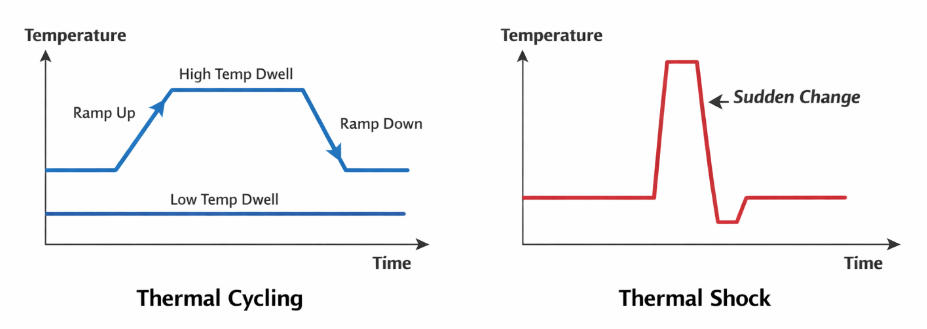
If your standard specifies gradual temperature ramps, choose a temperature cycling chamber. If it requires rapid hot-to-cold or cold-to-hot transfer, a thermal shock chamber is usually the more suitable solution.
Related Environmental Test Chambers
A complete reliability testing program may require more than temperature cycling.
|
|
|
|
Thermal Shock ChamberDesigned for rapid transfer between hot and cold zones, suitable for applications requiring severe thermal shock testing. |
Temperature & Humidity Test ChamberAdds controlled humidity to temperature testing and is widely used for electronics, automotive components, materials, and accelerated aging. |
Walk-in Environmental Test ChamberSuitable for large automotive assemblies, battery packs, industrial equipment, and components that cannot fit inside standard benchtop chambers. |


Using complementary environmental chambers allows manufacturers to evaluate temperature, humidity, thermal shock, and other environmental stresses within a broader reliability program.
FAQ
What is the most common temperature cycling standard?
IEC 60068-2-14 is one of the most widely referenced international standards for temperature-change testing. Automotive and semiconductor industries may use additional standards such as AEC-Q100 and JEDEC JESD22-A104.
What temperature range should a cycling chamber have?
There is no universal range. Common configurations include -40°C to +150°C and -70°C to +150°C, but the correct specification should be determined by the applicable standard and product requirements.
How many temperature cycles are required?
Cycle quantity depends on the applicable standard, component type, reliability target, and qualification plan. It may range from hundreds to thousands of cycles.
What is the difference between temperature cycling and thermal shock?
Temperature cycling uses controlled temperature transitions, while thermal shock uses much faster transfers between temperature extremes.
Can LIB customize a temperature cycling chamber?
Yes. LIB Industry can customize chamber volume, temperature range, ramp rate, cable ports, safety systems, control functions, data logging, and other configurations according to the customer's testing requirements.
Choose the Right Temperature Cycling Test Solution
Temperature cycling standards provide the framework for evaluating product reliability under repeated thermal stress, but selecting the correct test chamber requires more than simply matching a temperature range.
The chamber must provide the required temperature range, transition rate, thermal stability, specimen loading capacity, control accuracy, safety protection, and data management functions for your specific test program.
LIB Industry has supplied environmental simulation test equipment since 2009 for automotive, electronics, battery, aerospace, semiconductor, and industrial applications.
Need a temperature cycling chamber for IEC, MIL-STD, AEC-Q100, JEDEC, or a customer-specific test profile?
Contact LIB Industry for technical recommendations, customization, and a quotation within 24 hours.
Email: ellen@lib-industry.com
Three-Year Warranty & Lifetime Service