Why Marine Hardware Needs Salt Fog Validation?
Marine hardware operates in one of Earth's most unforgiving environments - a relentless combination of salt spray, humidity, and temperature fluctuations that systematically dismantles unprotected materials. A single corroded bolt or degraded fitting can compromise entire systems, leading to catastrophic failures, safety hazards, and astronomical replacement costs. Salt fog validation in a controlled salt spray chamber isn't just a regulatory checkbox; it's a predictive engineering tool that compresses a decade of marine exposure into months of testing. This process reveals latent weaknesses in materials, coatings, and designs before they ever touch seawater, ensuring that every component - from deck cleats to offshore rigging - can withstand the ocean's persistent, corrosive embrace.
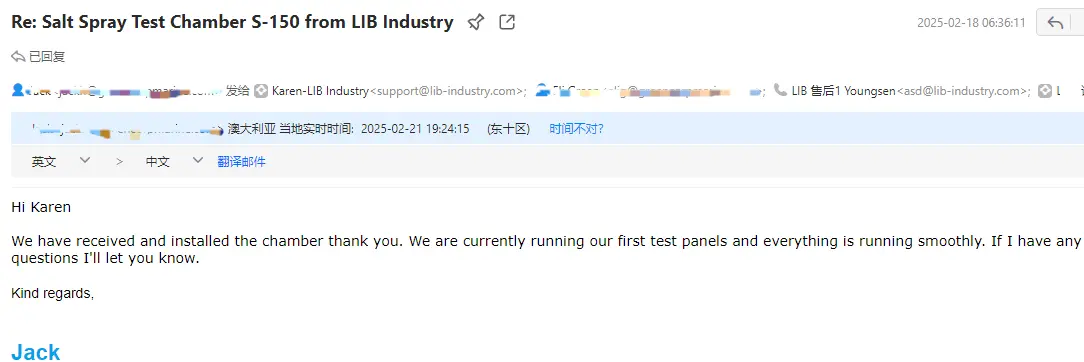
An Australian coatings manufacturer recently integrated a salt spray corrosion test system into its marine coating validation program. After installation, testing began immediately on offshore and coastal coating panels.The system delivered stable salt fog distribution and consistent test conditions, allowing engineers to evaluate corrosion resistance, blistering, and edge protection with confidence. Its reliable performance enabled the team to quickly start long-term exposure tests and formulation comparisons, improving validation efficiency and ensuring repeatable results.
Corrosion Challenges in Marine Environment Applications
The Electrochemical Onslaught of Seawater
Seawater constitutes an exceptionally aggressive electrolyte due to its high chloride content (approximately 19,000 ppm). When a metal surface is exposed, microscopic anodic and cathodic sites form, initiating galvanic corrosion. Chloride ions penetrate protective oxide layers on stainless steel, causing pitting corrosion that propagates rapidly beneath the surface. This electrochemical process accelerates dramatically with temperature increases common in tropical marine environments, making static laboratory tests insufficient without dynamic thermal cycling.
Beyond Simple Rust: Multifaceted Degradation Modes
Marine hardware faces more than just uniform rust. Crevice corrosion attacks hidden joints and under-heads of bolts where oxygen depletion creates aggressive microenvironments. Galvanic corrosion occurs when dissimilar metals (e.g., stainless steel bolts in aluminum frames) contact each other in seawater, with the more anodic metal sacrificing itself rapidly. Stress corrosion cracking combines tensile stress with a corrosive environment to cause sudden, brittle failure in high-strength alloys like 316 stainless. Fatigue corrosion under cyclic loads from waves and wind further complicates material selection.
Hidden Costs of Corrosion-Induced Failure
The financial impact extends far beyond part replacement. Corrosion-related failures on commercial vessels trigger costly dry-docking, lost revenue from downtime, and potential environmental fines from oil spills or cargo contamination. For recreational boating, a failed stern light bracket or stanchion can create safety hazards leading to liability claims. In offshore energy, a single corroded connector on a subsea control module can necessitate a multi-million dollar intervention. These systemic risks make accelerated validation not just advisable, but essential for risk management.
Table 1: Primary Corrosion Mechanisms in Marine Applications
|
Corrosion Type |
Primary Driver |
Vulnerable Materials |
Typical Failure Mode |
|
Uniform Corrosion |
General seawater exposure |
Carbon steel, unprotected aluminum |
Thinning, section loss |
|
Pitting Corrosion |
Chloride ions |
300-series stainless steels |
Localized deep penetration |
|
Crevice Corrosion |
Stagnant micro-environments |
Bolted joints, under gaskets |
Hidden severe attack |
|
Galvanic Corrosion |
Dissimilar metal couples |
Any mixed-metal assembly |
Rapid anodic material loss |
|
Stress Corrosion Cracking |
Tensile stress + chloride |
High-strength austenitic steels |
Sudden brittle fracture |
How Salt Fog Testing Simulates Coastal Exposure Conditions?
Accelerated Electrochemical Replication
A salt spray chamber creates a controlled, saturated atmosphere (95-98% RH) with a fine mist of sodium chloride solution (typically 5% NaCl). The continuous or periodic fog deposition rate of 1-2 ml per 80 cm² per hour ensures consistent electrolyte film formation on all specimen surfaces. This environment dramatically accelerates the electrochemical corrosion processes that would take years in a marine setting, allowing engineers to observe failure modes in 500-2000 hours instead of waiting for real-world exposure.
Critical Parameters for Realistic Simulation
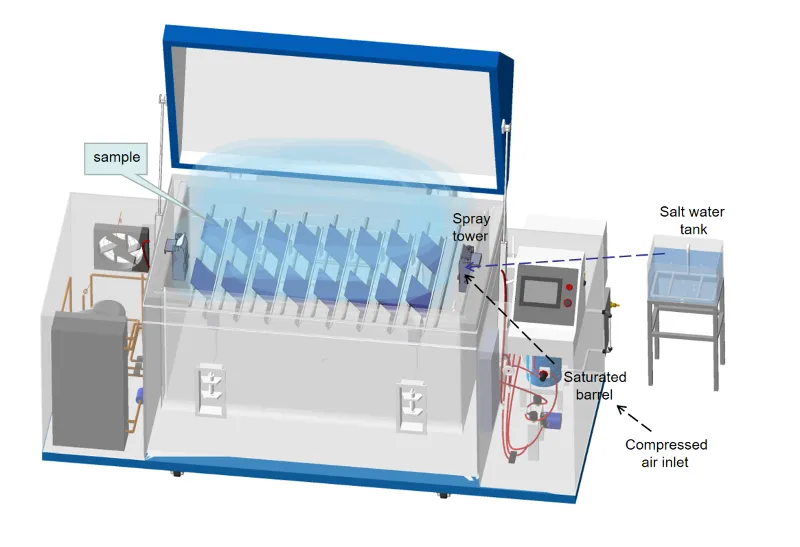
The chamber's temperature stability (±0.5°C fluctuation, ±2.0°C deviation) is crucial because corrosion rates double with every 10°C rise. Testing at 35°C simulates tropical conditions, while 25°C represents temperate climates. The fog's particle size distribution - controlled by the atomizer tower and nozzle design - determines whether droplets deposit as a film (simulating sea spray) or as discrete droplets (simulating wave splash). LIB's adjustable spray tower allows fine-tuning to match specific geographic exposure conditions, from the misty Pacific Northwest to the arid, salty air of the Red Sea.
Cyclic Testing for Realistic Wet/Dry Transitions
Continuous salt fog is the ASTM B117 standard, but many marine components experience wet-dry cycles as tides change and waves splash and recede. Periodic spray cycles (e.g., 10 minutes on, 50 minutes off) simulate these transitions, allowing corrosion products to form during wet periods and then concentrate during drying - a condition that often accelerates attack. This cyclic approach better predicts the performance of coatings that rely on film formation and self-healing mechanisms.
Table 2: Salt Spray Test Parameters for Different Marine Applications
|
Application |
Test Standard |
Temperature (°C) |
Spray Type |
Duration (Typical) |
Primary Assessment |
|
Fasteners & Hardware |
ASTM B117 |
35 |
Continuous |
500-1000 hrs |
Base metal corrosion, coating adhesion |
|
Marine Coatings |
ISO 9227 (NSS) |
35 |
Continuous |
1000-2000 hrs |
Blistering, rust-through, edge corrosion |
|
Electrical Connectors |
ASTM B117 + Humidity |
35 |
Periodic |
750-1500 hrs |
Contact resistance, insulation degradation |
|
Anodized Aluminum |
ASTM B117 |
35 |
Continuous |
500-1000 hrs |
Pitting at coating defects |
|
Welded Assemblies |
ISO 9227 (Cyclic) |
35/25 cycling |
Periodic |
1000+ hrs |
Weld zone attack, crevice at joints |
Evaluating Protective Coatings for Marine Hardware
Coating Failure Modes Under Salt Fog
Salt fog testing exposes coating weaknesses that might not appear in simple humidity tests. Blistering occurs when water vapor pressure builds at the coating-substrate interface due to poor adhesion or soluble contaminants. Delamination starts at edges or scratches where electrolyte penetrates. Cathodic disbondment happens when a coating's dielectric breakdown allows current to flow, generating alkali at the metal surface that lifts the coating. These modes progress at different rates depending on coating chemistry - epoxies may blister early but resist disbondment, while polyurethanes might chalk but maintain adhesion.
Measuring Corrosion Progression Quantitatively
Beyond visual inspection (rating per ASTM D1654), modern salt spray testing uses quantitative metrics. Weight loss measurements after cleaning corrosion products determine corrosion rate in mils per year (mpy). Cross-sectional microscopy reveals coating thickness loss and pit depth. Electrochemical impedance spectroscopy (EIS) can be performed periodically during testing to monitor coating degradation in real-time. The salt deposition rate (1-2 ml/80cm²·h) must be verified with a fallout collector to ensure test validity - a key feature in LIB's design.
Accelerated Validation for New Coating Systems
Developing a new marine coating involves testing multiple formulations. A salt spray chamber allows side-by-side comparison of primers, intermediates, and topcoats. Test coupons with intentional scribes (through to bare metal) simulate coating damage. The time to first red rust appearance at the scribe is a critical benchmark. For topcoats, gloss retention and color shift (ΔE) measurements before and after testing quantify aesthetic durability - a major selling point for yacht hardware and premium boat fittings.
Material Selection for Improved Corrosion Resistance
Stainless Steels: Not All Are Created Equal
The 300-series austenitic stainless steels (304, 316) are common but have limits. 316's molybdenum content improves pitting resistance in seawater, but its critical pitting temperature (CPT) can be exceeded in warm tropical waters. Duplex stainless steels (2205) offer superior resistance but at higher cost. Salt fog testing quickly identifies whether a specified grade meets the required threshold - a 316 part that shows pitting after 500 hours at 35°C may need upgrading to a super duplex or requiring cathodic protection.
Aluminum Alloys and Anodizing Strategies
Marine-grade aluminum alloys (5000-series like 5086, 6000-series like 6061-T6) rely on passive oxide films. Salt fog testing evaluates both the base alloy's inherent resistance and the quality of anodizing or conversion coatings. Hardcoat anodizing (Type III) provides thicker, more wear-resistant protection but can be brittle. Testing reveals if the anodic coating cracks under thermal cycling or if sealant degradation leads to pitting at pores. For critical applications, testing compares different sealing methods (hot water, nickel acetate, sol-gel).
Non-Metallic Alternatives: Composites and Plastics
Fiber-reinforced polymers (FRP) and thermoplastics like acetal (POM) or polypropylene are increasingly used in marine hardware to eliminate corrosion entirely. However, they face different challenges: galvanic corrosion of embedded metal fasteners, hydrolysis in hot, humid environments, and UV degradation on deck. Salt fog testing at elevated temperatures (40-50°C) accelerates hydrolytic attack on plastics, while the constant humidity tests for water absorption that can swell dimensions and affect tolerances in precision components.
Industry Standards for Marine Corrosion Testing
Foundational Standards: ASTM B117 and ISO 9227
ASTM B117 is the original and most widely recognized salt spray (fog) testing standard. It specifies a 5% NaCl solution at 35°C with continuous fog, but notably does not define test duration or acceptance criteria - those come from product-specific standards. ISO 9227 offers three variations: Neutral Salt Spray (NSS, identical to ASTM B117), Acetic Acid Salt Spray (AASS, more aggressive for electroplated coatings), and Copper-Accelerated Acetic Acid Salt Spray (CASS, highly aggressive for decorative coatings). Understanding which variant applies is critical for meaningful results.
Industry-Specific Protocols
The automotive industry uses SAE J2334 for cyclic corrosion testing that includes humidity, dry, and salt spray phases, better simulating road salt environments. The aerospace sector references ASTM B117 but with specific pre-treatments and evaluation criteria for aircraft alloys. Marine hardware often follows National Marine Manufacturers Association (NMMA) guidelines or ASTM F1941 for fasteners. Compliance requires not just running the test, but documenting specimen preparation, orientation, and evaluation methods per the referenced standard.
Calibration and Laboratory Accreditation
To ensure results are defensible in warranty disputes or liability cases, testing must be performed in an accredited laboratory (ISO/IEC 17025). This requires regular calibration of the salt spray chamber's temperature, humidity, and salt deposition rate using traceable instruments. LIB's inclusion of a calibration certificate addresses this need. The chamber's design - with its fog collector and measuring cylinder - facilitates the required verification of deposition rate (1-2 ml/80cm²·h) during routine operation.
Table 3: Key Standards Governing Marine Hardware Corrosion Testing
|
Standard |
Issuing Body |
Test Environment |
Primary Application |
Key Parameter |
|
ASTM B117 |
ASTM International |
5% NaCl, 35°C, continuous fog |
Baseline corrosion resistance |
Deposition: 1-2 ml/80cm²·h |
|
ISO 9227 (NSS) |
ISO |
5% NaCl, 35°C, continuous fog |
Coatings, fasteners (global) |
Identical to ASTM B117 |
|
ISO 9227 (AASS) |
ISO |
5% NaCl + acetic acid, pH 3.1-3.3 |
Electroplated coatings |
More aggressive than NSS |
|
ASTM B368 |
ASTM International |
Copper-accelerated acetic acid salt spray (CASS) |
Decorative chromium/nickel plating |
Highly aggressive |
|
SAE J2334 |
SAE International |
Cyclic: humidity, dry, salt spray |
Automotive body components |
Simulates road salt cycles |
|
NEMA TR-1 |
NEMA |
Various salt solutions, temperatures |
Electrical enclosures |
Industry-specific variants |
Extending Marine Equipment Lifespan Through Validation Tests
Design Iteration Before Production
Salt fog testing during the prototyping phase identifies design flaws that cause trapped moisture or crevices. A cleat design with a hidden cavity might hold salt solution, leading to severe localized corrosion. Testing reveals this, prompting a design change to add drainage holes or seal seams. Similarly, testing different fastener materials in an assembly shows if galvanic coupling will cause rapid failure, allowing specification changes before costly tooling is committed.
Warranty and Life Prediction
Data from accelerated salt fog tests feeds into life prediction models. If a coating system shows first rust at 1000 hours in a chamber, engineers can correlate this to a certain number of years in a specific marine environment (e.g., 5 years in a Florida boatyard). This quantitative backing justifies warranty periods and informs maintenance schedules. For components where failure is catastrophic (e.g., steering linkage), the test data supports conservative replacement intervals.
Supplier Qualification and Quality Control
Salt fog validation becomes a receiving inspection criterion for critical hardware. A batch of stainless steel shackles from a new supplier can be tested alongside the approved vendor's product. If the new batch shows pitting at 300 hours versus 800 hours for the control, it fails acceptance. This ongoing monitoring ensures production consistency, especially when sourcing from regions with varying metallurgical quality controls.
Selecting the Right Test Cycles for Marine Applications
Matching Test Aggressiveness to Service Severity
Not all marine environments are equal. A component for a freshwater lake boat faces far less challenge than one for a deep-sea fishing vessel in the tropics. The test cycle must match this severity. For mild service (inland waterways), a 500-hour NSS test might suffice. For severe service (commercial offshore, tropical), 1000-2000 hours or even cyclic tests are required. Using an overly aggressive test (like CASS) for a mild application can reject viable materials, while an insufficiently aggressive test for severe service creates a false sense of security.
Beyond the Salt Fog: Combined Stresses
Real marine exposure combines salt with UV, temperature cycling, and mechanical wear. For above-deck hardware, a salt fog test alone is insufficient. It should be combined with UV weathering (xenon arc) to evaluate coating degradation from sunlight. For submerged or tidal zone components, testing might incorporate immersion cycles or wet/dry cycling to simulate tidal exposure. LIB's salt spray chambers can be integrated into multi-stress testing protocols, though pure salt fog remains the baseline for submerged and splash-zone parts.
Specimen Preparation and Orientation Matter
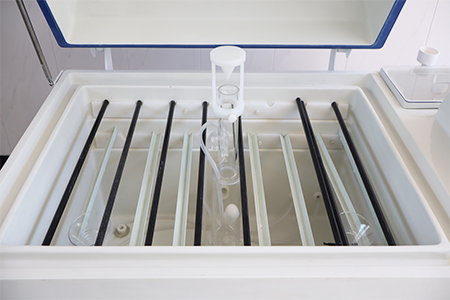
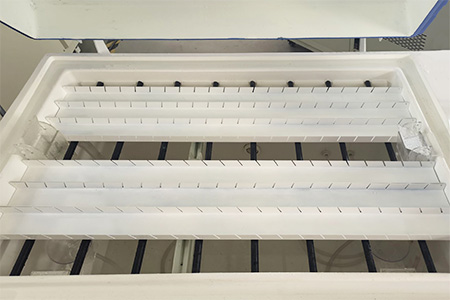
How you mount specimens drastically affects results. Horizontal orientation promotes solution pooling and faster corrosion. Vertical orientation with 15-30° tilt mimics natural runoff and is standard for many tests. The number and placement of specimens affect airflow and fog distribution - overloading the chamber creates shadowing and invalid results. LIB's chambers with adjustable spray towers and multiple shelf configurations (6 round bars, 5 V-grooves) allow proper specimen arrangement per standard requirements.
LIB Industry Delivers Reliable Salt Fog Corrosion Testing Solutions
 |
 |
|
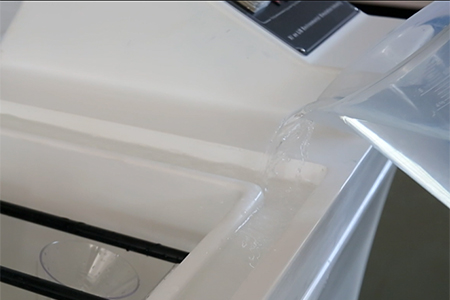
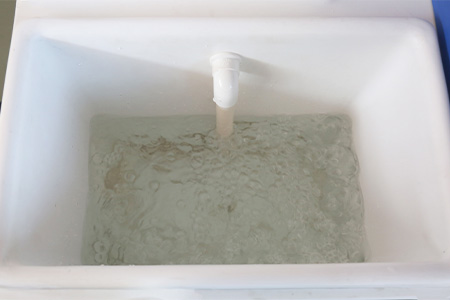
Durable, Leak-Resistant Workspace |
Flexible Sample Rack System |
Water-Sealed Lid Design |
|
Uniform Salt Solution Agitation |
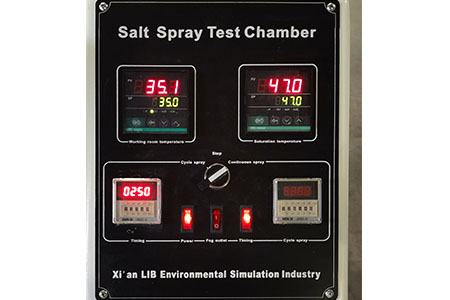
Intelligent Controller |
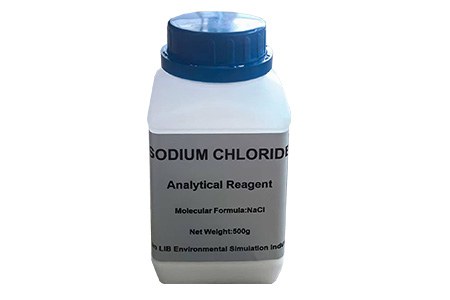
Included Industrial-Grade Salt |
Engineering for Precision and Uptime
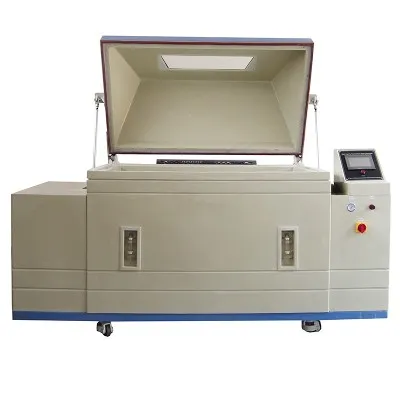
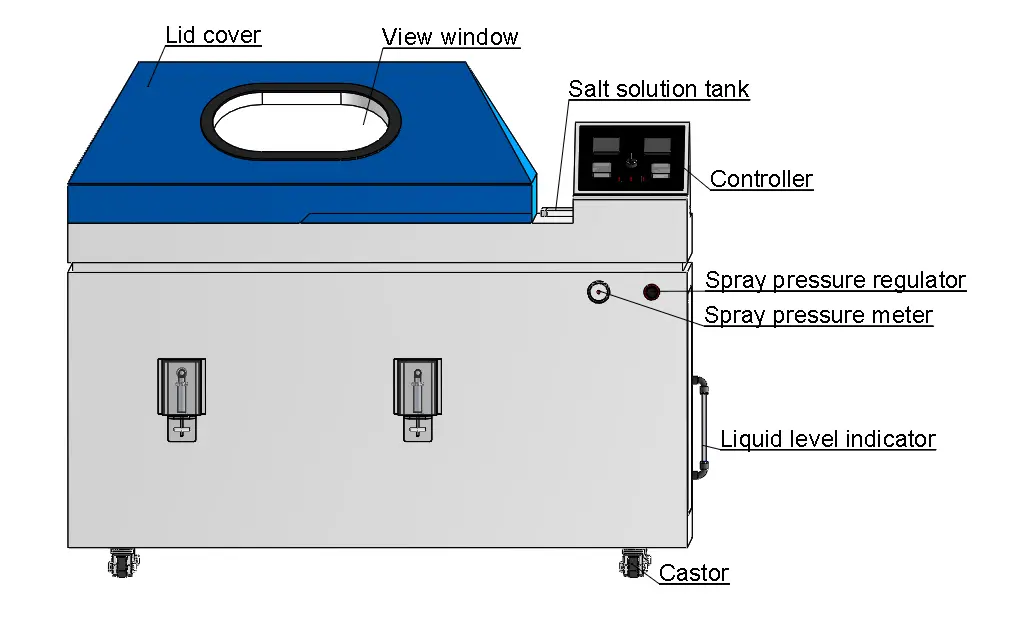
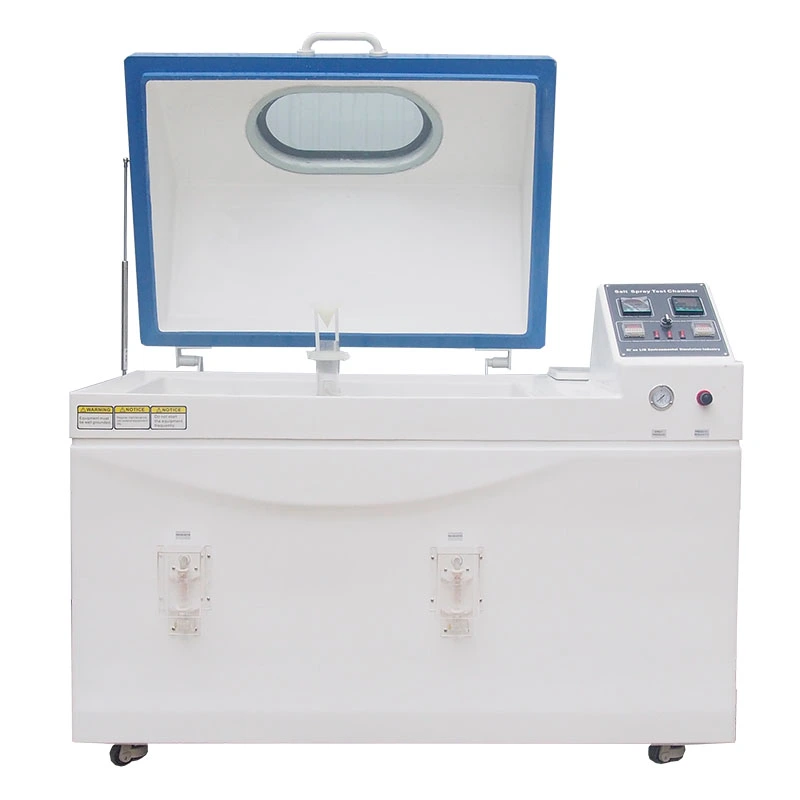
LIB's salt spray chambers are built around consistent, repeatable test conditions. The saturated air barrel preheats and humidifies compressed air before it reaches the atomizer, ensuring fog droplets are the correct size and salinity. The external portable salt solution tank (sizes from 73L to 115L+) allows easy refilling without disturbing the test. The pneumatically operated 'easy open' canopy with timed purge cycle safely vents corrosive fog before access, protecting operators and preventing condensation on newly opened specimens.
Compliance and Documentation Built-In
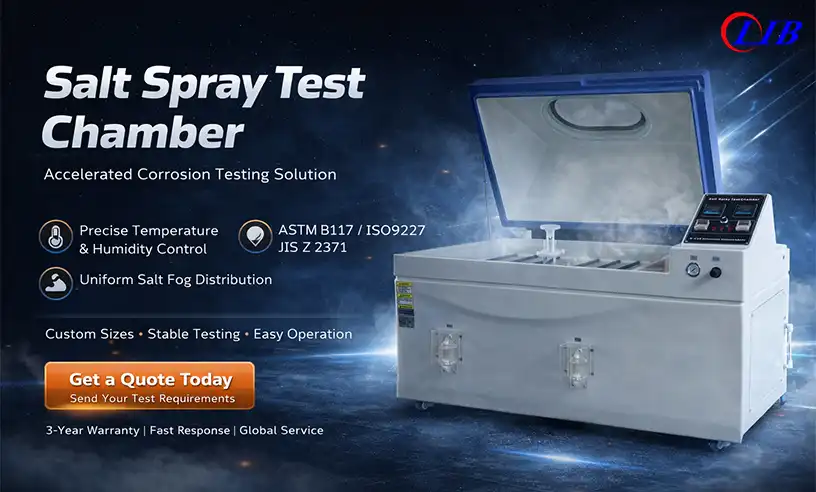
Every chamber comes with a calibration certificate and meets ASTM B117, ISO 9227, and JIS Z 2371 standards. The PID controller with multi-language support (English, French, Spanish, German, Russian) ensures proper setup by global teams. The central viewing window with interior lighting allows non-intrusive observation. The dry seal gasket on the canopy prevents fog leakage onto lab floors - a critical feature for facilities with sensitive equipment nearby. These details reflect an understanding of real-world laboratory constraints.
Global Support and Customization for Niche Applications
LIB's service centers in Malaysia, Canada, the UK, and the US provide localized technical support. Their customization capability addresses unique needs: oversized specimens for wind turbine components, special fixturing for complex assemblies, or modified control programs for proprietary cyclic protocols. The fall-out measuring kit and consumables spares kit included with purchase ensure customers can maintain chamber performance and validate deposition rates themselves. This turn-key approach - from consultation through training - de-risks the investment for manufacturers whose product reputation depends on flawless corrosion performance.
Conclusion
Salt fog validation in a purpose-built chamber is the cornerstone of confidence for any marine hardware manufacturer. It transforms subjective notions of "marine-grade" into quantifiable, repeatable data on corrosion resistance. By simulating years of ocean exposure in months, this testing guides material selection, validates coating systems, and identifies design flaws before products face real saltwater. For companies committed to safety, reliability, and brand integrity in marine environments, investing in rigorous salt spray testing isn't an expense - it's the foundation of product excellence and customer trust.
FAQ
How long should marine hardware be tested in a salt spray chamber?
There is no single duration. It depends on the material, coating, and service severity. Basic hardware might require 500 hours for screening, while premium marine coatings often specify 1000-2000 hours. Always refer to the relevant product standard (e.g., NMMA, ASTM) for your specific application. Validation requires establishing correlation to real-world exposure for your target market.
Can a salt spray chamber test large assemblies like boat ladders or railings?
Yes, LIB offers models up to 1600L internal volume (S-020: 1000x2000x800mm). For very large structures, you may need to test representative sections or use a custom oversized chamber. The key is ensuring all critical surfaces receive uniform fog exposure, which requires proper specimen orientation and spacing within the chamber's fog distribution envelope.
What's the difference between continuous and periodic salt spray tests?
Continuous spray (ASTM B117) maintains a constant fog, simulating constant immersion or heavy spray environments. Periodic spray introduces dry intervals, simulating wet-dry tidal cycles or splash zones. Periodic cycles are often more aggressive for coatings because corrosion products concentrate during drying, and repeated wetting stresses the coating-substrate bond. Choose based on your product's actual service condition.
Contact LIB Industry for Your Marine Corrosion Testing Needs
As a global manufacturer and supplier of salt spray chambers, LIB Industry provides turn-key corrosion testing solutions compliant with ASTM B117, ISO 9227, and JIS Z 2371. Our chambers feature precise fog deposition control, robust construction, and comprehensive global support. Contact our engineering team at ellen@lib-industry.com to discuss your specific marine hardware testing requirements and receive a customized configuration.