Why Plastic Manufacturers Need Xenon Weathering Tests?
Plastic manufacturers face mounting pressure to deliver products that withstand years of outdoor exposure without compromising appearance or structural integrity. Xenon weathering tests conducted in a xenon test chamber provide the critical answer to this challenge by simulating decades of real-world conditions in just weeks or months. Through controlled exposure to UV radiation, temperature fluctuations, and moisture cycles, these tests reveal how plastic formulations respond to environmental stress before products reach the market. This accelerated aging process helps manufacturers identify weaknesses, optimize material selection, refine stabilizer packages, and confidently predict product lifespan - ultimately protecting brand reputation and reducing costly field failures.
Understanding UV Degradation in Plastic Materials
The Photochemical Process Behind Plastic Deterioration
When plastic materials encounter ultraviolet radiation, photons with sufficient energy break molecular bonds within the polymer chains. This photochemical reaction initiates a cascade of degradation processes that fundamentally alter the material's properties. The carbon-hydrogen bonds in most plastics absorb UV wavelengths between 290-400nm, triggering free radical formation. These reactive molecules propagate chain scission reactions, creating shorter polymer segments that compromise mechanical strength and surface characteristics.
Visible Signs of UV-Induced Damage
Surface chalking represents one of the earliest indicators of photodegradation, appearing as a powdery residue when UV exposure breaks down polymer chains near the surface. Color shifts occur as chromophores within pigments or the base polymer undergo chemical changes, typically manifesting as yellowing, fading, or complete discoloration. Gloss reduction follows as surface roughness increases from differential degradation rates across the material matrix.
Long-Term Structural Consequences
Beyond aesthetic deterioration, UV exposure severely impacts mechanical performance. Tensile strength declines as polymer chain length decreases, making materials brittle and prone to cracking under stress. Impact resistance drops dramatically when degraded surface layers propagate fractures through the bulk material. Dimensional stability suffers as cross-linking or chain scission alters the polymer network, leading to warping or shrinkage that compromises assembly tolerances.
How Xenon Exposure Simulates Outdoor Environments?

Spectral Matching with Natural Sunlight
A xenon test chamber employs water-cooled xenon arc lamps that generate a continuous spectrum remarkably similar to solar radiation reaching Earth's surface. Unlike fluorescent UV lamps that produce discrete spectral lines, xenon sources deliver broad-spectrum output from 290nm through the visible range into infrared wavelengths. Advanced optical filter systems customize this output to match specific exposure conditions - whether simulating direct sunlight through window glass or outdoor weathering with full UV spectrum.
Controlled Environmental Parameters
Temperature management within xenon test chambers goes beyond simple heating. Black panel temperature sensors measure the actual surface temperature of dark-colored specimens, which often exceeds ambient air temperature by 20-30°C under intense irradiation. This metric better represents real-world conditions where black automotive dashboards or dark building panels experience extreme thermal stress. Humidity control adds another dimension, cycling between dry periods and high-moisture conditions that accelerate hydrolytic degradation mechanisms.
Accelerated Time Compression
The fundamental advantage of xenon weathering lies in concentrating months or years of outdoor exposure into manageable test durations. By operating at irradiance levels of 0.35 to 1.5 W/m² at 340nm - significantly higher than typical outdoor conditions - test cycles compress aging timelines while maintaining proportional degradation mechanisms. A properly designed test protocol achieves reliable correlation factors, where 1000 hours of chamber exposure equates to specific outdoor exposure periods depending on geographic location and application.
Common Plastic Failures Detected During Weathering Tests
Color Stability Failures
Color shift measurements using spectrophotometry reveal how pigment systems respond to sustained UV bombardment. Organic colorants often show significant fading within 500-1000 hours of xenon exposure, while inorganic pigments generally demonstrate superior lightfastness. Manufacturers testing automotive exterior trim discover whether their chosen colorant package maintains acceptable ΔE values below 2-3 units, the threshold where human eyes perceive noticeable color differences.
Mechanical Property Degradation
Tensile testing at intervals throughout xenon exposure quantifies strength retention. High-density polyethylene formulations without adequate UV stabilizers may lose 40-60% of original tensile strength after 2000 hours exposure. Elongation at break typically declines even more dramatically, dropping from 500% to below 50% as chain scission creates brittle surface layers. Impact testing reveals embrittlement that renders products susceptible to catastrophic failure during handling or use.
Surface Integrity Breakdown
Microscopic examination after weathering cycles exposes surface cracking patterns invisible to naked eyes. Micro-cracks initiated at stress concentration points propagate through degraded polymer matrices, eventually creating visible crazing networks. Gloss measurements track surface roughening quantitatively - initial gloss values of 85-90 units declining to 30-40 units signal significant surface deterioration. Adhesion testing evaluates whether coatings or printing remain bonded to substrates after UV exposure compromises surface chemistry.
Table 1: Common Degradation Modes Detected in Xenon Weathering Tests
|
Degradation Type |
Initial Detection Time |
Measurement Method |
Acceptance Criteria |
|
Color Fading |
200-500 hours |
Spectrophotometry (ΔE) |
ΔE < 3.0 |
|
Gloss Reduction |
300-800 hours |
60° Gloss Meter |
>50% retention |
|
Tensile Strength Loss |
500-1500 hours |
ASTM D638 |
>70% retention |
|
Surface Cracking |
800-2000 hours |
Visual/Microscopy |
No visible cracks |
|
Embrittlement |
1000-2500 hours |
Impact Testing |
>60% retention |
Industry Standards for Plastic Weathering Evaluation
ISO 4892 Series Requirements
The ISO 4892 standard series provides comprehensive guidance for xenon arc weathering tests conducted in a xenon test chamber across multiple parts. ISO 4892-2 specifically addresses xenon lamp exposure methods, defining filter types, irradiance levels, temperature parameters, and moisture cycling protocols. Manufacturers targeting European markets rely on these specifications to ensure testing aligns with regulatory expectations and customer requirements.
ASTM G155 Protocol Details
ASTM G155 offers detailed procedures for xenon arc exposure testing adapted to North American industry practices. This standard outlines specific test cycles including continuous light exposure, light with water spray, and light-dark cycling with controlled humidity transitions. The protocol specifies calibration procedures using reference materials and radiometer verification to ensure consistent irradiance delivery throughout test duration.
Material-Specific Test Methods
Beyond general weathering standards, material-specific protocols address unique requirements. ASTM D4459 covers outdoor weathering of polyolefins, while ASTM D6662 focuses on polyolefin-based plastic lumber. These specialized methods define appropriate exposure doses, relevant property measurements, and performance benchmarks tailored to specific polymer families and applications. Automotive specifications like SAE J2527 establish weathering requirements for exterior plastic components with pass/fail criteria tied to warranty expectations.
Table 2: Key International Standards for Plastic Weathering Testing
|
Standard |
Region |
Application Focus |
Key Parameters |
|
ISO 4892-2 |
International |
General xenon exposure |
Filter types, irradiance, temperature |
|
ASTM G155 |
North America |
Xenon arc weathering |
Test cycles, calibration procedures |
|
SAE J2527 |
Automotive |
Exterior components |
Color stability, gloss retention |
|
ASTM D4459 |
North America |
Polyolefin weathering |
UV stabilizer evaluation |
|
ISO 11341 |
International |
Paints and varnishes |
Coating performance on plastics |
Improving Product Lifespan Through Accelerated Aging
Stabilizer Package Optimization
Xenon weathering tests enable systematic evaluation of UV stabilizer effectiveness before committing to full-scale production. Hindered amine light stabilizers (HALS) function through radical scavenging mechanisms, while UV absorbers like benzotriazoles convert harmful radiation into harmless heat. Testing multiple concentrations and combinations reveals optimal loading levels that balance performance against cost constraints. Manufacturers discover whether 0.2% or 0.5% stabilizer addition provides adequate protection for their specific application's exposure severity.
Material Selection Validation
Comparative weathering studies guide material selection decisions among competing polymer grades or suppliers. Testing demonstrates whether a premium-grade polycarbonate justifies higher material costs through superior UV resistance compared to standard grades. Manufacturers evaluate engineering plastics like ASA (acrylonitrile styrene acrylate) against ABS to confirm whether enhanced outdoor durability warrants material substitution for exterior applications.
Quality Control Benchmarking
Establishing baseline weathering performance for approved formulations using a xenon test chamber creates quality control benchmarks for ongoing production monitoring. Periodic testing of production batches against historical data ensures formulation consistency and detects raw material variations before they cause field failures. When a batch shows premature degradation at 800 hours compared to the typical 1200-hour threshold, investigation can identify whether stabilizer concentration drifted below specifications or if a pigment supplier changed formulations.
Selecting the Right Xenon Test Parameters for Plastics
Irradiance Level Determination
Choosing appropriate irradiance settings depends on balancing acceleration factors against maintaining realistic degradation mechanisms. Standard testing at 0.55 W/m² at 340nm provides moderate acceleration suitable for general material screening. Higher irradiance levels up to 1.5 W/m² dramatically reduce test duration but risk introducing artificial degradation modes not encountered outdoors. Conservative approaches start at lower irradiance for initial correlation studies, then increase intensity once correlation with outdoor exposure is validated.
Temperature and Humidity Cycling
Black panel temperature settings should reflect actual end-use conditions. Automotive interior components may experience 90°C surface temperatures in closed vehicles during summer, justifying aggressive 85°C test temperatures. Outdoor building products in temperate climates rarely exceed 70°C, suggesting lower test temperatures better represent service conditions. Humidity cycling between 50-98% RH simulates dew formation and rain events that accelerate degradation through hydrolytic mechanisms and contaminant concentration cycles.
Spray Cycle Configuration
Water spray introduces mechanical stress from thermal shock while simulating moisture exposure. Front-face spray directly impacts specimens with room-temperature water while lamps remain energized, creating rapid cooling followed by reheating. This thermal cycling stresses adhesive bonds and tests coating flexibility. Spray duration and frequency depend on application - outdoor furniture testing might include 18-minute spray cycles every 120 minutes, while automotive testing follows OEM-specific protocols matching their correlation data.
Table 3: Recommended Xenon Test Parameters for Common Plastic Applications
|
Application |
Irradiance (W/m²) |
Black Panel Temp (°C) |
Relative Humidity |
Spray Cycle |
|
Automotive Exterior |
0.55 @ 340nm |
70-85 |
50-70% RH |
18 min/2 hr |
|
Building Products |
0.35-0.55 @ 340nm |
60-75 |
60-90% RH |
18 min/2 hr |
|
Consumer Electronics |
0.55 @ 340nm |
55-70 |
50-65% RH |
Optional |
|
Outdoor Furniture |
0.55-0.80 @ 340nm |
65-80 |
50-80% RH |
18 min/102 min |
|
Agricultural Film |
0.80-1.20 @ 340nm |
60-75 |
60-90% RH |
Not required |
LIB Industry Enables Reliable Plastic UV Aging Performance Testing
 |
 |
|
|
|


xenon lamp and filters
Precision Environmental Control Technology
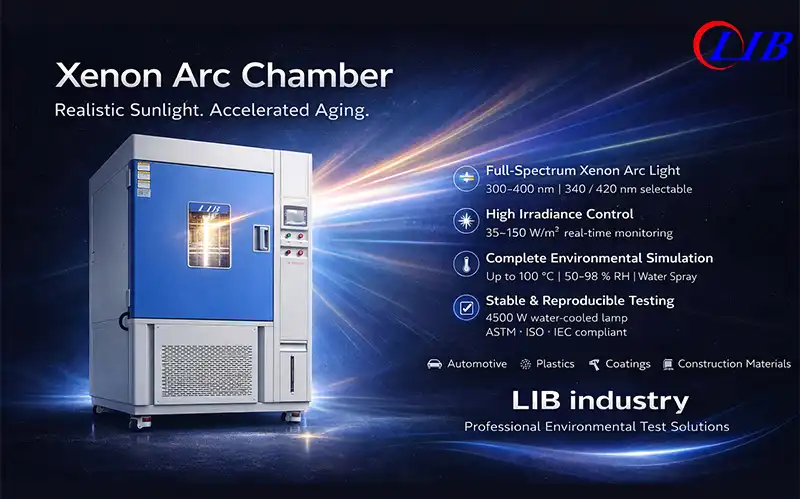
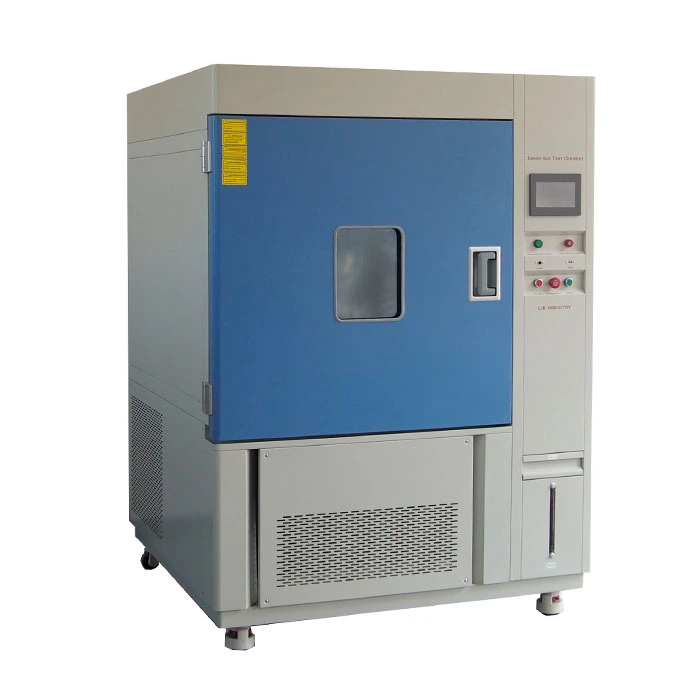
LIB Industry's xenon test chamber delivers the controlled conditions essential for reproducible weathering studies. The 4500W water-cooled xenon arc lamp provides stable spectral output across the critical 300-400nm bandwidth measurement range, with irradiance adjustable from 35-150 W/m². Built-in Solar Eye technology continuously monitors light intensity and automatically compensates for lamp aging, maintaining consistent irradiance levels throughout multi-thousand-hour test programs. This closed-loop control eliminates the variations that compromise result validity when testing plastic formulations.
Comprehensive Testing Capacity
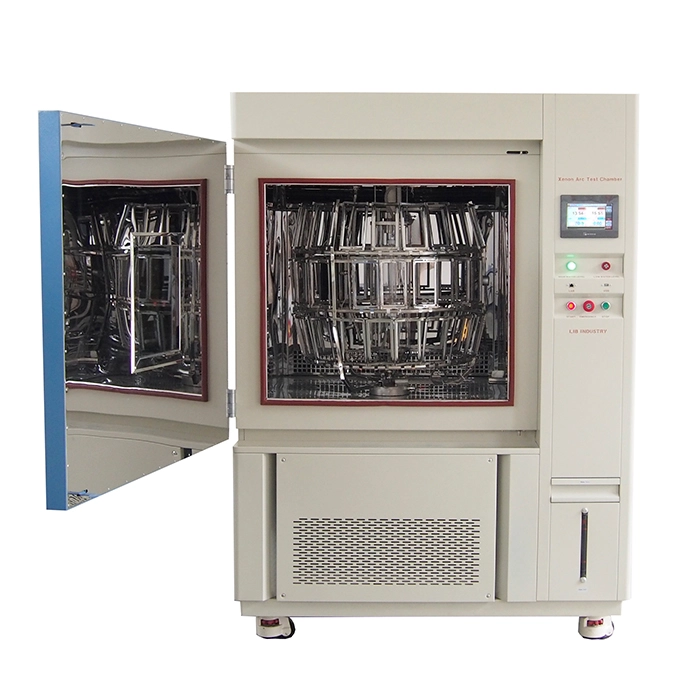
The rotating sample holder accommodates 42 specimens simultaneously, each measuring 95×200mm, providing statistical validity through multiple replicates per test condition. Continuous rotation ensures uniform exposure as each sample passes through identical positions relative to the light source and spray nozzles. Black panel temperature control maintains 35-85°C ±2°C accuracy, while humidity ranges from 50-98% RH with ±5% deviation. Programmable spray cycles from 1-9999 hours 59 minutes enable precise moisture exposure matching specific test protocols.
Global Standards Compliance
LIB Industry's chambers meet international testing requirements including ISO 4892, ASTM G154, and ASTM G155 specifications. The programmable color LCD touch screen controller simplifies protocol setup for complex multi-stage test sequences. Automatic water supply with integrated purification systems ensures consistent water quality for spray cycles. Multiple safety protections including over-temperature, over-current, water shortage, earth leakage, and phase sequence safeguards protect samples and operators. CE certification and third-party validation by SGS and TUV confirm compliance with international quality standards.
Customization and Support Infrastructure
Understanding that different industries face unique testing challenges, LIB Industry offers custom solutions tailored to specific plastic weathering applications. The engineering team collaborates with manufacturers to configure chamber parameters, sample holders, and control sequences matching proprietary test protocols. A 3-year warranty backed by lifetime service commitment provides peace of mind, while 24/7 global support ensures technical assistance across time zones. The closed-loop water circulation system with multi-stage filtration reduces operational costs while maintaining environmental responsibility.
Conclusion
Xenon weathering testing has become indispensable for plastic manufacturers committed to delivering durable products that maintain appearance and performance throughout their service life. By simulating years of outdoor exposure in controlled laboratory conditions, these tests reveal material vulnerabilities, validate stabilizer systems, and guide formulation optimization before costly production begins. Understanding UV degradation mechanisms, selecting appropriate test parameters aligned with industry standards, and partnering with reliable testing equipment providers creates the foundation for successful product development programs that minimize field failures and maximize customer satisfaction.
FAQ
How long should plastic manufacturers run xenon weathering tests to predict outdoor lifespan?
Test duration depends on acceleration factors and correlation studies, but typical automotive plastics undergo 2000-3000 hours of exposure. Manufacturers should establish correlation between chamber hours and actual outdoor years through parallel testing. Geographic location, orientation, and application significantly influence required exposure time for meaningful predictions.
What's the difference between xenon arc and fluorescent UV weathering chambers for plastic testing?
Xenon arc lamps provide full-spectrum output closely matching natural sunlight, including visible and infrared wavelengths that affect temperature-dependent degradation. Fluorescent UV lamps offer only UV wavelengths with discrete spectral peaks, making them suitable for UV-dominant degradation screening but less representative of actual outdoor conditions for comprehensive material evaluation.
Can xenon weathering tests predict how plastic products perform in different climates?
Yes, through parameter adjustment including irradiance intensity, temperature settings, and moisture cycling. Florida subtropical exposure requires different test cycles than Arizona desert conditions. Manufacturers develop multiple protocols representing various geographic markets, validating correlation through outdoor exposure sites in target regions before relying solely on accelerated testing.
Contact LIB Industry for Your Xenon Test Chamber Needs
As a leading xenon test chamber manufacturer and supplier, LIB Industry delivers turn-key environmental testing solutions worldwide. Contact our team at ellen@lib-industry.com to discuss your plastic weathering testing requirements and discover how our chambers can support your quality assurance goals.