Choosing a Dust Simulation Chamber for Electronics Testing
Selecting the right dust simulation chamber for electronics testing requires careful evaluation of compliance standards, circulation technology, and control precision. A quality dust testing chamber must accurately replicate real-world particle exposure while maintaining strict environmental controls for IP certification. The ideal equipment combines automated pressure regulation, consistent talcum powder distribution, and programmable test sequences that align with IEC 60529 and ISO 20653 standards. Understanding your product's protection requirements, testing frequency, and sample dimensions ensures you invest in equipment that delivers repeatable results, minimizes maintenance downtime, and supports your certification goals without compromising laboratory safety or operational efficiency.
How to Select a Dust Simulation Chamber for Electronic Components?

Understanding Your Testing Requirements
Electronic components face varying dust exposure levels depending on their application environment. Consumer electronics destined for household use require different protection levels compared to industrial sensors operating in manufacturing facilities or automotive components exposed to road debris. Your dust simulation chamber selection begins with identifying the specific IP rating targets your products must achieve, whether that's IP5X for dust-protected devices or IP6X for completely dust-tight enclosures.
Matching Chamber Capacity to Sample Dimensions
The physical dimensions of your test samples directly influence which chamber model suits your needs. LIB offers models ranging from 800L to 2000L internal volume, with the DI-800 (800×1000×1000mm) accommodating smaller electronic assemblies, while the DI-2000 (1000×2000×1000mm) handles large automotive control units or multiple simultaneous samples. Reinforced stainless steel rack systems support heavy industrial equipment without compromising test accuracy.
Evaluating Manufacturer Expertise and Support
Partnering with experienced manufacturers ensures access to technical knowledge accumulated through thousands of testing cycles. LIB's 16-year track record serving global technology leaders like Apple and Intel demonstrates proven capability in precision environmental testing. Comprehensive support including custom programming, installation training, and turnkey laboratory solutions reduces implementation risks and accelerates your testing program launch.
Environmental Risks of Dust Exposure in Electronics
Circuit Board Contamination and Failure Mechanisms
Dust particles infiltrating electronic enclosures create multiple failure pathways that compromise device reliability. Conductive particles bridging circuit traces cause short circuits, while non-conductive dust absorbs moisture, creating corrosion accelerators that degrade solder joints and connector contacts. Fine talcum powder used in standardized testing - with 50μm wire diameter and 75μm gap specifications - accurately simulates real-world particles that bypass inadequate sealing systems.
Thermal Management Degradation
Accumulated dust on heat sinks, cooling fans, and ventilation pathways significantly reduces thermal dissipation efficiency. Electronics operating in dust-contaminated conditions experience elevated junction temperatures that accelerate semiconductor degradation and shorten operational lifespans. Dust simulation testing validates that enclosure designs prevent particle accumulation in thermally critical areas while maintaining necessary airflow for component cooling.
Optical and Mechanical Component Interference
Beyond electrical failures, dust infiltration disrupts optical sensors, camera modules, and precision mechanical assemblies common in modern electronics. Particles settling on lens surfaces scatter light and degrade imaging quality, while abrasive dust in moving parts accelerates wear. Comprehensive dust testing identifies vulnerabilities before products reach customers, preventing warranty claims and reputation damage.
Chamber Design Requirements for Precision Electronics Testing
Advanced Dust Circulation Architecture
Effective dust testing demands uniform particle distribution throughout the dust simulation chamber without creating stagnant zones where samples receive inadequate exposure. LIB's vertical circulation system employs strategically positioned blowers that create controlled airflow patterns, ensuring consistent talcum powder suspension. The multi-stage design prevents common problems like dust clumping that invalidate test results and require time-consuming restarts.
Temperature and Humidity Control Systems
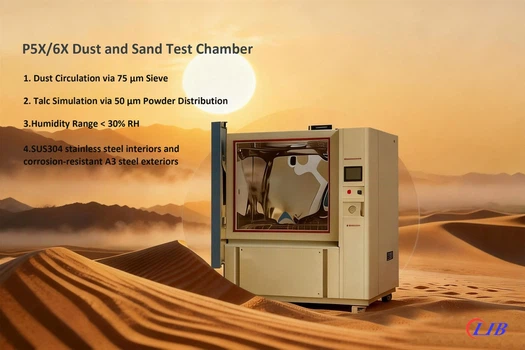
Maintaining ambient to +50°C temperature range with humidity below 30% RH prevents moisture absorption that causes talcum powder to agglomerate. Heated circulation chambers actively manage environmental conditions, keeping test dust in optimal flowing condition throughout extended test cycles. This environmental stability ensures test repeatability across different seasons and laboratory locations.
Specialized Sealing and Containment Features
The double-layer thermo-stability silicone rubber sealing around observation windows and electromagnetic door locks creates dust-tight integrity that protects laboratory environments while maintaining precise internal test conditions. Dust-proof cable ports with specialized sealing allow powered testing of active electronics without contamination pathways, enabling functional testing during particle exposure.
Critical Performance Factors: Sealing, Circulation, and Control

Automated Pressure Regulation for IP6X Certification
IP6X dust-tight certification requires maintaining 2kPa negative pressure differential while preventing any particle ingress. LIB's integrated vacuum system with pressure gauge, air filter, and regulator automatically sustains this critical parameter throughout test duration. One-touch preset configurations eliminate manual adjustments and human error, ensuring your products meet certification criteria on initial testing.
Programmable Test Sequence Management
The color LCD touchscreen controller provides comprehensive test parameter management with programmable sequences for both "Fight Time" (dust exposure) and "Blowing Time" (circulation) ranging from 0 to 99 hours 59 minutes. Multi-language support and Ethernet connectivity enable remote monitoring and data logging, while automated fault detection prevents equipment damage and test invalidation.
Real-Time Monitoring and Documentation
Certification bodies require detailed documentation of test conditions and duration. The controller's real-time monitoring displays dust concentration, pressure levels, and exposure time with automatic data logging through USB download capability. This digital documentation streamlines certification submissions and provides traceability for quality management systems.
|
Control Feature |
Capability |
Testing Benefit |
|
Programmable Sequences |
0-99H59M duration settings |
Matches diverse standard requirements |
|
Pressure Monitoring |
Real-time 2kPa regulation |
Ensures IP6X compliance accuracy |
|
Multi-language Interface |
Global language support |
Facilitates international team operations |
|
Ethernet Connectivity |
Remote access and monitoring |
Enables centralized laboratory management |
|
Automated Data Logging |
USB export capability |
Simplifies certification documentation |
Compliance with Industry Standards for Electronics Testing
IEC 60529 IP Code Testing Framework
The International Electrotechnical Commission's IEC 60529 standard defines the IP (Ingress Protection) rating system recognized globally for electronics enclosure protection. IP5X testing validates protection against dust ingress sufficient to prevent interference with equipment operation, while IP6X certifies complete dust-tight performance. Your dust simulation chamber must precisely replicate the specified test conditions including talcum powder characteristics, exposure duration, and pressure differentials.
ISO 20653 Automotive-Specific Requirements
Automotive electronics face particularly demanding environmental challenges, prompting ISO 20653 standards that extend IEC 60529 with additional specifications. This standard addresses road dust exposure scenarios specific to vehicle operating conditions. Chambers serving automotive manufacturers require flexibility to accommodate both general IEC testing and specialized ISO protocols within the same equipment platform.
MIL-STD Military and Aerospace Applications
Military and aerospace electronics demand extreme reliability under harsh environmental conditions. MIL-STD specifications for dust resistance testing often exceed commercial standards, requiring extended exposure durations and finer particle sizes. LIB's custom programming capabilities allow implementation of specialized military testing protocols while maintaining calibration traceability required for defense contractor quality systems.
|
Testing Standard |
Application Sector |
Key Requirements |
LIB Chamber Capability |
|
IEC 60529 IP5X/IP6X |
Consumer & Industrial Electronics |
Standardized talcum powder, timed exposure |
One-touch preset configurations |
|
ISO 20653 |
Automotive Components |
Enhanced dust protection levels |
Programmable custom sequences |
|
MIL-STD-810 |
Military & Aerospace |
Extended duration, fine particles |
Custom programming, reinforced construction |
Cost, Maintenance, and Long-Term Reliability Considerations
Initial Investment Versus Lifecycle Value
Budget constraints tempt some laboratories toward lower-cost dust chambers, but total ownership costs tell a different story. Wear-resistant fan designs and strategic component positioning in LIB chambers protect critical systems from abrasive particle damage that degrades cheaper equipment within months. The sloped bottom chamber with quick-release drainage allows complete dust changeover in just 5 minutes without equipment disassembly, reducing operational downtime and technician labor costs.
Preventive Maintenance Requirements
Traditional dust chambers suffer from fan wear, dust blockages in circulation pathways, and seal degradation requiring frequent replacement. LIB's maintenance-free operation philosophy incorporates durable materials and intelligent design that minimizes scheduled maintenance. The 304 stainless steel interior resists corrosion from humidity and chemical exposure, while the wear-resistant circulation fan maintains consistent performance through thousands of test cycles.
Calibration Stability and Verification Costs
Certification bodies and quality management systems require regular calibration verification of environmental test equipment. Chamber designs with stable temperature control, consistent pressure regulation, and reliable mesh filtration systems maintain calibration longer between verification cycles. This stability reduces calibration service costs and eliminates production delays from extended equipment downtime during recertification procedures.
Energy Efficiency and Operating Costs
Continuous operation of environmental test chambers represents significant ongoing electrical consumption. Modern control systems with intelligent heating management and optimized circulation fan operation reduce energy waste compared to legacy equipment. The programmable controller's automated test sequencing ensures equipment operates only during necessary testing phases, further reducing utility costs across annual operations.
|
Cost Factor |
Traditional Chambers |
LIB Dust Simulation Chamber |
|
Dust Changeover Time |
30-45 minutes with disassembly |
5 minutes quick-release system |
|
Fan Replacement Frequency |
Every 6-12 months |
Wear-resistant design, multi-year operation |
|
Calibration Interval |
Quarterly verification needed |
Stable performance, extended intervals |
|
Energy Consumption |
Continuous full-power operation |
Intelligent heating, programmable sequences |
LIB Industry Custom Dust Testing Solutions for Sensitive Electronics
| Name | Dust Proof Tester |
IP6X Dust Test Chamber |
|
Workroom dimension (mm) |
800*800*800 D*W*H |
|
|
External dimension (mm) |
950*3150*1800 D*W*H |
|
|
Interior Volume (L) |
510 |
|
|
Diameter of Turntable (mm) |
600 |
|
|
Turntable loads |
20kgs Max |
|
|
Turntable Rotation Speed |
0~7r/min (Adjustable) |
|
|
Internal Diameter of IPX5 Nozzle |
6.3 mm |
|
|
Internal Diameter of IPX6 Nozzle |
12.5 mm |
|
|
Water Flow Rate IPX5/ IPX6 |
12.5L/min ±5% / 100L/min ±5% |
|
|
Controller |
Programmable color LCD touch screen controller |
|
|
Ethernet connection, PC Link, USB |
||
|
Build-in Water Tank(mm) |
370*375*950 |
|
|
View Window Size(mm) |
475*475 |

 |
 |
|
| Test Area | LAN and USB | Controller |

Tailored Chamber Configurations for Unique Applications
Standard chamber models serve most electronics testing requirements, but specialized applications demand customized solutions. LIB's engineering team designs chambers accommodating oversized industrial equipment, high-power test samples requiring enhanced electrical capacity, or specialized mounting configurations for automotive assemblies. Custom size chambers integrate seamlessly into existing laboratory layouts and production line quality control stations.
Integrated Testing Software and Laboratory Management
Modern testing laboratories require equipment integration with laboratory information management systems (LIMS) and quality management databases. LIB provides custom testing software that connects dust chambers to enterprise systems through Ethernet protocols, enabling automated test scheduling, result documentation, and compliance reporting. This integration eliminates manual data transcription errors and accelerates certification workflows.
Comprehensive Turnkey Laboratory Solutions
Establishing a complete IP testing laboratory involves more than purchasing individual chambers. LIB's turnkey solutions include facility planning, environmental control system design, test equipment selection, installation, commissioning, and operator training. This comprehensive approach ensures your laboratory meets accreditation requirements while optimizing workflow efficiency and testing capacity.
Global Technical Support Network
Electronics manufacturers operate across multiple continents, requiring equipment suppliers with international service capabilities. LIB's global support network provides local-language technical assistance, spare parts availability, and field service engineers who understand regional certification requirements. Standard configuration includes remote diagnostic capabilities that allow LIB technicians to troubleshoot issues without site visits, minimizing testing interruptions.
Conclusion
Selecting a dust simulation chamber for electronics testing balances compliance precision, operational efficiency, and long-term reliability. The right equipment delivers consistent IP certification results while minimizing maintenance burdens and operating costs. LIB's advanced circulation technology, automated pressure regulation, and programmable control systems provide the accuracy modern electronics demand. Whether testing consumer devices, automotive components, or military-grade equipment, matching chamber capabilities to your specific requirements ensures successful product certification and market access across global regions.
FAQ
What's the difference between IP5X and IP6X dust testing requirements?
IP5X certification permits limited dust ingress that doesn't interfere with equipment operation, while IP6X requires complete dust-tight performance with zero particle penetration. IP6X testing maintains 2kPa negative pressure differential throughout the test cycle, demanding more sophisticated chamber capabilities and automated pressure regulation systems.
How often does talcum powder need replacement in dust simulation chambers?
Talcum powder degrades through moisture absorption and mechanical breakdown during circulation. Replace test dust every 15-20 test cycles or when particle size analysis indicates contamination. LIB chambers include 5kg starter supply, with quick-change systems allowing fresh powder loading in 5 minutes without equipment downtime.
Can dust chambers test powered electronics during particle exposure?
Specialized dust-proof cable ports with multi-layer sealing allow electrical connections to active test samples without compromising chamber integrity. The 16A dust-proof outlet supports functional testing during exposure, revealing real-world failure modes that static testing misses, particularly important for electronics with active cooling systems.
Ready to enhance your electronics testing capabilities? LIB Industry, a leading dust simulation chamber manufacturer with over 16 years of expertise, provides custom environmental testing solutions tailored to your certification requirements. Contact our technical team at ellen@lib-industry.com to discuss your specific application needs and receive a detailed equipment proposal.