Temperature Humidity Chambers in Automotive Component Testing
 Modern vehicles integrate thousands of electronic components that must function flawlessly across extreme environmental conditions - from desert heat exceeding 50°C to Arctic cold below -40°C, combined with humidity levels ranging from bone-dry to tropical saturation. A temperature humidity chamber provides automotive engineers with controlled environments to validate component reliability before production deployment. These precision testing systems replicate years of environmental stress within compressed timeframes, exposing design vulnerabilities in circuit boards, sensors, actuators, and control modules. By systematically subjecting components to temperature cycling, moisture exposure, and combined climatic stress, manufacturers prevent field failures while meeting stringent automotive quality standards that protect both brand reputation and passenger safety.
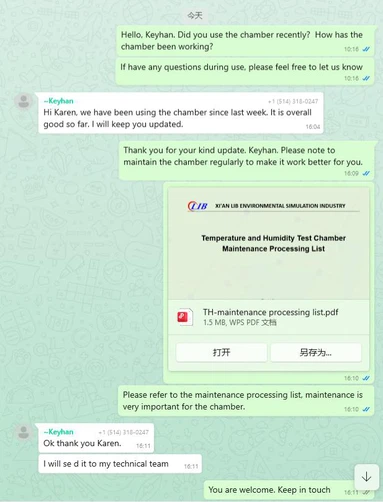
After commissioning, customer Keyhan shared his early feedback:“We started using the chamber last week. Everything is running well so far. I will continue to monitor the performance.”
From initial operation, the system showed stable temperature control and consistent humidity regulation across standard test programs. During early runs such as 85 °C / 85 % RH damp heat exposure and −40 °C to +85 °C thermal cycling, the chamber maintained smooth transitions, steady internal uniformity, and quick recovery after door openings.This early stability is crucial for laboratory testing, as it supports reliable data collection and ensures uninterrupted long-duration experiments. The feedback confirms that precise control and robust design are essential for dependable environmental testing performance.
Why Is Humidity Testing Essential for Automotive Electronics?
Corrosion Acceleration in High-Moisture Environments
Automotive electronic assemblies contain dissimilar metal interfaces - copper traces on circuit boards, tin-plated connectors, aluminum housings, and steel fasteners - that form galvanic couples when moisture creates conductive pathways. High humidity testing within temperature chambers accelerates electrochemical corrosion processes that gradually degrade electrical connections and component functionality. Engineers use controlled humidity exposure at elevated temperatures to condense months of coastal or tropical climate exposure into weeks, identifying vulnerable designs before vehicles enter production.
Hygroscopic Material Behavior Under Climate Stress
Modern automotive electronics incorporate various polymeric materials - circuit board substrates, connector housings, wire insulation, and potting compounds - that absorb atmospheric moisture at rates determined by temperature and relative humidity. This moisture absorption causes dimensional changes, reduces dielectric strength, and alters mechanical properties critical for long-term reliability. Temperature humidity chamber testing quantifies these hygroscopic effects, validating material selections against specifications that account for humidity-induced property degradation throughout the vehicle's expected service life.
Condensation Formation During Thermal Transitions
Vehicles parked overnight in cold conditions experience rapid temperature increases when engines start and electronic systems activate. These thermal transitions drive condensation formation on cold surfaces as warm humid air contacts components below the dew point temperature. Programmable chambers simulate these condensation events by executing rapid temperature ramps while maintaining controlled humidity levels, revealing whether protective coatings, conformal applications, or housing designs adequately prevent moisture-related failures during actual vehicle operation.
Environmental Stress Factors in Vehicle Component Validation

Temperature Extremes in Automotive Applications
Vehicle electronic components face dramatically wider temperature ranges than consumer electronics or industrial equipment. Engine compartment modules endure temperatures approaching 125°C during operation, while the same vehicle parked overnight in northern climates experiences ambient temperatures below -40°C. Under-hood sensors, powertrain controllers, and lighting modules require validation across these extremes. The temperature humidity chamber's range from -70°C to +150°C accommodates comprehensive automotive testing, including thermal shock sequences that transition components between temperature extremes within minutes.
Combined Climate and Thermal Load Testing
Realistic automotive validation requires simultaneous application of multiple environmental stresses. A climate control module must regulate cabin temperature while its own electronics endure high ambient heat, electrical power dissipation, and exposure to varying humidity levels. Advanced temperature humidity chambers accommodate heat-generating test specimens through precision thermal management that compensates for internal heat loads up to 1000W while maintaining setpoint accuracy within ±0.5°C, ensuring test conditions remain consistent regardless of component power consumption.
Vibration and Climate Multi-Axis Stress
Automotive components simultaneously experience mechanical vibration from road surfaces and powertrain operation combined with environmental temperature and humidity variations. Specialized integrated testing systems combine vibration tables with climate chambers, subjecting components to realistic multi-axis stress profiles. This combined environmental and mechanical testing reveals failure modes impossible to detect through sequential single-stress validation, particularly in solder joint fatigue, connector fretting, and housing seal degradation accelerated by simultaneous thermal cycling and vibration exposure.
Table 1: Automotive Component Environmental Stress Profiles
|
Component Type |
Temperature Range |
Humidity Exposure |
Critical Failure Modes |
Test Duration |
|
Engine Control Units |
-40°C to +125°C |
20% to 95% RH |
Solder joint cracking, connector corrosion |
1000+ hours |
|
Infotainment Systems |
-30°C to +85°C |
30% to 90% RH |
Display delamination, touch sensor drift |
500-750 hours |
|
Sensor Modules |
-40°C to +150°C |
10% to 98% RH |
Sensing element drift, housing seal failure |
800+ hours |
|
Battery Management Systems |
-30°C to +65°C |
20% to 85% RH |
Current measurement error, communication loss |
1500+ hours |
|
Lighting Electronics |
-40°C to +105°C |
40% to 95% RH |
LED degradation, driver circuit failure |
600-1000 hours |
Temperature Cycling and Humidity Exposure in Automotive Testing
Thermal Shock Profile Development
Automotive components experience abrupt temperature transitions that standard slow-ramping climate testing fails to replicate adequately. A vehicle entering a heated garage after extended cold-weather driving subjects electronic modules to temperature changes exceeding 60°C within minutes. The chamber's heating rate of 3°C/min and cooling rate of 1°C/min enables thermal shock protocol development with controlled transition speeds. Engineers program multi-step sequences alternating between temperature extremes with precise dwell times, replicating specific drive cycles and parking scenarios.
Humidity Cycling for Accelerated Aging
Constant humidity exposure provides limited reliability prediction compared to cycling protocols that alternate between dry and humid conditions. These humidity cycles drive moisture absorption and desorption in hygroscopic materials, accelerating interfacial degradation between dissimilar materials. The chamber's humidity range from 20% to 98% RH combined with programmable control allows complex cycling profiles. Typical automotive validation sequences include high-humidity soaks at elevated temperatures followed by dry conditions, condensing years of diurnal humidity variation into compressed test periods.
Combined Temperature-Humidity Stress Mapping
Comprehensive automotive component validation requires systematic exploration of the temperature-humidity operating space. Engineers develop stress matrices testing components at multiple temperature and humidity combinations - cold-dry conditions representing winter climates, hot-dry profiles simulating desert environments, and hot-humid scenarios replicating tropical regions. The programmable controller managing up to 120 programs with 100 steps each enables automated execution of these complex test matrices, systematically mapping component performance boundaries across the entire environmental operating envelope.
How Do Chambers Simulate Real-World Driving Conditions?

Geographic Climate Profile Replication
Automotive manufacturers sell vehicles globally, requiring validation against diverse climate zones from Scandinavian winters to Middle Eastern summers. The temperature humidity chamber replicates these geographic profiles through programmed sequences derived from meteorological data. A tropical validation profile maintains 30°C to 40°C with 80% to 95% RH for extended periods, while Arctic testing sequences cycle between -40°C during cold starts and elevated temperatures during operation, accurately representing real-world thermal and moisture stress patterns.
Drive Cycle Thermal Simulation
Vehicle operation generates characteristic thermal profiles as components heat during driving and cool during parking. Engine compartment electronics experience rapid heating following ignition, sustained elevated temperatures during highway driving, and gradual cooling after shutdown. The chamber's precise thermal control replicates these drive cycle profiles by programming temperature ramps and holds that mirror actual component thermal histories. This drive cycle simulation reveals temperature-dependent failure mechanisms - thermal expansion mismatch, solder creep progression, and adhesive degradation - occurring specifically during operational thermal transients.
Altitude and Pressure Considerations
Vehicle electronics at high altitudes experience reduced atmospheric pressure affecting heat dissipation, dielectric breakdown voltage, and humidity behavior. Specialized chambers integrate altitude simulation capabilities, reducing chamber pressure while controlling temperature and humidity. This combined environmental testing validates components for high-altitude markets, revealing cooling inadequacies in convection-dependent designs and insulation failures in circuits where reduced air density lowers breakdown thresholds. Automotive suppliers targeting global markets require this multi-parameter environmental validation capability.
Table 2: LIB Temperature Humidity Chamber Model Comparison
|
Specification |
TH-100 |
TH-225 |
TH-500 |
TH-800 |
TH-1000 |
|
Internal Dimensions (mm) |
400×500×500 |
500×600×750 |
700×800×900 |
800×1000×1000 |
1000×1000×1000 |
|
Chamber Volume |
100L |
225L |
500L |
800L |
1000L |
|
Temperature Range (Option C) |
-70°C to +150°C |
-70°C to +150°C |
-70°C to +150°C |
-70°C to +150°C |
-70°C to +150°C |
|
Humidity Range |
20% to 98% RH |
20% to 98% RH |
20% to 98% RH |
20% to 98% RH |
20% to 98% RH |
|
Heat Load Capacity |
1000W |
1000W |
1000W |
1000W |
1000W |
|
Temperature Stability |
±0.5°C |
±0.5°C |
±0.5°C |
±0.5°C |
±0.5°C |
|
Suitable For |
Individual ECUs, small sensors |
Instrument clusters, small assemblies |
Complete control modules, medium assemblies |
Door modules, seat electronics |
Full dashboard assemblies, large components |
|
|
|
|
|
|
| Robust Workroom | Cable Hole | Temperature and Humidity Sensor | PID controller |


Compliance Standards for Automotive Environmental Testing
AEC-Q Qualification Requirements
The Automotive Electronics Council establishes AEC-Q qualification standards that semiconductor manufacturers and component suppliers must satisfy for automotive applications. AEC-Q100 for integrated circuits, AEC-Q200 for passive components, and AEC-Q101 for discrete semiconductors all mandate specific temperature cycling and humidity exposure protocols. The temperature humidity chamber enables compliance testing including Temperature Humidity Bias (THB) testing at 85°C/85% RH for extended periods, Temperature Cycling between temperature extremes, and Highly Accelerated Stress Testing (HAST) protocols that compress reliability qualification timelines.
ISO 16750 Environmental Conditions Standard
ISO 16750 specifies environmental conditions and testing procedures for automotive electrical and electronic equipment. Part 4 addresses climatic loads including temperature, humidity, and combined exposures relevant to various vehicle mounting locations. The standard defines test severity levels corresponding to different installation positions - under-hood, passenger compartment, or underbody - each requiring specific temperature ranges and humidity profiles. Chambers programmed with ISO 16750 protocols provide standardized validation ensuring components meet minimum environmental robustness regardless of vehicle manufacturer or geographic market.
Manufacturer-Specific Validation Requirements
Beyond industry standards, major automotive manufacturers impose proprietary environmental testing specifications reflecting their quality expectations and historical field experience. German automotive specifications like VW TL 82066, BMW GS 95024, and Mercedes-Benz DBL standards establish rigorous climate testing protocols. Japanese manufacturers reference testing procedures from JASO standards. The programmable temperature humidity chamber controller stores multiple test protocols, enabling rapid switching between different manufacturer requirements without manual reconfiguration, streamlining qualification for suppliers serving multiple automotive customers.
Chamber Configuration for Complex Automotive Assemblies
Custom Fixture Development for Large Components
Automotive testing often involves complete assemblies - entire instrument clusters, door control modules, or seat electronics - rather than individual circuit boards. These complex assemblies require specialized fixtures maintaining proper orientation, providing electrical connections, and simulating mounting conditions. LIB Industry's custom engineering capabilities design application-specific test fixtures integrated into chamber interiors. Cable ports with sealed plugs accommodate power and communication connections while maintaining environmental integrity, enabling functional testing during climate exposure.
Multiple Specimen Testing Efficiency
Automotive validation programs require testing numerous component variants, production batches, and design iterations under identical environmental conditions. The chamber's adjustable shelf configuration accommodates multiple test specimens simultaneously, dramatically improving testing throughput. Temperature uniformity mapping ensures consistent conditions throughout the chamber volume regardless of specimen placement location. This multi-specimen capability proves particularly valuable during design validation phases when engineers compare competing designs or evaluate manufacturing process variations under standardized environmental stress.
Energy-Efficient Climate Control
Traditional climate chambers consume excessive energy by simultaneously operating heating and cooling systems fighting against each other - particularly during low humidity testing where dehumidification cooling competes with temperature control heating. LIB's Electronic Expansion Valve technology intelligently regulates refrigerant flow based on actual chamber conditions. This smart system eliminates wasteful heating-versus-cooling conflicts, reducing energy consumption by 30% while maintaining exceptional stability even during challenging low humidity conditions down to 10% RH. Automotive suppliers conducting continuous validation testing realize substantial operational cost savings from this efficiency improvement.
Precision Control and Documentation
Automotive component qualification demands rigorous documentation demonstrating compliance with test specifications throughout extended validation campaigns. The PID touchscreen controller provides intuitive programming of complex test sequences while maintaining ±0.001°C sensor resolution using high-accuracy PT100 Class A sensors. Real-time data monitoring via WiFi or Ethernet enables remote supervision of long-duration tests, while one-click export of test reports in CSV or Excel format streamlines documentation workflows. This precision control combined with comprehensive data management satisfies automotive quality system requirements including IATF 16949 certification.
Proven Automotive Industry Experience
LIB Industry has delivered environmental testing solutions to automotive leaders globally since 2009, developing specialized expertise in component validation requirements. The customer base includes major manufacturers and tier-one suppliers demanding chambers configured specifically for automotive applications - extended temperature ranges, high heat load capacity, and integration capabilities for functional testing during climate exposure. ISO 9001 certification with CE compliance and third-party validation from SGS and TUV authorities provides quality assurance, while the comprehensive 3-year warranty with lifetime service support protects capital equipment investments critical to automotive quality programs.
Conclusion
Comprehensive environmental validation using temperature humidity chambers represents an indispensable element of automotive component development, protecting manufacturers from catastrophic field failures while ensuring compliance with rigorous industry standards. Advanced chamber technology combining precise climate control, programmable test sequencing, and integrated monitoring capabilities enables systematic exploration of component performance boundaries across the full spectrum of automotive environmental conditions. As vehicles incorporate increasingly sophisticated electronics controlling safety-critical functions, the role of environmental testing intensifies, making chamber selection and configuration decisions directly impact both product reliability and market success.
FAQ
What temperature range is required for automotive component testing?
Automotive components typically require validation from -40°C to +125°C covering global climate extremes and under-hood temperatures. Specialized applications like cold-start sensors or exhaust-mounted components may require extended ranges down to -70°C or up to +150°C. Chamber selection should accommodate the specific mounting location and operational environment.
How long do typical automotive environmental validation tests require?
Duration varies significantly based on component criticality and applicable standards. AEC-Q qualification requires 1000+ hours of Temperature Humidity Bias testing plus numerous thermal cycles. Complete validation programs combining multiple test methods typically span several weeks to months. Accelerated testing methodologies using elevated stress levels can compress timelines while maintaining correlation to field reliability.
Can temperature humidity chambers accommodate functional testing during climate exposure?
Yes, specialized chambers include sealed cable ports and electrical feedthroughs enabling powered operation and communication monitoring throughout environmental testing. This capability proves essential for automotive components requiring functional validation under climate stress, revealing performance degradation that static resistance or visual inspection cannot detect. Real-time monitoring correlates environmental conditions with functional parameters.
Partner with LIB Industry - a leading temperature humidity chamber manufacturer and supplier specializing in automotive environmental testing solutions. Contact our engineering team at ellen@lib-industry.com to discuss customized chamber configurations engineered specifically for your automotive component validation requirements.