How Aging Chambers Support Material R&D and Innovation?
Material innovation drives competitive advantage across industries, yet predicting long-term performance remains one of research and development's most challenging obstacles. Accelerated aging chambers compress years of environmental exposure into controlled testing periods, enabling scientists to evaluate degradation patterns, optimize formulations, and validate durability claims before market introduction. These sophisticated instruments simulate sunlight intensity, temperature fluctuations, humidity cycles, and precipitation effects that materials encounter throughout their service lives. By revealing weaknesses invisible to conventional testing methods, aging chambers empower researchers to iterate designs rapidly, select superior raw materials, and develop breakthrough products that withstand decades of environmental stress while maintaining performance characteristics critical to end-user satisfaction.
Long-term users have validated the chamber’s dependable performance under actual laboratory conditions. One recent example comes from a customer in Vietnam, who, after adhering to LIB’s maintenance instructions, reported: “The chamber works stably.” This positive feedback confirms that, when properly maintained, LIB’s Xenon Arc Chamber Weatherometer delivers consistent, high-accuracy accelerated weathering tests without downtime—reinforcing trust in its ability to evaluate coating durability reliably.

Why Accelerated Aging Is Critical in Material Development?
Compressed Timeline Benefits for Innovation Cycles
Traditional weathering studies require exposing specimens outdoors for extended periods, creating bottlenecks that delay product launches and increase development costs. An accelerated aging chamber replicates months or years of natural exposure within weeks through intensified environmental stressors. This temporal compression enables multiple design iterations within single development cycles, allowing research teams to explore broader material variations and optimization strategies than real-time weathering permits.
Predictive Performance Validation
Material failures occurring after market introduction generate warranty costs, reputation damage, and potential safety liabilities. Accelerated testing identifies degradation mechanisms before production commitment, revealing whether formulations meet durability specifications under worst-case environmental scenarios. Researchers correlate laboratory results with field performance data, establishing confidence intervals that predict service life expectations across diverse climate zones and application conditions.
Regulatory Compliance Documentation
Standards organizations worldwide mandate aging resistance testing for materials used in construction, automotive, aerospace, and consumer products. ASTM D2436, ASTM D4332, and ASTM F1980 establish protocols requiring controlled environmental exposure to verify compliance claims. Laboratory chambers provide reproducible conditions satisfying these requirements, generating documented evidence supporting product certifications, building code approvals, and industry-specific quality benchmarks essential for market access.
Simulating Real-World Conditions in Laboratory Settings
Full-Spectrum Solar Radiation Reproduction
Natural sunlight contains ultraviolet, visible, and infrared wavelengths that each contribute distinct degradation effects on polymers, coatings, and composites. Xenon arc lamps generate spectral distributions closely matching solar radiation across 300-800 nanometer ranges. The accelerated aging test chamber maintains irradiance levels from 35 to 150 W/m² within narrow tolerances, ensuring consistent photon flux across specimen surfaces throughout extended testing campaigns spanning thousands of hours.
|
Light Source Type |
Wavelength Coverage |
Primary Application |
Lamp Service Life |
|
Xenon Arc System |
Full spectrum 300-800nm |
Color fastness, visual changes |
Up to 1600 hours |
|
UV Fluorescent |
Focused UV 295-365nm |
Polymer degradation, chalking |
5000+ hours |
|
Metal Halide |
Broad spectrum 320-780nm |
Outdoor durability simulation |
2000 hours |
Thermal Cycling and Temperature Management
Material degradation accelerates exponentially with temperature elevation according to Arrhenius kinetics. Precise black panel temperature (BPT) control between 35°C and 85°C simulates surface heating conditions exceeding ambient chamber temperatures. This differential mimics dark-colored materials absorbing solar radiation, experiencing higher temperatures than surrounding air. Programmable cycling between elevated exposure temperatures and cooler rest periods replicates diurnal thermal stress patterns causing fatigue crack propagation in brittle matrices.
Moisture-Induced Degradation Simulation
Humidity control spanning 50% to 98% relative humidity combined with condensation and spray cycles recreates dew formation and rainfall events. Water vapor diffusion into polymer matrices plasticizes amorphous regions, accelerating hydrolytic chain scission reactions. Spray systems apply controlled water volumes simulating precipitation impact and surface wetting dynamics. This moisture management capability proves essential for evaluating materials exposed to coastal environments, tropical climates, or applications involving frequent water contact.
Data-Driven Material Performance Evaluation
Quantitative Degradation Measurement Techniques
Objective assessment methodologies transform subjective observations into statistically rigorous datasets. Colorimetry quantifies color shift magnitude using CIELAB coordinates, detecting changes invisible to unaided visual inspection. Gloss meters measure surface reflection angles revealing early-stage erosion before substantial material loss occurs. Tensile testing on aged specimens documents mechanical property retention, establishing whether materials maintain structural integrity after environmental exposure equivalent to projected service lifetimes.
Continuous Monitoring and Real-Time Adjustments
Modern accelerated aging chambers feature programmable touchscreen controllers logging temperature, humidity, irradiance, and cycle parameters with timestamp precision. Network connectivity enables remote monitoring across multiple chambers simultaneously, allowing research teams to track parallel experiments from centralized workstations. Automated alerts notify operators when parameters drift outside specification limits, preventing test invalidation due to equipment malfunction or utility supply interruptions.
Statistical Analysis for Formulation Optimization
Design of experiments (DOE) methodologies leverage accelerated testing throughput to evaluate multiple formulation variables simultaneously. Researchers systematically vary stabilizer concentrations, pigment selections, or polymer blend ratios, subjecting each variant to identical aging protocols. Statistical software identifies optimal compositions balancing cost constraints against performance requirements, revealing synergistic combinations that individual component testing might overlook.
|
Performance Metric |
Measurement Method |
Acceptance Criteria |
Testing Frequency |
|
Color Stability |
Spectrophotometry ΔE |
ΔE < 3.0 units |
Every 250 hours |
|
Gloss Retention |
60° gloss meter |
>80% initial value |
Every 500 hours |
|
Tensile Strength |
ASTM D638 protocol |
>70% initial strength |
1000, 2000 hours |
|
Elongation at Break |
Extensometry |
>50% initial elongation |
1000, 2000 hours |
|
Surface Cracking |
Visual rating scale |
No cracks Grade 0-1 |
Every 500 hours |
Reducing Time-to-Market Through Accelerated Testing
Parallel Development Pathway Enablement
Traditional sequential testing approaches require completing outdoor exposure before initiating subsequent development phases. Accelerated ageing chambers allow simultaneous evaluation of competing formulations, packaging materials, and protective coating systems. Research teams advance multiple candidates through testing pipelines concurrently, maintaining backup options when lead formulations encounter unexpected failures. This parallelization strategy compresses overall development timelines despite individual test duration requirements.
Early-Stage Screening Efficiency
Preliminary screening tests conducted at elevated stress levels quickly eliminate inferior candidates before investing resources in comprehensive validation studies. High-intensity exposure protocols reveal catastrophic failures within hundreds rather than thousands of hours, enabling rapid down-selection among broad formulation libraries. Surviving candidates then undergo standard testing protocols confirming durability under less severe conditions representing actual service environments.
Iterative Design Refinement Acceleration
Rapid feedback loops between testing results and formulation adjustments enable continuous improvement cycles impossible with real-time weathering. Chemists modify stabilizer packages, adjust crosslink densities, or incorporate novel additives based on degradation patterns observed in completed test cycles. Subsequent iterations enter testing within days, creating spiral development progressions converging toward optimized formulations through guided experimentation rather than trial-and-error approaches.
Identifying Failure Mechanisms and Improvement Areas
Photodegradation Pathway Characterization
Ultraviolet radiation initiates free radical reactions cleaving polymer backbone chains, causing molecular weight reduction and mechanical property deterioration. Spectroscopic analysis of aged specimens identifies specific chromophores absorbing damaging wavelengths, informing stabilizer selection targeting vulnerable chemical structures. Surface analytical techniques reveal whether degradation remains confined to exposed surfaces or propagates throughout material thickness, distinguishing erosion mechanisms from bulk property changes.
Hydrolysis and Moisture-Induced Weakening
Polyesters, polyurethanes, and polyamides exhibit susceptibility to hydrolytic degradation when water molecules attack ester or amide linkages. The accelerated aging chamber creates high-humidity environments accelerating these reactions, revealing whether moisture barriers adequately protect vulnerable matrices. Differential scanning calorimetry detects glass transition temperature shifts indicating plasticization or crystallinity changes affecting dimensional stability and mechanical performance.
Thermal Oxidation and Stabilizer Depletion
Elevated temperatures accelerate oxidative chain scission reactions consuming antioxidants and UV absorbers protecting polymer matrices. Depleted stabilizer reserves leave materials vulnerable to catastrophic degradation during later service life stages. Extraction studies quantify remaining stabilizer concentrations in aged specimens, establishing whether initial loading levels provide adequate protection margins. This knowledge guides formulation adjustments ensuring stabilizer reservoirs survive projected product lifetimes.
Enabling Innovation Across Multiple Industries
Automotive Component Development
Exterior trim components, dashboard materials, and lighting assemblies must withstand decades of solar exposure without color fading, surface cracking, or mechanical failure. Accelerated testing validates whether new thermoplastic formulations meet automotive OEM specifications requiring 2000+ hour xenon exposure with minimal property degradation. Headlamp lens materials undergo specialized testing confirming optical clarity retention and impact resistance after simulated environmental aging equivalent to 10-year vehicle service lives.
Construction Material Advancement
Architectural coatings, composite cladding panels, and roofing membranes face extreme weathering conditions varying by geographic installation locations. An accelerated aging chamber enables manufacturers to optimize formulations for specific climate zones, testing Alaska-bound products under intense UV with freeze-thaw cycling while subjecting Florida-destined materials to high humidity and temperature combinations. Building code approvals increasingly require documented accelerated aging data demonstrating long-term performance predictions.
Consumer Electronics Durability
Smartphone housings, wearable device enclosures, and outdoor electronics require materials maintaining appearance and structural integrity despite continuous UV exposure and moisture contact. Accelerated testing reveals whether polycarbonate formulations resist yellowing, evaluates whether surface coatings prevent scratch damage accumulation, and confirms that adhesive bonds maintain strength after environmental exposure. This validation supports premium product positioning based on superior durability claims differentiating brands in competitive markets.
LIB Industry's Turnkey Solutions Accelerating Development Cycles with Confidence
|
|
 |
 |
 |
 |
|
Precision-Engineered Environmental Control Systems
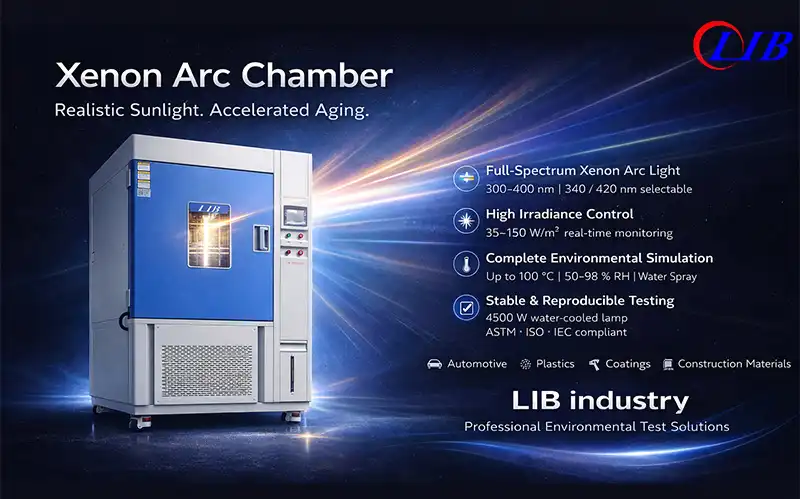
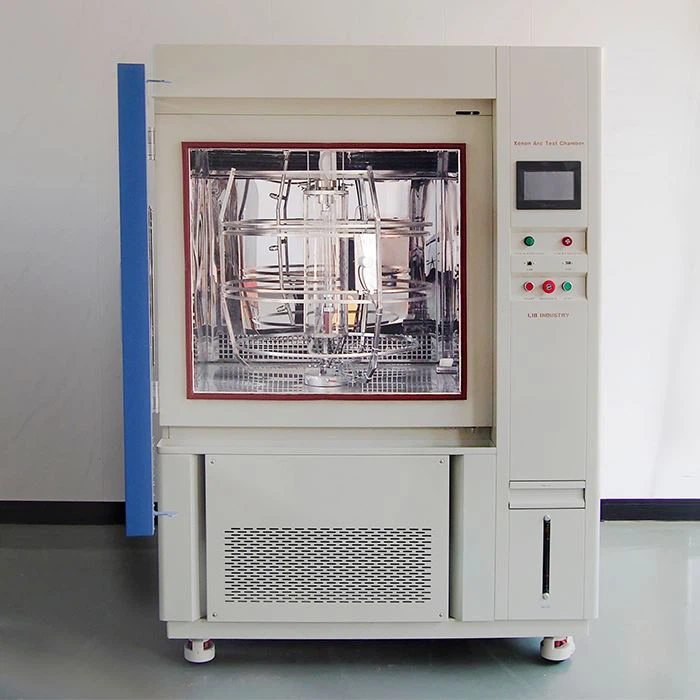
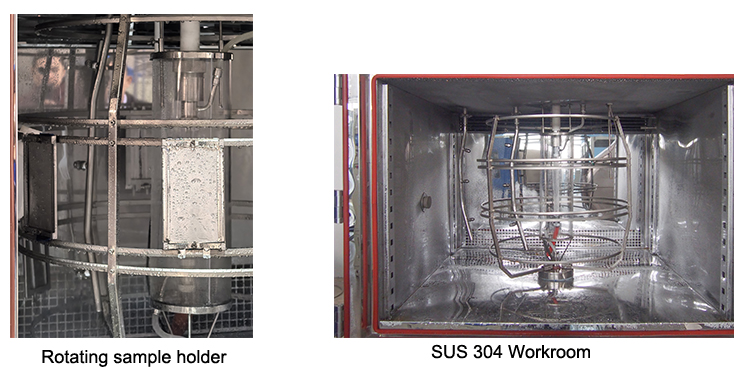
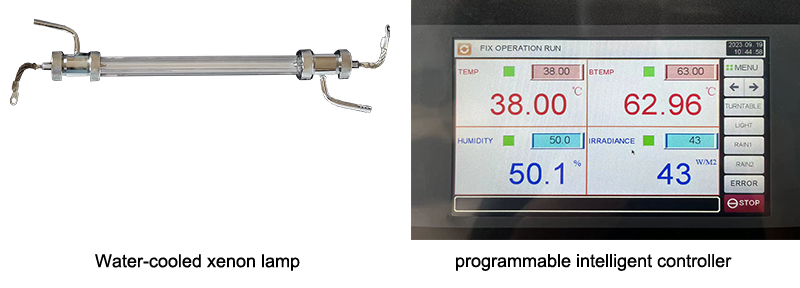
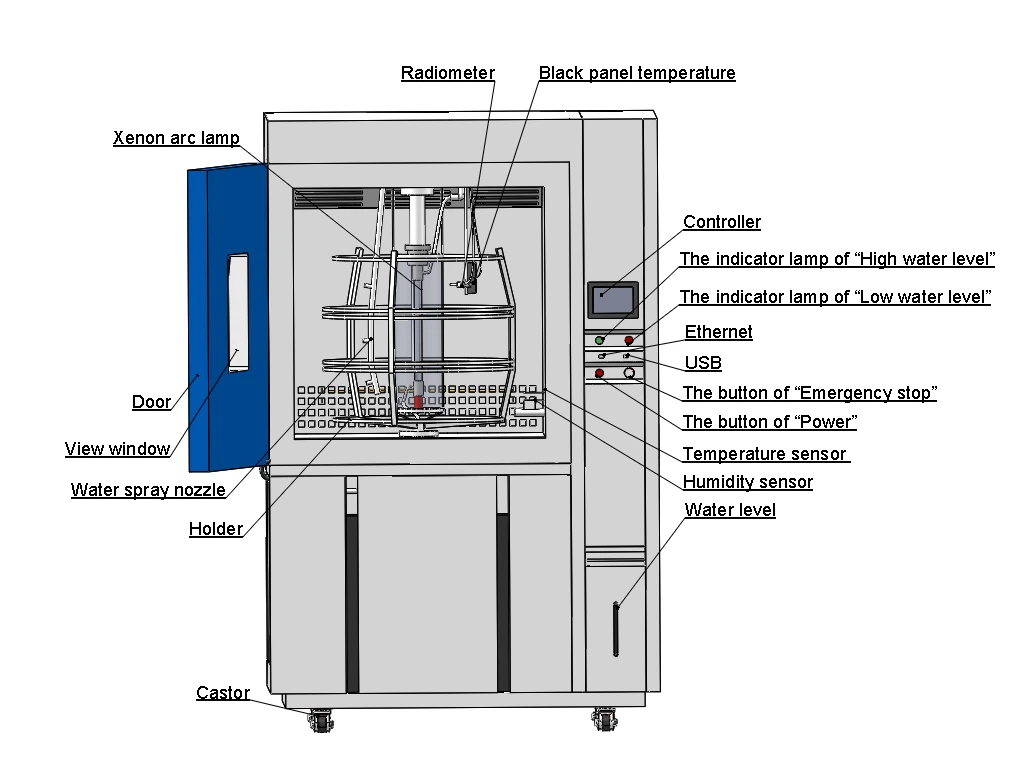
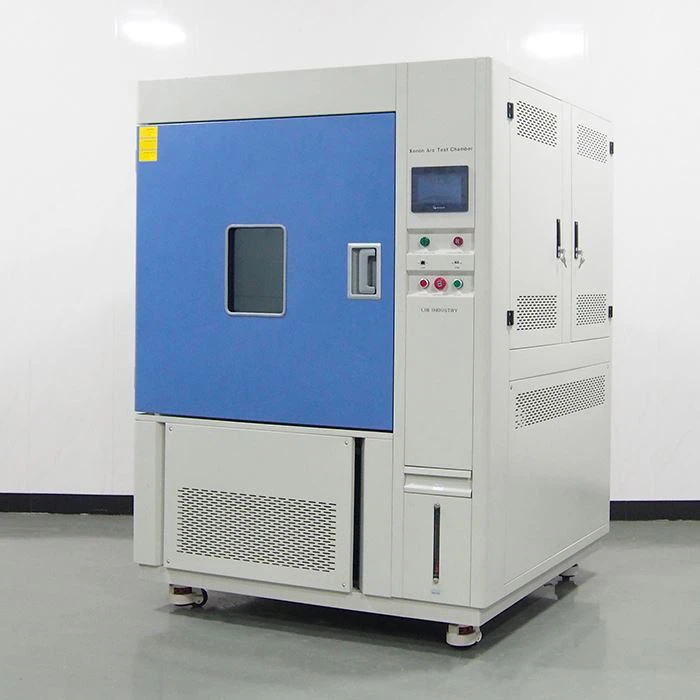
LIB Industry's accelerated ageing chamber features a rotating specimen holder accommodating 42 standard-sized samples within a 950×950×850mm stainless steel chamber. The 4500-watt water-cooled xenon arc lamp delivers irradiance spanning 35-150 W/m² across 300-400nm bandwidths with ±5% radiometer accuracy. This precise control eliminates testing variability stemming from inconsistent exposure conditions, ensuring results reflect material performance rather than equipment limitations.
Comprehensive Temperature and Humidity Management
Black panel temperature regulation maintains surfaces at 35-85°C ±2°C regardless of chamber ambient conditions, replicating solar heating effects on dark-colored materials. Independent humidity control achieves 50-98% RH with ±5% deviation, creating condensation conditions or dry heat exposure as testing protocols demand. Programmable water spray cycles ranging from minutes to hours simulate precipitation events complementing steady-state humidity exposure, comprehensively addressing moisture-related degradation mechanisms.
User-Centric Control Interface Design
The programmable color LCD touchscreen simplifies complex test protocol programming through intuitive menu structures and one-touch standard mode selection. Pre-loaded programs for ISO 4892, ASTM G154/G155, and SAE J2527 eliminate manual parameter entry errors ensuring regulatory compliance. Network connectivity enables remote monitoring and data export via USB, integrating chamber operations with laboratory information management systems for centralized experimental tracking and results documentation.
Robust Construction for Long-Term Reliability
SUS304 stainless steel interior construction resists corrosion from continuous humidity exposure and chemical interactions with specimen off-gassing products. Polyurethane foam insulation combined with thermal cotton layering maintains temperature stability while minimizing energy consumption. Double-layer observation windows with interior lighting enable specimen inspection without interrupting test cycles, while silicone rubber sealing prevents light leakage and maintains environmental isolation.
Comprehensive Safety and Protection Systems
Multi-layer safety protocols including over-temperature protection, water shortage detection, earth leakage monitoring, and phase sequence verification prevent equipment damage and operator hazards. Automatic lamp shutdown triggers activate when cooling water flow interruptions threaten xenon arc lamp integrity. These redundant protection systems ensure continuous operation reliability during unattended overnight and weekend testing campaigns spanning thousands of hours.
Global Support Infrastructure
LIB Industry's 24/7 technical assistance network provides remote diagnostics, troubleshooting guidance, and spare parts procurement support minimizing equipment downtime. Three-year warranty coverage with replacement guarantee for irreparable failures demonstrates manufacturing quality confidence. Installation services include operator training ensuring research teams maximize chamber capabilities from initial commissioning, while ongoing consultation assists with test protocol development optimized for specific material evaluation objectives.
Custom Engineering Capabilities
Non-standard chamber dimensions, specialized specimen mounting fixtures, or unique environmental profile requirements benefit from LIB Industry's experienced R&D team collaboration. Custom solutions address industry-specific testing challenges such as oversized architectural panel evaluation, textile sample configurations, or pharmaceutical packaging validation. This engineering flexibility ensures testing equipment matches research objectives rather than forcing experimental compromises accommodating standardized chamber limitations.
Conclusion
Accelerated aging chambers transform material development from protracted observation exercises into data-intensive innovation accelerators. By compressing environmental exposure timelines, revealing degradation mechanisms, and enabling iterative refinement cycles, these instruments empower researchers to optimize formulations, validate durability claims, and introduce superior products confidently. The integration of precise environmental control, comprehensive monitoring capabilities, and regulatory compliance features positions aging chambers as indispensable tools across industries demanding long-term material performance assurance while maintaining competitive development velocities.
FAQ
What differentiates xenon arc chambers from UV fluorescent aging systems?
Xenon arc lamps reproduce full-spectrum solar radiation including visible and infrared wavelengths, making them ideal for color stability and appearance retention testing. UV fluorescent systems concentrate energy in ultraviolet bands where polymer degradation occurs most rapidly, optimizing efficiency for chemical resistance evaluation rather than visual property assessment.
How do researchers correlate accelerated test results with actual outdoor weathering performance?
Correlation studies compare materials exposed simultaneously in laboratory chambers and outdoor weathering sites across multiple climate zones. Statistical analysis establishes acceleration factors relating chamber exposure hours to equivalent outdoor months, validated through molecular analysis confirming similar degradation mechanisms occurring through both exposure routes.
Can accelerated aging chambers test multiple material types simultaneously?
Chambers accommodate diverse specimen configurations including flat panels, three-dimensional components, and flexible substrates mounted on rotating holders ensuring uniform exposure. Dissimilar materials undergo identical environmental protocols enabling comparative evaluations, though outgassing from certain materials might require isolation preventing cross-contamination affecting sensitive specimens.
Partner with LIB Industry for advanced accelerated aging chamber solutions tailored to your research requirements. As a trusted environmental test equipment manufacturer and supplier, we deliver complete installations including commissioning, operator training, and ongoing technical support worldwide. Contact our engineering specialists at ellen@lib-industry.com to discuss custom testing chamber configurations optimized for your material development and innovation programs.