How Temperature and Humidity Cabinets Improve LED Product Reliability?
LED manufacturers face mounting pressure to deliver products that withstand diverse environmental conditions while maintaining consistent luminous performance throughout extended operational lifetimes. Temperature and humidity cabinets serve as indispensable validation tools that expose LED assemblies to controlled climatic stresses, revealing potential failure mechanisms before market deployment. These sophisticated environmental chambers replicate moisture ingress scenarios, thermal cycling extremes, and condensation phenomena that degrade phosphor coatings, corrode electrical contacts, and compromise encapsulant materials. Through systematic testing protocols within precisely controlled environments, manufacturers identify design vulnerabilities, validate packaging improvements, and generate quantitative reliability data supporting warranty claims and quality certifications demanded by increasingly discerning lighting markets.
Why Do LED Products Require Temperature and Humidity Testing?
Moisture-Induced Degradation Mechanisms
LED packages contain hygroscopic materials including phosphor binders, silicone encapsulants, and epoxy substrates that absorb atmospheric moisture during storage and operation. Water molecules penetrating these materials catalyze corrosion of metallic bond wires, degrade phosphor conversion efficiency, and create ionic pathways enabling electrochemical migration between electrical traces. Humidity testing within controlled chambers quantifies moisture absorption rates, identifies susceptible material interfaces, and validates hermetic sealing effectiveness for packages destined for high-humidity environments including tropical climates, outdoor installations, and industrial facilities.
Thermal Expansion Mismatch Challenges
Modern LED assemblies incorporate materials spanning vastly different coefficients of thermal expansion - from aluminum heat sinks expanding at 23×10⁻⁶/°C to ceramic substrates at 6×10⁻⁶/°C and silicone encapsulants exceeding 200×10⁻⁶/°C. Temperature cycling generates interfacial stresses at these material boundaries, initiating delamination between chip and substrate, cracking within phosphor layers, and bond wire fatigue. Environmental chambers programmed with application-representative thermal profiles reveal cumulative damage mechanisms, enabling engineers to optimize material selection, die attach processes, and stress-relief geometries.
Regulatory Compliance and Market Access
International lighting standards including IEC 60068, LM-80, and JESD22 mandate environmental stress testing to demonstrate product reliability claims. Energy efficiency programs such as ENERGY STAR and Design Lights Consortium require LM-80 compliant lumen maintenance data generated through standardized temperature-humidity exposure protocols. A temperature and humidity cabinet configured to these specification requirements becomes essential infrastructure supporting certification processes, enabling market access across regulated jurisdictions and qualifying products for utility rebate programs valued by commercial customers.
Moisture and Thermal Stress Testing for LED Components
Highly Accelerated Stress Testing (HAST) Protocols
HAST methodologies subject LED packages to elevated temperature and humidity combinations far exceeding normal operating conditions - typically 110°C at 85% relative humidity under pressurized conditions - to compress months of ambient exposure into days of accelerated testing. These extreme conditions amplify moisture-driven failure mechanisms including phosphor degradation, silicone yellowing, and metallization corrosion. Failure analysis of HAST-exposed samples reveals degradation pathways, while statistical modeling translates accelerated failure rates into field lifetime predictions supporting design validation and comparative material evaluations.
Temperature-Humidity-Bias (THB) Testing
THB protocols combine elevated temperature and humidity with continuous electrical bias, creating the synergistic stress condition most representative of operational LED environments. Applied voltage during humid exposure accelerates electrochemical migration, enabling dendritic growth between conductive traces that eventually causes short circuits. Chamber integration with programmable power supplies through cable access ports enables simultaneous electrical stressing of multiple LED arrays, while real-time monitoring detects incipient failures through changes in forward voltage or luminous flux output.
Condensation and Freeze-Thaw Cycling
LED fixtures installed in outdoor environments experience repeated condensation formation during nocturnal temperature drops, followed by potential ice formation in cold climates. These moisture phase transitions within optical cavities create mechanical stresses on encapsulant materials while establishing conditions favorable for corrosion initiation. Temperature and humidity cabinet capable of controlled transitions through the dew point enable condensation simulation, while extended cycling below 0°C validates package integrity against freeze-thaw damage mechanisms affecting exterior architectural lighting, street luminaires, and automotive exterior applications.
|
Test Protocol |
Typical Conditions |
Primary Failure Mechanisms Detected |
|
HAST |
110°C / 85% RH / 24-96h |
Phosphor degradation, wire corrosion |
|
THB |
85°C / 85% RH / 1000h biased |
Electrochemical migration, leakage |
|
Thermal Shock |
-40°C - +125°C / 500 cycles |
Delamination, bond wire fatigue |
|
Condensation Cycling |
25°C - 65°C / 95% RH |
Optical degradation, moisture ingress |
Environmental Reliability Validation for LED Lighting Systems
System-Level Integration Testing
Complete luminaire assemblies incorporate drivers, thermal management systems, optical components, and housing materials that interact during environmental exposure to create system-level failure modes invisible in component testing. Driver electronics may experience capacitor degradation in humid environments, thermal interface materials may pump out during cycling, and plastic lenses may develop hazing from moisture absorption. Chamber testing of complete fixtures rather than isolated LED packages reveals these integration issues, validating overall product architecture against application-specific environmental profiles.
Outdoor Lighting Qualification Requirements
Architectural facades, parking lot poles, and street lighting applications subject LED products to continuous outdoor exposure spanning temperature extremes from -40°C winter nights to +70°C summer surface temperatures, combined with humidity ranging from desert aridity to tropical saturation. Qualification testing replicates these seasonal patterns through multi-month chamber programs incorporating diurnal temperature cycling, periodic high-humidity exposure, and intermittent condensation events. Products surviving these comprehensive protocols demonstrate readiness for 10-15 year warranty commitments expected in municipal and commercial outdoor lighting procurement.
Automotive Lighting Validation Standards
Automotive LED applications face particularly demanding environmental requirements defined by standards including AEC-Q102 and ISO 16750, mandating exposure to temperature ranges from -40°C to +125°C combined with humidity cycling and salt fog testing. Headlamp assemblies must maintain optical performance despite moisture vapor transmission into sealed housings, while interior ambient lighting must tolerate dashboard temperatures exceeding 100°C during solar loading. Automotive-qualified environmental chambers equipped with vibration capability enable combined mechanical and climatic stress testing replicating under-hood and exterior mounting locations.
How Do Humidity Conditions Affect LED Lifespan and Performance?
Phosphor Conversion Efficiency Degradation
Phosphor materials converting blue LED emission to broad-spectrum white light exhibit moisture-sensitive degradation mechanisms that reduce conversion efficiency and shift color temperature over time. Water molecules adsorbed onto phosphor particle surfaces create non-radiative recombination pathways that diminish luminous efficacy, while hydrolysis reactions degrade silicate phosphor host materials. Humidity exposure testing combined with spectroradiometric measurement reveals phosphor degradation kinetics, enabling formulation improvements through hydrophobic surface treatments, alternative binder chemistries, and optimized encapsulation strategies that isolate phosphors from atmospheric moisture.
Silicone Encapsulant Yellowing and Cracking
Silicone encapsulants protecting LED chips from environmental exposure undergo optical degradation when exposed to combined moisture, elevated temperature, and high-energy photon flux. Humidity accelerates photo-oxidation reactions that generate chromophoric species absorbing blue light, creating the characteristic yellowing that reduces luminous output and alters color rendering. Concurrently, moisture absorption induces swelling stresses that nucleate cracks at interfaces with rigid substrates. Chamber testing with in-situ optical measurement tracks these progressive degradation mechanisms, validating encapsulant formulations optimized for long-term transparency retention.
Electrical Contact Corrosion and Resistance Increase
Wire bond connections between LED chips and lead frames, solder joints between packages and circuit boards, and crimp connections within luminaire assemblies all present vulnerable interfaces where moisture ingress enables electrochemical corrosion. Localized corrosion increases electrical resistance, generating additional heat that accelerates further degradation in a positive feedback loop ultimately resulting in open circuits. Humidity testing combined with electrical monitoring detects resistance increases before catastrophic failure, enabling identification of corrosion-susceptible metallization systems and validation of protective conformal coatings.
|
Humidity-Related Failure |
Observable Symptom |
Affected LED Component |
|
Phosphor degradation |
Color shift, lumen loss |
Phosphor layer |
|
Silicone yellowing |
Reduced blue transmission |
Encapsulant material |
|
Wire bond corrosion |
Increased Vf, flickering |
Chip interconnections |
|
Solder joint oxidation |
Thermal resistance increase |
Package-to-PCB interface |
Accelerated Aging Tests for Commercial LED Products
LM-80 Lumen Maintenance Testing
The LM-80 standard established by the Illuminating Engineering Society defines protocols for measuring LED package lumen maintenance under controlled temperature conditions over minimum 6,000-hour durations. While the standard specifies dry conditions, manufacturers often supplement LM-80 testing with parallel humidity exposure to characterize moisture effects on lumen depreciation rates. These extended temperature and humidity cabinet tests generate the empirical data required for TM-21 projections estimating L70 lifetimes (time to 70% lumen maintenance), supporting product specifications and warranty determinations for commercial and residential lighting applications.
Step-Stress Methodology for Rapid Screening
Step-stress accelerated testing exposes LED samples to progressively increasing temperature and humidity levels while monitoring performance parameters at each stress increment. This approach rapidly identifies failure thresholds and comparative durability between design variants, compressing timeline compared to constant-condition testing. Samples surviving 85°C/85%RH exposure advance to 95°C/95%RH, then 105°C/95%RH until failures occur, establishing thermal-humidity operating limits. The resulting stress-life relationships guide design margin decisions and inform derating strategies for products deployed in challenging environmental conditions.
Field Return Correlation Analysis
Manufacturers investigating field failures often employ environmental chamber recreation of suspected failure-inducing conditions to validate root cause hypotheses. A returned luminaire exhibiting phosphor degradation from a coastal installation might undergo accelerated salt-fog and humidity testing to reproduce the failure mechanism. Successfully recreating field failures under controlled laboratory conditions validates corrective actions, whether material substitutions, improved sealing, or conformal coating application, providing confidence that redesigned products will resolve customer issues.
Temperature and Humidity Standards for LED Reliability Testing
IEC 60068 Environmental Testing Framework
The IEC 60068 series establishes standardized methods for climatic and mechanical testing of electronic components and equipment, including specific procedures directly applicable to LED qualification. Test Db (damp heat cyclic) specifies 12-hour cycles alternating between 25°C and 55°C at 95% relative humidity, creating condensation during cooling phases. Test Ca (damp heat steady state) maintains constant 40°C or 55°C at 93% relative humidity for extended durations up to 56 days, evaluating resistance to continuous humid exposure. Compliance with these internationally recognized standards facilitates global market acceptance and supports quality claims in competitive bidding scenarios.
JEDEC Moisture Sensitivity Level Classification
JEDEC standards define moisture sensitivity levels (MSL) classifying LED packages based on their susceptibility to moisture-induced damage during reflow soldering processes. MSL determination requires preconditioning in humidity chambers at 30°C/60%RH or 85°C/60%RH depending on package thickness, followed by vapor phase or infrared reflow simulation. LED packages absorbing excessive moisture during preconditioning experience "popcorn cracking" from rapid vapor expansion during reflow, causing delamination and reliability degradation. Manufacturers must validate MSL ratings through humidity chamber testing, informing customers about required dry-packing and floor-life limitations.
Automotive AEC-Q102 Qualification Requirements
The AEC-Q102 standard developed by the Automotive Electronics Council specifies comprehensive qualification testing for LED devices intended for automotive applications, including multiple humidity-related stress tests. Test H requires 1000 hours exposure at 85°C/85%RH while electrically biased, directly stressing LED packages under conditions combining thermal, humidity, and electrical loads. Additional tests including temperature cycling (-40°C to +150°C) and thermal shock verify robustness against rapid environmental transitions. Products achieving AEC-Q102 qualification demonstrate suitability for demanding automotive environments, commanding premium positioning in this high-value lighting segment.
|
Standard |
Test Condition |
Duration |
Application Sector |
|
IEC 60068-2-30 |
55°C / 93% RH |
56 days |
General electronics |
|
JEDEC JESD22-A113 |
85°C / 85% RH |
168 hours |
Package qualification |
|
AEC-Q102 Test H |
85°C / 85% RH biased |
1000 hours |
Automotive lighting |
|
LM-80 + Humidity |
85°C / 85% RH |
6000+ hours |
Commercial/architectural |
LIB Industry: Advanced Environmental Simulation for LED Reliability

Precision Multi-Point Control Systems
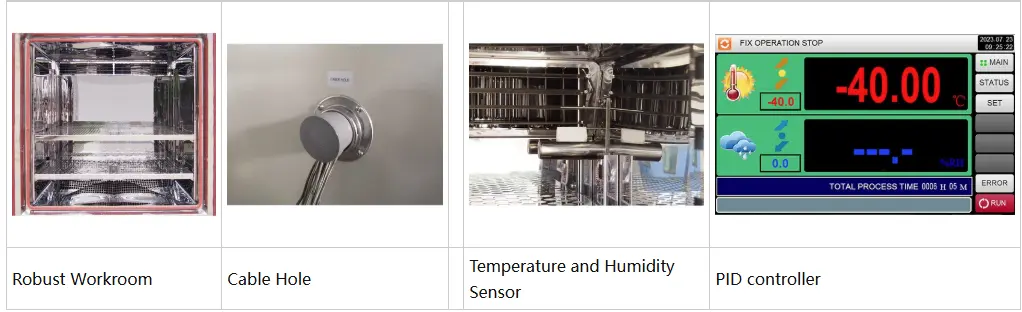
LIB Industry's temperature and humidity cabinets incorporate advanced control architecture maintaining temperature fluctuation within ±0.5°C and humidity deviation under ±2.5%RH across the entire test volume. This exceptional uniformity proves critical for LED testing where localized hot spots or humidity gradients generate misleading results. The programmable color LCD touchscreen controller stores multiple test profiles, enabling seamless transitions between different standard protocols without manual reprogramming. High-precision PT100 Class A sensors providing ±0.001°C resolution ensure compliance with stringent calibration requirements demanded by ISO/IEC 17025 accredited testing laboratories.
External Humidification Innovation
The patented external humidification system addresses persistent challenges plaguing conventional humidity chambers where internal humidifiers contaminate test samples with mineral deposits and require frequent maintenance interrupting long-duration LED aging tests. LIB's design positions the stainless steel surface evaporation humidifier outside the workspace, delivering purified vapor through dedicated ports while preventing scaling within the chamber interior. The automatic water supply system with integrated filtration maintains continuous operation throughout multi-month LM-80 testing campaigns without operator intervention, dramatically improving testing throughput and reducing contamination-related test invalidations.
Energy-Efficient Refrigeration Architecture
Extended LED reliability testing spanning thousands of hours generates substantial energy consumption, making operational efficiency a significant economic consideration. LIB Industry temperature and humidity cabinets employ electronic expansion valve (EEV) technology that precisely meters refrigerant flow based on real-time thermal load, reducing energy consumption by 20-30% compared to conventional hot-gas bypass systems. Premium French TECUMSEH compressors ensure reliable continuous operation throughout multi-year service intervals, while the optimized refrigeration circuit achieves 1°C/min cooling rates enabling rapid transitions during thermal shock protocols without excessive refrigeration capacity investment.
Comprehensive Safety and Monitoring Features
LED battery-integrated emergency lighting and automotive applications introduce lithium-ion battery testing requirements within environmental chambers, creating potential safety hazards from thermal runaway scenarios. LIB Industry chambers incorporate multiple safety provisions including over-temperature protection, refrigerant high-pressure monitoring, and earth leakage detection. Optional battery testing safety packages add smoke detection, pressure relief ports, and exhaust gas management systems. Ethernet connectivity enables remote monitoring of chamber conditions, automated data logging supporting regulatory documentation requirements, and integration with laboratory information management systems (LIMS) streamlining quality assurance workflows in high-volume LED manufacturing environments.
Conclusion
Environmental simulation through precision temperature and humidity cabinets has evolved from optional validation activity to mandatory infrastructure supporting LED product development, qualification, and continuous improvement initiatives. These sophisticated test systems reveal moisture-induced failure mechanisms, validate design improvements, and generate quantitative reliability data demanded by competitive lighting markets. As LED technology advances toward longer warranted lifetimes and expanded application environments, environmental testing capabilities become increasingly critical differentiators between manufacturers delivering truly reliable products versus those making unsupported longevity claims.
FAQ
What temperature and humidity conditions best replicate outdoor LED fixture operating environments?
Outdoor LED testing typically employs 85°C/85%RH for 1000-hour minimum durations, representing accelerated tropical conditions. Supplemental thermal cycling between -40°C and +85°C with periodic condensation exposure at 95%RH during cooling transitions provides comprehensive environmental qualification matching field deployment conditions.
How do environmental chambers validate LED color stability over product lifetime?
Chambers enable controlled humidity and temperature exposure while specimens remain powered, allowing periodic spectroradiometric measurement tracking color coordinate shifts (Δu'v'), correlated color temperature drift, and color rendering index degradation. These measurements generate objective color maintenance data supporting manufacturer specifications and warranty claims.
Can temperature and humidity testing predict actual LED product lifespan?
Accelerated testing establishes failure mechanisms and comparative durability between designs but requires statistical modeling to translate chamber results into field lifetime predictions. Arrhenius relationships and humidity acceleration factors derived from multi-condition testing enable scientifically defensible lifetime projections when properly calibrated against field return data.
What chamber size accommodates complete LED luminaire testing versus component-level validation?
Complete luminaire testing requires chamber volumes matching fixture dimensions - 800L to 1000L chambers accommodate most commercial downlights and linear fixtures, while custom walk-in chambers become necessary for large architectural or street lighting assemblies. Component testing of LED packages requires only 100L to 225L chambers, optimizing footprint for research laboratories.
Elevate your LED product reliability through advanced environmental testing solutions from LIB Industry, a trusted temperature and humidity cabinet manufacturer and supplier serving global lighting manufacturers. Our engineering team provides customized chamber configurations, application-specific test protocol development, and ongoing technical support ensuring your LED products meet the highest reliability standards. Contact us at ellen@lib-industry.com to discuss your environmental testing requirements and discover how our chambers accelerate your path to market-leading LED product quality.