How Thermal Shock Testing Improves Battery Safety Performance?
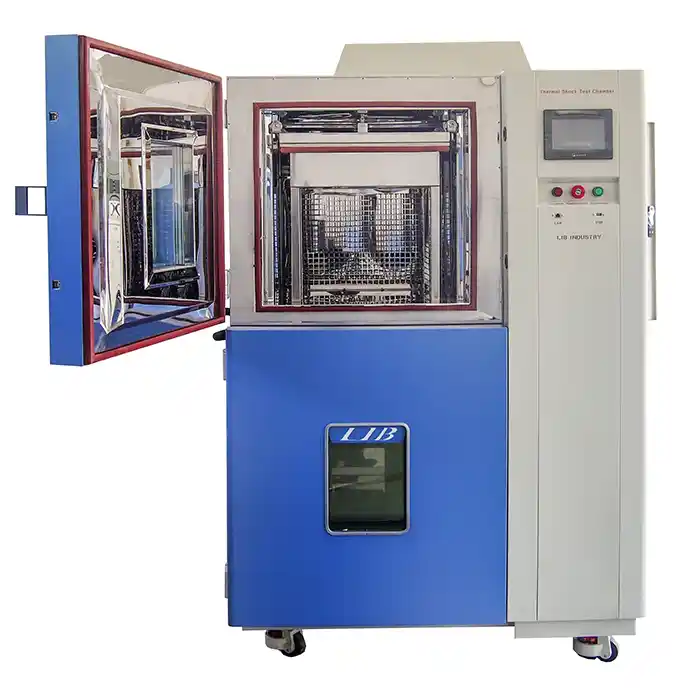
Thermal shock testing improves battery safety performance by exposing cells, modules, and pack assemblies to rapid temperature transitions that reveal hidden structural weaknesses, material incompatibilities, and sealing deficiencies. Inside a thermal shock test chamber, batteries endure abrupt shifts between extreme cold and intense heat - often spanning from -70°C to +200°C - with recovery times under five minutes. This accelerated thermal stress replicates years of real-world temperature fluctuations in compressed timeframes, forcing latent defects to manifest before batteries reach consumers. Engineers use the resulting data to refine electrode bonding, optimize enclosure sealing, strengthen tab connections, and validate electrolyte stability. The outcome is a battery product with verified resilience against the thermal extremes encountered during charging, discharging, storage, and transportation.
A Russian aerospace testing facility recently integrated our thermal shock chamber into their reliability assessments. Using the thermal shock chamber’s extreme temperature swings from -70°C to +200°C, their engineers were able to simulate the rapid thermal stresses experienced during high-altitude flights. This revealed micro-cracks and joint weaknesses in turbine components that conventional tests had failed to detect. The team highlighted that the chamber runs steadily with minimal intervention, providing dependable, repeatable results that have become critical in optimizing component designs and ensuring mission-critical safety.

Why Batteries Are Sensitive to Rapid Temperature Changes?
Electrochemical Reactions and Temperature Dependence
Lithium-ion battery performance hinges on electrochemical kinetics that fluctuate dramatically with temperature. At elevated temperatures, reaction rates accelerate and side reactions produce gas buildup inside sealed cells. At sub-zero conditions, lithium plating on the anode becomes a genuine concern. Rapid transitions between these extremes amplify chemical instability, making batteries uniquely vulnerable to sudden thermal shifts that most passive mechanical components would tolerate without incident.
Multilayer Material Architecture
Modern battery cells consist of thin, layered structures - copper and aluminum current collectors, coated electrode films, porous polymer separators, and liquid or gel electrolytes. Each layer exhibits a distinct coefficient of thermal expansion (CTE). When temperature changes occur gradually, these layers accommodate dimensional shifts. Abrupt transitions generate differential expansion rates across adjacent materials, introducing interfacial shear stresses that accumulate with each thermal cycle and eventually compromise structural cohesion.
Real-World Exposure Scenarios
Batteries in electric vehicles, aerospace systems, and portable electronics routinely encounter harsh thermal transients. A parked vehicle absorbing solar radiation can expose its battery pack to +60°C before air conditioning engagement drops cabin temperatures precipitously. Aircraft cargo holds cycle between ground-level heat and sub-zero cruising altitudes. These operational realities demand rigorous pre-deployment validation using controlled thermal shock simulation.
Thermal Stress Impact on Battery Cells and Module Structures
Electrode Delamination and Active Material Loss
Repeated thermal shocks weaken the adhesive bond between active electrode coatings and their metallic substrates. As layers expand and contract at mismatched rates, micro-cracks propagate through the coating matrix. Active material particles detach from the current collector surface, reducing available capacity and increasing internal resistance. This degradation pattern - invisible during visual inspection - is reliably detected through post-thermal-shock electrochemical impedance measurements.
Separator Integrity Under Thermal Cycling
The polymer separator membrane serves as the sole physical barrier preventing internal short circuits between anode and cathode. Thermal stress induces shrinkage, wrinkling, and pinhole formation in these ultra-thin films. A compromised separator allows direct electrode contact, triggering localized heating that can cascade into thermal runaway. Thermal shock testing identifies separator materials and thicknesses that maintain dimensional stability across the full operational temperature envelope.
Welded Tab and Busbar Connection Fatigue
Battery modules rely on ultrasonic or laser-welded tab connections between individual cells and busbar conductors. These joints experience concentrated thermal stress due to geometry changes at weld interfaces. Cyclic expansion and contraction fatigue these connections, increasing electrical resistance at the joint. Elevated joint resistance generates localized hotspots during high-current discharge events - a failure mode that thermal shock qualification testing is specifically designed to uncover before module integration.
Safety Risks Caused by Thermal Expansion and Material Degradation
.jpg "blog-1-1")
Electrolyte Leakage from Seal Failures
Battery cells and modules depend on hermetic sealing to contain flammable organic electrolytes. Gasket materials, adhesive bonds, and crimped seals undergo dimensional changes during thermal excursions. When sealing compounds lose elasticity or develop micro-fractures after repeated thermal cycles, electrolyte vapors escape - creating fire hazards and exposing neighboring components to corrosive fluids. Chamber-based thermal shock testing conducted in a thermal shock machine validates seal longevity under worst-case temperature transition profiles.
Internal Short Circuit and Thermal Runaway Initiation
Material degradation from thermal stress creates pathways for internal short circuits. Separator damage, electrode particle migration, and conductive dendrite growth each contribute to this risk. Once an internal short develops, localized Joule heating raises cell temperature beyond the thermal runaway threshold - typically between 130°C and 200°C depending on cell chemistry. Identifying cells prone to these failure cascades through pre-deployment thermal shock evaluation prevents catastrophic field incidents.
Housing Deformation and Structural Compromise
Prismatic and pouch cell housings undergo measurable dimensional changes during thermal cycling. Aluminum prismatic cans bulge under internal gas pressure amplified by elevated temperatures. Pouch cell laminate edges delaminate when adhesive layers soften and re-solidify repeatedly. These structural deformations compromise the mechanical constraints that keep cell stacks under compression - a critical parameter for maintaining consistent electrochemical contact and preventing internal displacement of battery components.
|
Risk Category |
Root Cause |
Potential Consequence |
|
Electrolyte Leakage |
Seal and gasket degradation |
Fire hazard, corrosion damage |
|
Internal Short Circuit |
Separator damage, dendrite growth |
Thermal runaway, cell venting |
|
Capacity Fade |
Electrode delamination |
Reduced range, premature replacement |
|
Connection Failure |
Weld joint fatigue |
Hotspots, module-level failure |
|
Housing Deformation |
CTE mismatch, gas generation |
Loss of compression, displacement |
Thermal Shock Test Chambers for Battery Reliability Validation
Rapid Temperature Transition Capability
A thermal shock test chamber engineered for battery evaluation must achieve extreme temperature transitions within tightly defined timeframes. Chambers operating from -70°C to +200°C with temperature recovery times within five minutes generate the abrupt thermal gradients required by battery qualification protocols. The specimen basket transfers automatically between hot and cold compartments along a vertical rail system, ensuring consistent transition timing across every cycle - eliminating operator variability from the test sequence.
Applicable Battery Testing Standards
Multiple international standards mandate thermal shock evaluation for batteries. UN 38.3 (Transport of Dangerous Goods) prescribes thermal cycling between +75°C and -40°C for lithium battery transport classification. IEC 62660-2 specifies reliability testing for EV battery cells. UL 2580 addresses battery safety for electric vehicle applications. Each standard defines unique temperature ranges, dwell times, and cycle counts - requiring chambers with programmable controllers capable of storing and executing diverse test profiles with precision.
Chamber Sizing for Cell, Module, and Pack Testing
Battery specimens range from small coin cells weighing grams to full battery packs exceeding 50 kg. Matching chamber capacity to specimen dimensions and mass is essential for maintaining accurate temperature profiles. Compact chambers with 22L interior volumes accommodate individual cells and small modules, while larger 505L units handle substantial pack assemblies with loading capacities up to 60 kg.
|
Model |
TS-162 |
TS-340 |
TS-500 |
TS-1000 |
|
Internal Dimensions (mm) |
300×300×250 |
450×450×360 |
650×650×500 |
850×850×700 |
|
Interior Volume |
22L |
72L |
211L |
505L |
|
Loading Capacity |
20 kg |
30 kg |
50 kg |
60 kg |
|
Temperature Range |
-70°C to +220°C |
-70°C to +220°C |
-70°C to +220°C |
-70°C to +220°C |
|
Recovery Time |
Within 5 min |
Within 5 min |
Within 5 min |
Within 5 min |
Testing Battery Enclosures, Connectors, and Sealing Components
Enclosure Thermal Integrity Assessment
Battery enclosures fabricated from aluminum alloys, engineering plastics, or composite materials must maintain dimensional stability across temperature extremes. Thermal shock testing in a thermal shock testing machine reveals warping, cracking, and fastener loosening that compromise IP-rated dust and moisture protection. Engineers evaluate post-test enclosures for gap formation at mating surfaces, thread engagement loss in mounting hardware, and coating adhesion degradation - each representing a potential ingress pathway for moisture and contaminants during field service.
Connector and Terminal Reliability Under Thermal Cycling
High-voltage connectors and terminal blocks within battery systems carry substantial currents. Thermal expansion mismatch between connector housing materials, metal contact pins, and sealing O-rings can create intermittent connections and arc-generating air gaps. Chamber-based cycling quantifies contact resistance changes across hundreds of thermal transitions, identifying connector designs vulnerable to resistance drift - a precursor to overheating failures in operational battery management systems.
Gasket and Adhesive Bond Validation
Silicone gaskets, polyurethane sealants, and structural adhesives form the sealing boundaries of battery assemblies. These polymeric materials exhibit viscoelastic behavior that changes dramatically across the thermal spectrum. Compression set, hardening, and adhesion loss become apparent after accelerated thermal shock cycling. Test data guides material selection decisions, helping engineers choose sealing compounds that retain elasticity and bond strength throughout the battery's projected 10-to-15-year automotive service life.
Improving Battery Safety and Lifecycle Stability Through Testing
Early-Stage Defect Screening
Thermal shock testing functions as an effective screening tool during incoming quality inspection. Cells that contain manufacturing defects - insufficient electrolyte filling, contaminated electrode surfaces, or inconsistent separator coating - tend to fail earlier under thermal stress than defect-free units. Implementing thermal shock screening at receiving inspection prevents defective cells from entering module assembly lines, reducing downstream scrap rates and avoiding costly pack-level rework.
Design Iteration and Material Optimization
Each round of thermal shock testing generates measurable failure data that feeds directly into design improvements. Engineers correlate crack locations with stress concentration features, match delamination patterns to adhesive cure parameters, and relate capacity fade rates to electrode formulation adjustments. This empirical loop - test, analyze, modify, retest - progressively hardens battery designs against thermal stress until qualification targets are met consistently across production lots.
Warranty Period Reliability Prediction
Automotive battery warranties spanning 8 to 10 years demand confidence in long-term durability. Accelerated thermal shock cycling compresses decades of seasonal temperature variation into weeks of laboratory testing. By correlating accelerated test cycles to equivalent field exposure using Arrhenius-based modeling and Coffin-Manson fatigue analysis, engineers generate quantitative reliability predictions that support warranty commitments with data-backed assurance rather than speculative estimates.
Ensuring Thermal Stability with Uniform Airflow Distribution - LIB Industry
|
|
|
|||||||||
|
Model |
TSI-038 |
|||||||||
|
Basket Useful Dimensions (mm) |
2400*1200*1300 D*W*H |
|||||||||
|
Salt Water Tank Dimensions (mm) |
3000*2000*1600 D*W*H |
|||||||||
|
Overall Dimension (mm) |
3600*2800*3800 D*W*H |
|||||||||
|
Loading Capacity |
200 kg |
|||||||||
|
Parameters |
Pre-heat Room |
Upper limit Temperature |
+220℃ |
|||||||
|
Heating Time |
Ambient ~ + 180℃, within 30 minutes |
|||||||||
|
Splash Water |
Splash Water Temperature |
0 to +4 ℃ (Adjustable) |
||||||||
|
Cycle Duration |
30 minutes |
|||||||||
|
Splash Nozzle |
Water Flow Rate |
3 to 4 liters per splash nozzle |
||||||||
| Number |
4 pieces |
|||||||||
|
Distance between nozzle and DUT |
300 to 350 mm |
|||||||||
|
Splashing Time |
3 seconds |
|||||||||
|
Number of cycles |
100 |
|||||||||
| Controller | Programmable color LCD touch screen controller | |||||||||
| Cooling system | Mechanical compression refrigeration system | |||||||||
| Exterior material | A3 Steel Plate with protective coating | |||||||||
| Viewing window | Interior lighting , double-layer thermo stability silicone rubber sealing | |||||||||


|
|
|
|
Test Basket |
The Controller |
|
|
|
|
Cable Hole |
Castor |


Precision Temperature Control Across the Test Volume
LIB Industry's thermal shock test chambers employ mechanical compression refrigeration systems with French TECUMSEH compressors and environmentally friendly refrigerants to achieve temperature uniformity of ≤±3°C deviation across the working volume. Temperature fluctuation is held within ≤±0.5°C during soak periods. Programmable color LCD touch screen controllers with Ethernet connectivity enable remote monitoring and multi-profile test sequencing, giving battery engineers complete command over complex qualification protocols without manual intervention.
Versatile Specimen Handling and Access
The vertical basket transfer mechanism moves specimens smoothly between hot and cold compartments along precision rails, completing transitions within five minutes. Standard cable hole diameters of 50mm, 100mm, and 200mm - located on the basket itself - allow instrumented specimens to remain connected to external data acquisition systems throughout the test. Double-layer silicone rubber sealed observation windows with interior LED lighting provide continuous visual monitoring without compromising chamber thermal integrity.
Comprehensive Safety Architecture and Global Support
LIB chambers integrate over-temperature protection, over-current protection, refrigerant high-pressure cutoff, and earth leakage safeguards - essential when testing lithium batteries that carry inherent thermal runaway risks. SUS304 stainless steel interiors resist corrosion from any outgassing events. LIB Industry provides turnkey solutions encompassing research, design, production, commissioning, delivery, installation, and operator training, backed by a dedicated global service network.
|
Feature |
Specification |
Battery Testing Benefit |
|
Temperature Range |
-70°C to +220°C |
Covers all major battery test standards |
|
Temperature Fluctuation |
≤±0.5°C |
Ensures repeatable soak conditions |
|
Temperature Deviation |
≤±3°C |
Uniform exposure across entire specimen |
|
Heating Time |
Ambient to +200°C within 30 min |
Rapid chamber conditioning |
|
Cooling Time |
Ambient to -70°C within 30 min |
Efficient cold zone preparation |
|
Recovery Time |
Within 5 min |
Meets stringent transition requirements |
Conclusion
Thermal shock testing occupies a central role in battery safety engineering, exposing vulnerabilities in cell chemistry, module structures, sealing systems, and electrical connections that remain invisible under steady-state evaluation. By subjecting batteries to controlled rapid temperature transitions inside purpose-built chambers, manufacturers detect defects early, refine designs iteratively, and build quantitative reliability cases that support long-term warranty commitments. As electrification accelerates across automotive, aerospace, and energy storage sectors, the demand for precise, repeatable thermal shock qualification infrastructure will continue to expand - making chamber selection a strategic decision with direct implications for product safety, regulatory compliance, and brand reputation.
FAQ
What temperature range is required for battery thermal shock testing?
Most battery standards require thermal shock cycling between -40°C and +75°C, though chambers capable of -70°C to +200°C accommodate broader qualification protocols including material-level and component-level aerospace and automotive evaluations.
How quickly should temperature transitions occur during battery testing?
Leading thermal shock test chambers achieve full temperature recovery within five minutes. This rapid transition generates the steep thermal gradients necessary to reveal material weaknesses, seal failures, and connection fatigue in battery assemblies.
Can thermal shock chambers test fully assembled battery packs?
Yes. Larger chambers with interior volumes up to 505L and loading capacities reaching 60 kg accommodate assembled battery packs. Cable access holes allow continuous electrical monitoring throughout the thermal cycling process.
Need a dependable thermal shock test chamber for your battery qualification program? LIB Industry is a professional manufacturer, supplier, and factory delivering complete environmental testing solutions customized to your specifications. Contact us at ellen@lib-industry.com to discuss your requirements.