Automotive exterior lighting systems face relentless environmental challenges that can compromise both safety and performance. JIS D 0203 R1 R2 rain test equipment provides manufacturers with a rigorous evaluation platform to simulate real-world water exposure conditions, ensuring headlamps, tail lights, and auxiliary lighting assemblies maintain their sealing integrity throughout their service life. This specialized testing apparatus replicates precipitation patterns ranging from light drizzle to heavy downpours, exposing potential vulnerabilities in gasket materials, lens bonding, and housing construction before products reach the marketplace. By subjecting lighting components to controlled water ingress scenarios, manufacturers can identify design weaknesses, validate protective measures, and deliver products that withstand years of harsh weather exposure.
The Critical Impact of Water Ingress on Automotive Lighting Systems
Optical Performance Degradation Through Moisture Penetration
When water breaches the protective barriers of automotive lighting assemblies, it creates a catastrophic chain reaction affecting illumination quality. Condensation forms on internal reflective surfaces, scattering light beams and reducing effective road visibility by up to 40%. The moisture acts as a refractive interference layer between LED modules and optical lenses, distorting beam patterns that engineers carefully calibrated for regulatory compliance. This degradation doesn't occur uniformly - localized water accumulation creates uneven lighting distribution that confuses oncoming drivers and diminishes the vehicle operator's perception of road hazards.
Electrical Circuit Corrosion and Short-Circuit Risks
Moisture intrusion initiates electrochemical reactions that rapidly degrade electrical connections within lamp assemblies. Copper conductors develop verdigris oxidation, increasing resistance and creating heat concentration points that accelerate component failure. Water contamination in LED driver circuits causes leakage currents that drain vehicle batteries and trigger sporadic lighting malfunctions. The presence of dissolved minerals in infiltrating water creates conductive pathways between terminals, potentially causing complete circuit failures during critical driving situations.
Structural Integrity Compromise of Housing Materials
Repeated wet-dry cycles subject polycarbonate lenses and ABS housings to dimensional stresses that manifest as micro-fractures. Water absorption causes polymer matrices to swell, weakening molecular bonds and reducing impact resistance by measurable percentages. The thermal expansion differential between wet and dry states creates internal stresses at bonding interfaces, particularly where dissimilar materials join. These structural vulnerabilities compound over time, transforming minor sealing imperfections into catastrophic failures that necessitate complete assembly replacement.
Why Are Headlight Enclosures Highly Susceptible to Moisture Accumulation?
Complex Geometries Creating Condensation Traps
Modern automotive lighting designs incorporate intricate internal structures that inadvertently create moisture accumulation zones. Multi-reflector systems and projection lens assemblies feature numerous concealed surfaces where temperature differentials promote condensation. Ventilation pathways designed to equalize pressure often include tortuous passages that trap humid air, allowing water vapor to condense on cooler internal components. The aesthetic demand for sleek, sculpted lighting profiles forces compromises in drainage path design, leaving manufacturers struggling to balance visual appeal with functional water management.
Temperature Cycling Inducing Pressure Variations
Headlight assemblies experience dramatic temperature fluctuations between operational heating and ambient cooling cycles. High-intensity discharge lamps and LED modules generate substantial thermal energy, creating internal pressure increases that expel air through breathing vents. When these components deactivate, rapid cooling creates negative pressure that draws external moisture-laden air into the enclosure. This respiratory effect becomes particularly problematic during rain events following extended driving periods, effectively pumping water vapor past protective membranes designed only to resist direct liquid intrusion.
Material Interface Vulnerabilities in Bonded Assemblies
Contemporary headlight construction relies on adhesive bonding rather than mechanical fastening to achieve seamless aesthetics. These bonded joints between polycarbonate lenses and thermoplastic housings represent the primary vulnerability for water penetration. Ultraviolet radiation degrades adhesive polymers, creating microscopic separation channels that capillary action exploits during precipitation exposure. Thermal expansion mismatches between dissimilar materials generate cyclical stress concentrations that progressively weaken bonding integrity, particularly at geometric transition points where stress amplification occurs.
Targeted Spray Testing Protocols for Exterior Lamp Assemblies
JIS D0203 R1 Low-Intensity Rain Simulation
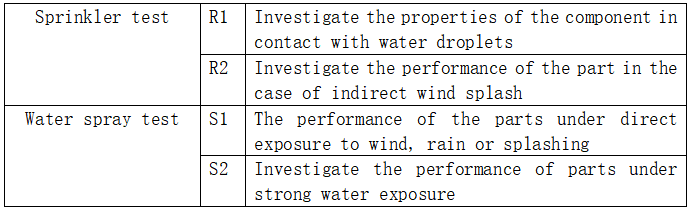
The R1 protocol in a rain test chamber delivers 1.9 liters per minute through precision-calibrated nozzles positioned approximately 400 mm from test specimens. This configuration replicates gentle rainfall conditions that vehicles encounter during the majority of precipitation events. The test duration extends for predetermined periods while the turntable rotates at 17 revolutions per minute, ensuring uniform exposure across all enclosure surfaces. This methodology identifies sealing deficiencies that might escape detection under high-pressure testing yet cause progressive failures during extended real-world exposure.
|
Test Parameter |
R1 Specification |
Testing Objective |
|
Water Flow Rate |
1.9 L/min |
Simulate light rain conditions |
|
Nozzle Distance |
400mm approx. |
Replicate natural droplet impact |
|
Rotation Speed |
17 rpm |
Ensure comprehensive coverage |
|
Nozzle Configuration |
2 holes, Φ0.5mm |
Control droplet size distribution |
JIS D0203 R2 High-Volume Precipitation Testing
The R2 variant intensifies water delivery to 3.3 liters per minute, representing heavy downpour scenarios that challenge sealing systems under extreme conditions. This elevated flow rate increases hydrostatic pressure at potential entry points while overwhelming drainage pathways that might adequately handle lighter precipitation. The identical nozzle positioning maintains consistency with R1 testing, allowing direct performance comparison across varying precipitation intensities. Manufacturers utilize R2 results to validate design margins and confirm that protective measures exceed minimum performance thresholds.
Spray Nozzle Protocols S1 and S2 for Dynamic Exposure
Beyond standard rain simulation, the equipment incorporates spray testing capabilities delivering 24.5 L/min (S1) and 39.2 L/min (S2) through 40-hole nozzles with 1.2mm apertures. These configurations replicate high-velocity water impingement from road spray, vehicle washing, and storm-driven precipitation. The pressurized delivery system maintains adjustable pressure ranges between 0.03 and 0.30 MPa, enabling precise simulation of varied environmental conditions. This comprehensive testing approach reveals vulnerabilities that single-mode evaluation might overlook.
|
Test Mode |
Flow Rate |
Nozzle Configuration |
Application Scenario |
|
R1 Rain |
1.9 L/min |
2×Φ0.5mm |
Standard rainfall |
|
R2 Rain |
3.3 L/min |
2×Φ0.5mm |
Heavy precipitation |
|
S1 Spray |
24.5 L/min |
40×Φ1.2mm |
Road splash conditions |
|
S2 Spray |
39.2 L/min |
40×Φ1.2mm |
Extreme water impingement |
How Do JIS D 0203 R1 R2 Tests Expose Micro-Cracks and Gasket Weaknesses?
Prolonged Exposure Revealing Capillary Penetration Paths
Extended testing durations allow water molecules to exploit microscopic imperfections invisible to visual inspection. Capillary action draws moisture through hairline fractures measuring mere microns in width, gradually accumulating internal condensation that betrays these hidden flaws. The continuous application of water maintains hydrostatic pressure gradients that force penetration through defects that intermittent exposure would never reveal. Time-dependent testing protocols distinguish between catastrophic sealing failures and progressive degradation mechanisms requiring different corrective approaches.
Pressure Differential Identification Through Flow Pattern Analysis
The rotating turntable combined with stationary spray nozzles creates varying water impingement angles that reveal directional sealing vulnerabilities. Gasket compression irregularities become apparent when water penetrates from specific orientations while remaining sealed against others. This angular sensitivity indicates assembly tolerances issues or design features that create preferential leak paths. Engineers analyze penetration patterns to identify whether failures stem from material inadequacies, geometric design flaws, or manufacturing process inconsistencies.
Thermal Cycling Integration Accelerating Material Fatigue
Advanced testing protocols incorporate temperature variations during water exposure, replicating the thermal shock conditions occurring when hot lamp assemblies encounter cold rainfall. The JIS D 0203 R1 R2 rain test equipment from LIB Industry features programmable environmental control enabling simultaneous thermal and water exposure evaluation. This combined stress testing accelerates material aging processes, compressing months of field exposure into hours of laboratory evaluation. Elastomeric gaskets subjected to these conditions reveal embrittlement tendencies and compression set characteristics that predict long-term sealing performance.
Thermal Shock and Condensation Evaluation During Continuous Rain Exposure
Temperature Gradient Effects on Internal Atmosphere Saturation
When cold rainwater contacts heated lamp housings, it creates steep temperature gradients across enclosure walls that drive complex moisture dynamics. The exterior surface cooling causes internal air temperatures to drop, reducing the atmosphere's moisture-carrying capacity and forcing water vapor condensation on interior surfaces. This phenomenon occurs independently of whether external water penetrates sealing barriers, creating the perception of leakage when gaskets remain functionally intact. Testing protocols using a rain test machine must distinguish between actual seal failures and condensation artifacts to avoid unnecessary design modifications.
Breathing Vent Performance Under Wet Conditions
Pressure equalization membranes incorporated into modern lighting assemblies must maintain breathability while preventing liquid water ingress. The JIS D 0203 R1 R2 rain test equipment evaluates these critical components by subjecting them to sustained water exposure while monitoring internal pressure fluctuations. Membrane contamination by water-borne particles can dramatically reduce air permeability, causing pressure imbalances that stress seals and draw moisture past protective barriers. Testing reveals whether vent designs maintain functionality when exposed to the contaminated water conditions encountered in real-world service.
Material-Specific Thermal Response Characteristics
Different housing materials exhibit unique thermal expansion coefficients that influence sealing performance during temperature transitions. Polycarbonate lenses expand at rates differing from ABS housings, creating dimensional mismatches at bonded interfaces during thermal cycling. The water spray cooling effect amplifies these differentials beyond what dry thermal testing reveals, exposing vulnerabilities specific to wet operating conditions. Manufacturers utilize this data to select material combinations that minimize thermally-induced stress concentrations at critical sealing locations.
Can Advanced Rain Testing Prevent Catastrophic Illumination Failures on the Road?
Predictive Failure Analysis Through Accelerated Exposure
Comprehensive testing protocols compress years of environmental exposure into condensed evaluation periods, revealing failure modes before market introduction. The controlled laboratory environment enables precise monitoring impossible in field testing, capturing subtle performance degradation that precedes catastrophic failures. Engineers correlate test results with failure mechanism models to predict service life under various climate conditions. This predictive capability transforms reactive warranty responses into proactive design optimization, reducing field failures by addressing vulnerabilities during development phases.
Regulatory Compliance Verification for Global Markets
Automotive lighting systems must satisfy stringent ingress protection requirements codified in international standards including IEC 60529 and ISO 20653. The JIS D 0203 R1 R2 rain test equipment provides documented evidence of compliance through traceable testing procedures and calibrated instrumentation. Certification authorities require third-party validation of water resistance claims, necessitating testing equipment that meets metrological standards. LIB Industry chambers receive CE certification and undergo SGS and TUV evaluation, ensuring test results withstand regulatory scrutiny across global markets.
Quality Assurance Integration in Manufacturing Operations
Beyond design validation, rain testing serves critical quality control functions in production environments. Statistical sampling of manufactured assemblies detects process variations that compromise sealing integrity, preventing defective products from reaching customers. Automated testing systems interface with manufacturing execution systems to track individual unit performance and trigger corrective actions when results deviate from specifications. This closed-loop quality management approach maintains consistent production standards while documenting compliance for traceability requirements.
Consistent Water Flow Ensuring Long-Term Seal Integrity - LIB Industry
 |
 |
Arc-Shaped Nozzle ArrangementPrecision Flow Control Systems Maintaining Test Repeatability
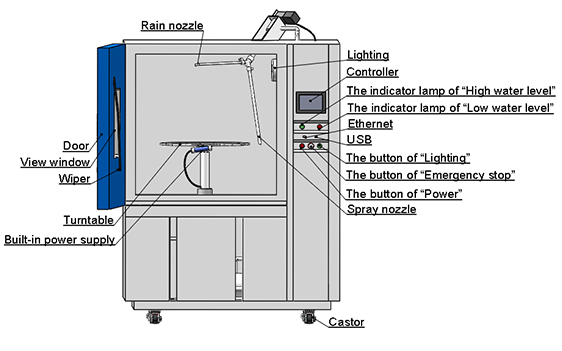
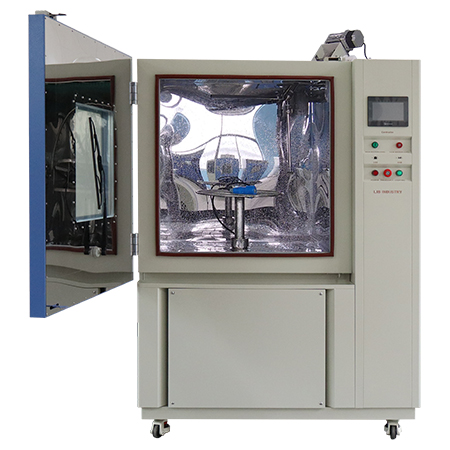
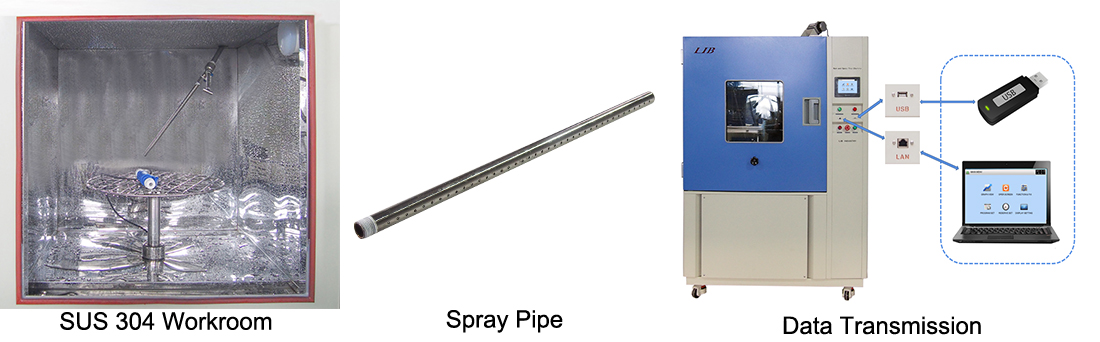
The JIS D 0203 R1 R2 rain test equipment incorporates sophisticated flow metering technology that maintains water delivery accuracy within tight tolerances throughout extended testing campaigns. Programmable color LCD touchscreen controllers enable operators to establish precise test parameters and monitor real-time performance metrics including pressure, flow rate, and rotation speed. Ethernet connectivity facilitates remote monitoring and data logging for comprehensive documentation that satisfies quality management system requirements. This automation eliminates operator variability that introduces uncertainty in manual testing procedures.
Multi-Stage Filtration Protecting Nozzle Calibration Accuracy
The advanced water purification system removes particulate contamination that would otherwise compromise spray pattern consistency. Nozzle blockages caused by mineral deposits or debris particles create flow irregularities that invalidate test results and necessitate frequent recalibration. The closed-loop circulation design incorporates progressive filtration stages that maintain water quality while reducing consumption through recycling. This eco-friendly approach delivers operational cost savings while ensuring environmental sustainability in testing operations.
Durable Construction Materials Resisting Corrosion Degradation
LIB Industry constructs chamber interiors from SUS304 stainless steel that withstands continuous water exposure without corrosion or contamination. The material selection prevents rust particles from depositing on test specimens and creating false failure indications. Sealed electrical connections maintain safety during testing of powered lighting assemblies, eliminating shock hazards and enabling realistic operational evaluation. The robust rotating platform handles diverse specimen sizes and weights with consistent performance, accommodating everything from compact auxiliary lamps to complete headlight assemblies.
|
Component |
Specification |
Performance Benefit |
|
Interior Material |
SUS304 Stainless Steel |
Corrosion resistance, contamination prevention |
|
Control System |
Programmable LCD touchscreen |
Precise parameter control, data logging |
|
Water Circulation |
Closed-loop with filtration |
Reduced consumption, consistent quality |
|
Turntable |
SUS304 construction, 17 rpm |
Uniform exposure, accommodates varied specimens |
|
Safety Features |
Over-temp, over-current, water shortage, earth leakage protection |
Operator safety, equipment longevity |
Conclusion
Exterior automotive lighting durability depends fundamentally on rigorous water ingress evaluation using calibrated JIS D 0203 R1 R2 rain test equipment. These sophisticated systems replicate precipitation conditions ranging from gentle rainfall to intense storms, exposing sealing vulnerabilities that field testing cannot reliably identify. LIB Industry's advanced testing solutions combine precision engineering with intelligent automation, delivering repeatable results that support both design validation and manufacturing quality control. Investing in comprehensive rain testing capabilities prevents costly field failures while ensuring regulatory compliance across global markets.
FAQ
What differentiates R1 from R2 testing protocols in JIS D0203 standards?
R1 simulates light rainfall at 1.9 L/min while R2 represents heavy precipitation at 3.3 L/min. Both utilize identical nozzle positioning but different flow rates to evaluate sealing performance across varied precipitation intensities, revealing whether designs include adequate safety margins beyond minimum requirements.
How does spray testing complement standard rain simulation procedures?
Spray modes S1 and S2 deliver high-velocity water impingement replicating road splash and storm-driven precipitation that create different sealing challenges than vertical rainfall. The pressurized delivery at 24.5-39.2 L/min exposes vulnerabilities to dynamic water forces that static rain testing might overlook.
Can testing equipment accommodate complete vehicle headlight assemblies?
The R-1000JIS model features 1000×1000×1000mm internal dimensions suitable for most automotive lighting assemblies. LIB Industry offers customized chamber sizes including 1500L and 2000L capacities for larger components, with engineering support for specialized mounting fixtures ensuring proper specimen orientation during evaluation.
Partner with a Trusted Manufacturer for Your Testing Needs
LIB Industry concentrates on providing turn-key environmental testing solutions encompassing research, design, production, commissioning, delivery, installation, and training. As a leading JIS D 0203 R1 R2 rain test equipment manufacturer and supplier, we deliver customized systems meeting your specific requirements. Contact our technical team at ellen@lib-industry.com to discuss your exterior lighting durability testing applications.