Sand Dust Test Chambers in Automotive Component Durability Testing
Automotive components face relentless exposure to airborne particulates - from highway road dust and construction debris to extreme desert sandstorms and unpaved off-road trails. A sand and dust test chamber replicates these punishing conditions inside a controlled laboratory environment, allowing engineers to evaluate how seals, connectors, sensors, filters, and enclosures withstand prolonged particle ingress. By circulating calibrated talcum powder or fine silica at defined concentrations, wind speeds, temperatures, and humidity levels, these chambers compress months or years of real-world dust exposure into manageable test cycles lasting hours or days. The resulting data reveals vulnerabilities in gasket design, IP-rated housings, and ventilation pathways long before a vehicle reaches production - protecting both brand reputation and end-user safety across global markets.
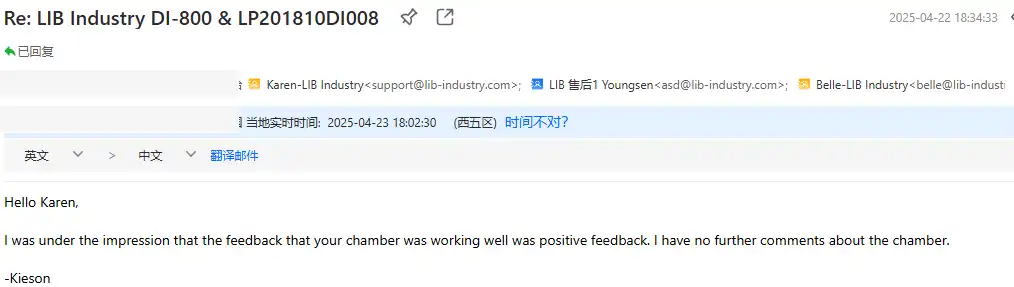
Customers worldwide continue to recognize the performance of our Dust Proof Test Chambers. A lighting manufacturer in the U.S., for example, highlighted that the chamber provided “stable and reliable results” throughout their testing procedures. This real-world feedback emphasizes how our chambers deliver dependable performance for rigorous dust-resistance evaluations. By leveraging these chambers, companies can identify potential design vulnerabilities, optimize product durability, and confidently bring dust-resistant solutions to market that meet both industry standards and end-user expectations.
Which Automotive Components Require Sand and Dust Resistance Testing?
 Exterior Modules Exposed to Airflow
Headlamp assemblies, tail lights, side-mirror housings, and grille-mounted radar units sit directly in the vehicle's slipstream. Dust particles traveling at highway velocity can breach poorly sealed lens joints, depositing films that reduce optical clarity and degrade sensor accuracy. Testing these modules inside a sand and dust test chamber confirms whether gasket compression and adhesive bonds maintain their integrity under sustained particle bombardment.
Under-Hood and Underbody Parts
Engine control units (ECUs), transmission housings, brake calipers, and exhaust heat shields operate in a turbulent zone where tire-generated particulates swirl continuously. Fine dust infiltrating an ECU enclosure can settle on circuit boards, creating conductive bridges that trigger intermittent faults. Underbody fuel lines and wiring harness connectors also demand validation against abrasive particulate intrusion.
Cabin and HVAC Components
Blower motors, cabin air filter housings, and instrument cluster bezels must resist dust migration into the passenger compartment. Particulate ingress through HVAC ductwork degrades indoor air quality and accelerates wear on fan bearings. Chamber testing at controlled concentrations helps engineers optimize filter media grades, seal profiles, and duct joint geometries.
Dust Exposure Risks for Automotive Electrical and Mechanical Systems
Electrical Failures Caused by Particle Contamination
Conductive dust settling across PCB traces can lower insulation resistance, triggering parasitic leakage currents and false signals. Connector pin-and-socket interfaces accumulate particulate films that increase contact resistance over time, leading to voltage drops and intermittent communication faults on CAN bus networks. These failure modes are notoriously difficult to reproduce in the field but straightforward to induce inside a chamber with precise concentration control.
Mechanical Wear and Abrasion
Sand particles - coarser and harder than typical road dust - act as a lapping compound when trapped between sliding surfaces. Window regulators, sunroof tracks, door latch mechanisms, and wiper pivot bearings all experience accelerated wear when abrasive grit invades their lubricant films. A sand and dust chamber capable of wind speeds up to 29 m/s can replicate the aggressive sand entrainment that vehicles encounter during desert operation.
Thermal and Optical Degradation
Dust accumulation on heat sink fins reduces convective cooling efficiency, raising junction temperatures in power electronics modules. On ADAS cameras and LiDAR windows, even a thin particulate layer scatters light, narrowing detection range and undermining autonomous driving algorithms. Quantifying these degradation rates under standardized chamber conditions enables data-driven design countermeasures.
|
Risk Category |
Affected Components |
Typical Failure Mode |
|
Electrical Contamination |
ECUs, connectors, sensors |
Leakage current, signal noise, short circuits |
|
Mechanical Abrasion |
Bearings, tracks, latches |
Accelerated wear, seizure, lubricant degradation |
|
Thermal / Optical |
Heat sinks, cameras, LiDAR |
Overheating, reduced detection range, image blur |
|
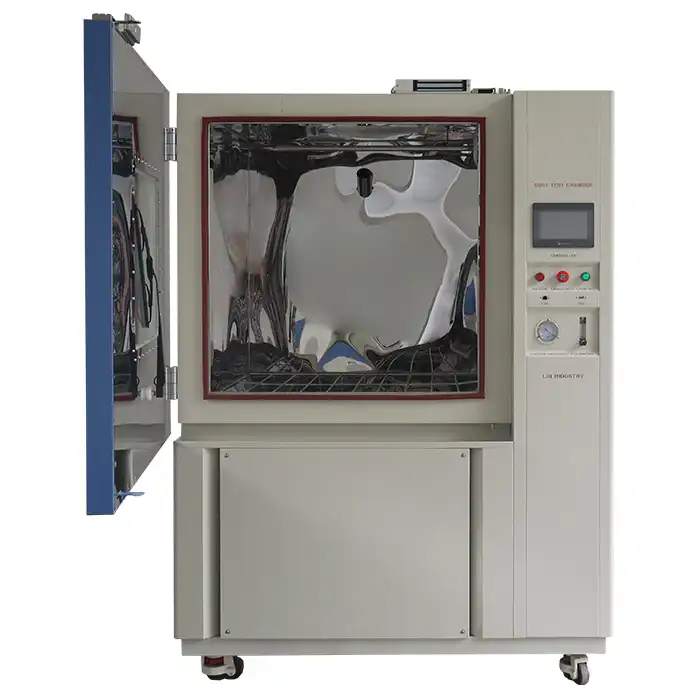
IP5X 6X dust test chamber |
|
Automotive Industry Standards for Sand and Dust Testing
IEC 60529 Ingress Protection Ratings
The IP code - particularly IP5X (dust-protected) and IP6X (dust-tight) - defines the degree to which an enclosure prevents solid particle ingress. IP5X permits limited dust entry that must not interfere with function, while IP6X demands zero ingress after prolonged exposure. A properly equipped sand and dust test chamber maintains the talcum powder concentration, vacuum conditions, and cycle durations specified in IEC 60529 Clause 13.
ISO 20653 for Road Vehicles
ISO 20653 adapts the IEC 60529 framework specifically for automotive applications, adding IPX9K high-pressure wash requirements and refining dust test parameters for vehicle-mounted components. This standard is referenced extensively in OEM engineering specifications from European and Asian automakers.
MIL-STD-810 Method 510
Military Standard 810, Method 510, addresses both blowing dust (fine particles, ≤150 µm) and blowing sand (coarser particles, 150-850 µm) at elevated wind velocities. Although originally a defense specification, many commercial vehicle manufacturers - especially those producing trucks, SUVs, and off-road platforms - adopt MIL-STD-810 procedures to validate components destined for harsh operational theaters.
|
Standard |
Particle Size |
Key Application |
|
IEC 60529 (IP5X/IP6X) |
Talcum powder ≤ 75 µm |
General enclosure ingress protection |
|
ISO 20653 |
Talcum powder ≤ 75 µm |
Road vehicle-specific IP classification |
|
MIL-STD-810 Method 510 |
Dust ≤ 150 µm / Sand 150-850 µm |
Military and heavy-duty vehicle components |
Simulating Road Dust, Desert Sandstorms, and Off-Road Conditions
Replicating Fine Road Dust Environments
Urban and highway driving generates a persistent plume of fine particulates - tire rubber fragments, brake pad residue, mineral fines, and organic matter - typically below 75 µm in diameter. Sand and dust test chamber tests use talcum powder with a nominal wire mesh gap of 75 µm and wire diameter of 50 µm to replicate this particle distribution. Temperature remains at ambient to +50 °C while humidity stays below 30% RH, preventing moisture-induced clumping that would distort particle behavior.
Desert and Arid Region Simulation
Desert environments introduce larger, more abrasive silica particles carried by winds exceeding 20 m/s. Chambers capable of sand-grade testing circulate coarser media at higher velocities, stressing seals, coatings, and surface finishes far beyond what road dust alone would achieve. Reinforced interior walls and protective fan blade coatings prevent chamber degradation during these aggressive cycles.
Off-Road and Construction Site Profiles
Vehicles operating on unpaved logging roads, mining haul routes, or agricultural tracks encounter a broad particle spectrum - from clay-sized fines to gravel chips. Programmable controllers allow engineers to create complex multi-stage profiles that alternate between low-concentration dust soak phases and high-velocity sand blast phases, mirroring the variable exposure a truck or SUV endures across a full duty cycle.
Performance Validation for Sensors, Filters, and Sealed Components
Sensor Window and Lens Testing
ADAS cameras, ultrasonic parking sensors, and rain-light sensors rely on optically clean surfaces to function. Inside the chamber, engineers expose sensor modules to defined dust concentrations and durations, then measure changes in signal strength, detection range, and image contrast. This quantitative approach replaces subjective field observations with traceable laboratory data.
Filter Media Efficiency Evaluation
Cabin air filters, engine air intake filters, and breather elements must balance particulate capture efficiency against airflow restriction. Chamber testing enables gravimetric analysis - weighing the filter element before and after exposure - to calculate dust-holding capacity and pressure drop evolution. These metrics guide filter media selection, pleat geometry optimization, and recommended service intervals.
Sealed Enclosure Integrity Verification
After a full IP6X dust test cycle, technicians open the enclosure and inspect internal surfaces for any trace of particle ingress. Even a few milligrams of talcum powder on internal components constitutes a failure. The chamber's real-time concentration monitoring and anti-clogging vibration mechanisms ensure that the particle challenge remains consistent throughout the test, producing defensible pass/fail results.
Improving Automotive Component Durability Through Environmental Testing
Early Design-Stage Screening
Running prototype seals, gaskets, and snap-fit enclosures through dust exposure early in the development cycle identifies weak points before tooling investments are finalized. Redesigning a gasket groove at the CAD stage costs a fraction of modifying a hardened injection mold after production launch.
Supplier Qualification and Incoming Inspection
OEMs increasingly require tier-one and tier-two suppliers to submit sand and dust test reports alongside PPAP documentation. A chamber on the supplier's own production floor enables self-certification, accelerating approval timelines and reducing the burden on OEM validation laboratories.
Warranty Cost Reduction and Field Reliability
Dust-related warranty claims - foggy headlamps, noisy blower motors, erratic sensor readings - erode profit margins and consumer trust. Systematic chamber testing at end-of-line audit stations catches sealing defects before vehicles ship, compressing warranty claim rates and strengthening long-term brand loyalty.
Precision Control for Long-Term Component Validation - LIB Industry
Turnkey Chamber Solutions
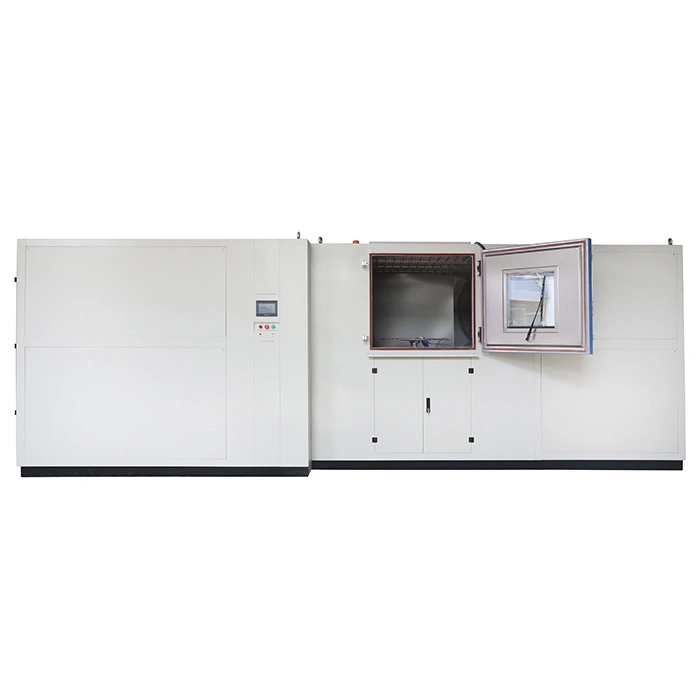
LIB Industry delivers a complete ecosystem covering research, design, manufacturing, commissioning, installation, and operator training. Standard models of sand and dust chambers range from 800 L to 2,000 L, and custom dimensions accommodate oversized assemblies such as complete door modules, bumper fascias, or battery pack enclosures.
|
Model |
Internal Dimensions (mm) |
Useful Volume (L) |
Overall Dimensions (mm) |
|
DI-800 |
800 × 1000 × 1000 |
800 |
1040 × 1450 × 1960 |
|
DI-1000 |
1000 × 1000 × 1000 |
1000 |
1330 × 1450 × 1960 |
|
DI-1500 |
1000 × 1500 × 1000 |
1500 |
1330 × 1950 × 1990 |
|
DI-2000 |
1000 × 2000 × 1000 |
2000 |
1330 × 2450 × 1990 |
 |
 |
|
| Test Area | LAN and USB | Controller |

Advanced Control and Safety Architecture
A programmable color LCD touch-screen controller with Ethernet connectivity supports complex multi-stage test profiles. Electromagnetic door locks, over-temperature protection, over-current cutoff, earth leakage detection, and phase-sequence monitoring safeguard both equipment and operators during unattended long-duration runs. The built-in dustproof LED lighting and observation window with integrated wiper allow real-time visual monitoring without interrupting the test.
Quality Assurance and Global Support
All LIB chambers are manufactured under ISO 9001 quality management protocols and carry CE certification, with independent verification by SGS and TUV. Each unit ships with a 3-year warranty and lifetime technical support. A 24/7 global service network spanning 29 countries ensures rapid response - and complete unit replacement is available if a repair proves impractical during the warranty period.
Conclusion
Sand and dust testing is an indispensable pillar of automotive component durability validation. From fine road particulates that silently degrade electrical connections to coarse desert sand that abrades mechanical surfaces, airborne particles pose risks that only controlled chamber testing can quantify before production. Investing in a well-engineered sand and dust test chamber - one with precise concentration control, multi-standard compliance, and robust safety features - translates directly into fewer warranty claims, stronger supplier partnerships, and vehicles that perform reliably across the world's harshest terrains.
FAQ
What particle size does a sand and dust test chamber use for IP6X testing?
IP6X testing typically uses talcum powder with particles passing through a mesh with 75 µm nominal gap width and 50 µm wire diameter, as specified in IEC 60529 for dust-tight enclosure verification.
Can the chamber test both dust and sand conditions?
Yes. LIB chambers support fine dust testing at lower air velocities and coarse sand testing at wind speeds up to 29 m/s, covering IEC 60529, ISO 20653, and MIL-STD-810 Method 510 requirements.
How long can a sand and dust test run without operator intervention?
The programmable controller allows blowing and flight times up to 99 hours 59 minutes. Safety features including electromagnetic locks, over-temperature protection, and phase-sequence monitoring enable extended unattended operation.
Need a trusted sand and dust test chamber manufacturer and supplier for your automotive testing lab? LIB Industry provides standard and custom environmental testing solutions with global service coverage. Contact us at ellen@lib-industry.com to discuss your project.