JIS Z 2371 Salt Spray Test Chambers for Corrosion Testing
Salt spray testing remains one of the most widely adopted accelerated corrosion evaluation methods across automotive, aerospace, electronics, and marine industries. A JIS Z 2371 salt spray test chamber recreates harsh salt-laden environments inside a controlled enclosure, exposing metal substrates and protective coatings to continuous or cyclic sodium chloride mist. This process compresses years of real-world atmospheric degradation into manageable laboratory timeframes - often hundreds or thousands of hours - so engineers can quantify coating adhesion, anodizing quality, plating integrity, and bare-metal resilience before a product ever reaches the field. Understanding how these chambers work, what the JIS Z 2371 standard demands, and which design features separate mediocre equipment from precision instruments is essential for any quality-assurance team pursuing reliable, data-driven corrosion analysis.
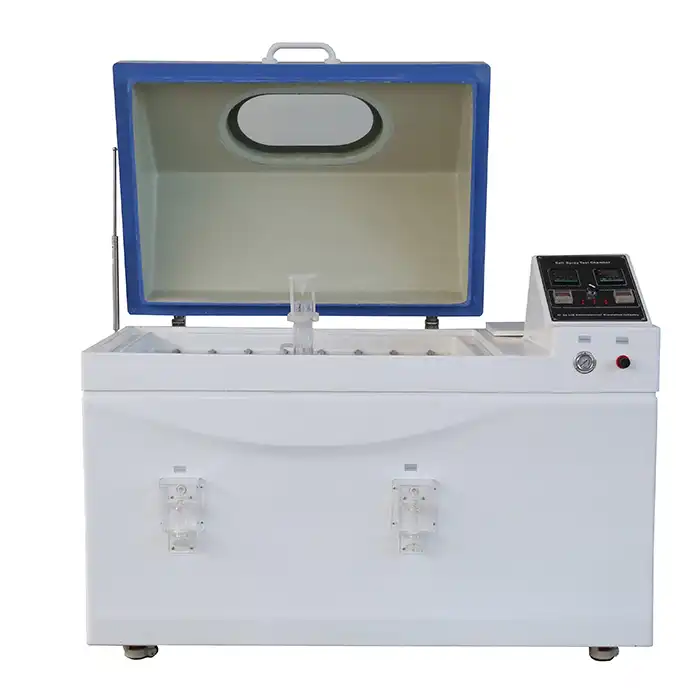
A client in Mexico recently shared their experience using the JIS Z 2371 Salt Spray Test Chamber from LIB industry. They reported that the chamber has been operating smoothly in their lab, providing consistent and reliable corrosion testing results. While a small issue with the saline solution container arose, it was promptly addressed with the guidance from our technical team. The user praised the system for its stability and ease of use, highlighting how a high-quality salt spray chamber like this supports daily testing workflows with confidence and efficiency.

What Is the Purpose of JIS Z 2371 Salt Spray Corrosion Testing?
Defining the Standard's Scope
JIS Z 2371, published by the Japanese Standards Association, prescribes methods for evaluating the corrosion resistance of metallic materials, metallic coatings, conversion coatings, and organic finishes. The standard encompasses three distinct test types - Neutral Salt Spray (NSS), Acetic Acid Salt Spray (AASS), and Copper-Accelerated Acetic Acid Salt Spray (CASS) - each targeting different material categories and severity levels.
Why Accelerated Testing Matters?
Natural outdoor exposure studies can take decades to yield conclusive data. Salt spray chambers condense that timeline by maintaining a constant 5% NaCl fog at elevated temperature and humidity. This allows R&D teams and quality departments to compare candidate materials, benchmark coating thicknesses, and validate process changes without waiting for real-world degradation cycles to complete.
Industries That Depend on JIS Z 2371
Automotive OEMs in Japan and across Asia-Pacific frequently specify JIS Z 2371 compliance in supplier quality manuals. Fastener manufacturers, electroplating shops, architectural hardware producers, and marine equipment fabricators also rely on this standard to certify product longevity and meet contractual durability guarantees.
Overview of Corrosion Mechanisms in Salt-Laden Environments
Electrochemical Fundamentals
Corrosion is an electrochemical reaction requiring an anode, cathode, electrolyte, and metallic pathway. When a salt-water film blankets a metal surface, dissolved chloride ions penetrate passive oxide layers, initiating localized pitting or uniform dissolution. The chamber's saturated fog ensures an unbroken electrolyte film, accelerating anodic dissolution far beyond what intermittent rain or coastal humidity would produce.
Chloride-Ion Aggression
Chloride ions are particularly destructive because of their small ionic radius, which allows them to migrate through oxide lattice vacancies. Once beneath a protective film, chlorides destabilize the metal-oxide bond, creating micro-anodes that propagate into deep pits. Maintaining a consistent NaCl concentration - typically 50 ± 5 g/L as JIS Z 2371 mandates - is critical for reproducible attack rates.
The Role of Temperature and Humidity
Elevated salt fog chamber temperatures (35 °C ± 2 °C for NSS, 50 °C ± 2 °C for CASS) increase ion mobility and reaction kinetics. Relative humidity held between 95% and 98% RH prevents specimen drying, which would arrest the corrosion cell. Together, these parameters create a relentless environment that exposes material weaknesses with remarkable speed.
|
Parameter |
NSS Test |
AASS Test |
CASS Test |
|
Solution Concentration |
5% NaCl |
5% NaCl + Acetic Acid |
5% NaCl + CuCl₂ + Acetic Acid |
|
Chamber Temperature |
35 °C ± 2 °C |
35 °C ± 2 °C |
50 °C ± 2 °C |
|
pH Range |
6.5 - 7.2 |
3.1 - 3.3 |
3.1 - 3.3 |
|
Typical Duration |
24 - 2000 h |
24 - 720 h |
6 - 720 h |
Key Testing Conditions Defined in the JIS Z 2371 Standard
Fog Deposition Rate Requirements
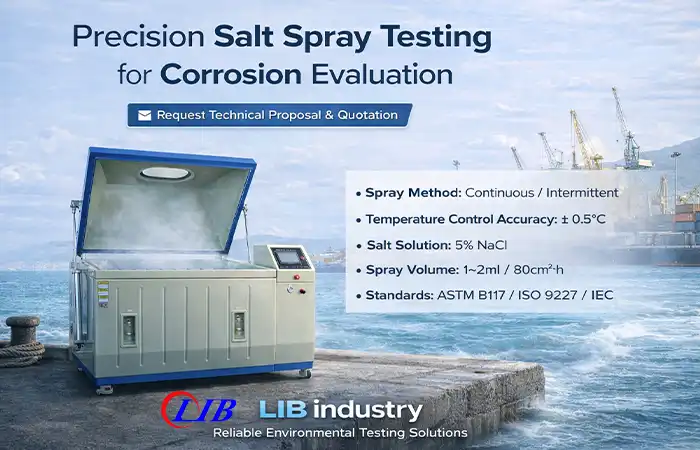
JIS Z 2371 stipulates that each 80 cm² horizontal collection funnel must accumulate between 1.0 and 2.0 mL of solution per hour. Maintaining this narrow window guarantees that specimens receive a consistent, quantifiable salt load - too little fog under-stresses the sample; too much introduces runoff artifacts that skew results.
Specimen Positioning Angles
The standard requires test panels to be supported at 15° to 25° from vertical, ensuring condensate drains away rather than pooling. Pre-calibrated V-type and O-type holders eliminate manual angle adjustments, reducing operator-to-operator variability and strengthening inter-laboratory reproducibility.
Solution Preparation and pH Monitoring
Preparing the brine solution involves dissolving analytical-grade sodium chloride in deionized water, then adjusting pH with dilute hydrochloric acid or sodium hydroxide before atomization. The standard mandates pH verification both in the reservoir and in the collected fog, a dual checkpoint that catches drift caused by CO₂ absorption or nozzle contamination.
Salt Spray Test Chamber Design for Accurate Corrosion Simulation
Chamber Construction Materials
Premium salt spray chambers use fiberglass-reinforced plastic (FRP) for interior walls, lids, and structural panels. FRP resists chloride attack, withstands continuous exposure to 5% NaCl under high humidity, and does not introduce galvanic contaminants. The V-shaped transparent lid design prevents condensation from dripping onto specimens - a subtle but critical detail for maintaining test validity over extended cycles.
Atomization and Air Saturation Systems
Compressed air passes through a saturated air barrel (pre-heater) before reaching the atomizer tower and spray nozzles. This pre-conditioning step brings the air to the correct temperature and 100% relative humidity, preventing evaporative cooling at the nozzle tip that would alter droplet size distribution. The nozzles themselves are engineered for clog resistance, high-temperature tolerance, and easy disassembly for cleaning.
Dual Temperature Regulation
Independent temperature controllers govern the chamber interior and the air-saturation barrel separately. Multi-layer insulation decouples internal conditions from ambient fluctuations, ensuring that a facility running at 18 °C in winter and 32 °C in summer produces identical fog characteristics year-round.
|
Model |
Internal Dimensions (mm) |
Interior Volume (L) |
Overall Dimensions (mm) |
|
S-150 |
590 × 470 × 400 |
110 |
1460 × 760 × 1140 |
|
S-250 |
1000 × 640 × 500 |
320 |
1850 × 960 × 1350 |
|
S-750 |
1100 × 750 × 500 |
410 |
1950 × 1030 × 1350 |
|
S-010 |
1000 × 1300 × 600 |
780 |
2000 × 1300 × 1600 |
|
S-016 |
900 × 1600 × 720 |
1030 |
2300 × 1300 × 1700 |
|
S-020 |
1000 × 2000 × 800 |
1600 |
2700 × 1300 × 1900 |
Evaluation of Metal Components and Protective Coatings
Quantifying Coating Breakdown
After a prescribed exposure period, technicians assess specimens for blistering, scribe-line creepage, white rust (zinc corrosion products), and red rust (ferrous corrosion). Rating systems such as those in JIS and ISO 4628 translate visual observations into numerical grades, enabling objective pass/fail decisions and lot-to-lot trend analysis.
Comparing Plating and Anodizing Processes
Electroplated zinc, zinc-nickel, and chromium finishes each exhibit distinct failure modes under salt fog. Running identical test durations on samples from different plating baths - or from competing suppliers - provides a direct performance ranking. CASS testing is especially valuable for decorative chromium and copper-nickel-chromium systems, where accelerated acidic attack reveals pore density and micro-crack propagation that NSS alone may miss.
Validating Organic and Hybrid Coatings
Powder coatings, e-coats, and paint systems are often tested with a scribed "X" cut through the film to expose bare substrate. Post-test evaluation measures undercutting distance from the scribe, adhesion loss, and osmotic blistering. The data feeds directly into coating specification revisions and warranty models.
Improving Product Durability Through Standardized Corrosion Testing
Closing the Design-Validation Loop
Salt spray data collected early in the design cycle allows engineers to select alloys, coating thicknesses, and surface treatments that meet target service-life specifications. When a prototype fails prematurely, the chamber becomes a diagnostic tool - rerunning tests after process adjustments confirms the fix before mass production begins.
Reducing Warranty and Recall Costs
Field failures tied to corrosion carry steep financial and reputational penalties. Implementing routine JIS Z 2371 testing at incoming inspection, in-process checkpoints, and final audit stages catches degradation risks before products ship, significantly lowering after-market claim rates.
Supporting Continuous Improvement Programs
Long-term trending of salt spray hours-to-first-rust across production lots reveals process drift - a gradual thinning of plating thickness, contamination in rinse tanks, or oven-cure temperature deviations. This proactive surveillance transforms the salt spray chamber from a pass/fail gate into a statistical process control instrument.
Precision-Engineered Chambers for JIS Compliance - LIB Industry
  |
|
salt spray tower |
cylinder |
spray collector |


Turnkey Testing Solutions
LIB Industry delivers a complete ecosystem: research, design, manufacturing, commissioning, installation, and operator training. Each JIS Z 2371 salt spray test chamber ships with a standard configuration of 6 round bars and 5 V-shaped grooves, a built-in brine mixing system, movable fog collectors, and a programmable PID controller supporting 120 programs with 100 steps each - covering both continuous and cyclic spray profiles.
Safety and Reliability Architecture
Comprehensive protective interlocks - humidifier dry-combustion prevention, over-temperature shutdown, over-current cutoff, water-shortage alarm, and earth-leakage detection - safeguard operators and equipment during unattended multi-day runs. The automatic water refill system halts operation and alerts personnel if reservoir levels drop below safe thresholds.
Quality Assurance and Global Support
All units are manufactured under ISO 9001 protocols and carry CE certification, with third-party verification by SGS and TUV. LIB Industry backs every chamber with a 3-year warranty, lifetime technical support, and a 24/7 global response team. Custom chamber dimensions, specialized specimen holders, and integration with external data-logging platforms are available for laboratories with non-standard requirements.
|
Feature |
Specification |
|
Temperature Range |
Ambient to +60 °C |
|
Temperature Fluctuation |
± 0.5 °C |
|
Temperature Deviation |
± 2.0 °C |
|
Humidity Range |
95% - 98% RH |
|
Salt Fog Deposition |
1 - 2 mL / 80 cm² · h |
|
Construction Material |
Fiberglass Reinforced Plastic (FRP) |
|
Certification |
CE, ISO 9001, SGS, TUV |
Conclusion
JIS Z 2371 salt spray testing provides a rigorous, standardized framework for predicting how metals and coatings perform under aggressive chloride exposure. Selecting a chamber built with FRP construction, precise atomization, dual temperature regulation, and robust safety interlocks ensures that test results are both accurate and repeatable. Whether the goal is supplier qualification, coating development, or ongoing production surveillance, investing in a well-engineered salt spray test chamber translates directly into improved product durability and reduced field-failure risk.
FAQ
What is the difference between NSS, AASS, and CASS tests under JIS Z 2371?
NSS uses a neutral 5% NaCl solution for general corrosion evaluation. AASS adds acetic acid to lower pH for acidic simulation. CASS introduces copper chloride alongside acetic acid for accelerated testing of decorative chromium and copper-nickel coatings.
How long does a typical JIS Z 2371 salt spray test last?
Test duration varies by material and coating type, ranging from 24 hours to over 2,000 hours. The specific duration depends on the product specification, industry standard, or customer requirement being validated.
Can the salt spray chamber run unattended for extended periods?
Yes. Built-in safety features - including automatic water refill, over-temperature protection, dry-combustion prevention, and earth-leakage detection - allow continuous or cyclic operation over hundreds of hours without constant operator presence.
Looking for a reliable JIS Z 2371 salt spray test chamber manufacturer and supplier? LIB Industry provides customized corrosion testing solutions backed by global service. Contact us at ellen@lib-industry.com to discuss your requirements.