Sand Dust Testing for Solar Panels in Harsh Desert Environments
Solar panels deployed across arid landscapes face relentless bombardment from airborne sand and fine particulate matter. Desert installations - spanning the Sahara, Arabian Peninsula, Gobi, and Mojave - lose between 15% and 40% of their energy yield annually due to soiling and abrasion damage. A sand dust test chamber enables manufacturers to replicate these punishing conditions inside a controlled laboratory, accelerating years of desert exposure into programmable test cycles. By subjecting photovoltaic modules to calibrated particle concentrations, wind velocities, and temperature profiles, engineers can evaluate glass coatings, frame seals, junction box integrity, and anti-reflective surface durability. This testing methodology transforms guesswork into quantifiable performance data, ensuring solar products survive where sandstorms are routine.
How Do Sandstorms Affect Solar Panel Performance?
Optical Transmission Loss from Surface Abrasion
High-velocity sand particles strike the glass cover of photovoltaic modules at speeds exceeding 20 m/s during desert storms. Each impact creates microscopic pitting and surface roughness that scatters incoming photons. Over repeated storm events, cumulative micro-abrasion reduces optical transmittance by measurable percentages, directly diminishing the current generated by underlying solar cells.
Mechanical Stress on Panel Frames and Seals
Sand-laden wind exerts dynamic pressure on module frames, edge seals, and mounting hardware. Particles wedge into gasket interfaces and frame joints, accelerating wear through repetitive micro-erosion. Junction boxes and cable entry points are particularly susceptible - once particles breach these enclosures, electrical connections face degradation from conductive dust bridging and thermal hotspots.
Thermal Consequences of Dust Layering
A uniform dust layer across the panel surface acts as an insulating blanket, elevating cell operating temperature beyond optimal thresholds. Each degree Celsius above the rated operating temperature reduces crystalline silicon module efficiency by approximately 0.4%-0.5%. In desert environments where ambient temperatures already approach 50 °C, this added thermal load compounds energy losses significantly.
Dust Accumulation Risks for Photovoltaic Modules
Soiling Rate Variability Across Desert Regions
Dust deposition rates differ dramatically between geographic zones. The Arabian Peninsula experiences average soiling rates of 0.1-0.3 g/m² per day, while regions near unpaved roads or construction sites can see rates three to five times higher. Understanding site-specific particle characteristics - mineralogy, grain size distribution, and hygroscopic behavior - guides appropriate testing parameters inside the chamber.
Impact on Anti-Reflective Coatings
Modern solar panels utilize nano-textured anti-reflective coatings to maximize light capture. Fine dust particles with diameters below 50 μm adhere to these coatings through van der Waals forces and electrostatic attraction. Repeated cleaning cycles to remove this dust can themselves degrade the coating, creating a paradox that laboratory testing helps resolve by evaluating coating resilience under controlled abrasion and soiling sequences.
Moisture-Dust Synergy in Dew-Prone Deserts
Many arid regions experience significant nocturnal dew formation despite daytime aridity. When morning dew mixes with accumulated dust, it forms a cemented layer - often called "mud caking" - that resists natural wind cleaning. A sand and dust test chamber combined with humidity control below 30% RH can simulate the dry deposition phase, while complementary environmental chambers address the wet-dry cementation cycle.
|
Desert Region |
Dominant Particle Composition |
Average Grain Size (μm) |
Typical Soiling Loss (%/day) |
|
Sahara (North Africa) |
Silica, iron oxide, calcite |
20-100 |
0.2-0.5 |
|
Arabian Peninsula |
Calcite, quartz, gypsum |
10-80 |
0.3-0.8 |
|
Thar (India) |
Feldspar, quartz, ite |
15-90 |
0.2-0.6 |
|
Gobi (China/Mongolia) |
Silica, calcium carbonate |
30-150 |
0.1-0.4 |
|
Atacama (Chile) |
Halite, gypsum, silica |
5-60 |
0.1-0.3 |
Environmental Testing Standards for Solar Energy Equipment
IEC 60068-2-68 and Its Relevance to PV Modules
IEC 60068-2-68 defines sand and dust testing procedures categorized into blowing dust (fine particles) and blowing sand (coarser abrasive particles). Test severity levels specify particle size ranges, air velocity, concentration, and duration. Solar panel manufacturers reference this standard when qualifying modules for desert deployment, using a sand dust test chamber configured to match the prescribed environmental classes.
MIL-STD-810 Sand and Dust Procedures
Originally developed for military equipment, MIL-STD-810 Method 510 outlines rigorous sand and dust exposure protocols with wind speeds reaching 29 m/s. Solar installations at military bases and remote defense sites often require compliance with this standard. The method distinguishes between blowing dust (particles below 149 μm) and blowing sand (150-850 μm), each demanding distinct chamber configurations.
IP Rating Verification for Enclosure Components
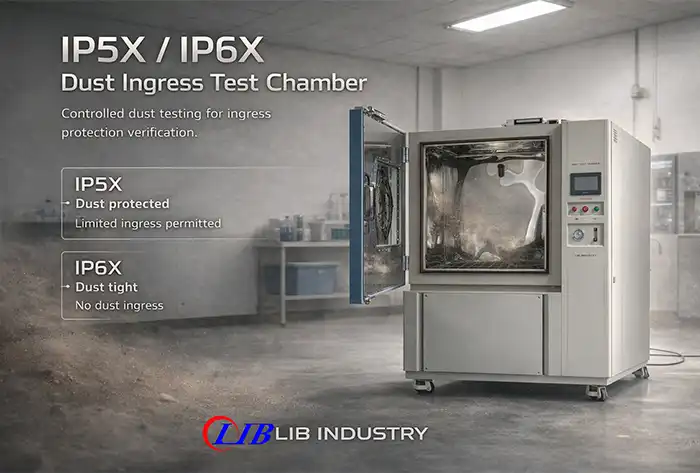
Junction boxes, combiner boxes, and inverter housings on solar installations carry IP5X or IP6X dust ingress ratings. Validating these ratings requires standardized chamber testing where talcum powder or equivalent fine particulate circulates at defined concentrations. The wire mesh specifications - 50 μm wire diameter with 75 μm gap width - ensure particle size control aligns with IP code test methodologies.
|
IP5X 6X dust test chamber |
|
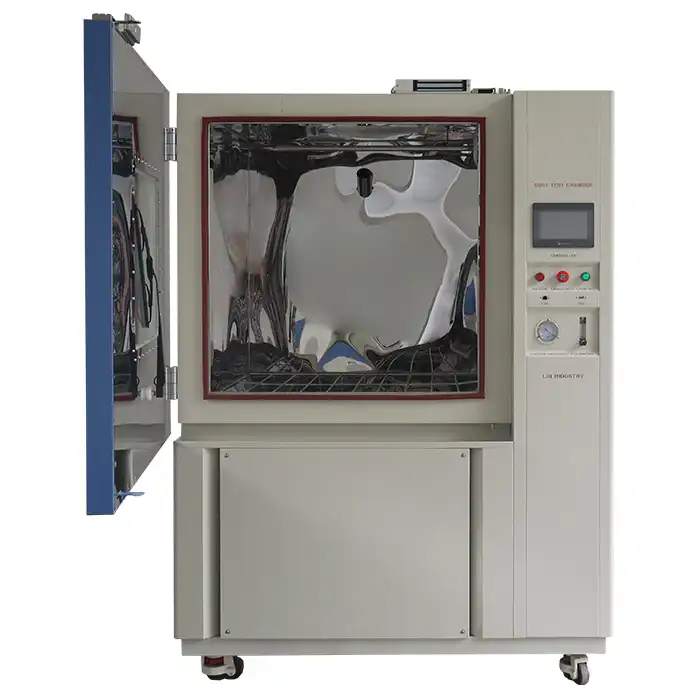
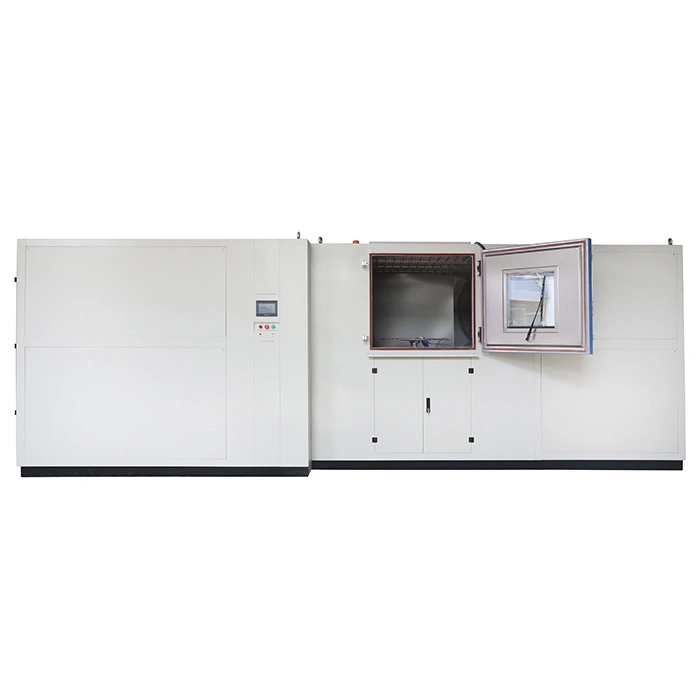
Simulating Desert Wind-Blown Sand Conditions in Test Chambers
|
|
|


 |
 |
|
| Test Area | LAN and USB | Controller |

Wind Velocity Calibration and Particle Entrainment
Desert sandstorms generate wind speeds ranging from 10 m/s during moderate events to over 25 m/s in severe haboob conditions. A capable sand dust test chamber reproduces these velocities while maintaining consistent particle entrainment. Anti-clogging vibration mechanisms and pre-heating systems prevent moisture-related clumping, ensuring particles remain freely flowing throughout extended test durations.
Concentration Monitoring and Feedback Control
Maintaining uniform particle density inside the chamber is critical for repeatable results. Real-time concentration monitoring systems paired with feedback sensors adjust particle feed rates to sustain target levels. Without this closed-loop control, localized concentration gradients produce uneven abrasion patterns that misrepresent actual field exposure.
Temperature and Humidity Conditioning
Desert testing profiles demand elevated temperatures - ambient to +50 °C - combined with low humidity below 30% RH. These conditions replicate the thermal stress that photovoltaic materials endure during peak irradiance hours. The sand and dust chamber's temperature stability ensures that material property changes observed during testing stem from particle exposure rather than thermal artifacts.
|
Model |
Internal Dimensions (mm) |
Volume (L) |
Temperature Range |
Blowing Time |
|
DI-800 |
800 × 1000 × 1000 |
800 |
Ambient to +50 °C |
0-99H59M |
|
DI-1000 |
1000 × 1000 × 1000 |
1000 |
Ambient to +50 °C |
0-99H59M |
|
DI-1500 |
1000 × 1500 × 1000 |
1500 |
Ambient to +50 °C |
0-99H59M |
|
DI-2000 |
1000 × 2000 × 1000 |
2000 |
Ambient to +50 °C |
0-99H59M |
Durability Testing for Solar Panel Coatings and Glass Surfaces
Evaluating Hydrophobic and Self-Cleaning Coatings
Nano-engineered hydrophobic coatings promise reduced soiling and easier rain-cleaning on solar modules. Chamber testing quantifies how many hours of sand exposure these coatings withstand before their water contact angle degrades below functional thresholds. Comparative testing across coating chemistries - fluoropolymer, titanium dioxide photocatalytic, and silica-based formulations - yields actionable selection data.
Tempered Glass Erosion Profiling
Solar-grade tempered glass (typically 3.2 mm thick with low iron content) constitutes the primary barrier against particle impact. Chamber testing at multiple wind velocities maps the erosion rate curve, identifying the critical speed above which surface damage escalates nonlinearly. This data feeds directly into warranty duration calculations for modules destined for high-wind desert installations.
Edge Seal and Backsheet Integrity Assessment
Sand infiltration at the panel edge seal compromises the encapsulant layer, leading to moisture ingress, delamination, and potential-induced degradation. By positioning complete modules inside the chamber with sealed cable ports providing electrical connections, engineers can simultaneously monitor insulation resistance and power output while sand exposure progresses - capturing the exact onset of seal compromise.
|
Test Parameter |
Blowing Dust (Fine) |
Blowing Sand (Coarse) |
|
Particle Size Range |
< 149 μm |
150-850 μm |
|
Air Velocity |
1.5-8.9 m/s |
18-29 m/s |
|
Concentration |
10.6 ± 7 g/m³ |
1.1 ± 0.3 g/m³ |
|
Typical Duration |
6-24 hours |
1-6 hours |
|
Primary Damage Mode |
Soiling, coating wear |
Abrasion, pitting, cracking |
Improving Long-Term Energy Efficiency Through Sand Dust Testing
Quantifying Cleaning Cycle Economics
Sand dust chamber data helps plant operators determine optimal cleaning frequencies. By measuring power loss as a function of cumulative dust exposure hours, engineers calculate the breakeven point where cleaning costs equal recovered energy revenue. This analysis differs for robotic dry-cleaning, water-based washing, and electrostatic self-cleaning systems.
Validating Module-Level Electronics Resilience
Microinverters and power optimizers attached to individual panels share the same dust exposure as the modules themselves. Chamber testing with the internal 16A power interface energizing these electronics during dust cycling reveals whether heat sinks clog, ventilation paths obstruct, or PCB conformal coatings resist particle infiltration. Identifying these vulnerabilities pre-deployment avoids costly field retrofits.
Accelerated Lifecycle Prediction Models
Correlating chamber test hours with field soiling data from operational desert plants enables predictive degradation modeling. When a module survives 500 hours of calibrated dust cycling without measurable transmittance loss, engineers can extrapolate performance confidence across a 25-year operational lifespan - provided the acceleration factor between chamber and field conditions is rigorously established.
Simulating Extreme Dust Storms with Uniform Concentration - LIB Industry
Reinforced Interior Construction
LIB Industry sand and dust test chambers feature SUS304 stainless steel interiors engineered to resist abrasive particle erosion during prolonged testing. Protective fan blades and reinforced internal walls maintain structural integrity across thousands of test hours. This rugged construction ensures the chamber itself does not become a source of contamination through wall material degradation.
Programmable Multi-Phase Test Profiles
The programmable color LCD touch screen controller with Ethernet connectivity enables complex test sequences that alternate between high-velocity sand blasting, low-speed dust settling, and static accumulation phases. Engineers can program blowing durations from minutes to 99 hours and 59 minutes, replicating the intermittent nature of real desert storm patterns rather than relying on unrealistic continuous exposure.
Observation and Safety During Extended Cycles
The double-layer thermally stable silicone rubber sealed observation window, paired with a built-in dustproof LED light and dust wiper system, provides clear specimen visibility without interrupting the test. Electromagnetic door locks prevent accidental opening during high-concentration cycles. Comprehensive safety protections - over-temperature, over-current, earth leakage, and phase sequence - safeguard both equipment and operators throughout unattended overnight and weekend runs.
Conclusion
Desert-deployed solar panels confront an unforgiving particle environment that erodes surfaces, infiltrates seals, and blankets modules with efficiency-robbing dust layers. Sand dust chamber testing transforms these field hazards into controlled, measurable laboratory parameters. By validating glass coatings, frame seals, junction boxes, and module-level electronics against calibrated sand and dust exposure profiles, manufacturers deliver photovoltaic products that sustain energy yield across decades of desert operation. The correlation between accelerated chamber data and real-world soiling metrics empowers solar developers to optimize cleaning strategies, predict degradation trajectories, and select materials with proven resilience - turning harsh desert conditions from a liability into a well-characterized engineering challenge.
FAQ
What particle sizes does a sand dust test chamber use for solar panel testing?
Blowing dust tests use particles below 149 μm to simulate fine soiling, while blowing sand tests use 150-850 μm particles to evaluate surface abrasion resistance on glass covers and coatings.
How long does a typical sand dust exposure test last for PV modules?
Blowing dust tests generally run 6 to 24 hours at lower wind speeds, while coarse sand abrasion tests run 1 to 6 hours at higher velocities up to 29 m/s.
Can the chamber supply power to solar panels during dust testing?
Yes. LIB Industry chambers include an internal single-phase 16A power interface and sealed cable ports, allowing engineers to energize and monitor module electronics throughout the test cycle.
Looking for a reliable sand dust test chamber for solar panel qualification? LIB Industry is a professional manufacturer and supplier of sand and dust testing equipment with turn-key solutions including custom engineering, installation, and operator training. Reach out at ellen@lib-industry.com to discuss your project.