Small Environmental Chambers for Sensor Calibration Applications
Sensor calibration demands precise environmental control to establish accurate reference points across operational temperature and humidity ranges. Small environmental test chambers provide compact, laboratory-grade solutions that enable calibration engineers to verify sensor performance under controlled climatic conditions without dedicating extensive floor space or infrastructure investments. These desktop-sized units deliver temperature ranges from -70°C to +150°C with humidity control spanning 20% to 98% RH, replicating the environmental extremes sensors encounter during field deployment. By maintaining ±0.5°C temperature stability and ±2.5% RH humidity deviation, compact calibration chambers ensure traceability to national standards while accommodating the space and budget constraints of modern calibration laboratories.
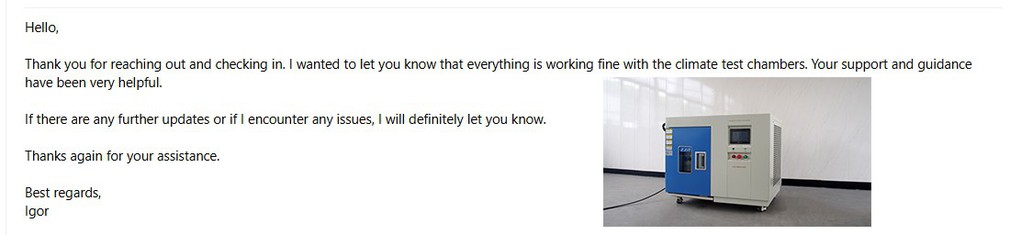
LIB Small Environmental Test Chambers provide a space-saving yet powerful solution for laboratories requiring precise environmental control.
A customer from Israel, Igor, who purchased four units, shared his feedback: “The chambers are operating very well. Your technical support and guidance have been very helpful. If anything changes or we need assistance, I'll contact you. Thank you again.”
Why Is Environmental Control Important in Sensor Calibration?
Temperature-Dependent Measurement Drift
Sensor output characteristics inherently vary with ambient temperature due to material property changes in sensing elements. Resistance temperature detectors exhibit predictable resistance-temperature relationships, yet thermistor-based sensors demonstrate exponential response curves requiring multipoint calibration across temperature ranges. Pressure transducers utilizing piezoresistive elements experience zero-point drift and span shifts as semiconductor material properties respond to thermal fluctuations. Without environmental control during calibration, technicians cannot distinguish between legitimate sensor characteristics and ambient-induced measurement errors.
Humidity Effects on Sensor Sensitivity
Capacitive humidity sensors require calibration at multiple relative humidity setpoints to characterize their response curves accurately. Beyond humidity sensors themselves, moisture influences numerous sensor types through condensation effects, material hygroscopic expansion, and dielectric property changes. Optical sensors experience lens fogging that degrades transmission, while electronic circuits suffer leakage current increases under high humidity conditions. A small environmental test chamber isolates these humidity variables, enabling controlled exposure that separates intended sensor response from environmental interference.
Establishing Traceability to Measurement Standards
Accredited calibration laboratories must demonstrate traceability chains connecting their measurements to national metrology institutes. Environmental conditions during calibration directly impact uncertainty budgets - the mathematical framework quantifying measurement confidence levels. Uncontrolled ambient variations introduce additional uncertainty components that degrade overall calibration accuracy. Stable environmental chambers minimize these contributions, allowing dominant uncertainty sources to arise from reference standards rather than environmental fluctuations.
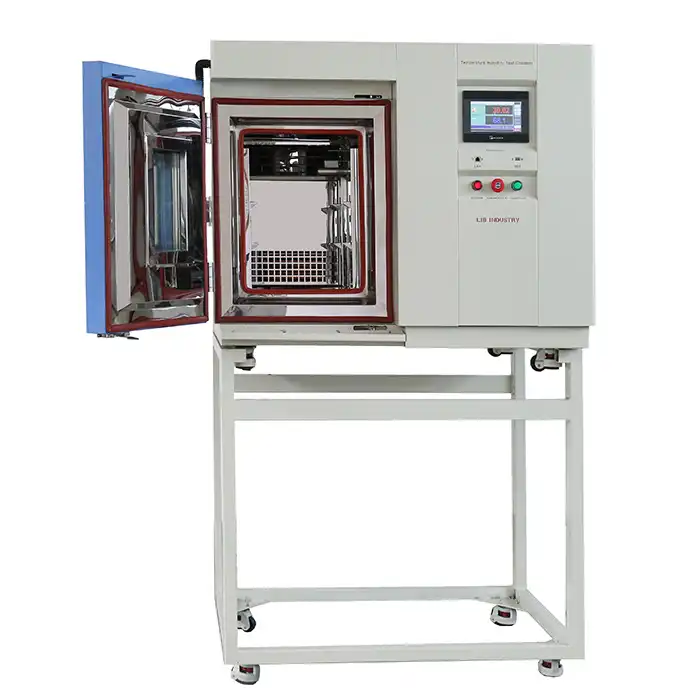
Precision Temperature and Humidity Testing for Sensor Accuracy
Multipoint Calibration Across Operating Ranges
Comprehensive sensor calibration extends beyond single-point verification to characterize response across the entire operational envelope. Temperature sensors require calibration at multiple temperatures spanning their measurement range - typically five points from -40°C to +125°C for industrial applications. Humidity sensors similarly demand multipoint calibration at intervals such as 20%, 40%, 60%, 80%, and 95% RH. Compact environmental chambers facilitate these protocols by providing stable setpoints throughout extended calibration sessions.
Hysteresis Characterization Under Cycling Conditions
Many sensor technologies exhibit hysteresis - output differences depending on whether the measured quantity approaches from above or below the setpoint. Humidity sensors commonly demonstrate 2-3% RH hysteresis between ascending and descending humidity cycles. Characterizing this behavior requires controlled environmental cycling that incrementally steps through the measurement range. Programmable controllers in advanced chambers automate these cycling protocols, supporting 120 programs with 100 steps each.
Response Time Verification at Operational Conditions
Sensor dynamic response characteristics vary significantly with environmental conditions. Gas sensors respond more rapidly at elevated temperatures where reaction kinetics accelerate, while humidity sensors exhibit slower response at temperature extremes. Calibration protocols verifying response time specifications must conduct measurements at relevant environmental conditions. Compact chambers with rapid heating rates of 3°C/min and cooling rates of 1°C/min enable efficient response time testing.
|
Sensor Type |
Calibration Points |
Environmental Range |
Accuracy Target |
|
RTD Temperature |
5-7 points |
-40°C to +150°C |
±0.1°C |
|
Capacitive Humidity |
5 points |
20% to 95% RH |
±2.0% RH |
|
Pressure Transducer |
3-5 points |
-20°C to +80°C |
±0.25% FS |
Calibration Stability Under Simulated Environmental Conditions
Minimizing Environmental Uncertainty Contributions
Calibration uncertainty budgets aggregate multiple error sources including reference standard accuracy, instrumentation resolution, environmental stability, and repeatability. Environmental temperature variations during calibration directly translate into measurement uncertainty through sensor temperature coefficients. Chambers maintaining ±0.5°C fluctuation significantly improve overall calibration confidence levels and enable tighter specification tolerances.
Extended Stabilization for Thermal Equilibrium
Sensor calibration accuracy depends critically on achieving thermal equilibrium between the sensor, reference standards, and surrounding environment. Thermal time constants vary dramatically across sensor designs - miniature thermistors stabilize within minutes while massive pressure transducers require hours. Small environmental test chambers with exceptional uniformity throughout the workspace ensure all components experience identical conditions. The ±2.0°C temperature deviation specification across the chamber volume guarantees equivalent thermal exposure.
Long-Duration Stability Testing
Calibration validation often extends beyond instantaneous verification to include stability assessments over hours or days. Drift testing quantifies how sensor outputs change over time under constant environmental conditions. Temperature humidity test chambers designed for continuous operation enable these extended protocols through robust construction featuring SUS304 stainless steel interiors and polyurethane foam insulation.
How Do Small Chambers Enhance Sensor Reliability Testing?
Accelerated Aging Through Environmental Stress
Calibration laboratories increasingly incorporate reliability screening into their service offerings, exposing sensors to accelerated environmental stress that precipitates latent defects. Temperature-humidity cycling protocols subject sensors to repeated thermal expansion and moisture absorption cycles, revealing construction weaknesses. Compact chambers accommodate batch testing of multiple sensors simultaneously, improving screening throughput while maintaining precise environmental control.
Condensation and Dew Point Testing
Sensors deployed in outdoor or refrigeration applications must withstand condensation exposure without performance degradation. Calibration protocols verifying condensation resistance require precise dew point control - cooling sensor surfaces below ambient dew point while maintaining elevated humidity. Small environmental test chambers achieve these conditions through independent temperature and humidity control. The observation window with built-in LED lighting allows visual monitoring without disturbing chamber conditions.
Environmental Robustness Validation
Beyond basic accuracy verification, sensor calibration increasingly addresses environmental robustness - the ability to maintain specifications across temperature, humidity, and pressure variations. Automotive sensor calibration protocols demand verification across -40°C to +125°C temperature ranges. Medical device sensors require validation under body temperature conditions. The wide temperature range capabilities (-70°C to +150°C) accommodate diverse robustness testing requirements.
Environmental Simulation for Industrial Sensor Validation
Replicating Field Deployment Conditions
Industrial sensor applications span extreme environmental diversity - from arctic pipeline monitoring to desert solar installations. Calibration relevance improves dramatically when conducted under conditions matching actual deployment environments. Desert applications experiencing 60°C surface temperatures with 10% humidity require different calibration approaches than tropical installations at 35°C with 90% humidity. Programmable small environmental test chambers enable calibration technicians to recreate specific field conditions.
Altitude and Pressure Compensation Verification
Pressure-dependent sensors including barometric altimeters and differential pressure transmitters require calibration accounting for altitude effects. While compact environmental chambers primarily control temperature and humidity, they facilitate pressure sensor calibration when combined with external pressure references. The controlled temperature environment eliminates thermal errors in pneumatic calibration systems.
Contamination and Corrosion Resistance Assessment
Industrial environments often contain airborne contaminants affecting sensor longevity. Temperature and humidity cycling under corrosive gas exposure accelerates degradation mechanisms, revealing design vulnerabilities before field deployment. The SUS304 stainless steel chamber construction resists corrosion from test atmospheres.
Compact Calibration Chambers for High-Precision Testing Labs
Space-Optimized Laboratory Integration
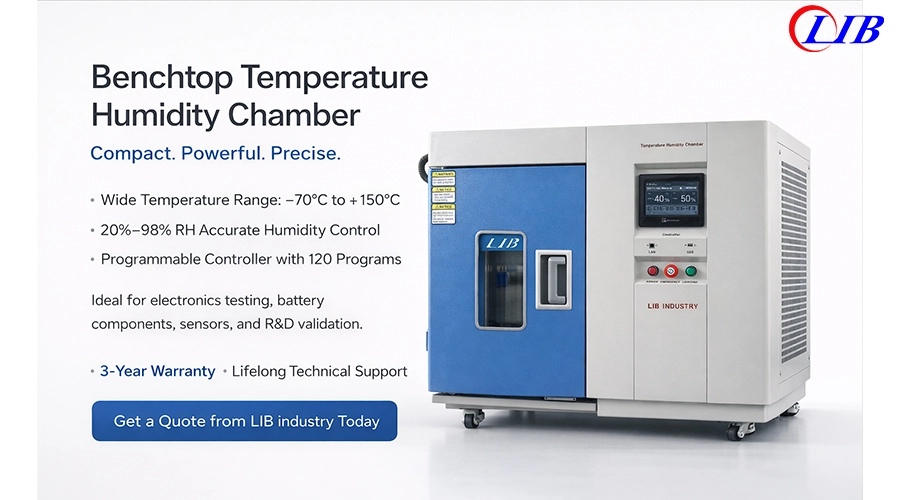
Modern calibration laboratories face increasing pressure to maximize workspace utilization. Benchtop small environmental test chambers deliver full-featured environmental control within footprints comparable to standard laboratory equipment. The 50L model with 320×350×450mm internal dimensions occupies less than one square meter of bench space, positioning conveniently alongside calibration instrumentation.
Rapid Deployment Without Infrastructure Modifications
Traditional environmental chambers often require dedicated electrical circuits or cooling water supplies. Desktop calibration chambers eliminate these barriers through plug-and-play operation from standard 220V/110V power outlets. Air-cooled refrigeration systems dissipate heat directly into the laboratory environment. The whisper-quiet operation below 65 dB allows placement in occupied workspaces without noise disruption.
Cost-Effective Calibration Capacity Expansion
Purchasing multiple compact chambers often proves more economical than investing in single large-capacity units. Multiple chambers enable parallel testing of different sensor types under distinct environmental conditions simultaneously, dramatically improving throughput. LIB Industry chambers' competitive pricing makes this distributed capacity strategy financially attractive.
LIB Industry Ensures Ultra-Stable Temperature & Humidity Control for Precise Sensor Calibration
|
|
|
|||||


Advanced PID Control Systems
Temperature and humidity stability fundamentally depends on control algorithm sophistication. LIB Industry chambers incorporate advanced PID controllers with adaptive tuning that optimizes performance across diverse operating conditions. High-precision PT100 Class A temperature sensors with 0.001°C resolution provide exceptionally accurate feedback, enabling tight regulation. Real-time curve displays show measured values tracking setpoints without overshoot.
Micro-Circulation Airflow Engineering
Temperature uniformity throughout the chamber workspace directly impacts calibration accuracy. LIB Industry small environmental test chambers utilize specially designed micro-circulation airflow systems that minimize temperature stratification while avoiding excessive air velocities. The airflow patterns ensure sensors positioned at different locations experience equivalent environmental exposure, allowing batch calibration with confidence.
Comprehensive Safety Protection Systems
Calibration laboratories operate chambers for extended periods, often unattended. LIB Industry chambers incorporate multiple protection systems ensuring safe operation. Over-temperature protection prevents runaway heating, humidifier dry-combustion protection guards against heating element damage, and refrigerant high-pressure protection safeguards the cooling system. These interlocking protections enable confident unattended operation.
|
LIB Chamber Feature |
Calibration Benefit |
Specification |
|
Temperature Stability |
Reduced uncertainty |
±0.5°C fluctuation |
|
Humidity Precision |
Accurate RH calibration |
±2.5% RH deviation |
|
Spatial Uniformity |
Batch testing capability |
±2.0°C across volume |
|
Programmability |
Automated protocols |
120 programs × 100 steps |
Industry-Leading Warranty and Support
LIB Industry backs every small environmental test chamber with comprehensive 3-year warranty coverage plus lifetime technical support. The global 24/7 support team provides assistance across time zones, minimizing downtime. During the warranty period, LIB commits to replacement rather than repair if chambers cannot be restored to specification.
Conclusion
Small environmental test chambers revolutionize sensor calibration by delivering laboratory-grade environmental control within space-efficient, cost-effective packages. These compact solutions enable calibration laboratories to expand testing capabilities without facility modifications, supporting multipoint calibration, environmental robustness validation, and reliability screening protocols. LIB Industry chambers provide the temperature stability, humidity precision, and operational reliability essential for maintaining calibration accuracy while meeting modern laboratories' space and budget constraints.
FAQ
What temperature stability is required for high-precision sensor calibration?
High-precision sensor calibration typically requires environmental stability within ±0.5°C to minimize temperature-induced uncertainty contributions. LIB Industry chambers achieve this specification through advanced PID control systems and superior insulation, enabling accurate calibration of sensors with tight tolerance specifications.
Can small environmental chambers accommodate batch calibration of multiple sensors?
Yes, the 50L and 80L chamber volumes accommodate simultaneous calibration of multiple sensors on adjustable stainless steel shelves. The ±2.0°C spatial uniformity ensures all sensors experience equivalent environmental conditions, enabling efficient batch processing while maintaining calibration accuracy throughout the workspace.
How do compact chambers compare to larger units for calibration applications?
Compact chambers provide identical environmental control performance while offering superior space efficiency and lower capital costs. The benchtop design enables placement near calibration instrumentation, reducing cable lengths. Multiple small chambers often prove more cost-effective than single large units when expanding capacity.
Partner with LIB Industry for Calibration Chamber Solutions
As a trusted small environmental test chamber manufacturer and supplier, LIB Industry delivers precision-engineered calibration solutions worldwide. Contact us at ellen@lib-industry.com to discuss your specific calibration requirements.