Thermal Shock Testing for Semiconductor and Chip Packaging
Thermal shock testing subjects semiconductor packages to abrupt temperature swings - often from -65°C to +150°C - within seconds, deliberately inducing the mechanical stresses that surface hidden defects in solder joints, wire bonds, die attach layers, and encapsulant materials. Because modern chip packages combine silicon, copper, epoxy, and ceramic - each expanding at a different rate - rapid thermal transitions amplify interfacial stresses far beyond what gradual temperature cycling reveals. A thermal shock test chamber automates this process by shuttling specimens between pre-conditioned hot and cold compartments, enabling engineers to predict long-term field reliability in a compressed timeframe. This testing discipline is indispensable across automotive, aerospace, 5G, and consumer electronics sectors.
Why Semiconductor Packages Require Thermal Shock Testing?
Harsh Operating Environments and Thermal Cycling
Semiconductor devices routinely encounter drastic ambient shifts. An automotive ECU module can swing from -40°C during a cold start to well above +125°C near the engine block. Aerospace avionics face even wider excursions during altitude changes. These real-world conditions generate repetitive thermal stress that accumulates over thousands of cycles, gradually degrading internal interconnects and interfaces within the package.
Cost of Field Failures in Semiconductor Devices
A single field failure in an automotive safety system or a medical implant carries consequences extending far beyond replacement costs - product recalls, warranty liabilities, and regulatory penalties compound rapidly. Thermal shock testing during the qualification phase catches latent defects early, when corrections remain inexpensive and engineering changes are still feasible.
Accelerated Stress Screening for Package Qualification
Rather than waiting years to observe natural wear-out, engineers compress thousands of real-life thermal cycles into days by using extreme temperature differentials and rapid transfer times. Accelerated screening in a thermal shock test chamber isolates vulnerable interfaces and materials, supplying failure-mode data that feeds directly into design revisions and material selections.
Thermal Expansion Differences in Chip Packaging Materials
CTE Mismatch Between Silicon, Metals, and Polymers
The coefficient of thermal expansion (CTE) defines how much a material elongates per degree of temperature change. Silicon expands at roughly 2.6 ppm/°C, while copper - used extensively for lead frames and redistribution layers - expands at approximately 17 ppm/°C. Epoxy molding compounds fall between 10 and 20 ppm/°C depending on filler content. These disparities create a persistent tug-of-war at every bonded interface.
Table 1: CTE Values of Common Chip Packaging Materials
|
Material |
Approximate CTE (ppm/°C) |
Typical Role in Package |
|
Silicon die |
2.6 |
Active device substrate |
|
Copper |
17 |
Lead frame, RDL traces |
|
SAC305 solder |
21-23 |
Solder bumps, BGA balls |
|
FR-4 PCB substrate |
14-17 |
Printed circuit board |
|
Epoxy molding compound |
10-20 |
Encapsulant |
|
Alumina ceramic |
6.5 |
Hermetic package substrate |
Interfacial Stress Buildup During Temperature Excursions
When a package heats up, materials with higher CTE values stretch further than those with lower values. The bonded interfaces resist this differential motion, building shear and tensile stress at solder bumps, die attach films, and underfill boundaries. Rapid temperature transitions - the hallmark of thermal shock - magnify these stresses because materials have no time to relax through viscoelastic creep.
Common Failure Modes Driven by CTE Mismatch
CTE-driven stresses manifest as solder fatigue cracking, die-corner delamination, wire bond heel fractures, and micro-cracks in ceramic substrates. Repeated cycling in a thermal shock chamber propagates these flaws until electrical opens or shorts emerge. Identifying these failure signatures through controlled thermal shock allows packaging engineers to optimize geometries, material stacks, and process parameters before mass production.
Standards and Test Methods for Semiconductor Thermal Shock Testing
JEDEC and MIL-STD Thermal Shock Protocols
JEDEC JESD22-A106 specifies test conditions - including temperature extremes, soak times, and cycle counts - for commercial and industrial semiconductor devices. MIL-STD-883, Method 1011, governs military-grade components with stricter requirements and wider temperature ranges, often spanning -65°C to +150°C. Both standards mandate that transfer between temperature zones occurs within a tightly defined window.
Automotive-Grade Qualification Under AEC-Q100
The Automotive Electronics Council's AEC-Q100 standard demands that semiconductors endure a minimum of 500 to 1,000 thermal shock cycles before earning qualification status. Given the safety-critical nature of automotive applications, AEC-Q100 compliance requires meticulous documentation and often mandates additional failure analysis after testing concludes.
Table 2: Typical Thermal Shock Test Conditions by Standard
|
Standard |
Temperature Range |
Transfer Time |
Typical Cycle Count |
|
JEDEC JESD22-A106 |
-65°C to +150°C |
≤ 10 s |
100-1,000 |
|
MIL-STD-883, Method 1011 |
-65°C to +150°C |
≤ 10 s |
15-100 |
|
AEC-Q100 (Grade 1) |
-65°C to +150°C |
≤ 10 s |
500-1,000 |
|
IEC 60068-2-14, Test Na |
Custom |
Per specification |
Custom |
.jpg "blog-1-1")
Selecting Appropriate Temperature Ranges and Cycle Counts
The test profile should mirror - and exceed - the thermal envelope the device will encounter in its target application. Over-specifying conditions wastes resources and may reject otherwise sound designs. Under-specifying risks field failures. Engineers often collaborate with end-product teams to define realistic worst-case profiles, then add a safety margin that accounts for process variability.
Evaluating Solder Bump, Wire Bond, and Package Integrity
Solder Joint Fatigue and Crack Propagation
Solder alloys such as SAC305 undergo cyclic plastic deformation during thermal shock. Micro-cracks nucleate at high-stress corners of BGA balls or flip-chip bumps and propagate along the intermetallic layer with each subsequent cycle. Cross-sectional analysis and X-ray imaging after testing reveal crack length and path, guiding underfill formulation and pad geometry refinements.
Wire Bond Lift-Off and Heel Cracking
Gold and copper wire bonds experience stress concentration at the heel - the thin neck where the wire exits the bond pad. Thermal expansion differences between the wire, bonding pad, and molding compound concentrate bending fatigue at this juncture. Repeated shock cycling can initiate heel cracks or complete bond lift-off, both detectable through electrical continuity monitoring and scanning acoustic microscopy.
Die Attach and Underfill Delamination Assessment
Die attach adhesives and underfill materials bond the silicon die to its substrate. Delamination at these interfaces creates voids that impede heat dissipation and alter stress distribution, potentially triggering secondary failures. C-mode scanning acoustic microscopy (C-SAM) provides non-destructive visualization of delaminated regions before and after thermal shock exposure, enabling quantification of degradation progression.
Simulating Rapid Temperature Transitions in Electronic Devices
Basket-Transfer Mechanism for Instant Zone Switching
Modern thermal shock machine employ a basket-transfer system that shuttles test specimens vertically between a pre-conditioned cold compartment and a pre-conditioned hot compartment. This mechanical transfer eliminates the thermal lag inherent in single-chamber systems, ensuring the sample encounters the full temperature delta almost instantaneously - a critical requirement for faithful replication of real-world thermal transients.
Recovery Time and Dwell Period Considerations
Recovery time - the interval needed for the chamber to re-stabilize after the basket transfer - directly affects test validity. Chambers with recovery times within five minutes maintain consistent soak conditions, ensuring every cycle applies equivalent stress. Dwell periods must be long enough for the specimen to reach thermal equilibrium throughout its cross-section, particularly for thermally massive packages.
Programmable Profiles for Multi-Condition Testing
Programmable controllers allow engineers to define multi-step profiles that combine different temperature extremes, soak durations, and cycle counts within a single test run. This capability proves valuable when qualifying a semiconductor device for multiple end-use environments - such as both automotive under-hood and industrial outdoor installations - without reconfiguring hardware between successive tests.
Enhancing Reliability of Semiconductor Packaging Systems
Data-Driven Design Optimization Through Failure Analysis
Every cracked solder joint or delaminated interface uncovered during thermal shock testing contributes to a failure-mode database. Statistical tools - including Weibull analysis and cumulative damage models - transform raw failure data into actionable insights, highlighting which design parameters exert the greatest influence on package longevity.
Extending Product Lifespan with Robust Package Designs
Insights gleaned from thermal shock data drive tangible design improvements: optimized bump pitch, reinforced underfill corners, graded CTE buffer layers, and improved die attach materials. Each iteration narrows the gap between predicted and observed reliability, ultimately delivering packages that surpass field-life requirements by comfortable margins.
Integrating Thermal Shock Data into Reliability Models
Combining thermal shock results with finite element analysis (FEA) enables predictive modeling of package behavior under conditions not explicitly tested. Calibrated models accelerate future design cycles by reducing the number of physical prototypes needed, lowering both development cost and time-to-market for next-generation semiconductor products.
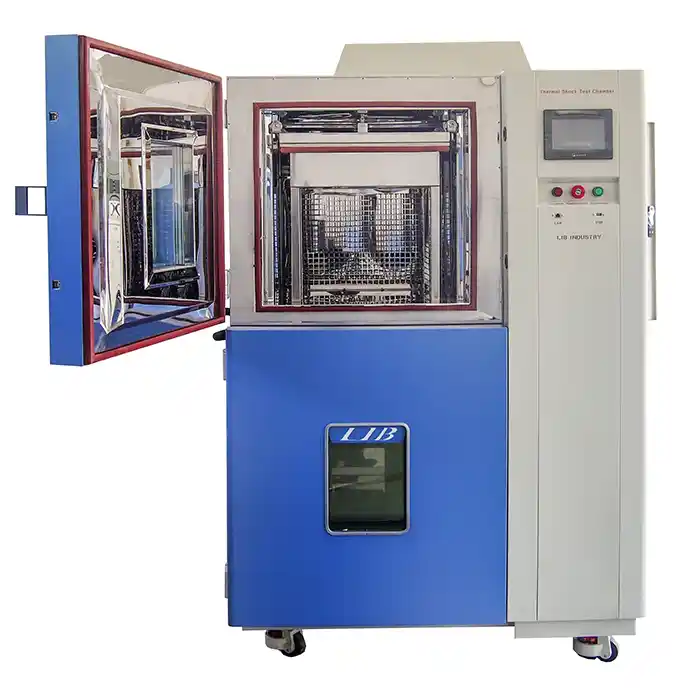
Ultra-Low Temperature Accuracy for Microelectronics Reliability - LIB Industry
|
LIBAir-to-Air Thermal Shock Chamber |
|
|||||||||


|
|
|
|
Test Basket |
The Controller |
|
|
|
|
Cable Hole |
Castor |


Wide Temperature Range from -70°C to +200°C
LIB Industry's thermal shock test equipment span -70°C to +200°C, comfortably covering the most demanding semiconductor qualification profiles. The hardware lower limit of -75°C and upper limit of +220°C provide additional headroom beyond typical test specifications, ensuring the chamber meets evolving standards without hardware upgrades.
Precision Control and Fast Transition Performance
Temperature fluctuation held within ±0.5°C and deviation within ±3°C guarantee that every cycle delivers consistent stress to the specimen. A recovery time within five minutes - paired with a French TECUMSEH compressor and environmentally friendly refrigerant - ensures rapid stabilization after each basket transfer. Heating to +200°C and cooling to -70°C each complete within 30 minutes.
Scalable Chamber Sizes for Diverse Semiconductor Applications
LIB offers four models accommodating everything from small wafer-level coupon tests to full-board assemblies, with loading capacities from 20 kg to 60 kg.
Table 3: LIB Industry Thermal Shock Test Chamber Specifications
|
Specification |
TS-162 |
TS-340 |
TS-500 |
TS-1000 |
|
Internal Dimensions (mm) |
300×300×250 |
450×450×360 |
650×650×500 |
850×850×700 |
|
Interior Volume |
22 L |
72 L |
211 L |
505 L |
|
Loading Capacity |
20 kg |
30 kg |
50 kg |
60 kg |
|
Overall Dimensions (mm) |
1560×870×1545 |
1710×1020×1845 |
1910×1220×2265 |
2110×1420×2665 |
All models feature a programmable color LCD touch screen controller with Ethernet connectivity, SUS304 stainless steel interiors, and comprehensive safety protections - including over-temperature, over-current, refrigerant high-pressure, and earth leakage safeguards.
Conclusion
Thermal shock testing stands as a non-negotiable gate in semiconductor package qualification. By exposing solder bumps, wire bonds, and die attach layers to abrupt temperature swings, engineers uncover CTE-driven failure modes long before products reach the field. Standardized protocols from JEDEC, MIL-STD, and AEC-Q100 provide the framework, while high-performance chambers deliver the precision and speed these protocols demand. Investing in rigorous thermal shock evaluation strengthens package reliability, reduces warranty exposure, and accelerates time-to-market for next-generation semiconductor devices.
FAQ
What temperature range is typically used for semiconductor thermal shock testing?
Most semiconductor qualification standards specify ranges from -65°C to +150°C, though automotive and military applications may extend lower, and high-power devices may require exposure up to +200°C.
How many thermal shock cycles are required for AEC-Q100 automotive qualification?
AEC-Q100 typically mandates 500 to 1,000 cycles between -65°C and +150°C, depending on the grade classification and specific stress test requirements for the target semiconductor device.
What is recovery time in a thermal shock test chamber?
Recovery time is the duration the chamber needs to return to its setpoint temperature after the basket transfers specimens between hot and cold zones - ideally within five minutes for consistent testing results.
Looking for a trusted thermal shock test chamber manufacturer and supplier? LIB Industry delivers turnkey environmental testing solutions - from research, design, and production to installation and training. Contact us at ellen@lib-industry.com to discuss your semiconductor packaging reliability testing requirements today.