Why PCB Manufacturers Use Thermal Shock Test Chambers?
PCB manufacturers rely on thermal shock test chambers to evaluate how printed circuit boards withstand rapid, extreme temperature transitions. During real-world operation, PCBs encounter abrupt thermal shifts - from cold startup environments to high-heat operating conditions. These fluctuations generate mechanical stress at material interfaces, threatening solder joints, vias, and layer adhesion. A thermal shock chamber replicates these conditions in a controlled setting, cycling specimens between hot and cold compartments within minutes. By exposing boards to accelerated thermal stress, manufacturers can detect latent defects like microcracks and delamination before products reach end users. This proactive validation step reduces field failures, satisfies compliance requirements, and builds confidence in product durability across demanding applications.
Feedback from real users highlights the practical value of advanced thermal shock testing. A recent aerospace customer in Russia utilized the LIB industry thermal shock test chamber to evaluate the durability of critical components under extreme temperature transitions. During testing, samples were repeatedly exposed to rapid cycles from -70 °C to +200 °C, enabling engineers to uncover micro-level material weaknesses that were not detected in conventional testing methods.
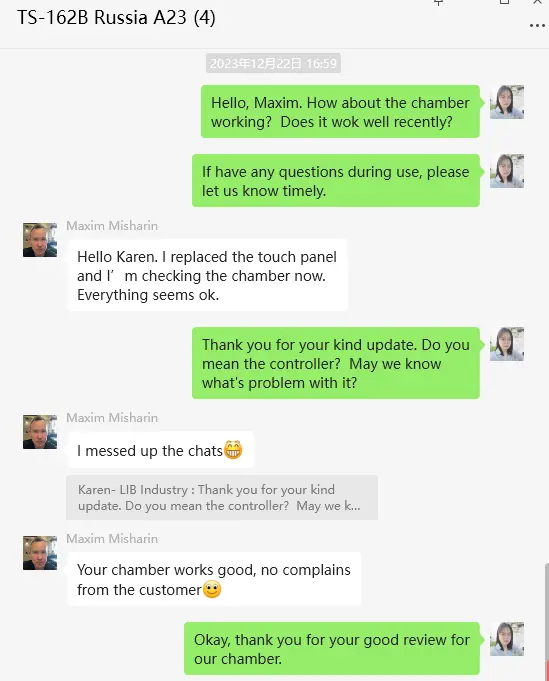
The fast temperature transfer significantly accelerated their reliability verification process, allowing potential failures to be identified much earlier in the product development stage. According to the customer, the system has been running stably with very low maintenance requirements, delivering highly consistent and repeatable results. As a result, the thermal shock testing system has become a key part of their aerospace component quality assurance workflow.
How Do Temperature Cycles Affect PCB Reliability?
Coefficient of Thermal Expansion Mismatch
PCBs consist of diverse materials - copper, FR-4 laminate, solder alloys, and epoxy resins - each expanding and contracting at different rates when temperature changes. This coefficient of thermal expansion (CTE) mismatch generates internal stress at every material interface. When a board transitions from -65°C to +200°C rapidly, the differential expansion can reach magnitudes that exceed the elastic limit of bonding layers, initiating fractures that compromise electrical performance.
Fatigue Accumulation Across Repeated Cycles
A single temperature swing may not cause visible damage. Repeated cycling, however, accumulates fatigue in copper traces, barrel walls of plated through-holes, and solder interconnects. Each cycle introduces micro-level plastic deformation. Over hundreds or thousands of transitions, these cumulative strain events nucleate cracks that propagate until open circuits or intermittent failures emerge - problems nearly impossible to detect without dedicated thermal cycling equipment.
Impact on Via Structures and Plated Through-Holes
Vias and plated through-holes serve as critical vertical interconnects in multilayer PCBs. During rapid thermal excursions, the Z-axis expansion of the laminate exerts tensile stress on via barrel plating. Thin copper plating is particularly susceptible. Thermal shock testing reveals barrel cracks and corner cracks at via-to-pad junctions, allowing engineers to optimize plating thickness, aspect ratios, and material selection before volume production.
Thermal Stress Risks in Multilayer Printed Circuit Boards
.jpg "blog-1-1")
Layer-to-Layer Adhesion Under Rapid Temperature Shifts
Multilayer PCBs rely on resin-rich prepreg layers bonding copper foils and core materials together. Rapid heating and cooling challenge this adhesion. When internal moisture vaporizes at elevated temperatures or when CTE differences flex adjacent layers in opposing directions, separation between laminate layers - known as delamination - can occur. A thermal shock test chamber exposes these adhesion weaknesses within controlled cycle counts.
Copper Trace Fracture and Pad Lifting
Fine-pitch copper traces on high-density boards face elevated risk during temperature extremes. The mechanical stress from substrate expansion can lift pads from the laminate surface or fracture narrow traces at stress concentration points such as sharp corners and via transitions. Identifying these failure modes early through thermal shock machine testing prevents costly recalls and warranty claims.
Resin System Degradation at Extreme Temperatures
Epoxy and polyimide resin systems used in PCB fabrication have defined glass transition temperatures (Tg). Operating above Tg during the hot chamber phase softens the resin matrix, reducing its mechanical support for copper features. Repeated exposure accelerates oxidation and chemical decomposition of the resin, degrading dielectric properties. Thermal shock validation quantifies how quickly a specific resin system deteriorates under worst-case conditions.
Table 1: Common Thermal Stress Failure Modes in PCBs
|
Failure Mode |
Location |
Primary Cause |
Detection Method |
|
Barrel Crack |
Plated Through-Hole |
Z-axis CTE mismatch |
Cross-sectional analysis |
|
Delamination |
Inner layers |
Moisture, adhesion loss |
Acoustic microscopy |
|
Solder Joint Fracture |
BGA / SMD pad |
Cyclic fatigue |
X-ray, electrical test |
|
Pad Lifting |
Surface layer |
Thermal expansion stress |
Visual inspection |
|
Trace Fracture |
Fine-pitch routing |
Substrate flexure |
Continuity monitoring |
Industry Standards for PCB Thermal Shock Testing
IPC-TM-650 and MIL-STD-202 Requirements
IPC-TM-650 outlines specific test methods for evaluating PCB materials and assemblies, including thermal shock and thermal cycling protocols. MIL-STD-202 applies to electronic component parts destined for military and defense applications, mandating stringent temperature transition profiles. Both standards define acceptable temperature ranges, dwell times, and transition durations that test chambers must achieve to produce valid, repeatable results.
Automotive and Aerospace Compliance Benchmarks
The automotive sector follows AEC-Q100 and AEC-Q200 qualification standards, requiring components to survive thousands of thermal cycles between -40°C and +125°C (or wider ranges for under-hood applications). Aerospace specifications push extremes further, often demanding cycling from -65°C to +200°C. Meeting these benchmarks necessitates chambers capable of rapid recovery - ideally within 5 minutes - and precise temperature control with fluctuation no greater than ±0.5°C.
Cycle Count and Dwell Time Specifications
Standards prescribe specific numbers of cycles - sometimes 500, 1000, or even 2000 - depending on the reliability class of the PCB assembly. Dwell time at each temperature extreme allows the specimen to reach thermal equilibrium, ensuring uniform stress distribution. The combination of cycle count, dwell duration, and transition speed determines the severity of the test and its correlation to actual field life.
Table 2: Typical Thermal Shock Test Parameters by Industry
|
Industry |
Temperature Range |
Cycle Count |
Dwell Time |
Transition Time |
|
Consumer Electronics |
-40°C to +85°C |
500 |
10-15 min |
≤ 5 min |
|
Automotive |
-40°C to +125°C |
1,000 |
15-30 min |
≤ 5 min |
|
Aerospace |
-65°C to +200°C |
1,000-2,000 |
15-30 min |
≤ 5 min |
|
Military / Defense |
-65°C to +200°C |
1,000+ |
15-30 min |
≤ 5 min |
Testing Solder Joint Integrity and Interconnect Stability
BGA and SMD Solder Joint Vulnerability
Ball grid array (BGA) and surface mount device (SMD) solder joints represent some of the most thermally vulnerable interconnects on a PCB. The mismatch between the CTE of the silicon die, solder ball, and organic substrate concentrates stress at the joint interface. Thermal shock cycling accelerates crack initiation at the outermost solder balls - where strain is highest - revealing reliability limits that correlate with years of field service.
Intermetallic Compound Growth Under Thermal Stress
At elevated temperatures, intermetallic compounds (IMCs) form and grow at the solder-copper interface. While a thin IMC layer indicates good metallurgical bonding, excessive growth produces a brittle zone prone to fracture. Repeated high-temperature exposure during thermal cycling accelerates IMC thickening, and post-test cross-sectional analysis provides measurable data on growth rate and its impact on joint mechanical strength.
Electrical Continuity Monitoring During Testing
Advanced thermal shock test setups using thermal shock test equipment incorporate in-situ resistance monitoring to track electrical continuity throughout the cycling process. A sudden spike in resistance signals crack propagation or a complete open circuit at a solder joint. This real-time data pinpoints the exact cycle at which failure occurs, enabling engineers to build precise Weibull reliability models and define safe operating margins for their designs.
Identifying Delamination and Microcrack Formation in PCBs
Visual and Cross-Sectional Analysis Post-Test
After completing the prescribed thermal shock cycles, technicians section the PCB at critical locations - via clusters, BGA footprints, and high-stress routing areas. Optical microscopy at 50× to 500× magnification reveals barrel cracks, lifted pads, and resin separation. This post-test metallographic evaluation remains one of the most direct and definitive methods for confirming structural integrity.
Acoustic Microscopy for Internal Defect Detection
Scanning acoustic microscopy (SAM) offers a non-destructive alternative for detecting internal delamination. Ultrasonic waves reflect at interfaces where voids, disbonds, or cracks are present. By comparing pre-test and post-test SAM images, engineers can map the progression of internal damage without destroying the sample. This capability proves especially valuable when specimens must undergo additional analysis or continued testing.
Root Cause Correlation Between Thermal Profiles and Failures
Linking specific failure modes to particular temperature profiles provides actionable intelligence. If delamination appears predominantly after hot-chamber exposure above +180°C, the resin system's thermal limits may need re-evaluation. If barrel cracks emerge after cold-chamber dwell at -65°C, copper plating thickness may require adjustment. A well-characterized thermal shock program transforms raw failure data into targeted design improvements.
Enhancing Long-Term PCB Reliability Through Thermal Shock Validation
Accelerated Life Testing and Field Failure Prediction
Thermal shock testing compresses years of thermal cycling into days or weeks of chamber operation. Acceleration factors derived from Arrhenius or Coffin-Manson models allow engineers to extrapolate chamber results to expected field life. A PCB assembly that survives 1,000 cycles between -65°C and +200°C may correlate to 10+ years of reliable service in an automotive engine compartment - a prediction credible only through validated test data.
Design-for-Reliability Feedback Loops
Test results feed directly back into the design cycle. When a particular via structure fails at 600 cycles, designers can modify the aspect ratio, switch to a higher-Tg laminate, or add tear-drop pads to redistribute stress. Re-testing the revised design confirms whether the modification resolves the issue. This iterative loop, powered by thermal shock chamber data, elevates product robustness with each design revision.
Cost Savings Through Early Defect Screening
Catching defects at the prototype or pilot-production stage is dramatically less expensive than addressing field failures. Warranty claims, product recalls, and brand damage carry costs that dwarf the investment in a quality test chamber. PCB manufacturers who integrate thermal shock validation into their quality assurance workflow report measurable reductions in customer returns and improved lot acceptance rates across production runs.
Precision Thermal Cycling for High-Density Circuit Boards - LIB Industry
|
LIBAir-to-Air Thermal Shock Chamber |
|
|||||||||


|
|
|
|
Test Basket |
The Controller |
|
|
|
|
Cable Hole |
Castor |


Temperature Range and Recovery Performance
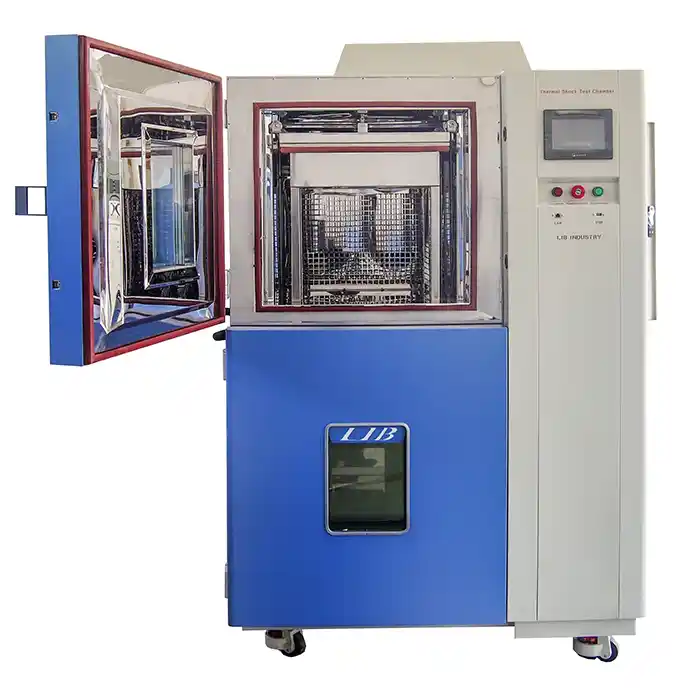
LIB Industry's thermal shock test chamber delivers a temperature range spanning -70°C to +200°C, covering the full spectrum of PCB testing requirements from consumer electronics to aerospace. The chamber achieves temperature recovery within 5 minutes, ensuring that transition time specifications mandated by IPC and MIL standards are consistently met. Temperature fluctuation stays within ±0.5°C, and deviation remains within ±3°C for uniform specimen exposure.
Model Options and Chamber Specifications
LIB offers four chamber models - TS-162, TS-340, TS-500, and TS-1000 - ranging from 22L to 505L interior volume. The specimen basket transfers automatically between cold and hot compartments along a vertical rail, eliminating manual handling and ensuring repeatable transition timing. A French TECUMSEH compressor powers the mechanical compression refrigeration system, using environmentally friendly refrigerant.
Table 3: LIB Industry Thermal Shock Test Chamber Specifications
|
Specification |
TS-162 |
TS-340 |
TS-500 |
TS-1000 |
|
Internal Dimensions (mm) |
300×300×250 |
450×450×360 |
650×650×500 |
850×850×700 |
|
Interior Volume |
22 L |
72 L |
211 L |
505 L |
|
Loading Capacity |
20 kg |
30 kg |
50 kg |
60 kg |
|
Overall Dimensions (mm) |
1560×870×1545 |
1710×1020×1845 |
1910×1220×2265 |
2110×1420×2665 |
Key Features That Support PCB Testing Programs
The programmable color LCD touch screen controller with Ethernet connectivity allows engineers to store, recall, and share custom temperature profiles across facilities. Safety devices - including over-temperature, over-current, refrigerant high-pressure, and earth leakage protection - safeguard operators and specimens alike. The SUS304 stainless steel interior resists corrosion, while a double-layer observation window with interior lighting enables real-time visual monitoring without interrupting the test cycle.
Conclusion
Thermal shock test chambers serve as indispensable instruments in PCB manufacturing, bridging the gap between laboratory validation and real-world performance. From exposing CTE-driven via failures to qualifying solder joints against automotive and aerospace standards, these chambers provide the data that drives confident design decisions. Accelerated thermal cycling compresses field-life simulation into manageable timeframes, while early defect detection reduces downstream costs. For manufacturers producing high-density, multilayer circuit boards, investing in precise and reliable thermal shock testing equipment is not optional - it is a foundational element of a credible quality assurance program.
FAQ
What temperature range is suitable for PCB thermal shock testing?
Most PCB thermal shock tests operate between -65°C and +200°C, depending on the application sector. Automotive and aerospace standards often require the widest ranges to simulate harsh operating environments faithfully.
How many thermal shock cycles are typically required for PCB qualification?
Cycle counts vary by standard and reliability class, commonly ranging from 500 to 2,000 cycles. Higher-reliability applications such as military and aerospace electronics demand more cycles paired with extended dwell times at each extreme.
Can thermal shock testing detect internal PCB defects like delamination?
Thermal shock cycling induces stress that exposes internal defects including delamination and barrel cracks. Post-test analysis using cross-sectional microscopy or scanning acoustic microscopy confirms the presence and extent of internal damage.
Looking for a trusted thermal shock test chamber manufacturer and supplier? LIB Industry provides turn-key environmental testing solutions - from design and production to installation and training. Contact us at ellen@lib-industry.com to discuss your PCB testing requirements.