EV Battery Thermal Cycling Test Chamber: How It Extends Battery Life by Up to 25%
Electric vehicle batteries endure thousands of temperature swings over their operational life — from sub-zero winter charging to scorching highway drives in summer. Each swing quietly stresses the cell chemistry, and unless manufacturers catch the weak points before mass production, those weak points resurface later as warranty claims, range complaints, or field safety incidents that damage brand reputation.
Thermal cycling testing solves this by subjecting cells, modules, and packs to controlled, repeated temperature extremes — compressing years of real-world aging into weeks of lab testing. This proactive validation reveals material incompatibilities, electrode degradation, and electrolyte breakdown mechanisms early enough to act on. Done well, it reduces warranty claims by up to 40% and extends usable battery life by 15–25%.
LIB Industry designs and manufactures the thermal cycling test chambers that make this level of validation possible — from single-cell R&D units to full pack-level systems housing 50 kWh assemblies, backed by a 3-year warranty and lifetime technical support on every unit. Below, we break down why this testing matters, what it reveals, and how to choose the right chamber for your program.
Why EV Batteries Demand Rigorous Thermal Cycling
_1773978265968.jpg "blog-1-1") CTE Mismatches. A battery pack stacks materials with very different thermal expansion rates — aluminum housings, graphite anodes, copper collectors, polymer separators. Cycling between -20°C and +60°C, common in daily driving, generates real mechanical stress at every interface. Over time this causes micro-cracking in electrode coatings, delamination at current collectors, and separator punctures that can create internal short-circuit pathways. LIB Industry's TR5 series supports programmable ramp rates of 5–15°C/min, letting engineers replicate the exact stress accumulation pattern their pack design will face in the field, rather than a generic worst-case guess.
CTE Mismatches. A battery pack stacks materials with very different thermal expansion rates — aluminum housings, graphite anodes, copper collectors, polymer separators. Cycling between -20°C and +60°C, common in daily driving, generates real mechanical stress at every interface. Over time this causes micro-cracking in electrode coatings, delamination at current collectors, and separator punctures that can create internal short-circuit pathways. LIB Industry's TR5 series supports programmable ramp rates of 5–15°C/min, letting engineers replicate the exact stress accumulation pattern their pack design will face in the field, rather than a generic worst-case guess.
Electrolyte Stability. Lithium-ion electrolytes rely on organic solvents and lithium salts to maintain ionic conductivity across a wide temperature range. Below freezing, viscosity spikes and lithium-ion mobility drops, raising internal resistance. Above 45°C, side reactions accelerate and build resistive SEI layers that consume active lithium. Mapping this behavior accurately requires precision tight enough that the data isn't noise — which is why LIB chambers hold ±0.5°C fluctuation throughout multi-week test cycles.
Capacity Fade Acceleration. Battery capacity fades through several temperature-dependent mechanisms running concurrently: lithium plating during cold-temperature charging, transition metal dissolution at elevated temperatures, and more. A pack subjected to 1,000 thermal cycles between -40°C and +85°C reveals capacity fade patterns equivalent to roughly 8–10 years of real-world vehicle operation — turning a decade-long reliability question into a testing program your team can complete this quarter.
How Temperature Cycling Drives Lithium-Ion Degradation
· SEI layer evolution: The solid-electrolyte interphase forms on the graphite anode during initial charging to protect against further electrolyte decomposition. Heat causes it to expand and partially dissolve; cooling causes it to contract and crack. Each cycle chips away at SEI integrity, exposing fresh graphite that consumes more lithium. Studying this evolution requires programmable, multi-segment temperature profiles — a core capability of LIB's touchscreen controllers, which store unlimited profiles with up to 100 segments each.
· Cathode structural degradation: Nickel-rich cathodes (NMC 811, NCA) deliver excellent energy density but are structurally fragile under heat. Elevated temperatures cause nickel ions to migrate out of position, degrading the ordered crystal structure into a disordered rock-salt phase that can no longer intercalate lithium — and repeated cycling accelerates this transformation.
· Separator shrinkage: Polyethylene separators become brittle and shrink significantly above 90°C, risking short-circuit pathways. Even within normal ranges, repeated cycling gradually reduces separator mechanical strength. Because moisture can confound these results, LIB chambers include anti-condensation protection, ensuring degradation data reflects thermal stress alone — not humidity artifacts.
|
Temperature Range |
Primary Degradation Mechanism |
Capacity Loss Rate |
Testing Duration |
|
-40°C to -20°C |
Lithium plating; electrolyte solidification |
0.5–1.2% per 100 cycles |
3–4 weeks |
|
-20°C to +25°C |
SEI layer growth; mechanical stress |
0.2–0.4% per 100 cycles |
6–8 weeks |
|
+25°C to +60°C |
Electrolyte decomposition; cathode dissolution |
0.3–0.6% per 100 cycles |
5–6 weeks |
|
+60°C to +85°C |
Accelerated aging; separator shrinkage |
1.0–2.5% per 100 cycles |
2–3 weeks |
|
|
|||

Catching Manufacturing Defects Before They Reach the Field
Thermal cycling is also one of the most effective ways to surface manufacturing defects that stay dormant under constant-temperature operation but manifest under real thermal stress.
· Electrode coating adhesion failures, caused by contamination, improper drying, or suboptimal binder ratios, often go unnoticed until differential expansion under thermal cycling creates interfacial shear stress and delamination. LIB's SUS304 stainless steel interiors and uniform airflow prevent localized hot spots that would otherwise produce false positives.
· Weld and connection joint fatigue occurs at aluminum-to-copper tab connections due to CTE mismatch between dissimilar metals. Precise, repeatable heating and cooling rates (around 10°C/min average) reveal weld joints with insufficient penetration before they fail prematurely in the field.
· Seal integrity issues in crimped or laser-welded cells can allow moisture ingress, triggering electrolyte hydrolysis and hydrofluoric acid generation. LIB chambers with observation windows and double-layer thermo-stability silicone sealing let engineers visually monitor cell swelling or venting in real time during a thermal event.
Simulating Real-World Driving Conditions in the Lab
A chamber is only as useful as its ability to mirror what actually happens on the road.
· Daily commute profiles, such as a morning cold-start near -10°C warming to +45°C during afternoon highway driving, are easily built and saved with LIB Industry's Ethernet-connected, PC Link-enabled controllers, so different vehicle segments can each run their own representative cycle.
· Fast-charging thermal shock, where a 150–350 kW DC fast charge can push a cell from 0°C to 40°C internally within 15–20 minutes, demands chambers capable of 15°C/min ramp rates to replicate that heating gradient accurately across cell layers.
· Seasonal storage extremes — batteries soaking at -30°C overnight or +70°C inside a sun-exposed vehicle — call for extended dwell testing (holding at -40°C or +85°C for 72 hours) combined with periodic charge-discharge cycling to assess long-term resilience.
Meeting Global EV Battery Safety Standards
|
Safety Standard |
Temperature Requirement |
Pass/Fail Criteria |
LIB Chamber Capability |
|
UN 38.3 Test T.3 |
+72°C to -40°C, 10 cycles |
No venting, leakage, or fire |
-40°C to +150°C range |
|
UL 2580 Thermal Shock |
-40°C to +85°C rapid transition |
Maintain electrical isolation |
5–15°C/min programmable rates |
|
ISO 12405-2 |
Per manufacturer specification |
<20% capacity loss after 1,000 cycles |
±0.5°C precision control |
Whether you're certifying for UN 38.3 transport safety, UL 2580 propulsion battery safety, or ISO 12405 / SAE J2464 performance standards, LIB Industry chambers are built with the temperature range, ramp-rate precision, and data-logging capability needed to generate audit-ready compliance records — with third-party validation from SGS and TUV, and ISO 9001 quality certification behind every unit.
Turning Test Data Into Better Battery Design
· Electrolyte additive optimization: Vinylene carbonate improves SEI stability but decomposes at elevated temperatures; fluoroethylene carbonate enhances low-temperature performance but adds cost. Running formulations through identical protocols on LIB's programmable controllers quantifies capacity retention and impedance growth for a valid comparison.
· Thermal interface material (TIM) selection: TIMs can maintain thermal conductivity while degrading mechanically under cycling stress, creating gaps that reduce heat transfer. Testing complete modules within LIB's larger-volume chambers (800L, 1000L) evaluates TIM performance under realistic packaging constraints.
· Manufacturing process validation: Subtle variations — coating thickness uniformity, electrolyte fill procedures — significantly affect thermal cycling performance. Statistically testing 30–50 cells from each production batch through 300–500 cycles catches process drift before it causes widespread field failures.
LIB Industry Chambers: Built for Every Stage of EV Battery Development
|
|
|
|
| Robust Workroom | Cable Hole | Romote Contro |


Selecting the right chamber means matching capability to the scale of what you're testing.
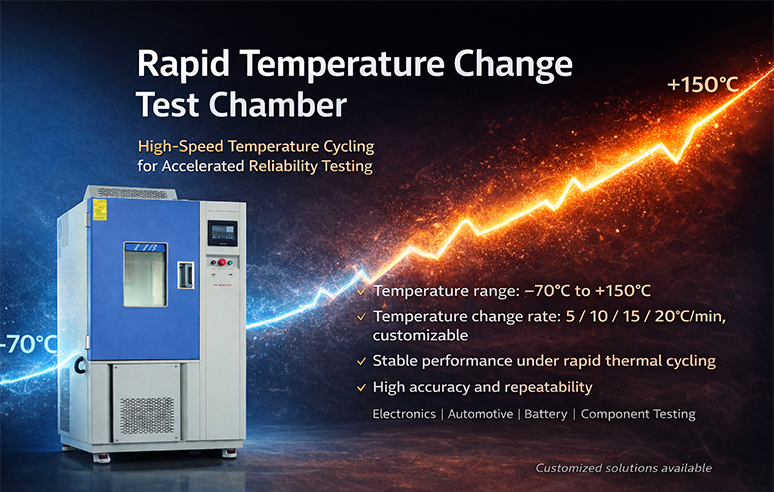
· Cell-Level Testing — TR5-100 (100L): Compact footprint (400×500×500mm internal), accommodates up to 100 cylindrical cells with instrumentation. -70°C to +150°C range, 5°C/min heating and cooling.
· Module Testing — TR5-225 to TR5-500: Sized for production-representative module assemblies, including 400V configurations, with temperature uniformity held within ±2.0°C.
· Pack-Level Validation — TR5-800 to TR5-1000: Full-scale chambers for complete pack thermal management validation, with the 1000L configuration accommodating packs up to 50 kWh.
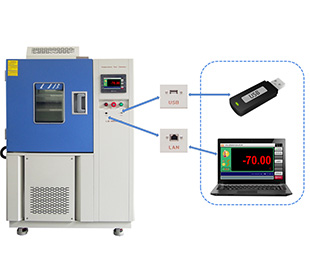
Engineering behind the spec sheet: cascade refrigeration with French Tecumseh compressors, rated for reliable operation through tens of thousands of temperature cycles; electronic expansion valves (EEV) cutting energy consumption by more than 20% while improving control during rapid transitions; nichrome open ceramic-core heating elements delivering uniform heat even at 15°C/min ramp rates; and PT100Ω/MV A-class temperature sensors offering 0.1°C resolution, with Ethernet and PC Link integration for synchronized voltage, current, and capacity data alongside temperature.
Backed by a 3-Year Warranty and Lifetime Technical Support
A thermal cycling chamber runs unattended for tens of thousands of cycles over many years — downtime doesn't just cost money, it delays certification timelines and product launches.
Every LIB Industry chamber includes:
· A 3-year warranty covering core components — compressors, refrigeration circuits, heating elements, and control systems — so unexpected failures don't become unplanned capital expense.
· Lifetime technical support, with direct access to our engineering team for troubleshooting, protocol setup, calibration guidance, and software updates, for as long as you own the chamber.
· Responsive global service, including remote diagnostics and access to genuine replacement parts, minimizing the time a chamber sits offline during a critical test campaign.
For manufacturers running continuous, multi-week thermal cycling programs to meet UN 38.3, UL 2580, or ISO 12405 deadlines, this level of after-sales commitment is often the deciding factor between suppliers with similar specifications on paper.
You May Also Need
Thermal cycling is usually one piece of a complete EV battery validation program. LIB Industry also supplies:
|
Battery Cyclers & Charge-Discharge Test Systems — for synchronized electrical and environmental testing. |
— validate moisture resistance per IEC 60068 and GB/T standards. |
Vibration & Mechanical Shock Systems — simulate transport and road conditions per UN 38.3 and SAE J2380. |
Thermal Runaway & Nail Penetration Chambers — for abuse and safety testing under GB 38031 and UL 2580. |


Ask our team for a bundled quote if you're building a full battery test lab.
Ready to Validate Your Battery Design?
Thermal cycling testing has moved from "nice to have" to a competitive requirement — the manufacturers extending warranty periods and winning on reliability are the ones catching failure modes in the lab, not in the field. Every chamber ships with a 3-year warranty and lifetime technical support, so your investment stays protected well beyond the initial certification cycle.
Talk to a thermal testing specialist: ellen@lib-industry.com Request the full TR5 series spec sheet, pricing, and warranty terms Book a 20-minute consultation to scope your testing program
FAQ
What temperature ramp rate should I use for EV battery thermal cycling testing?
Most programs use 5–15°C/min depending on the objective. Moderate rates (5–10°C/min) replicate normal driving thermal gradients and reveal manufacturing defects, while aggressive rates (10–15°C/min) simulate fast-charging thermal shock and accelerate test schedules. LIB Industry chambers support the full range with programmable ramp control.
How many thermal cycles are needed to validate EV battery longevity?
Industry practice typically calls for 500–1,000 cycles for comprehensive reliability validation. Cycling between -40°C and +85°C for 1,000 cycles approximates 8–12 years of real-world operation, aligning with typical 8-year/100,000-mile EV warranty periods. Premium designs targeting 15-year service life often extend testing to 2,000+ cycles.
Can thermal cycling testing actually predict real-world warranty failure rates?
Yes, when paired with tight temperature control. Accelerated aging data correlates with field performance when a chamber holds precision within ±0.5°C — which is what makes results repeatable enough to support reliability modeling and warranty cost projections, rather than just qualitative pass/fail outcomes.