How Does a Climatic Test Chamber Ensure 25-Year Reliability for Solar, Wind, and Battery Renewable Energy Systems?
Renewable energy products face extreme environmental conditions throughout their 20–30 year operational lifespans, making rigorous climatic validation essential for commercial viability. Solar panels endure desert heat exceeding 85°C, wind turbine electronics withstand arctic temperatures below -40°C, and battery storage systems cycle through daily humidity fluctuations. A climatic test chamber replicates these harsh conditions in controlled laboratory settings, enabling manufacturers to verify performance, identify design vulnerabilities, and achieve international certifications before field deployment. This article walks through why renewable energy testing depends on climatic chambers, which IEC/UL standards govern the process, how to select the right chamber size, and how LIB Industry's TH-series equipment and after-sales support fit into that validation workflow.
Why Renewable Energy Systems Require Climatic Testing Validation
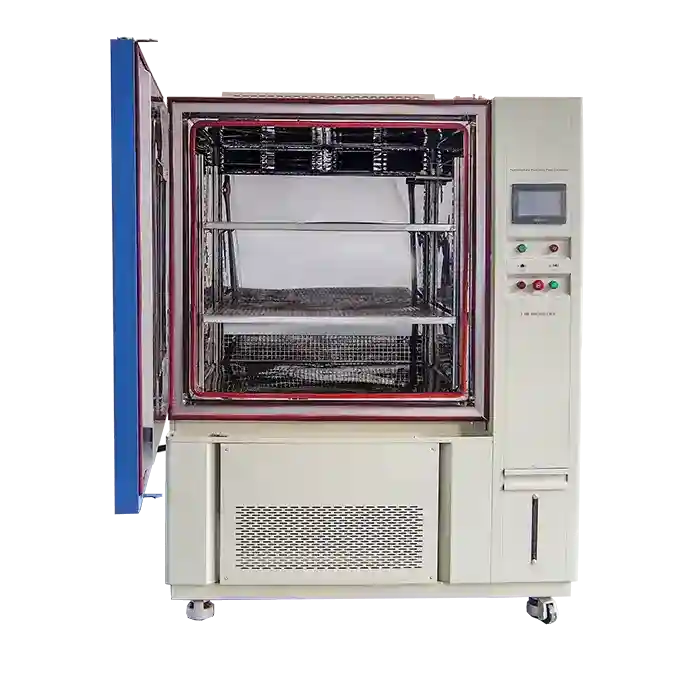 The renewable energy sector operates under unique pressures that elevate environmental chamber testing from optional quality assurance to mandatory business survival.
Extended service life expectations. Unlike consumer electronics replaced every 3–5 years, renewable energy installations must deliver reliable performance for 25–30 years to achieve economic viability. Solar photovoltaic systems typically warranty 80% power output after 25 years, and battery energy storage systems need 15-year calendar life with minimal capacity degradation. Climatic test chambers with temperature ranges from -70°C to +150°C enable accelerated aging studies that compress decades of field exposure into controlled testing timeframes.
Geographic deployment diversity. Renewable energy infrastructure deploys across every climate zone on Earth — from Saharan installations experiencing 50°C surface temperatures to Scandinavian sites enduring -40°C winters. Manufacturers cannot field-test in every deployment environment, so climatic chambers fill that gap by programming temperature-humidity profiles that match a target region without leaving the lab.
Certification and insurance requirements. International standards mandate comprehensive environmental qualification before a product reaches market, and insurance underwriters increasingly demand documented proof of that testing before releasing project coverage.
Which International Standards Require Climatic Chamber Testing for Solar, Wind, and Battery Products?
Every major renewable energy component category has a dedicated environmental testing standard, and all of them are performed inside a climatic chamber:
IEC 61215 (photovoltaic modules) — thermal cycling, damp heat, and humidity-freeze testing
UL 1703 (PV module safety) — fire, electrical, and environmental qualification
IEC 61427 (batteries for renewable energy storage) — cycle life and calendar aging under temperature control
IEC 61400 (wind turbine components) — environmental qualification of power electronics and control systems
Insurance underwriters and project financiers increasingly ask for documented proof of compliance with these standards before releasing coverage or capital, which means the climatic chamber sits at the center of both technical validation and financial bankability.
IEC 61215 Test Sequence at a Glance
| IEC 61215 Test | Environmental Conditions | Duration | Degradation Mechanism Revealed |
|---|---|---|---|
| Thermal Cycling (TC200) | -40°C to +85°C, 200 cycles | 1,200–1,500 hours | Solder fatigue, delamination |
| Damp Heat (DH1000) | +85°C, 85% RH constant | 1,000 hours | Corrosion, encapsulant degradation |
| Humidity-Freeze (HF10) | +85°C/85% RH to -40°C, 10 cycles | 240 hours | Ice damage, adhesion failures |
Environmental Stress Factors That Threaten Solar Panels and Battery Storage Systems
Real-world degradation rarely comes from a single stress factor — heat, humidity, and thermal cycling interact and compound each other. The table below summarizes how each stressor affects the two most common renewable energy product categories.

| Environmental Stressor | Solar PV Impact | Battery Storage Impact |
|---|---|---|
| High Temperature (+85°C) | Encapsulant degradation, solder fatigue | Electrolyte decomposition, capacity loss |
| Low Temperature (-40°C) | Glass breakage, interconnect fracture | Lithium plating, reduced power capability |
| High Humidity (98% RH) | Corrosion, potential-induced degradation | Terminal corrosion, seal failures |
| Thermal Cycling | Delamination, microcracks | Electrode coating detachment |
Crystalline silicon PV efficiency drops roughly 0.4–0.5% for every degree Celsius above the 25°C standard test condition, which is why chambers capable of holding realistic 60–85°C operating temperatures — not just the 25°C datasheet condition — are essential for validating real-world energy yield claims.
How LIB Industry's Climatic Test Chambers Simulate Real Renewable Energy Field Conditions
 |
 |
|
|
|
|
|
|
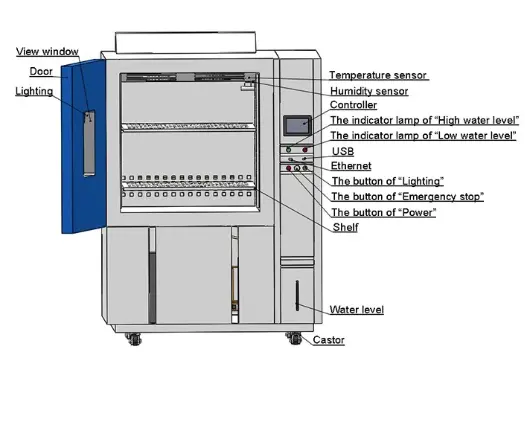
| Robust Workroom | Cable Hole | Temperature and Humidity Sensor | PID controller | |


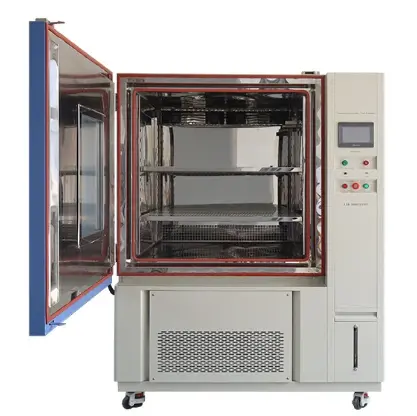
LIB Industry designs its chambers specifically to reproduce the diurnal cycling, seasonal shifts, and combined temperature-humidity profiles that solar, wind, and battery products actually experience in the field:
Cascade refrigeration with French Tecumseh compressors delivers temperatures down to -70°C reliably across tens of thousands of operating hours.
Stainless steel surface-evaporation humidifiers with automatic water purification hold humidity steady from 20% to 98% RH, even during 1,000-hour damp heat runs.
Programmable color LCD touchscreen controllers store 120 programs with 100 segments each, so engineers can chain together desert, monsoon, and winter profiles inside a single unattended test campaign.
304 stainless steel interior and polyurethane foam insulation maintain temperature uniformity within ±0.5°C and deviation within ±2.0°C across the full test volume.
Double-layer tempered glass observation windows and built-in interior lighting let engineers monitor specimens in real time without opening the chamber — critical for destructive battery abuse testing.
Related Products for a Complete Renewable Energy Testing Lab
A climatic chamber rarely works alone — most renewable energy qualification programs pair it with other environmental and mechanical test equipment to cover the full range of field stresses. LIB Industry's related product lines include:
|
Thermal Shock Test Chambers — for rapid hot/cold transition testing (typically under 3 seconds transfer time), simulating sudden temperature swings such as cloud transients hitting a hot PV module. |
Salt Spray / Corrosion Test Chambers — for evaluating junction box, connector, and mounting hardware corrosion resistance in coastal or high-humidity installations, complementing damp heat testing. |
Vibration Test Systems — for validating transportation and mounting durability of battery packs and inverter assemblies, often combined with climatic chambers for temperature-vibration combined testing. |
Walk-In Environmental Rooms — for large-scale testing of full battery racks, containerized energy storage systems, or multiple PV modules simultaneously, when a benchtop chamber's volume isn't sufficient. |


TH-100 vs. TH-500 vs. TH-1000: Which LIB Climatic Chamber Fits Your Renewable Energy Testing Program?
Chamber selection depends on what you're testing — a battery management system, a full battery module, or a complete solar panel. LIB Industry's product line covers all three scales:
| Model | Chamber Volume | Typical Test Article | Temperature Range | Best For |
|---|---|---|---|---|
| TH-100 | 100 L | BMS boards, inverter assemblies, power electronics | -70°C to +150°C | Component-level qualification |
| TH-225 to TH-500 | 225–500 L | Battery modules, junction boxes | -70°C to +150°C, ±2.0°C uniformity | Module-level reliability testing |
| TH-800 to TH-1000 | 800–1,000 L | Full-size PV modules, battery packs | -70°C to +150°C | IEC 61215 full-module certification |
For most manufacturers pursuing IEC 61215 certification of standard 1640mm × 990mm panels, the TH-1000 is the right starting point — its 1000×1000×1000mm usable volume accommodates a full module plus clearance for electrical characterization cabling at temperature extremes.
Real Customer Feedback: LIB Climatic Chambers in Renewable Energy Testing Labs
LIB Industry has delivered climatic test chambers to solar module manufacturers, battery pack assemblers, and independent certification labs across multiple regions. Customer feedback consistently highlights three things: on-time delivery, hands-on installation training, and responsiveness when unusual test protocols come up mid-project. Engineering teams have reported successfully running IEC 61215 thermal cycling and damp heat sequences back-to-back on LIB chambers without unplanned downtime, and battery testing labs have used the double-layer observation windows to safely document thermal runaway abuse tests for internal safety reports.
Frequently Asked Questions About Climatic Chambers for Renewable Energy Testing
1. What climatic test chamber size is required for standard solar panel testing? Standard solar panels (1640mm × 990mm) need a minimum 800–1,000L chamber to allow clearance for air circulation and cabling. LIB's TH-1000 provides 1000×1000×1000mm of usable space suited to IEC 61215 certification testing.
2. How long does IEC 61215 thermal cycling take in a climatic chamber? The TC200 sequence requires 200 complete cycles between -40°C and +85°C, with each cycle including dwell time and electrical characterization. Full testing typically takes 1,200–1,400 hours, or roughly 50–60 days of continuous chamber operation.
3. Can one climatic chamber replicate both desert and tropical deployment conditions? Yes. A chamber with -70°C to +150°C range and 20–98% RH humidity control can reproduce nearly any terrestrial climate — a desert profile (+55°C, 15% RH) and a tropical profile (+35°C, 95% RH) can be programmed as separate segments within the same test campaign.
4. What warranty and after-sales support does LIB Industry provide with its climatic chambers? LIB Industry backs every chamber with a 3-year warranty and lifetime technical support, so customers are never left without a service path once the warranty period ends. Response times and spare-parts availability are structured to minimize test-campaign downtime.
5. Does LIB Industry offer non-standard or custom-built climatic chambers? Yes. Beyond the standard TH-series, LIB Industry's engineering team designs non-standard, custom-configured chambers — larger interior volumes, specialized fixtures, or combined altitude/vibration testing — built on LIB's own full in-house production line, with one-stop service covering design consultation, manufacturing, installation, and operator training.
6. Do I need separate chambers for solar, wind, and battery testing? Not necessarily. Component-level chambers like the TH-100 can serve power electronics common to solar, wind, and battery systems, while module- and full-size chambers (TH-500 to TH-1000) can be shared across product lines if scheduling allows — a factor worth discussing with LIB's engineering team when planning lab capacity.
Partner with LIB Industry for Renewable Energy Environmental Testing
Climatic chamber testing is what turns a 25-year warranty claim into a defensible engineering fact — revealing solder fatigue, corrosion, and capacity fade months before they would otherwise surface in the field. Whether you're qualifying a single BMS board or certifying a full production line of PV modules, LIB Industry's TH-series chambers, backed by a 3-year warranty, lifetime service, and full custom-build capability, are built to support that validation from R&D through certification.
Contact LIB Industry's engineering team at ellen@lib-industry.com to discuss your renewable energy testing requirements, request a technical proposal, or get a quote on a standard or custom climatic test chamber.