IP6X Dust Testing for Automotive Component Protection
IP6X dust testing verifies that automotive components achieve complete protection against fine particulate ingress - a classification defined by IEC 60529 as "dust-tight." Modern vehicles contain hundreds of electronic modules, sensors, and sealed assemblies exposed to airborne particulates from unpaved roads, construction zones, and desert terrain. A DI-2000 IP6X dust chamber replicates these harsh conditions by circulating talcum powder (50 µm nominal wire diameter, 75 µm gap width) around test specimens under controlled vacuum differential pressure. When a component earns IP6X certification, it confirms zero dust penetration into the enclosure after prolonged exposure. This testing proves indispensable for automotive manufacturers aiming to deliver long-lasting, field-reliable products across global markets with diverse environmental challenges.
LIB industry’s IP6X dust test chambers are widely adopted by global manufacturers for their ability to accurately recreate harsh, particle-heavy environments. In real-world use, their stability and consistency have been validated through routine laboratory operations.
For instance, Principal Engineer at Halcon R&D Laboratories in the UAE, shared on September 23, 2025: “I use the Rain and Dust Chambers quite often. We have recently calibrated it for the next year. All is functioning well, thanks.”
Such feedback highlights the chamber’s dependable day-to-day performance, demonstrating its value not just in controlled testing scenarios, but in ongoing, high-frequency industrial applications.

What Does IP6X Certification Mean for Automotive Components?
Decoding the IP Rating System
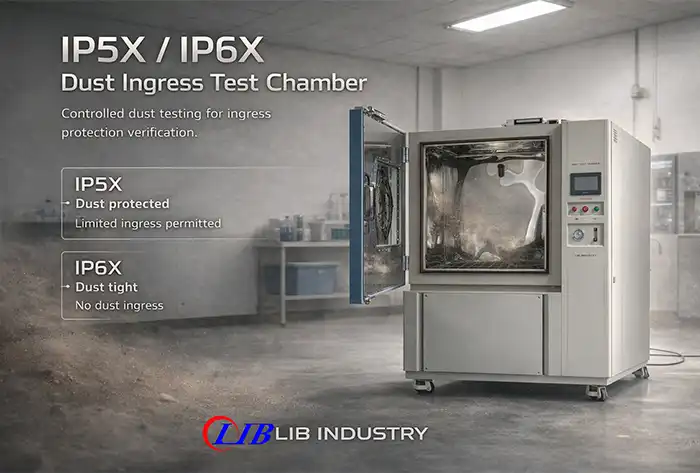
The Ingress Protection code, governed by IEC 60529, uses two digits following "IP" to classify an enclosure's resistance against solids and liquids. The numeral "6" in IP6X represents the highest solid-particle protection tier - dust-tight - meaning absolutely no dust ingress is permitted. The "X" placeholder indicates that liquid ingress rating is assessed separately. Automotive OEMs reference this classification when specifying enclosures for ECUs, lighting modules, and battery management systems.
Why Dust-Tight Matters in Vehicles?
Automotive electronics operate in perpetually contaminated atmospheres. Fine particles settling on circuit boards cause electrical tracking, thermal insulation of heat-dissipating surfaces, and abrasion of moving contacts. A single dust-related failure in an ADAS sensor or powertrain controller can trigger expensive warranty claims and erode brand reputation. The IP6X rating provides quantifiable assurance against these costly failure modes.
Regulatory and OEM Mandates
Major automotive manufacturers - including those producing electric vehicles - incorporate IP6X requirements into their component qualification specifications. Standards such as ISO 20653 (road vehicles - degrees of protection) build upon IEC 60529 and add automotive-specific test conditions. Meeting these mandates is non-negotiable for Tier 1 and Tier 2 suppliers pursuing contracts with global OEMs.
Dust Exposure Risks in Automotive Operating Environments
Airborne Particulate Sources
Vehicles encounter diverse dust sources throughout their operational lifespan: mineral dust from gravel roads, brake pad residue in wheel wells, agricultural particulates in rural regions, and fine sand in arid climates. Particle sizes range from sub-micron respirable fractions to coarse grains exceeding 100 µm. The 50 µm talcum powder specified in IEC 60529 IP6X tests represents a particle size fine enough to exploit minute seal imperfections.
Underhood and Underbody Exposure Severity
Components mounted beneath the hood or chassis experience intensified dust bombardment amplified by aerodynamic turbulence. Engine bay temperatures reaching 125 °C compound the challenge by degrading gasket elastomers over time, widening potential ingress pathways. Dust accumulation on power electronics or battery pack vents can restrict airflow, elevating operating temperatures and accelerating component aging beyond design margins.
Consequences of Dust Ingress on Electronics
Conductive dust particles bridging closely spaced PCB traces generate parasitic leakage currents, a failure mode commonly evaluated in a dust chamber. Hygroscopic dust absorbs ambient moisture, forming corrosive electrolytic films on metal contacts. Optical sensors - LiDAR emitters, camera housings, rain sensors - suffer signal attenuation when dust deposits coat lenses or protective covers. Each scenario degrades vehicle safety and functionality.
Table 1: Dust-Related Failure Modes in Automotive Components
|
Component Category |
Dust Ingress Effect |
Potential Consequence |
|
ECU / Control Modules |
Electrical tracking on PCBs |
Intermittent malfunctions, short circuits |
|
LED Headlamp Assemblies |
Internal lens contamination |
Reduced luminous intensity, uneven beam |
|
Battery Management System |
Thermal insulation of cells |
Overheating, capacity degradation |
|
Connector Interfaces |
Contact surface abrasion |
Signal dropout, increased resistance |
|
ADAS Sensors (LiDAR, Camera) |
Optical path obstruction |
Impaired object detection |
IP6X Dust Testing Principles and Standards
IEC 60529 Test Methodology
The IEC 60529 IP6X procedure places the test specimen inside a dust-filled enclosure and maintains a partial vacuum within the specimen (typically 2 kPa below atmospheric pressure for the smallest enclosures, or 20 air changes per hour for larger enclosures). Talcum powder circulated by an electric fan simulates sustained dust exposure. After eight hours of continuous exposure, the specimen is inspected - any visible dust ingress constitutes a test failure.
Automotive-Specific Extensions: ISO 20653
ISO 20653 adapts IEC 60529 for road vehicle applications, introducing additional severity levels and environmental preconditioning. Components may undergo thermal cycling or vibration before dust testing to replicate in-service seal aging. This layered approach captures real-world degradation sequences that pure IEC 60529 testing alone does not address.
Acceptance Criteria and Inspection Protocols
Upon test completion, the enclosure is opened under controlled conditions. Inspectors examine internal surfaces, gasket channels, and critical functional areas using magnification and calibrated lighting. The pass criterion is absolute: no dust deposit whatsoever on internal surfaces that could compromise the component's intended function. This binary outcome drives enclosure designers toward robust sealing architectures.
Simulating Fine Dust Ingress Using Controlled Chambers
Chamber Architecture and Dust Circulation
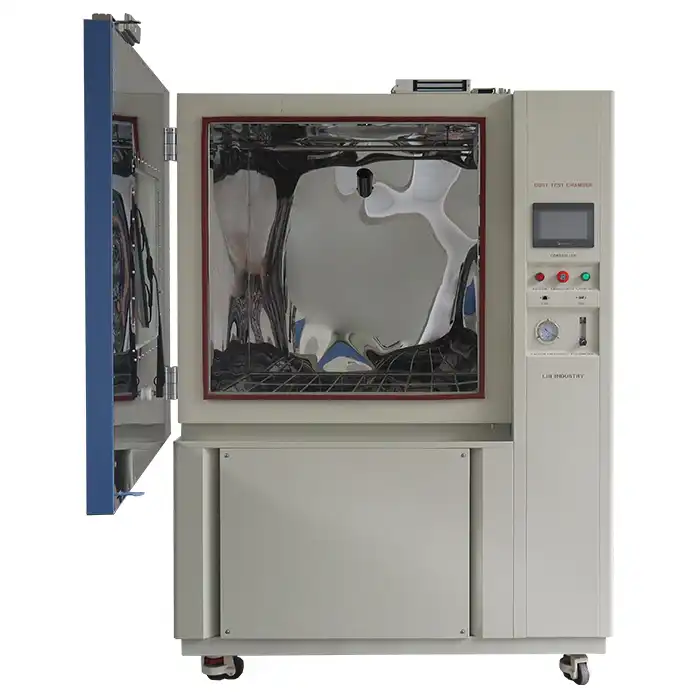
A purpose-built IP6X dust test chamber features a sealed stainless steel interior with an electric circulation fan generating uniform dust distribution. The DI-2000 IP6X dust chamber provides a generous 2000 L test volume (internal dimensions: 1000 × 2000 × 1000 mm) accommodating large automotive assemblies - headlamp units, battery enclosures, inverter housings - that smaller chambers cannot accept. Talcum powder is heated to below 30% RH before circulation to prevent clumping.
Vacuum and Pressure Differential Control
The integrated vacuum system includes a pressure gauge, air filter, pressure regulator, and connecting tubes. Maintaining the prescribed differential pressure across the specimen's enclosure wall is critical; even minor deviations invalidate test outcomes. Automated pressure monitoring within the dust proof chamber sustains the exact differential required by IEC 60529 throughout the entire test duration.
Programmable Test Profiles
The PLC-based programmable color LCD touchscreen controller enables engineers to configure dust fight time and blowing time from 0 to 99 hours 59 minutes. Custom test profiles accommodate OEM-specific protocols that may extend beyond the standard eight-hour cycle. Ethernet connectivity allows remote monitoring and centralized data management across multi-chamber laboratory environments.
Table 2: DI-2000 IP6X Dust Chamber Key Specifications
|
Parameter |
Specification |
|
Internal Dimensions |
1000 × 2000 × 1000 mm |
|
Useful Volume |
2000 L |
|
Temperature Range |
Ambient to +50 °C |
|
Humidity Range |
< 30% RH |
|
Nominal Wire Diameter |
50 µm |
|
Gap Between Wires |
75 µm |
|
Fight / Blowing Time |
0-99 H 59 M (programmable) |
|
Interior Material |
SUS304 stainless steel |
|
Specimen Power Outlet |
Dust-proof socket 16A |
|
Safety Protections |
Over-temperature, over-current, earth leakage, phase sequence |
Evaluating Sealing Performance and Component Integrity
Gasket and O-Ring Validation
IP6X testing delivers a definitive verdict on gasket design effectiveness. Engineers evaluate compression-set behavior of elastomeric seals, parting-line flatness of mating surfaces, and adhesive bond integrity at corners and transitions. A failed IP6X test pinpoints sealing weaknesses that engineering teams address through material upgrades, tighter dimensional tolerances, or revised groove geometries before production launch.
Enclosure Design Optimization
Test results feed back into enclosure design iterations. Cable gland placements, vent membrane selections, and snap-fit closure forces are refined based on observed ingress pathways. The large 2000 L capacity of the DI-2000 allows testing of fully assembled housings - with harnesses, brackets, and mounting hardware attached - revealing integration-level vulnerabilities that bench-top seal tests would miss entirely.
Powered Specimen Testing
The built-in 16A dust-proof power outlet inside the workroom enables specimens to operate electrically during dust exposure. Energized components generate internal heat, creating convective airflow that could draw dust through marginal seals. Testing under powered conditions provides a more rigorous assessment than static (unpowered) evaluation alone, reflecting actual vehicle operating states.
Table 3: Post-Test Inspection Checklist for IP6X Compliance
|
Inspection Area |
Method |
Pass Criterion |
|
Internal PCB Surfaces |
Visual + magnification |
No visible dust deposit |
|
Gasket Seating Grooves |
Tactile + visual |
No particle accumulation |
|
Connector Interfaces |
Visual + continuity check |
No dust on contacts |
|
Optical Surfaces |
Calibrated light source |
No particulate contamination |
|
Ventilation Membranes |
Differential pressure retest |
Membrane integrity maintained |
Improving Vehicle Reliability Through Dust Protection Testing
Warranty Cost Reduction
Dust-related field failures generate disproportionate warranty expenses because diagnosis is time-consuming and often misattributed to electronic faults. Validating IP6X compliance during development catches sealing defects before they propagate into production volumes, preventing field returns that erode profit margins and burden dealer service networks.
Extended Product Lifespan in Harsh Markets
Vehicles destined for Middle Eastern, North African, or Australian markets encounter sustained airborne dust concentrations far exceeding temperate-climate conditions. IP6X-certified components retain functional integrity across these demanding environments, enabling manufacturers to offer extended warranties and differentiate their products in competitive markets.
Supporting Electrification and Autonomous Driving
Electric vehicle battery packs and autonomous driving sensor suites demand impeccable dust protection. Battery enclosures must prevent particulate contamination of cell interconnects and cooling channels. LiDAR and radar modules require pristine optical paths. IP6X dust testing validates these critical assemblies against the highest solid-particle protection standard available under IEC 60529.
LIB Industry's DI-2000 Delivering Certified IP6X Compliance with Precision
|
|
|


 |
 |
|
| Test Area | LAN and USB | Controller |


Mesh Sieve and Heating Tube
Robust Construction for Long-Term Laboratory Service
The DI-2000 IP6X dust chamber features a SUS304 mirror-finish stainless steel interior that resists corrosion and simplifies post-test cleaning. The A3 steel exterior with protective coating withstands demanding laboratory environments. Double-layer thermally stable silicone rubber sealing on the observation window, combined with built-in dustproof LED lighting, permits real-time visual monitoring without compromising chamber integrity.
Automated Dust Management and Recovery
Efficient heating jackets automatically dry talcum powder before each test cycle, eliminating clumping in the circulation system. The one-touch powder recovery system with vibration assistance enables rapid changeover between test runs - processing kilograms of powder in minutes. This automation reduces operator labor and accelerates laboratory throughput for high-volume automotive qualification programs.
Global Support and Proven Track Record
Since 2009, LIB Industry has delivered environmental test chambers to industry leaders spanning automotive, consumer electronics, and aerospace sectors. A global network of 29 agents and service centers across Malaysia, Canada, the United Kingdom, and the United States ensures localized professional support. With over 14 IP dust chamber models ranging from 800 L to 2000 L and beyond, LIB Industry matches chamber capacity to each customer's unique specimen requirements.
Conclusion
IP6X dust testing stands as a non-negotiable validation step for automotive components destined for global markets where fine particulate exposure threatens electronic reliability and vehicle safety. Selecting a dust test chamber with sufficient volume, precise vacuum control, and programmable cycling capabilities determines whether test outcomes accurately reflect real-world ingress risks. The DI-2000 IP6X dust chamber addresses these demands through its 2000 L stainless steel workspace, automated dust management, and IEC 60529-aligned vacuum system. Rigorous IP6X qualification during development eliminates costly field failures, safeguards brand reputation, and validates enclosure designs for the harshest operating environments.
FAQ
What particle size is used in IP6X dust testing?
IEC 60529 specifies talcum powder with a nominal wire diameter of 50 µm and a gap width of 75 µm between wires, representing fine particles capable of exploiting minimal seal imperfections in automotive enclosures.
How long does a standard IP6X dust test last?
The standard IEC 60529 IP6X test runs for eight continuous hours of dust circulation. Custom automotive OEM protocols may extend duration or add preconditioning steps such as thermal cycling before dust exposure.
Can powered components be tested inside the DI-2000 chamber?
Yes. The DI-2000 includes a dust-proof 16A internal power outlet, enabling specimens to operate electrically during testing. Powered operation generates internal heat that more realistically challenges enclosure sealing performance.
Need a trusted DI-2000 IP6X dust chamber manufacturer and supplier? LIB Industry provides turnkey dust ingress testing solutions - from chamber design and production to installation and operator training. Reach out at ellen@lib-industry.com to discuss your automotive dust testing requirements.