Low Pressure Testing for Aviation Safety: Altitude Chamber Standards and Equipment Guide
At 35,000 feet, air pressure drops to roughly a quarter of what it is at sea level. Every material, seal, circuit board, and hydraulic line on a commercial aircraft has to keep working through that change — not just once, but across thousands of pressurization cycles over a 20-30 year service life.
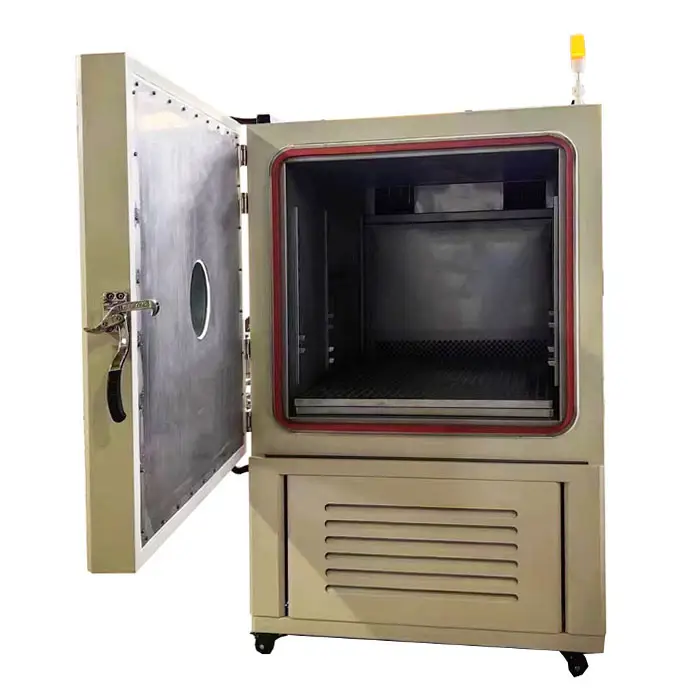
Ground-level testing can't reveal how a component behaves under those conditions. That's the job of hypobaric (low pressure) testing, performed in altitude chambers that reproduce the atmosphere an aircraft actually flies through. This article walks through why that testing matters, what regulators require, and what to look for when specifying test equipment — drawing on our experience at LIB Industry building altitude simulation chambers for aerospace manufacturers and test labs.
Why Low Pressure Testing Matters for Aircraft Safety
A few physical effects make high-altitude conditions fundamentally different from anything a component experiences sitting on a bench:
Reduced oxygen and time of useful consciousness. Cognitive impairment from hypoxia sets in within minutes above 18,000 feet, and above 25,000 feet, crew members may have only seconds to reach emergency oxygen after a depressurization event. Altitude chambers let pilots and aircrew experience their own hypoxia symptoms under controlled, supervised conditions — training that has demonstrably improved emergency response times.
Outgassing. Adhesives, sealants, and composite materials trap gases during manufacturing. As ambient pressure falls, those gases expand and escape, sometimes contaminating cabin air or fogging optical instruments. Materials get qualified against outgassing limits specifically because chamber testing can catch this before a material ever reaches a production line.
Cyclic structural loading. A pressurized cabin sits at roughly 8,000 feet of equivalent pressure while the aircraft cruises at 40,000 feet. That differential repeats on every flight, and the resulting fatigue is a known driver of metal fatigue cracking. Chamber-based accelerated cycling compresses years of flight cycles into months of lab testing.
Degraded cooling. Avionics rely on air density for convective heat dissipation. Thinner air at altitude means less effective cooling — components that run fine at sea level can overheat at cruise altitude if this isn't caught during design validation.
Reduced dielectric strength. Air insulates less effectively as pressure drops, making arcing and corona discharge more likely across gaps that are perfectly safe on the ground. This matters for ignition circuits, power buses, and any high-voltage system.
Each of these is a failure mode that's invisible until you actually remove the air — which is exactly what a hypobaric chamber does.
Aviation Low Pressure Testing Standards and Regulatory Requirements
Low pressure testing isn't optional or best-practice-only; it's written into certification requirements.
| Standard | Governing body | Focus | Typical test altitude |
|---|---|---|---|
| 14 CFR Part 25 | FAA (USA) | Transport aircraft certification | Up to 45,000 ft |
| CS-25 | EASA (Europe) | Large aircraft certification | Up to 45,000 ft |
| MIL-STD-810 Method 500.6 | US DoD | Military equipment qualification | Up to 100,000 ft |
| RTCA DO-160, Section 4 | RTCA | Avionics environmental qualification | 8,000–50,000+ ft |
|
|
|||

A few specifics worth knowing:
FAA Part 25.841 requires that cabin altitude not exceed 15,000 feet following any probable pressurization system failure — a requirement that can only be verified with chamber testing of the complete system.
RTCA DO-160 Section 4 sets both operational and rapid-decompression test procedures, with severity tied to where equipment is installed on the aircraft.
MIL-STD-810 Method 500.6 pushes into far more extreme territory, since military airframes operate outside the envelope commercial standards were built for.
ISO 2533 defines the standard atmosphere model — the reference curve every altitude chamber is calibrated against.
Taken together, these standards mean a chamber isn't just a nice-to-have lab tool. Without one capable of matching the pressure, temperature, and humidity ranges these standards specify, a program can't produce certifiable test data at all.
Benefits of Altitude Chamber Testing Beyond Certification
Meeting the regulatory minimum and building a reliable product aren't quite the same thing. A few areas where testing programs go further:
Finding margin before the fleet does. A component that barely passes at 40,000 feet equivalent altitude might fail outright at 43,000 feet. Testing beyond the certification point is how manufacturers catch design margin that's thinner than it looks on paper — before it becomes a field return.
Validating redundancy under real stress. Backup systems are supposed to activate when a primary system fails — but that assumption needs to be tested under the same low-pressure, low-temperature conditions the aircraft would actually be in during a real failure, not just on a bench at room temperature.
Compressing service life into a test schedule. Pressure vessels — oxygen bottles, fire suppression cylinders, fuel tanks — need fatigue life data long before they've flown enough hours to generate it naturally. Accelerated pressure cycling in a chamber is how that data gets produced on a development timeline instead of a decade-long one.
How to Choose an Altitude Chamber for Aerospace Testing
If you're specifying or sourcing test equipment for aerospace qualification work, a few parameters determine whether a chamber will actually support your certification program:
Pressure range and accuracy. You need to reach the altitude your test standard calls for (commonly down to 0.5 kPa, equivalent to 30,000+ meters) and hold it within a tight tolerance — ±2 kPa deviation is a reasonable benchmark for certification-grade work.
Temperature range. Combined pressure-and-temperature testing is often required, since a cold-soaked component at altitude behaves differently than a room-temperature one. A range from around -120°C to +150°C covers most aviation and defense scenarios.
Humidity control. Standards frequently call for 20-95% RH testing above 50 kPa, since moisture affects outgassing, insulation, and corrosion behavior.
Decompression rate. For rapid-decompression scenarios per Part 25 and DO-160, you need a chamber that can reach test pressure quickly and repeatably — typically within 30 minutes for a full cycle.
Data logging. Certification submissions need a defensible, timestamped record of pressure, temperature, and humidity throughout the test — automated logging (Ethernet-connected systems are now standard) saves real time during audit and submission.
Chamber construction and safety features. Look for explosion-proof viewing windows, fail-safe door interlocks, and pressure enclosures rated for the differentials you'll actually be testing at. A manganese steel enclosure with a stainless interior is a common, durable combination for this kind of cycling.
LIB Industry Altitude Chamber Solutions for Aviation
We build altitude chambers across three broad categories, matched to what aerospace programs actually need to test:
Compact benchtop units (50L-225L) for individual avionics boxes, oxygen regulators, and sensors — full range down to 0.5 kPa with -40°C to +150°C temperature control.
Floor-standing system-level chambers (500L-1500L), including our A-1000 model, sized for complete subsystems rather than single components.
Walk-in, human-rated chambers for aircrew hypoxia and decompression training, built with monitoring systems and emergency oxygen supply as standard.
Precision control and monitoring
| LIB chamber feature | Aviation testing benefit |
|---|---|
 |
 |
| Pressure range: atmospheric to 0.5 kPa | Simulates altitudes to 30,000+ meters |
| Temperature range: -120°C to +150°C | Covers the entire aviation operational envelope |
| Humidity control: 20-95% RH (>50 kPa) | Enables combined environmental stressor testing |
| Rapid decompression: ≤30 min | Replicates explosive decompression scenarios |
| Temperature accuracy: ±0.5°C | Provides certification-grade measurement precision |
Every chamber is built at an ISO 9001-certified facility, CE-marked, and independently tested by SGS and TÜV. That's not a claim we expect anyone to take at face value — we're happy to share test reports and certification documentation on request, and to walk through how a given configuration maps to the specific standard you're testing against (Part 25, CS-25, DO-160, or MIL-STD-810).
Altitude chambers are one part of a broader environmental testing lineup we manufacture, including temperature and humidity chambers, salt spray (corrosion) chambers, toxic gas test chambers, dust test chambers, rain test chambers, and UV/xenon weathering chambers — useful if your qualification program combines low pressure testing with other environmental stress screening under one vendor relationship.
Related Products
Most aerospace qualification programs don't stop at altitude testing. These are the chambers customers most often pair with a low pressure test setup:
|
Temperature & Humidity Chambers Combined thermal cycling and humidity exposure per RTCA DO-160 Section 4/6, ahead of or alongside altitude testing |
Salt Spray (Corrosion) Chambers Corrosion resistance testing for airframe fasteners, connectors, and exposed metal components |
Cabin material off-gassing and toxicity screening to support fire/smoke/toxicity (FST) compliance |
|
Sand and dust ingress validation for exterior-mounted avionics, sensors, and enclosures |
Water ingress and sealing validation for exterior surfaces, doors, and enclosures |
Long-term UV and weathering resistance for exterior coatings, canopies, and composite skins |


If you're scoping a full qualification program rather than a single test, our team can help sequence which chambers you'll need and in what order — reach out and we'll put together a test plan alongside the equipment recommendation.
Talk to an engineer
If you're specifying a chamber for a certification program — or trying to figure out why an existing setup isn't giving you repeatable results — reach out to our technical team at ellen@lib-industry.com. We'll ask about your test standard, target altitude and temperature range, and chamber size before recommending anything, rather than the other way around.
FAQ
What altitude range can aviation-grade altitude chambers simulate? Most aerospace-grade chambers cover sea level down to around 0.5 kPa — roughly 30,000 meters or 100,000 feet equivalent. That range spans commercial cruise altitudes, military operational ceilings, and margin testing above normal flight envelopes.
Why is temperature control tested alongside pressure? Because real failures rarely happen from one stressor alone. A cold-soaked component at altitude, or hot avionics in a sun-heated cockpit, behaves differently than either condition tested in isolation — which is why most standards specify combined pressure-temperature profiles rather than pressure alone.
Why does humidity matter in hypobaric testing? Humidity affects outgassing rates, electrical insulation performance, and corrosion — all of which behave differently under reduced pressure than they do at sea level. Standards that specify 20-95% RH testing above 50 kPa are trying to capture that interaction, not just add an extra variable.
What warranty and after-sales support does LIB Industry provide? LIB Industry chambers come with a 3-year warranty as standard, backed by lifetime technical support for the life of the equipment — spare parts, calibration guidance, and troubleshooting don't stop once the warranty period ends. Support is handled by an all-English-speaking after-sales team, so international customers work directly with engineers rather than through translation layers.
What other environmental test chambers does LIB Industry manufacture? Beyond altitude chambers, LIB Industry's product line covers temperature and humidity chambers, salt spray (corrosion) test chambers, toxic gas test chambers, dust test chambers, rain test chambers, and UV/xenon weathering chambers. Many aerospace and defense customers combine several of these into one qualification program, which is easier to coordinate through a single manufacturer.